- Yes, you can technically put a regular toilet in an RV, but it only makes sense in specific setups.
- For a traveling RV, a household toilet usually causes more problems than it solves.
- It is most practical in a permanently parked RV with plumbing designed for a direct sewer connection.
- Household toilets use far more water per flush than RV toilets, which fills a black tank fast.
- Weight, mounting, and winterizing add more complications on top of the water problem.
- For most RVers, a residential-style RV toilet (porcelain bowl, taller seat) gets you the comfort without the downsides.
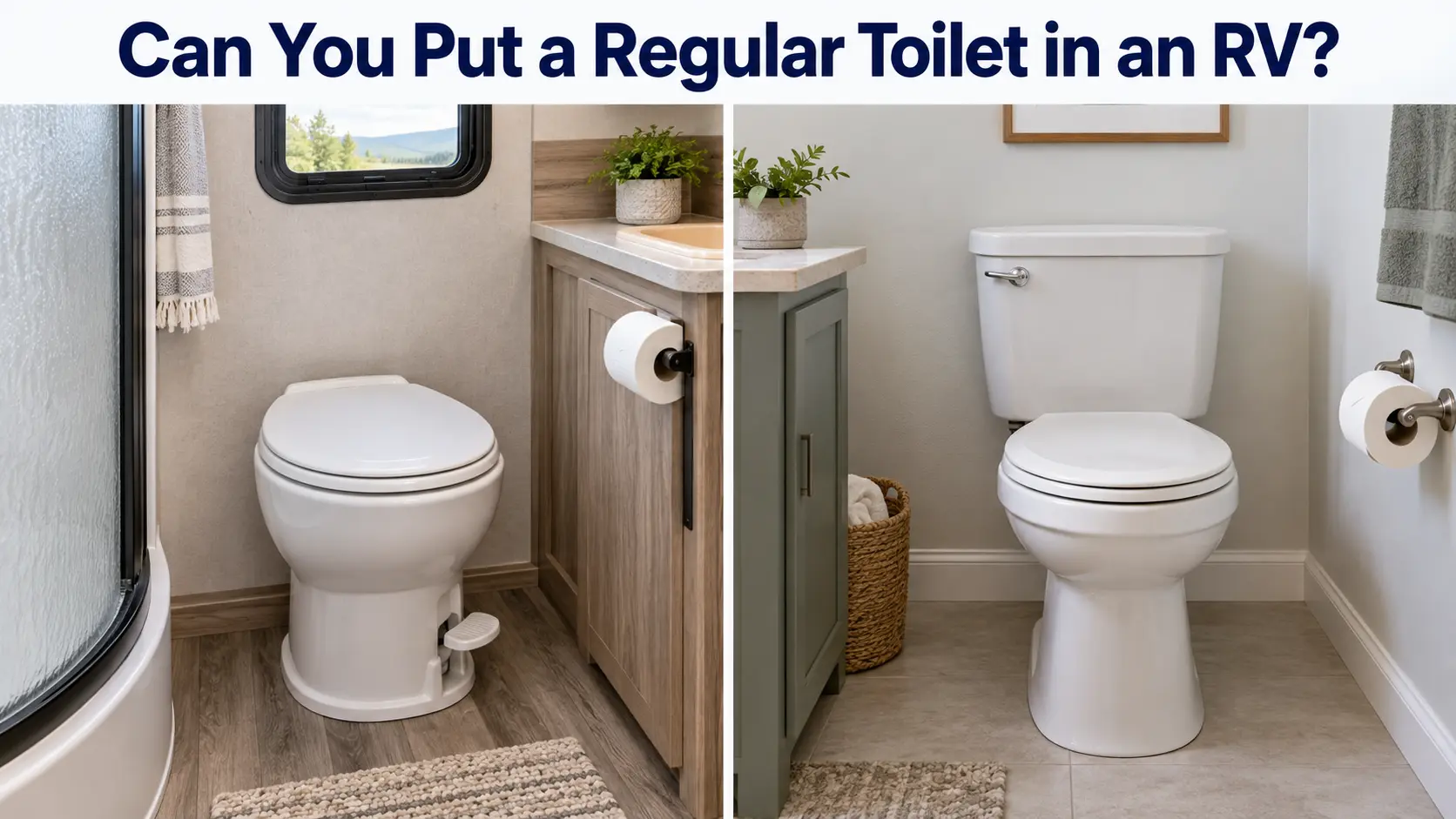
Can you put a regular toilet in an RV? Technically, yes, in the right setup. But for most traveling RVs, a full-size household toilet creates more problems than it fixes.
A residential toilet can work if your RV is parked long-term with full hookups, enough space for a different mounting setup, and plumbing designed for direct sewer drainage. For a rig that actually travels, a regular toilet’s water use, weight, and plumbing design usually make it a poor fit.
This guide covers when a regular toilet in an RV can work, why it usually doesn’t for a traveling rig, and what to install instead if you want your RV bathroom to feel more like home.
Can You Put a Regular Toilet in an RV?
Quick answer: Yes, you can technically put a regular toilet in an RV, but it only makes sense in a small number of cases. A regular toilet is usually a poor fit for a traveling RV with a black tank. A permanently parked RV with a purpose-built direct sewer setup is a different story.
Technically possible does not mean practical. A traveling RV runs on a small black tank, a limited freshwater supply, and a toilet built to move very little water per flush. A household toilet ignores all three of those limits.
Permanently sited RVs can be configured differently from traveling rigs. A unit with a properly designed direct sewer connection that bypasses the black tank is closer to how a house is plumbed. That’s the type of setup where a full-size residential toilet becomes more workable.
Why Regular Toilets and RV Toilets Work Differently
Whether you call it a house toilet, a residential toilet, or a full-size porcelain toilet, it solves the same problem as an RV toilet in a completely different way.
A gravity RV toilet drops waste straight into a black tank below the floor, using a flush ball or blade valve at the bottom of the bowl. A household toilet stores water in a tank on the back, then uses that stored water to push waste through a built-in trap and into a fixed sewer line.
Water use is where the two designs really split. The current U.S. federal maximum for new household toilets is 1.6 gallons per flush, while WaterSense-labeled toilets use 1.28 gallons or less. RV gravity toilets use a fraction of that. Dometic’s product page for the 510HPS lists water use at less than 0.10 gallons, about a pint, per flush. Thetford’s technical FAQ puts the comparison plainly: an RV toilet typically uses about a quart of water per flush, against roughly 1.6 gallons for a home toilet.
Mounting can also differ. RV and household toilets both use floor or closet flange-style connections, but the flange design, seal, bolt arrangement, outlet size, and rough-in can vary by toilet and RV. Many household toilets are designed around a 12-inch rough-in, the distance from the finished wall to the center of the drain, so compare the existing RV plumbing with the new toilet’s installation requirements before assuming it will fit.
Weight can differ too. Household toilets are often heavier than many RV models, especially compared with plastic RV toilets. Compare the exact fixture weight with your RV’s cargo carrying capacity instead of assuming the floor and mounting are suitable.
Can You Put a Regular Toilet in an RV With Full Hookups?
Quick answer: Full hookups solve the water supply problem but not the black tank or mounting problem. You still need somewhere for the extra flush water to go, and a household toilet’s rough-in rarely matches an RV’s existing plumbing without modification.
Full hookups give you continuous city water and a sewer connection, so you’re no longer limited by a small freshwater tank. That removes one obstacle. It doesn’t remove the black tank unless the RV’s plumbing is specifically configured to bypass it and drain directly to the sewer.
Even with a sewer hookup, an RV with a black tank shouldn’t run with the dump valve left open. Thetford’s own guidance warns against leaving the black tank valve open at a sewer hookup, since the liquid drains away while solids build up into a hard blockage at the bottom of the tank. Using more flush water does not make it safe to leave the black tank valve open.
If your RV has a permanent sewer hookup with plumbing specifically designed to drain directly to the sewer instead of through the black tank, a household toilet becomes far more workable.
Problems With Putting a Regular Toilet in a Traveling RV
Quick answer: In a traveling rig, a household toilet runs into water use, weight, space, mounting, and winterizing problems all at the same time. Any one of these may be manageable on its own. Together, they’re why a standard household toilet is usually a poor match for an RV meant to move.
A federal-standard household toilet uses up to 1.6 gallons per flush. Most RV toilets use a fraction of a gallon, so a household model drains your freshwater tank and fills your black tank much faster.
More water per flush means more dump station trips, especially while boondocking or camping without full hookups.
Household toilets can be considerably heavier than many RV toilets, especially lightweight plastic models. That added fixture weight also counts against the RV’s available cargo capacity, so check the specific toilet weight and your RV’s payload limits before making the change.
RVs flex and bounce on the road in ways a house never does. A tank-style household toilet adds a large ceramic fixture that must remain securely mounted while the RV moves, so the mounting method and floor support need to be checked carefully.
Many household toilets use a 12-inch rough-in and a larger overall footprint than compact RV toilets. Fitting one may require relocating the drain flange or changing nearby cabinetry, depending on the bathroom layout and toilet model.
A household toilet’s trap holds standing water at all times. In an unheated or lightly insulated RV, that water can freeze and crack the trap. RV toilets hold very little standing water and get winterized differently, with antifreeze added to the bowl and seal instead of a full water trap.
What Would You Need to Install a Regular Toilet in an RV?
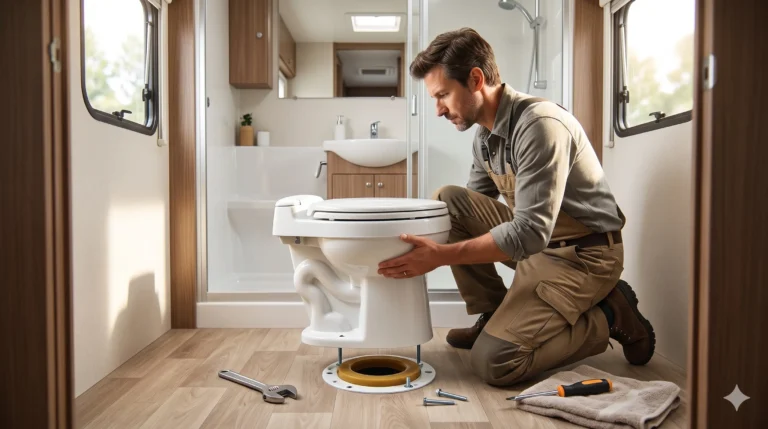
You may need to relocate or adapt the floor flange to match the household toilet’s rough-in, confirm the floor and mounting are suitable for the added fixture weight, secure a properly designed drain connection, and make sure the surrounding cabinetry still clears the larger footprint.
This isn’t automatically a bolt-in swap. RV and household toilets can use different floor flange designs, seals, bolt arrangements, and rough-in distances. Measure the existing setup and compare it with the new toilet’s installation requirements before deciding whether the flange needs to move or be adapted.
Things to check before starting:
Measure from the finished wall to the center of the flange. Many household toilets are designed for a 12-inch rough-in, but verify the exact requirement for the model you plan to install.
The household toilet’s outlet needs a solid, sealed connection down to the black tank or sewer line, sized for the larger flush volume.
Household toilets connect to a standard fill valve and supply line, different from an RV toilet’s low-flow water module.
The subfloor around the toilet needs to support the toilet’s weight plus a full user load without flexing.
Check the space in front of and beside the toilet. A larger bowl and tank can crowd a sink, shower, or cabinet door sized around a compact RV toilet.
Because this conversion can involve significant replumbing and mounting changes, an RV technician or qualified plumber may be the safer choice if the existing setup is not directly compatible.
Regular Toilet vs RV Toilet
This comparison ties together the residential toilet vs RV toilet differences covered above, side by side.
| Feature | Regular Household Toilet | RV Toilet |
|---|---|---|
| Water per flush | 1.28 to 1.6 gal (federal/WaterSense standard) | About 0.1 to 0.25 gal in the cited gravity-toilet examples; varies by model |
| Flush mechanism | Tank-fed water pushes waste through a built-in trap | Foot pedal opens a flush ball or blade into the tank below |
| Typical weight | Often heavier; varies by model | Often lighter; varies by model |
| Typical rough-in | Often 12 in; model-dependent | Model-dependent; verify manufacturer specs |
| Sewer connection | Fixed household drain and pressurized water supply | Usually onboard tanks, with campground hookups when available |
| Best suited for | Permanently plumbed structures | Traveling RVs with black and fresh tanks |
Better Alternatives to a Household Toilet
If you want the comfort of a household toilet without the water, weight, or mounting problems, a full-size RV toilet with a porcelain bowl, elongated shape, and residential-height seat gets you most of the way there.
Several current RV toilet lines are built to close that comfort gap:
- Porcelain RV toilets. These use a ceramic bowl instead of plastic, closer to a household toilet’s feel and easier to keep clean over time. Our porcelain RV toilet guide compares current options by rough-in and bowl depth.
- Elongated bowls. An elongated bowl adds legroom without changing the flush mechanism underneath, an upgrade over the round-bowl shape common on older RV toilets.
- Residential-height seating. Many current RV toilets sit around 18 inches at the seat, close to a standard household height, instead of the lower profile found on older or budget models.
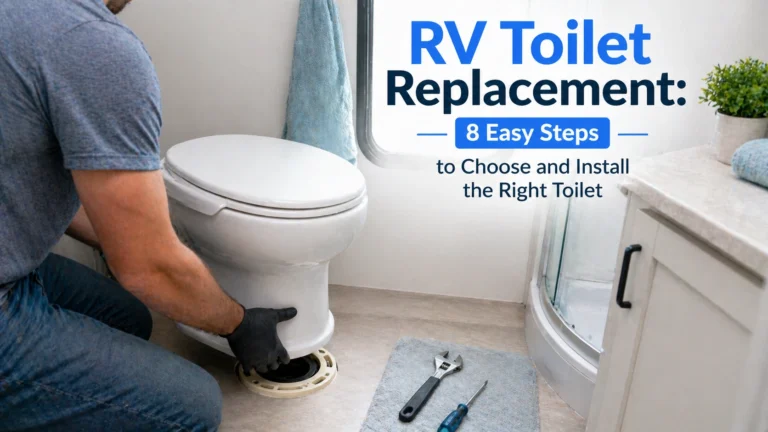
If your current toilet is worn out or leaking rather than just short on comfort, our RV toilet replacement guide walks through how RV-specific replacements are normally matched to your existing rough-in and installed.
Should You Put a Regular Toilet in Your RV?
Quick answer: For a frequently traveling RV or a boondocking setup, no. Stick with an RV-specific toilet. For a permanently parked RV, a household toilet can become a realistic option if the plumbing, drain, and mounting are specifically designed or adapted for it.
- Frequently traveling RV. Water use, weight, and vibration make a household toilet impractical. An RV-specific toilet, ideally porcelain and residential-height, is the better fit.
- Boondocking RV. Limited fresh water and tank space rule out a household toilet in almost every case.
- Full-hookup campground RV. Water supply is less of a concern, but the black tank and mounting issues remain unless the plumbing is specifically configured for direct sewer drainage.
- Permanently parked RV. This is where a household toilet can make the most sense, especially if the plumbing is purpose-built for a direct sewer connection instead of relying on the standard RV black-tank setup.
Frequently Asked Questions
Can you replace an RV toilet with a regular toilet?
Yes, but only with real changes to the mounting, rough-in, and drain connection. It works best on a permanently parked RV without a black tank. On a traveling RV, the added water use and weight usually outweigh the comfort gain.
Can you put a porcelain toilet in an RV?
Yes. Several RV-specific toilets already use porcelain (ceramic) bowls instead of plastic, giving you the durability and look of a household toilet while keeping the RV-style low-water flush and compact mounting.
Does an RV toilet use the same flange as a house toilet?
Not necessarily. RV and household toilets both use floor or closet flange-style connections, but the flange design, seal, bolt arrangement, outlet size, and rough-in can vary by model. Check the existing RV flange and the new toilet’s installation requirements before assuming they are compatible.
Can you use a residential toilet in a permanently parked RV?
Yes, this can be one of the more practical setups for a household toilet. It works best when the RV’s plumbing is specifically configured for a compatible direct sewer connection rather than relying on the standard black-tank setup.
Why don’t RVs use regular toilets?
Household toilets use much more water than most RV gravity toilets, can add more fixture weight, and use a rough-in and trap setup that may not match an RV’s plumbing. RV toilets are designed around limited water, holding tanks, compact spaces, and use in a moving vehicle.
Conclusion
A regular toilet can technically work in an RV, but only in the right setup. Traveling RVs depend on a small black tank and limited fresh water, and a household toilet’s flush volume works against both. Weight, mounting, and winterizing add more friction on top of that.
A permanently parked RV with plumbing specifically designed for a compatible direct sewer connection can be the exception where a household toilet becomes practical.
For everyone else, the more practical fix is an RV toilet built to feel residential: porcelain bowl, elongated shape, taller seat. Before you buy, measure your rough-in and compare it with our best RV toilet replacements to find a model that actually fits your bathroom.