Genuine Dometic and Thetford seals cost more, but they come with manufacturer-confirmed fit information and clearer product documentation. Aftermarket seals are often cheaper and can be reasonable alternatives when the exact model and part compatibility are well documented. This guide compares Dometic’s 385311658 and Thetford’s 34120/42141 so you know what to verify before you buy.
Two Amazon listings can claim to replace the exact same Dometic part number. One costs under $10. The other costs close to five times that. Read the descriptions and they sound almost identical: rubber gasket, drop-in fit, stops leaks and odor.
So what does the extra money actually buy? Sometimes real manufacturer backing. Sometimes just a bigger markup on the same idea. It’s not the same answer in every case, and guessing wrong means a seal that won’t seat right, or a warranty claim that gets denied for a reason you didn’t see coming.
If you’re still trying to figure out whether a seal is even your problem, our RV toilet bowl not holding water guide walks through the diagnosis first. This guide picks up once you already know you need a new seal and are deciding which one to buy.
Quick Verdict: OEM vs Aftermarket RV Toilet Seals
| Factor | OEM | Aftermarket |
|---|---|---|
| Fit confirmation | Confirmed by Dometic or Thetford’s own published model list | Seller-claimed; ranges from precise to overstated |
| Price | Several times more than a comparable aftermarket kit | A fraction of the OEM price for the same part number |
| Part-number practice | Sold as the manufacturer’s own service part | Usually marketed as “replaces” or “compatible with” the OEM number |
| Documentation | Consistent across retailers | Mixed. Some listings state exact exclusions. Others use vague, broad claims |
| Warranty | Avoids an added third-party-part dispute | Doesn’t automatically void warranty; damage caused by the part may be excluded |
| Best for | Warranty-sensitive repairs, unclear compatibility, hard-to-reach seals | Verified-fit repairs, budget jobs, keeping a spare |
Confirmed by Dometic or Thetford’s own published model list
Seller-claimed; ranges from precise to overstated
Several times more than a comparable aftermarket kit
A fraction of the OEM price for the same part number
Sold as the manufacturer’s own service part
Usually marketed as “replaces” or “compatible with” the OEM number
Consistent across retailers
Mixed. Some listings state exact exclusions. Others use vague, broad claims
Avoids an added third-party-part dispute
Doesn’t automatically void warranty; damage caused by the part may be excluded
Warranty-sensitive repairs, unclear compatibility, hard-to-reach seals
Verified-fit repairs, budget jobs, keeping a spare
What Does “OEM” Actually Mean for an RV Toilet Seal?
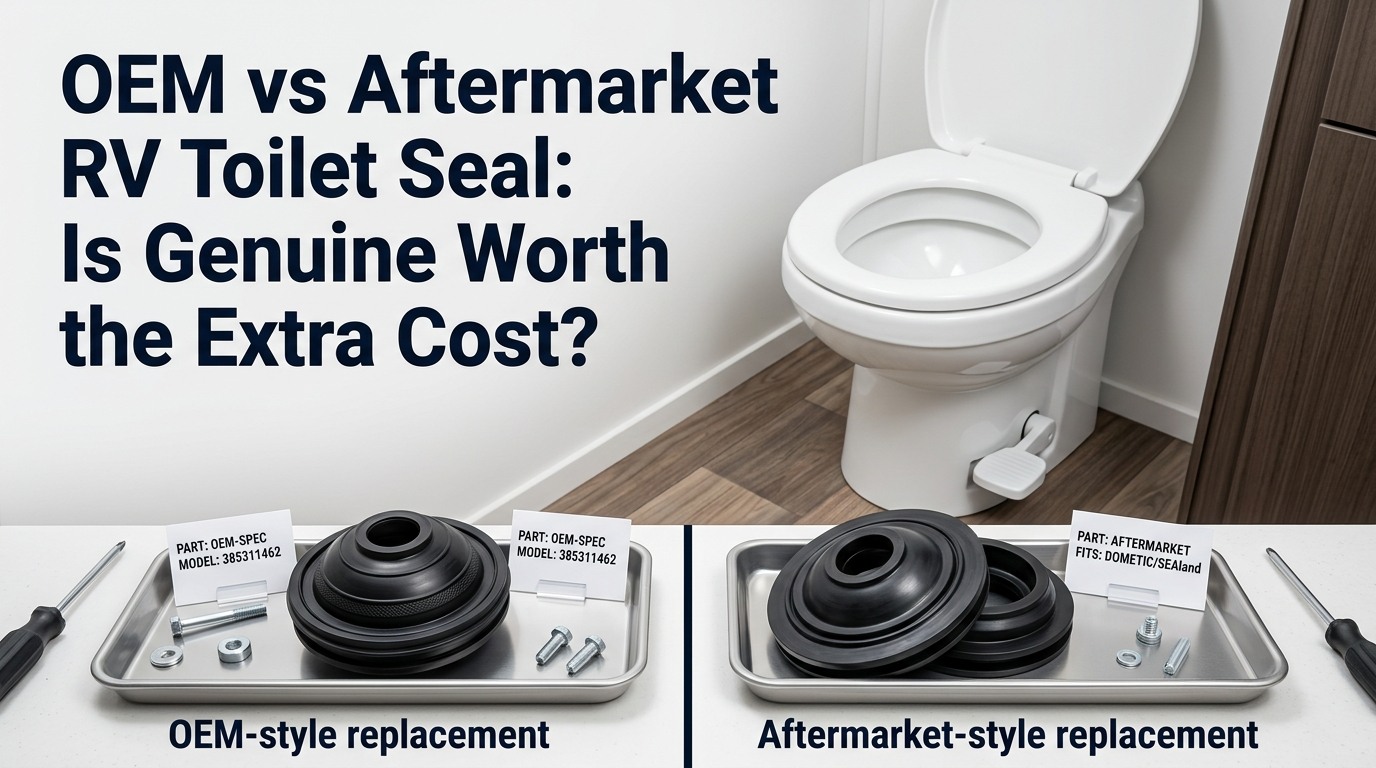
OEM means Dometic or Thetford made or specified the seal themselves, the same company that built your toilet. A listing that says “replaces OEM part” or “compatible with” is not automatically OEM. It just means the seller is targeting the same part number, not that Dometic or Thetford made the part.
This gets blurry fast on Amazon. Dometic’s own product page confirms the flush ball seal, part #385311658, as the genuine factory part for the 300, 301, and 310 series. That’s real OEM. A few listings down on the same search results page, you’ll find a two-pack from a seller with no connection to Dometic, whose own description says it “replaces” that same part number.
Neither listing is necessarily misleading. But only one of them is made by the company that built your toilet. If the seller name and packaging aren’t Dometic or Thetford, assume it’s aftermarket, even if the listing leans hard on words like “OEM quality” or “genuine fit.”
One more thing worth knowing: Dometic’s parts catalog also lists an older bowl seal kit, #385311462, but that part is built for VacuFlush and older Traveler toilets without overflow holes, not the 300, 310, or 320 series most owners are dealing with. It’s a good example of why matching your exact model matters more than matching a part number alone. Our RV toilet parts guide covers how to find that model number and match it to the right part.
Is an OEM RV Toilet Seal Worth Paying More For?
Sometimes. OEM buys you a confirmed model match and warranty language that specifically addresses unauthorized parts. Whether that’s worth the price gap depends on how confident you are in the aftermarket listing’s compatibility claim, and how big that price gap actually is for your specific part.
There’s no universal answer here, and this guide isn’t going to manufacture one. The OEM kit itself is a simple two-piece rubber gasket. Neither Dometic nor Thetford publishes a rubber compound spec, so there’s no documented material advantage to point to. What OEM does buy you is a part verified by the company that built your toilet, and coverage if a warranty claim ever comes up.
Owner reports on aftermarket fit are genuinely mixed. In one Airstream Forums thread, an owner describes a cheap Amazon ball seal that was too large to fit into the opening at all. In an iRV2 thread, a different owner reports a Dometic-branded part bought through Amazon that arrived correctly labeled and worked as expected. Neither report proves a pattern across all sellers. They’re two data points worth knowing, not a verdict.
Price is where this actually gets concrete, even if the exact numbers move around. OEM pricing for the same kit varies by retailer and can change over time, sometimes even between different pages on Dometic’s own site. Aftermarket multipacks are typically cheaper. Compare the current total price only after you’ve confirmed both products fit your exact toilet model, since a lower price on a part that doesn’t fit isn’t actually a deal.
Dometic OEM vs Aftermarket: What the 385311658 Case Shows
The Dometic #385311658 flush ball seal makes a useful case study because both genuine and aftermarket replacements are widely sold.
Dometic’s own product page identifies #385311658 as the OEM replacement for Sealand 300, 301, and 310 series toilets. Some retailer compatibility lists also include additional Dometic models, such as the 311, 320, 321, and 400-series toilets, so verify your exact toilet model before ordering. Retailer spec sheets list the seal at 4 inches outer diameter and 2.75 inches inner diameter.
On the aftermarket side, one widely sold two-pack listing is explicit about scope. It states the kit fits 300, 310, and 320 series toilets and does not fit 210, 510, or any model not listed. That kind of specific compatibility information is more useful than a vague “universal fit” claim, but it still shouldn’t replace checking your toilet’s model number.
That precision isn’t universal, though. Plenty of other listings for the same part number use vaguer language, like “universal fit” or “compatible with most RV toilets,” without naming a single model. Treat those with more caution than a listing that spells out exactly what it fits and what it doesn’t.
If you’re comparing your own options, look for an explicit model list on the listing itself, not just a part-number match in the title. A seller who names your exact model is telling you something real. A seller who doesn’t is asking you to assume it.
If your issue turns out to be water at the base rather than a dry bowl, that’s a different part and a different diagnosis. Our Dometic RV toilet leaking at base guide covers the floor flange seal separately, and our Dometic toilet not holding water guide walks through how to tell the two problems apart before you order anything.
Thetford OEM vs Aftermarket: Matching 34120 or 42141
Thetford’s Aqua-Magic lineup makes this comparison trickier, because two part numbers cover overlapping but not identical sets of models, and mixing them up is an easy mistake to make.
Thetford’s own installation instructions for part #42141 name it specifically as the “Aqua-Magic Style II, Residence Waste Ball Seal Kit.” That’s it. Two models, straight from Thetford’s own documentation.
Part #34120, by contrast, is documented by multiple retailers, including at least one listing sold as genuine Thetford stock, as fitting the Style Plus, Style Lite, and Style II lines. Some listings also include Residence in that list; others don’t. That inconsistency alone is worth noticing before you order.
Here’s the part worth flagging: several Amazon aftermarket listings for #42141 claim it fits “Style Plus, Style Lite, Style II, and Residence,” a broader claim than Thetford’s own kit documentation supports. That’s exactly the kind of gap this guide is warning about: two part numbers, overlapping coverage, and sellers whose compatibility claims don’t always draw the line where the manufacturer does.
If your Thetford toilet is a Style II or Residence, both 34120 and 42141 may turn up as apparent matches when you search. Confirm your exact model against the sticker before ordering either one. Our Thetford camper toilet parts guide breaks down how to find that model number if the label has worn off.
Does an Aftermarket Seal Affect Your Toilet’s Warranty?
Not automatically. Federal law limits how far a manufacturer can go in requiring branded parts to keep a warranty valid. But Dometic’s own owner’s manual does exclude failures caused by unauthorized components, and that exclusion can still apply if Dometic shows the aftermarket part actually caused the problem.
This one deserves a straight answer, because a lot of what gets repeated online overstates it in both directions.
Dometic’s 310-320 series owner’s manual states plainly that the warranty doesn’t cover failures resulting from use of unauthorized components. That’s real, documented language from Dometic itself, not a myth some forum invented.
At the same time, U.S. federal law puts a real limit on how that kind of language can be enforced. Under the Magnuson-Moss Warranty Act’s tying provision (15 U.S.C. § 2302(c)), a manufacturer generally can’t require you to use its own branded parts just to keep a warranty valid, unless it provides those parts free of charge. What a manufacturer can still do is deny a specific claim if it can show the aftermarket part actually caused the failure being claimed. The burden of proving that causation sits with the manufacturer, not with you.
In practice, that means putting an inexpensive aftermarket seal in your toilet almost certainly doesn’t void your entire warranty by itself. But if that seal fails and causes damage the warranty would otherwise cover, Dometic has a documented basis to deny that specific claim. This isn’t legal advice, and individual warranty disputes get resolved case by case, but it’s a more accurate picture than either extreme you’ll see online: “any non-OEM part kills your warranty” and “aftermarket parts never affect a warranty” are both wrong.
When Should You Choose OEM, and When Is Aftermarket Fine?
Choose OEM when your toilet is still under warranty, when you can’t find a listing that names your exact model, or when the seal is hard to reach and redoing the job would cost real time. Aftermarket makes sense when a listing clearly names your model, the price gap is significant, or you’re buying a spare rather than doing an active repair.
OEM Is the Safer Call When
- Your toilet is still under manufacturer warranty and you’d rather avoid questions about causation later.
- You can’t find an aftermarket listing that clearly names your specific toilet series.
- The seal is hard to reach, such as a Thetford waste ball seal, where a poor fit could mean pulling the bowl a second time.
- You’ve already had a bad fit experience with an aftermarket seal on the same toilet.
Aftermarket Is a Reasonable Buy When
- The listing clearly names your model and states which toilets it does and doesn’t fit.
- The price gap between OEM and aftermarket is large enough to matter to you.
- You’re buying a spare to keep in the RV rather than fixing an active problem right now.
- Your toilet is already well past its manufacturer warranty period.
What Should You Check Before Buying an Aftermarket Seal?
Confirm your exact toilet model from the label, match it against the seller’s stated compatibility, and look for a listing that names both what the seal fits and what it excludes. A listing that only lists what it fits deserves more caution than one that spells out both.
It’s usually on the back wall of the bowl or under the foot pedal housing.
Compare your exact toilet model against the listing, not just the part number in the title.
A listing that states both what it fits and what it excludes gives you more useful compatibility information than a vague universal-fit claim.
Some kits include mounting hardware or a base gasket. Others include only the seal.
Check the return policy before installation. A poor fit may not be obvious until you’re already mid-repair.
Focus on specific fit complaints instead of the star average alone. Detailed reviews are more useful than ratings without context.
install steps for both Dometic and Thetford toilets.
Bottom Line
If your toilet is under warranty, if you can’t confirm which models a listing actually fits, or if the seal is one of the harder ones to reach, OEM is the safer buy even at a much higher price. If a listing clearly names your exact model and states what it doesn’t fit, and the price gap is significant, aftermarket is a reasonable call, especially for a spare you’re not installing today.
The mistake to avoid isn’t choosing OEM or aftermarket. It’s choosing based on price or part number alone without checking whether the listing actually names your model.
Frequently Asked Questions
Does a cheaper aftermarket RV toilet seal mean lower quality?
Not automatically. Price mostly reflects manufacturer backing and confirmed compatibility, not necessarily material quality. Neither Dometic nor Thetford publishes a rubber compound spec that would let you compare formulations directly, so claims that one type of rubber outlasts another aren’t verifiable from the documentation available.
Can two seals with the same part number actually be different products?
Yes. A part number like 385311658 identifies what the seal is meant to replace, not who made it. Dometic’s own version and a third-party seller’s “replaces 385311658” version may differ in dimensions, fit tolerance, and included hardware even when they’re marketed under the same number.
Is a two-pack aftermarket seal worth buying as a spare?
For a seal already confirmed to fit your model, a two-pack aftermarket kit is a low-cost way to keep a spare on hand. It’s a lower-stakes purchase than an active repair, since you have time to return it if the fit turns out wrong.
Do OEM and aftermarket seals install the same way?
Usually. A correctly matched aftermarket seal should fit the same location as its OEM equivalent, but kit contents and instructions can vary, so follow the instructions supplied with the specific replacement you buy. Our RV toilet seal replacement guide covers the general install process for both Dometic and Thetford seals.