TL;DR
- To empty a cassette toilet, close the blade valve, pull the cassette out through the outside service door, and carry or wheel it to a dump station or another approved disposal point.
- Turn the spout down, press the vent button as you pour, then rinse the cassette, add toilet additive as the label directs plus a little water, and slide it back in without forcing it.
The level light just turned red, and you’re parked at a campground where everyone else is screwing on a sewer hose. If you need to know how to empty a cassette toilet, the good news is that you don’t need a hose at all. You pull out a small tank, empty it, rinse it, and put it back. Once you know the order, it takes a few minutes.
This guide follows the owner’s manuals for three common cassette toilet families: the Thetford C2, C3, and C4, the Thetford C-402 and C-403, and the Dometic CT 4110 and CTS 4110. Where they differ, you’ll see it called out, so check which model is in your rig before you start. It also covers where you’re allowed to empty a cassette in the US.
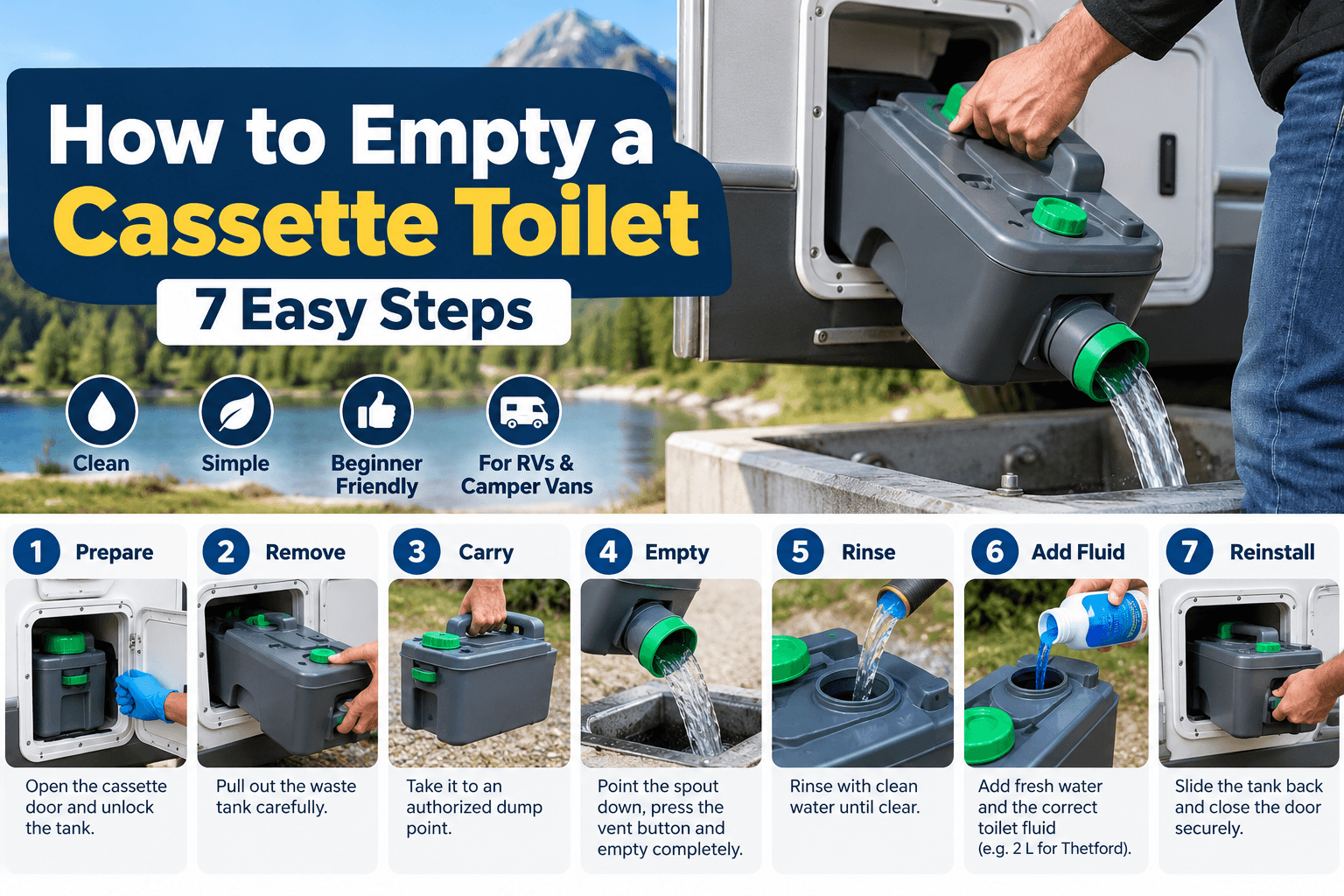
How to Empty a Cassette Toilet in 7 Steps
Before starting, put on waterproof gloves and find an authorized waste-disposal point. These steps cover the shared process; check the model comparison below for differences.
- Close the blade valve Make sure the blade under the bowl is shut before you touch the cassette.
- Open the outside service door and release the catch Then pull the cassette out. On the Dometic, expect some resistance. On the Thetford C-402, take off the water filling extension first so you don’t lose it.
- Take it to the disposal point Carry it by its handles. The C-402 has a pull handle and wheels, so you can roll it.
- Stand it upright and turn the spout up Then remove the spout cap. On Dometic CT/CTS 4110 models, do not rotate the spout more than 90°; it can come loose.
- Hold it so your thumb reaches the vent button Tip the cassette so the spout points down, then press and hold the vent button while it pours. Both Thetford manuals and the Dometic manual say to press the vent only once the spout is pointing down, which helps it drain steadily without splashing.
- Rinse it Rinse the cassette and the blade with water.
- Recharge and return it Add additive and water as directed for your model (see the recharging section below), refit the cap, and slide the cassette back in until the catch locks. If it doesn’t slide in easily, stop. Both Thetford manuals warn that forcing it can cause serious damage.
What Is a Cassette Toilet, and How Is It Different From a Black Tank?
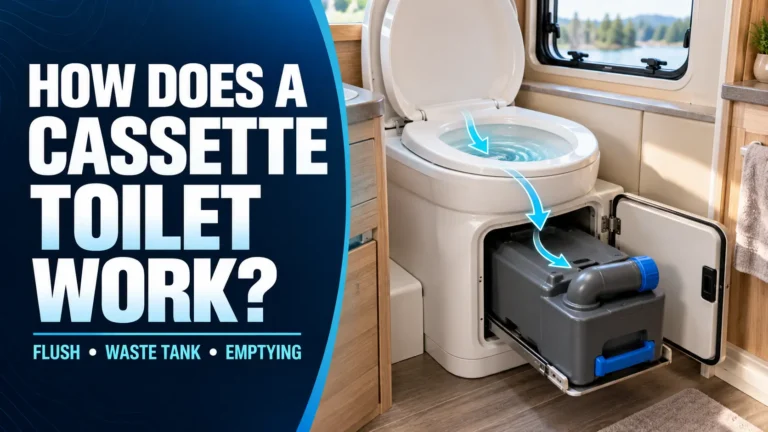
A cassette toilet stores waste in a small removable tank, about 5 gallons (19 to 20 liters) on the Thetford and Dometic models covered here, instead of a fixed black tank. You pull the cassette out through a door on the outside of the RV and empty it by hand, so there is no sewer hose or dump valve.
A cassette toilet is a built-in toilet. The bowl stays inside your camper van, truck camper, or small trailer, and a sliding blade valve under the bowl opens into the cassette below it. When you want to empty it, you work from outside the vehicle through a small service door. If you’re new to this setup, our explanation of how a cassette toilet works shows how the flush water, blade valve, and removable tank work together.
Capacity is small, which is why emptying comes up so often:
- Thetford C2, C3, C4: the waste tank holds 20 liters, about 5.3 gallons, per the Thetford C2/C3/C4 user manual.
- Thetford C-402, C-403: 19 liters, about 5 gallons, per the Thetford C-402/C-403 user manual.
- Dometic CT 4110, CTS 4110: 19 liters, about 5 gallons, per the Dometic CT/CTS 4110 manual.
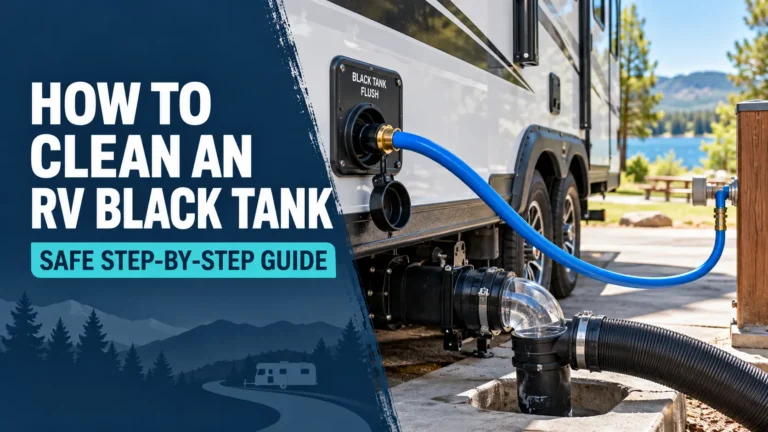
If your RV has a fixed black tank and a sewer hose instead, this isn’t your guide. See our steps for dumping a black tank. And if you have a freestanding unit that lifts off its base, our roundup of freestanding portable potties covers how those empty.
When Should You Empty a Cassette Toilet?
Empty it before the level indicator reaches full, not after. On the Thetford C2/C3/C4 the indicator only starts turning red at about three quarters full, and on the C-402 a warning lamp leaves room for roughly three more uses. Thetford’s own care guide suggests emptying every few days in normal use.
Each model warns you a little differently. The Thetford C2/C3/C4 manual says to empty by the time the indicator is fully red at the latest. The C-402/C-403 manual puts its warning lamp at about 2 liters of space left. The Dometic CT/CTS 4110 manual has a three quarters light and a full light, and warns that at three quarters full, liquid can overflow through the vent if the vehicle is parked on a tilt.
Thetford’s cassette toilet care guide gives a range of every few days, and the figure shifts between 2 and 5 days within that same article. Treat the indicator as your real signal, and empty early in hot weather, which the same guide says speeds up odor.
What You Need Before You Start
You don’t need much, but have it ready before you pull the cassette:
Have These Ready
- Waterproof gloves. The CDC’s guidance for workers who handle human waste calls for waterproof gloves, keeping your hands away from your face, and washing with soap and water right after. That page is written for sanitation workers, but the same basics make sense for emptying a cassette.
- Soap and water for your hands when you’re done.
- A place you’re allowed to empty it. See the legal section below.
- Rinse water, from the disposal point or your own supply.
- Your toilet additive. Use the dose printed on its label. None of the three manuals gives a fixed dose.
To find a dump station on the road, the Escapees RV Club lists finder tools such as Sanidumps, Campendium, RVdumpsites.net, iOverlander, The Dyrt, and Allstays.
Cassette Toilet Model Comparison
The basic emptying process is similar, but tank sizes, latches, level indicators, and seal care vary by model.
| Detail | Thetford C2/C3/C4 | Thetford C-402/C-403 | Dometic CT/CTS 4110 |
|---|---|---|---|
| Cassette size | 20 L (about 5.3 gal) | 19 L (about 5 gal) | 19 L (about 5 gal) |
| Full warning | Green to red, starts near 3/4 full | Lamp with about 2 L left | 3/4 and full lights |
| Getting it out | Press catch down, pull, tip, lift | Pull catch up, remove filling extension | Push catch up, expect resistance |
| Seal care | Olive oil | Thetford seal lubricant | OKS grease |
| Watch out for | Never force it back in | Clean the pressure release float once a season | No pressure washer inside; don’t hang it on a bike |
Sources: Thetford C2/C3/C4 manual, Thetford C-402/C-403 manual, Dometic CT/CTS 4110 manual.
Where Can You Legally Empty a Cassette Toilet in the US?
Empty it at an RV dump station or another approved disposal point, such as a campground dump station. Never pour it on the ground or into a street gutter or storm drain: Oakland and Los Angeles County, for example, both prohibit that. Thetford’s manual also allows a normal toilet, but check local rules and septic limits first.
Approved places. According to the Escapees RV Club, US options include campground and RV park dump stations, some rest areas, some truck stops, RV dealers and service centers, and many state and national park campgrounds. Fees, opening hours, and access rules vary by location. Call ahead before you go.
Never the ground or a storm drain. The City of Oakland bans RV wastewater in streets, gutters, and storm drains under Oakland Municipal Code 13.16.070. A Los Angeles County Public Health fact sheet says dumping RV wastewater on the ground or into a storm drain isn’t allowed under County Code 11.02.080, with fines up to $500, up to six months in jail, or both. Rules differ by city and county, so treat these as examples, not a complete list.
What about a regular toilet? The manufacturers don’t fully agree. The Thetford C2/C3/C4 manual lists a normal toilet as an option alongside a legal disposal point. Thetford’s care guide says to empty only at a dedicated disposal facility. If you do use a toilet, check local rules first, and if it drains to a septic system, read the next section on additives.
How Do You Rinse and Recharge the Cassette After Emptying?
Rinse the cassette at an approved rinsing point, then add the toilet additive through the spout at the dose on its label. For the Thetford C2/C3/C4 and C-402/C-403 models discussed here, the manuals specify approximately 2 liters (about half a gallon) of water to cover the bottom of the tank. The Dometic CT/CTS 4110 manual instructs owners to use the additive as directed on its packaging; do not assume the Thetford water amount applies to every cassette model.
Rinse every time. Thetford’s care guide says to rinse the tank with clean water after every empty.
Recharge it. Both Thetford manuals say to add the stated amount of toilet fluid, then about 2 liters of water to cover the bottom of the tank. Neither gives a fixed dose, so use the amount on your product’s label. Never pour additive in through the blade valve or the bowl. The Dometic manual also has you add the additive through the drain pipe and follow the packaging.
Septic systems need the right additive. Thetford’s care guide says that if your disposal point drains to a septic tank instead of a sewer, use a septic-safe additive such as Aqua Kem Green. Thetford’s Aqua Kem Green page describes it as septic tank safe. That is a manufacturer claim, not an independent test.
Deep clean occasionally. Thetford recommends a tank cleaner 2 to 3 times a year to remove scale and deposits that a regular additive doesn’t prevent. On a Dometic, don’t use a high-pressure washer inside the cassette: the manual says it can damage the level float.
What Should You Never Put in or Use on a Cassette Toilet?
Skip bleach, household cleaners, solvents, and car antifreeze. Thetford and Dometic both warn these can damage seals and parts, and Dometic rules out cleaners with chlorine or alcohol. Thetford also warns against vinegar and limescale removers. Use fast-dissolving toilet paper, because regular paper can clog the cassette.
- Thetford: the C2/C3/C4 manual says bleach, solvents, and strong household cleaners can permanently damage seals and components, and rules out Vaseline, car radiator antifreeze, and any vegetable oil except olive oil on the seals. Its care guide adds vinegar, limescale removers, and abrasive cloths.
- Dometic: the CT/CTS 4110 manual rules out antifreeze, cleaners with chlorine or alcohol, and abrasive scouring agents.
For paper, both Thetford and Dometic call for fast-dissolving toilet paper, and Dometic warns regular paper can clog the toilet. Our guide to RV vs regular toilet paper explains the difference.
Keep the Blade Seal and Valve Working
The blade seal is what stops odor from coming up into the bathroom, and it wears out over time. Each manual handles seal care a little differently, so follow the one for your model. You can compare lubricant types in our RV toilet seal care guide:
- Thetford C2/C3/C4: clean the seals and blade, rub them with olive oil, and wipe them down. Repeat when they’re dirty or the blade gets stiff to open. Before long storage, give the seals a light coat of olive oil.
- Thetford C-402/C-403: treat the rubber seals regularly with Thetford High Grade Seal Lubricant, and clean the waste tank’s automatic pressure release float and seal once per season.
- Dometic CT/CTS 4110: clean and grease the seals regularly with OKS grease. With frequent use, the manual says monthly or after 3 to 5 emptyings.
All three manuals treat the blade seal as a wear part to replace when it stops sealing well. A few habits also help:
- Keep the blade closed when the toilet isn’t in use, as Thetford’s care guide advises.
- Don’t leave water standing in the bowl. Both Thetford manuals say it doesn’t reduce odor and can cause flooding.
- Drain it before freezing weather if the toilet isn’t heated, and never use car antifreeze.
If you notice sewer odor in the RV even after emptying, a worn lip seal is one cause Thetford names. Our page on sewer gas safety covers when an odor is more than a nuisance.
Stop and check the manual
- if the cassette won’t seat, the catch won’t release, or the blade still won’t move after cleaning and lubricating the seal. Forcing parts can turn a cheap seal job into a broken toilet, so contact the manufacturer instead.
The Bottom Line on Emptying a Cassette Toilet
Empty it early, press the vent only once the spout points down, and only empty it at a dump station or another approved disposal point.
Your next step is to find your toilet’s model number and check which seal care product its manual calls for, since that’s where the three models differ most. If you’re still choosing a toilet for a van build, it’s also worth comparing how composting toilets work, the other common option for small rigs.