- A macerating toilet for RV use grinds waste and pumps it to the black tank instead of relying on gravity.
- Its biggest advantage is layout flexibility, because the toilet does not need to sit directly above the black tank.
- It can be especially useful for rear baths, half baths, second toilets, and unusual RV bathroom layouts.
- The trade-offs are electrical dependence, more mechanical parts, a more complex installation, and a higher purchase price.
- If your existing gravity toilet already sits above the black tank and works well, switching to a macerating toilet will usually add cost and complexity without much practical benefit.
A macerating toilet for RV bathrooms replaces the drop-through design of a gravity toilet with a grinder and a small electric pump. That lets the toilet sit away from the black tank, which is why these toilets appear in rear baths, half baths, and second bathrooms. The trade-off is more electrical and mechanical complexity.
This guide explains how the system works, how it differs from an external pump used at dump time, the pros and cons, what to check before a swap, and which models have current manufacturer RV documentation worth comparing. It is based on manuals and published sources. RVFlushGuide has not tested these toilets.
What Is a Macerating Toilet for RV Use?
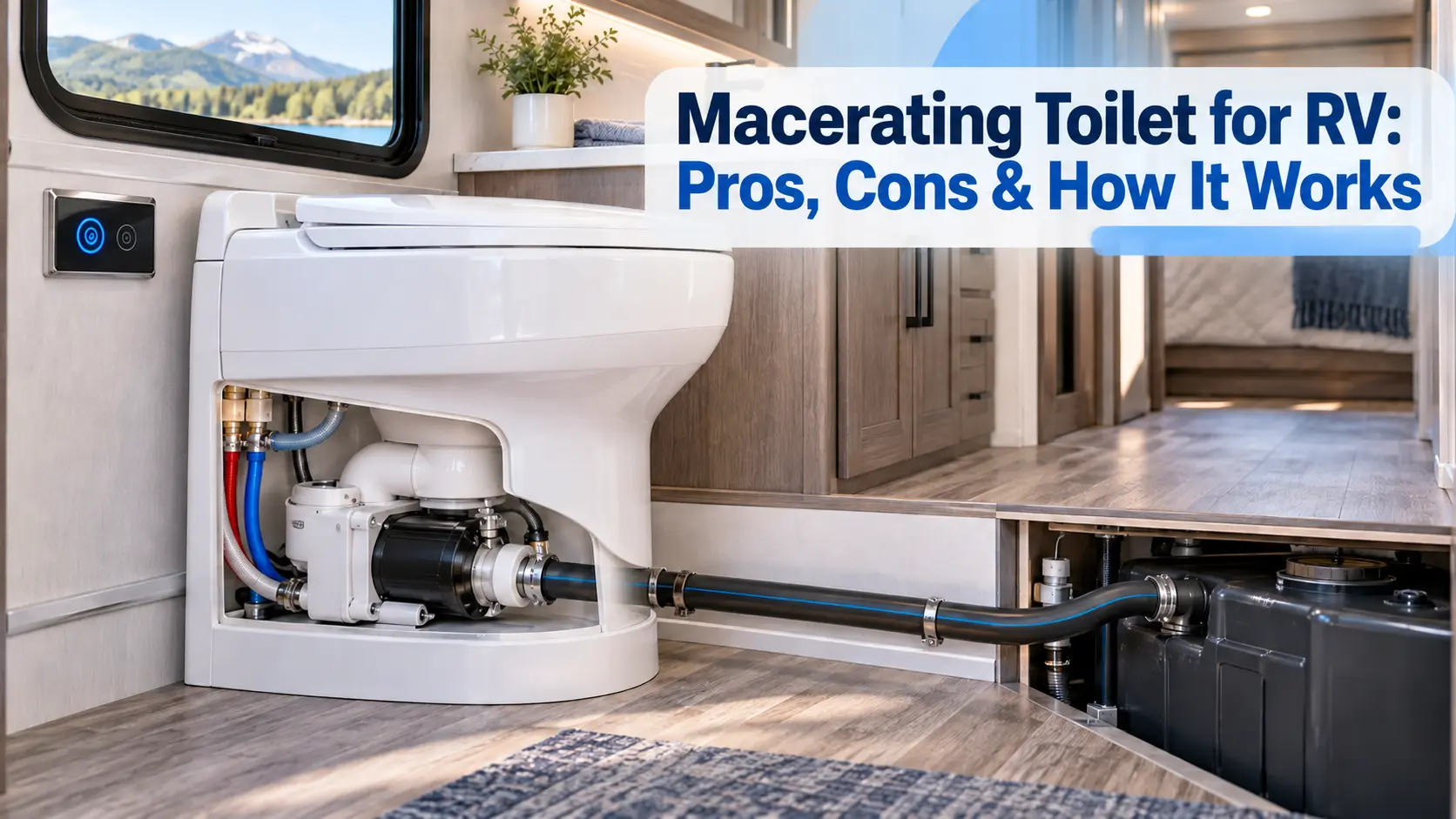
A macerating RV toilet is an electric toilet with a built-in grinder (a macerator) and a pump. It flushes with fresh water, chops waste and paper into a slurry, and pushes it through a small line to the black tank. Unlike a gravity toilet, it does not need to sit directly above the tank.
The main parts are easy to picture:
Blades turned by a motor break waste and toilet paper into small pieces, much like a garbage disposal. RV Geeks
Moves the ground waste out of the toilet. Electrical requirements vary by model and version. Many RV installations use 12-volt DC power, and the manuals reviewed below also cover 24-volt versions.
An electric water valve, called a solenoid, lets water from the RV’s pressurized supply into the bowl. The Thetford manual and Dometic manual both describe this valve, along with a device that protects the drinking water supply.
A small hose or pipe carries waste from the toilet to the tank. Thetford designs its Tecma toilet for a 1.5-inch inside-diameter (ID) line, while Dometic’s manual lists 1.5-inch or 1-inch lines.
The same holding tank your RV already uses to collect toilet waste.
A gravity toilet works differently. Its foot pedal opens a valve and waste falls straight into the tank below, so it has to sit over the tank (RV Geeks). It also uses a wider drain. RV Travel describes a typical gravity toilet as using a 3-inch pipe (RV Travel).
How Does an RV Macerating Toilet Work?
Most RV macerating toilets add water to the bowl, grind waste with the macerator, and pump the slurry to the black tank. Controls, flush modes, and tank-full behavior vary by brand, and even by manual revision.
Thetford’s current RV manual for the Tecma Silence Plus 2G (Rev. E, November 2023) describes this behavior (Thetford manual):
-
Use the Wall Panel
The wall panel has an Add Water button and a Flush button.
-
Add Water to the Bowl
Pressing Add Water puts a small amount of water in the bowl. The system allows water to be added only twice before a flush is required.
-
Start the Flush Cycle
Pressing Flush runs the macerator pump and empties the bowl into the discharge line leading to the black tank.
-
Adjust the Water Amount
A dial on the back of the wall switch lets you adjust how much water the toilet uses during each flush.
-
Full-Tank Protection
When the full-tank sensor detects a full tank, the panel light turns red. Water stops entering the bowl, while the macerator pump remains active.
Earlier Thetford manuals describe different panel behavior, so match the manual to your unit’s revision. Other brands differ too. Dometic’s manual describes a control module operated by a wall switch or electronic handle, with an optional tank-monitor input. Sanimarin describes eco and normal flushes and a tank-full indicator (Sanimarin). Do not assume one brand’s behavior applies to another.
Macerating Toilet vs RV Macerator Pump: They Are Not the Same
Two different products share the word “macerator.” Mixing them up leads to buying the wrong part.
| Comparison | Built-in Macerating Toilet | External RV Macerator Pump |
|---|---|---|
| Where it sits | At the toilet, between the bowl and the black tank | At the black tank outlet, between the tank and the sewer or cleanout |
| What it moves | Waste from the bowl into the holding tank | Waste out of the holding tank during dumping |
| Problem it solves | Toilet location and drain routing | Uphill or long dumps, home cleanouts, or using a smaller dump hose |
| When it runs | Every flush | Only while dumping |
| What it does not do | It does not empty the black tank | It does not change how the toilet itself flushes |
Three points prevent most confusion:
It moves waste from the toilet to the black tank. The tank still empties through its normal dump valve. RV Travel
A built-in toilet pump is rated for the run between the toilet and holding tank, while an external macerator pump is rated for the dump hose. Always follow the limits in your exact toilet’s manual. For dump-side systems, see our RV macerator pump guide .
If the tank will not drain, diagnose the blockage before trying to pump waste out. Start with our guide to a black tank that will not drain .
If your goal is easier dumping, you want the external pump. Our comparison of a macerator pump against a standard sewer hose covers that decision.
Macerating Toilet vs Gravity RV Toilet
Characteristics vary by model, so this table shows general differences and points to the exact manual for the rest.
| Factor | Macerating RV Toilet | Gravity RV Toilet |
|---|---|---|
| How waste moves | Waste is ground, then pumped through a discharge line. | Waste drops straight into the black tank below. |
| Electricity | Required for flushing. DC voltage varies by model. | Typical pedal models use a mechanical flush action. |
| Tank location | The toilet can be located away from the tank, within the model’s pumping limits. | The toilet normally needs to sit directly above the black tank. |
| Discharge pipe | About 1 to 1.5 inches ID in the manufacturer manuals reviewed. | Typically around 3 inches, according to RV Travel. |
| Installation | Requires electrical power, controls, water supply, sensors, and discharge routing. Manufacturers recommend qualified installation. | Can often be a simpler replacement when the size and mounting pattern match. |
| Water per flush | Varies by model and flush setting. | Varies by model. |
| Moving parts | Motor, pump, controller, water valve, and related components. | Mainly pedal linkage, valve, and seals on typical models. |
| Repair | May involve the pump, controller, sensors, or other electrical parts. | Typically has fewer electrical components and may be simpler to service, depending on the model. |
| Best fit | RV layouts where a gravity toilet cannot sit directly above the black tank. | Standard RV layouts where the toilet already sits above the black tank. |
What Are the Pros and Cons of an RV Macerating Toilet?
- Flexible toilet placement
Manufacturers publish rise and run limits for the toilet’s pump, and RV Geeks lists placement flexibility as a benefit.
- Smaller discharge plumbing
The manuals reviewed list 1 to 1.5-inch ID lines, compared with a typical 3-inch gravity drain described by RV Travel.
- Useful for second bathrooms and unusual layouts
RV Geeks and RV Travel both describe rear-bath and bath-and-a-half layouts where flexible toilet placement can help.
- Pumped waste movement
The built-in pump moves waste through the discharge line toward the holding tank, within the model’s published limits.
- Residential-style electric flushing on some models
Some models use wall-panel or handle controls with ceramic bowls and push-button flushing.
- Electrical dependency
Macerating toilets require electrical power and normally cannot flush properly when their power supply is unavailable.
- More mechanical and electrical parts
These systems can include a motor, pump, controller, sensors, and an electric water valve.
- More complex installation
Installation may require electrical wiring, water supply, discharge plumbing, controls, and tank sensors.
- Repairs can be more involved
Problems may involve the pump, controller, sensors, or electrical system and can require professional service.
- Higher purchase cost
Macerating systems can cost considerably more than basic gravity RV toilets. See the cost section below for current examples.
- Water use varies by model
Water consumption depends on the toilet model and the flush mode or water setting being used.
- Tank-full protection may limit flushing
Some systems restrict flush behavior when the holding-tank sensor reports that the tank is full.
Noise is not listed as a drawback here. I found manufacturer claims of quiet operation (Sanimarin, for example, lists 52 dB(A)) but no independent comparison.
When Does a Macerating Toilet Make Sense in an RV?
It makes sense when the toilet cannot sit over the black tank, or when you are adding a second toilet. In those cases the pump solves a plumbing-layout problem that a gravity toilet cannot. If the toilet already sits over the tank, the pump mostly adds complexity.
The toilet cannot sit above the black tank
Rear-bath and bath-and-a-half floor plans are the usual examples. RV Geeks says the toilet may not sit over the tank in these layouts, so a gravity design is not an option (RV Geeks). RV Travel says macerating toilets became more popular with bath-and-a-half plans, where the second toilet sits elsewhere and pumps to the tank (RV Travel). A site run by RV technicians gives a forward fifth-wheel bathroom and a spot over a Class A engine as examples (Mortons on the Move).
One iRV2 owner says the half bath in their bath-and-a-half rig is macerated and pumped across the RV, with no problems in five years (iRV2). That is one owner’s experience, not a reliability rate.
The layout still has to fit the model’s limits. Stay inside the published rise and run for your exact toilet.
Adding a second toilet
RV Geeks says a second toilet is possible in a large enough rig if you can route plumbing, water, and power (RV Geeks). Two more facts matter. Thetford and Dometic both require each toilet to have its own breaker or fuse, so a second toilet means a second protected circuit. And if both toilets discharge to the same black tank, that tank may fill faster.
Renovations and unusual layouts
If a renovation moves the bathroom, the small discharge line is the appeal. That is a reasoned reading of the published specs, not a manufacturer promise. Verify the rise, run, and tank connection for your layout before buying.
When Is a Gravity RV Toilet the Better Choice?
A gravity toilet is often the better choice when the existing toilet already sits over the black tank, works, and you value simplicity. Gravity toilets typically have fewer electrical components and may be simpler to service, depending on the model. Macerating toilets earn their place when layout forces the issue.
If your existing toilet already sits directly above the black tank, there may be no plumbing-layout problem for a macerating toilet to solve.
Gravity toilets typically rely on simpler mechanical parts such as seals and pedals. See our RV toilet replacement guide for common replacement considerations.
Macerating toilets need electrical power to flush. If your RV loses power or the batteries are depleted, normal flushing may not be available.
Macerating systems can cost more to buy and may also require electrical and plumbing modifications. See the cost section below for current examples.
Water use varies by model, but some macerating toilets use adjustable flush volumes. Thetford, for example, lists roughly 0.1 to 0.7 gallons per flush depending on the setting.
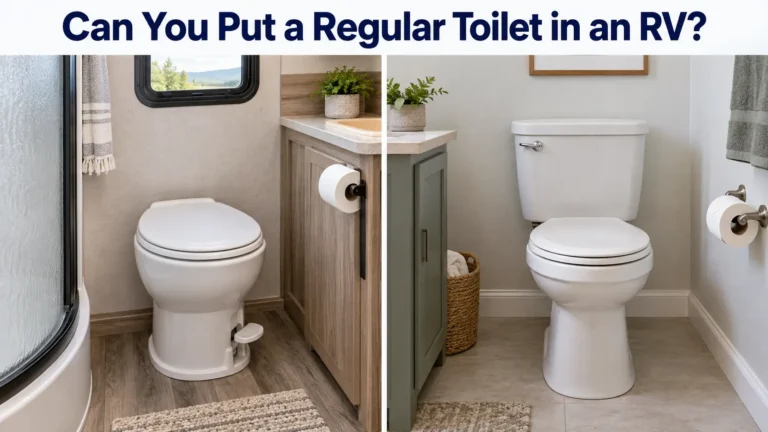
You do not need a macerating system just to get a taller or more residential-style bowl. See our RV toilet replacement comparison for other options.
Can You Replace a Standard RV Toilet With a Macerating Toilet?
Not as a simple swap. A macerating toilet needs a dedicated DC electrical supply sized for the exact model, fresh water at the required flow, a discharge line to the tank, and a tank-level arrangement that works with the toilet. Check each item against the manual for your exact model and revision.
Many RV-specific models use 12V DC, and some come in 24V. The exact voltage, fuse or breaker size, wiring, and circuit requirements must come from the manual for your exact model and revision. All three manufacturers below recommend professional installation. Thetford recommends a licensed tradesperson for plumbing and electrical work. Dometic recommends a qualified marine or RV technician or electrician. Sanimarin says a licensed plumber should install its RV unit in line with local plumbing codes.
Electrical supply
Having power available does not mean the existing circuit is adequate. These toilets draw serious current, and the rules differ by brand:
Circuit protection:
The current RV manual (Rev. E, 2023) requires a separate breaker or fuse for each toilet and RVIA-compliant circuits.
Fuse and wiring:
The wire chart pairs a 30-amp fuse with both 12V and 24V installations, with wire gauge based on the length of the run.
Voltage:
Supply voltage should stay within 2 volts of the rated voltage, with no more than a 10% drop while the macerator is running.
12V version:
The RV manual lists a current draw of 25 amps at 300 W.
24V version:
The manual lists a current draw of 15 amps at 360 W.
Cable sizing:
The manufacturer provides a cable-size chart based on the length of the electrical run.
12V version:
The 2018 manual lists a 20-amp breaker.
24V version:
The same manual lists a 15-amp breaker.
Wire sizing:
The manual gives conductor-size guidance in more than one place, and the published figures do not fully agree.
Circuits sized for lights or small accessories are not built for loads in this range. That is a reasoned inference, so have a qualified RV technician confirm capacity. Stop and call a technician if you cannot identify existing wiring, cannot confirm circuit capacity, or find hidden electrical damage. Do not improvise wiring.
Rough-in and physical dimensions
A macerating toilet does not use a gravity drop-through rough-in, so compare the manufacturer’s floor template, not just your old toilet’s measurements.
- Thetford: the manual includes High and Low templates. The Low model mounts the pump beneath the floor, which requires cutting a floor opening and having clearance below. The footprint is about 15.9 by 11.1 inches, and weights are 51.8 pounds (low version) and 56.2 pounds (standard). The floor must be level and strong enough, with fasteners reaching at least 3/4 inch into structure. A retailer support answer lists an 11-inch minimum rough-in clearance for the standard Tecma, but that comes from the retailer, not the manual.
- Sanimarin: use the drawings in the RV-market manual.
Freshwater connection
Thetford’s manual lists a 1/2-inch water supply connection (1/2-inch NPT) but does not give a minimum flow figure. Sanimarin’s manual shows a 25 psi minimum inlet pressure, and its product page recommends a pump flow of 2.9 gallons per minute. Check that your pump and lines can deliver what your model requires. Shut off the water supply and relieve line pressure before disconnecting anything.
Discharge plumbing and tank connection
Thetford calls for reinforced hose or rigid PVC, no sharp bends, secured runs, and a leak check. It also warns that the discharge tube position at the back of the toilet is critical: pulling the tube top below the bowl water level drains the bowl. Stop and call a technician if the tank fitting is damaged or inaccessible, or if the plumbing layout is unclear.
Tank sensors and controls
Tank-level monitoring and flush lockout vary by model and installation. Check how your toilet handles this before you buy.
Thetford uses its own adhesive full-tank sensor on the outside of the tank, with an optional mid-level sensor. When the tank reaches full, the control panel turns red and stops adding water to the bowl, while the macerator pump remains active.
Sanimarin uses sensors at 50% and 100%. At 100%, the indicator flashes red and sounds four beeps. The manual states that only three more flush cycles remain. Sensor setup is performed with the tank empty.
Dometic’s control module can shut the toilet down when it receives a full-tank signal. That signal comes from an optional Dometic tank monitor or another compatible source.
Do not assume your existing tank panel will work with the toilet.
Service access
Leave room for maintenance access, as Thetford’s manual requires.
Current Macerating Toilets for RVs Worth Comparing
Two models have current manufacturer documentation written for RV use. Figures below come from those documents, and performance figures are manufacturer claims unless noted.
| Specification | Thetford Tecma Silence Plus 2G | Sanimarin 4 (RV Market) |
|---|---|---|
| Voltage versions | 12V DC and 24V DC | 12V and 24V |
| Circuit protection | Requires its own breaker or fuse. The manual chart lists a 30-amp fuse. | Current draw is 25 A at 12V or 15 A at 24V. Confirm circuit protection in the manual. |
| Discharge | 1.5-inch ID hose or rigid PVC. | 1-inch or 1.5-inch discharge, according to the manufacturer’s product page. |
| Vertical rise | Up to 6 ft between the toilet and tank without affecting performance, according to the RV manual. | Up to 9.8 ft (3 m) according to the RV manual. |
| Horizontal run | Not stated in the RV manual. Thetford’s support page claims the pump can move waste up to 120 ft, but does not state the conditions. | Up to 98 ft (30 m) according to the RV manual. |
| Combined limits | Not stated | Not stated |
| Water | 1/2-inch NPT supply. Water use is listed at roughly 0.1 to 0.7 gal per flush. | Minimum inlet pressure is 25 psi. Flush volume varies by control system. |
| Tank control | Adhesive tank sensors. When the tank is full, bowl water is disabled. | Sensors at 50% and 100%, with a warning when the tank reaches full. |
| Mounting | Floor-mounted, with high and low versions. Approximate footprint is 15.9 × 11.1 in. | Refer to the manufacturer’s RV manual drawings for mounting dimensions. |
| Manual used | Rev. E, dated 11.1.23 | RV-market manual dated 01.20 |
Thetford describes a ceramic bowl with a 12V macerator and wall controller. See the Thetford product page .
The RV-market manual states that the Sanimarin 4 is designed for mobile use.
The manufacturer lists run limits of about 10 ft vertical and 100 ft horizontal. These are rounded versions of the same 3 m and 30 m figures shown in the manual.
Older Dometic MasterFlush 8700 series. Dometic’s current US RV toilet lineup does not include a MasterFlush macerating model, and the 8743 product page lists that variant as discontinued. That is why it is not included in the comparison table.
If you already own one, the 2018 Dometic manual covers 12V and 24V versions, 1-inch or 1.5-inch discharge lines, and pumping limits of up to 98 feet horizontally or 9.8 feet vertically. If you are considering buying old stock, confirm current parts support and documentation with Dometic first.
Left out on purpose. SEAFLO sells electric macerating toilets, but I could not verify RV-specific manufacturer documentation for the RV-labeled versions. Our SEAFLO RV toilet review covers its gravity models. Sanimarin 31 was also excluded because I could not verify an RV-specific manual.
How Much Does a Macerating RV Toilet Cost?
Listed prices vary by seller, voltage, and configuration, so treat these as examples, not averages. Both were listed on September 29, 2026, in US dollars:
- Thetford Tecma Silence Plus 2G, standard height: $1,735.99 at etrailer.
- Sanimarin 4: $896.75 for the 12V and 24V versions at SanifloStore, a Saniflo distributor.
I did not verify a current Dometic 8700 series price. For comparison, our replacement guide, updated September 19, 2026, puts gravity models at roughly $150 to $500.
The toilet is only part of the cost. I could not find reliable labor pricing, so here are the cost drivers instead:
- The toilet unit itself
- A dedicated electrical circuit, fuse or breaker, and wiring
- Discharge plumbing and fittings
- The tank connection
- Controller and tank sensor installation
- Floor modification, if the model needs it (Thetford’s low model does)
- Labor
Ask a qualified RV technician for a written estimate that lists each item.
What Should You Never Flush Through a Macerating Toilet?
Only human waste and toilet paper. Thetford says never to flush paper towels, pre-moistened wipes, condoms, feminine hygiene products, dental floss, or household garbage. Sanimarin’s warranty covers only toilet paper, fecal matter, and wastewater, and excludes cotton, wipes, food, hair, oils, and solvents.
Check your model’s manual for its own list, since not every brand publishes the same restrictions.
What Maintenance Does a Macerating RV Toilet Need?
The manuals I reviewed do not publish service intervals, and Sanimarin says its toilet does not need any particular maintenance. What they do give is care guidance:
Thetford recommends toilet tissue designed to break down quickly rather than standard household tissue.
Thetford recommends non-abrasive, non-petroleum cleaners and warns against household cleaners that may contain bleach or acids.
Thetford says to use propylene glycol RV antifreeze, not automotive antifreeze or windshield washer fluid, and to winterize both the water-supply and discharge sides.
For storage longer than two weeks, Thetford provides cleaning and deodorizing instructions. Sanimarin recommends switching off the toilet’s water and electrical supply during long absences or power interruptions.
Thetford recommends testing the flush at the start of the season and checking the system and connections for leaks.
Common RV Macerating Toilet Problems
These checks come from manufacturer troubleshooting tables where available. Where a symptom is not covered by a manual, it is marked as a reasoned check.
Power is on but the toilet will not flush
Thetford’s Rev. E table lists a full tank, a clog at the pump inlet, a solid object in the macerator, and low voltage. For a full tank, empty it. For a solid object, turn the power off before trying to remove it, and contact Thetford if you cannot. For low voltage, the manual says a drop of more than 10 percent while the macerator runs may point to a wiring problem in the RV. Stop there and call a technician.
The motor runs but waste does not seem to move
The manuals reviewed do not list this symptom separately. Reasoned checks: a kinked discharge hose (Thetford warns kinks restrict flow) or a blockage. If the hose is not the cause, stop.
The tank sensor says full when it is not
Thetford says to clean the tank surface with isopropyl alcohol before mounting sensors, and to keep wires away from the sensor pads. Sanimarin says no metal or second tank should sit in a sensor’s clearance area. Owners report debris on the tank wall or loose adhesive triggering false full readings (RV Geeks comments). Tank-gauge cleaning products are made for specific sensor designs, so check that a product matches your sensor type before using it, and contact the manufacturer if a sensor keeps reading full.
The bowl empties itself after a flush
Thetford says a discharge tube pulled below the bowl water level drains the bowl. Re-check the tube position.
No water enters the bowl
Check for a kinked or disconnected supply line, a blown fuse or breaker on a water pump, or a loose solenoid connector, per Thetford’s table.
Leaks at connections
Check hose clamps first. If the leak comes from the tank fitting or a hidden line, stop and call a technician.
For grinding noise, or any problem that requires opening the pump, electrical work, or hidden plumbing, do not continue. Turn the power off and contact the manufacturer or a qualified RV technician.
Is a Macerating Toilet Worth It for Your RV?
It is worth it when your layout needs it, and usually not when it does not. The pump’s value is plumbing flexibility. If a working gravity toilet already sits over your black tank, converting adds cost, wiring, and parts to service without a clear payoff.
| Situation | Likely Better Fit | Why |
|---|---|---|
| Toilet is directly above the black tank and works | Gravity toilet | There is no layout problem to solve, and the system stays simpler. |
| Bathroom is far from the tank or off to the side | Macerating toilet | The pump allows flexible waste routing within the model’s published limits. |
| Adding a second bathroom | Macerating toilet may offer more flexibility | You still need suitable power, water, a discharge route, and enough holding-tank capacity. |
| Lowest possible maintenance is the priority | Gravity toilet | Typical gravity toilets have fewer electrical components. |
| Flexible discharge routing is required | Macerating toilet | Many models use a smaller 1 to 1.5-inch discharge line instead of a large gravity drain. |
| Long boondocking trips | Gravity toilet or a low-flush macerating model | Water use matters more off-grid, and flush volume varies by macerating-toilet model. |
| Weak or unreliable DC power | Gravity toilet | Macerating toilets rely on electrical power to flush. |
| You only want easier tank dumping | External dump-side macerator pump | It addresses the dumping problem without replacing the toilet. |
| You only want a more comfortable bowl | Residential-height gravity toilet | You can get a taller or more residential-style toilet without adding a macerator pump. |
These rows are starting points. Verify your rise, run, circuit, and tank sensors before deciding.
Bottom Line
A macerating toilet’s major advantage is plumbing flexibility. It is not automatically an upgrade for every RV.
If your gravity toilet works and sits over the black tank, you may gain little from converting. If you need flexible bathroom placement or pumped waste movement, it can be worth the added cost and complexity. Whichever way you lean, confirm the exact model’s manual for power, water, discharge, and tank sensor requirements before you buy, and use a qualified RV technician for any wiring you cannot verify yourself.