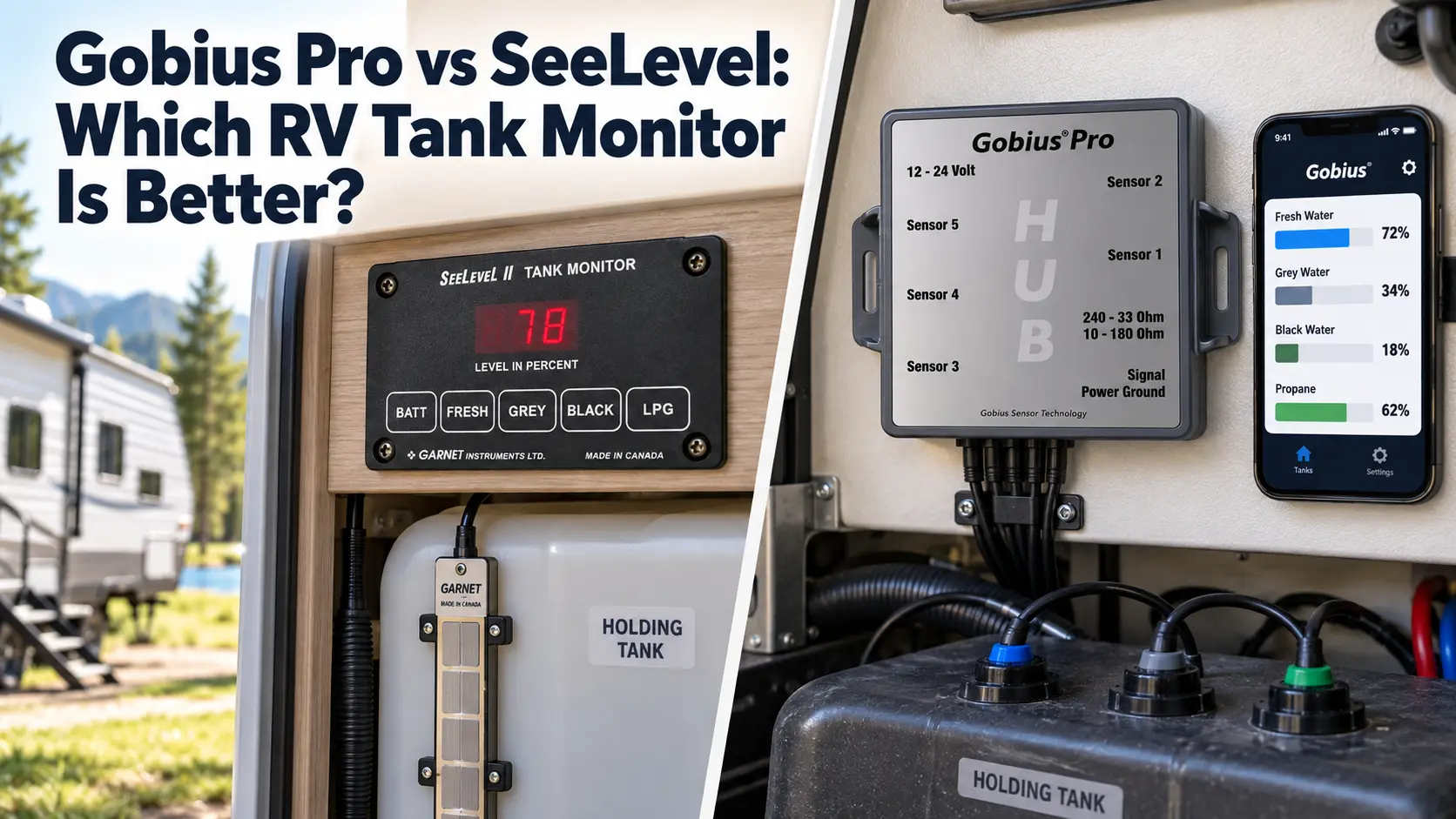
- SeeLevel is the stronger pick for most RV owners with conventional plastic or polyethylene holding tanks because it gives a percentage-based 0-100% readout instead of a simple on/off signal.
- Gobius Pro earns its place when a tank is metal, something SeeLevel can’t read at all.
- The real deciding factor isn’t Bluetooth or price.
- It’s whether you need a precise level or just a reliable alarm before a tank fills up.
Your factory tank gauge lies to you. Waste and paper coat the probes, and the panel reads full when the tank’s actually been empty for days. Two very different products fix this by moving the sensor outside the tank instead of inside it: SeeLevel from Garnet Instruments, and Gobius Pro from Gobius Sensor Technology in Sweden.
They sound like the same idea. They aren’t. SeeLevel reads your tank the way a fuel gauge does, as a percentage. Gobius Pro works more like a tripwire. Each sensor tells you whether liquid has crossed one specific height, and nothing more.
Our detailed SeeLevel review found that accuracy depends as much on sender placement and metal clearance as it does on the sensing technology itself. That same rule applies here. The right pick depends less on the brand name and more on your tank material and what kind of reading you actually need.
This comparison covers how each system measures a tank, which materials they support, what installation looks like, and which one fits your setup.
How we researched this: RVFlushGuide has not personally tested or installed either the SeeLevel or Gobius Pro system. This comparison is based on current manufacturer documentation and specifications, official app listings, and independent reporting from marine and RV publications. Where sources disagree or a figure is retailer-specific rather than manufacturer-published, that’s noted directly.
Gobius Pro vs SeeLevel at a Glance
| Feature | SeeLevel Garnet Instruments | Gobius Pro Gobius Sensor Technology |
|---|---|---|
| Measurement method | Capacitive sensing through the tank wall | Vibration measured by a built-in accelerometer |
| Reading type | Percentage-based 0-100% readout | Level switch: on/off signal per sensor |
| Compatible tank materials | Plastic or polyethylene only, up to about 3/8″ wall | Stainless steel, steel, aluminum, polyethylene, fiberglass |
| Fresh, gray, and black tanks | Yes, plus an optional LPG sender | Yes, any liquid-holding tank |
| Bluetooth | Yes, on the 709-BTP7 model | Yes, built into every sensor |
| Display | 3-digit percentage display; phone app on Bluetooth models | Phone app; optional red/green LED indicator panels |
| Sensors per tank | 1 sender per tank, trimmed or stacked to height | 1 to 9 sensors per tank |
| Wiring | 2-wire bus, often reuses factory wiring | Sensor cable to a control panel, 12-24V |
| Best use case | Plastic tanks where you want a specific level | Metal tanks, or a simple overfill alarm |
| Approx. price (at publication) | About $265 for a 3-sender 709-BTP7 kit | About $199-270 per sensor; about $395 for a 3-sensor kit at one retailer |
| Major limitation | Won’t work on metal tanks at all | Reports a threshold, not a percentage |
How Do Gobius Pro and SeeLevel Measure Tank Levels?
SeeLevel uses a flexible sender strip that sticks to the outside of the tank and reads liquid level through the wall using capacitive sensing, then reports a percentage. Gobius Pro uses a small sensor that vibrates the tank wall and reads that vibration with a built-in accelerometer, a method Gobius calls “knock and listen.” It reports whether liquid is present at the sensor’s mounted height, not a percentage.
Both approaches exist for the same reason. Factory tank gauges use metal probes that sit inside the tank, and a black tank sensor reads full after dumping once waste residue bridges the gap between two probes. Moving the sensing hardware outside the tank prevents the sensors themselves from becoming coated in waste, although heavy buildup on the inside wall can still affect an external reading.
SeeLevel’s sender is a thin circuit board that reads capacitance changes along its length. Garnet’s own holding tank page describes this as a high-accuracy sensing method, accurate to within about a quarter inch.
Gobius Pro works differently. Gobius’s own documentation describes the sensor exerting a small mechanical force on the tank wall and measuring the resulting vibration with an accelerometer. That vibration pattern changes depending on whether liquid is present at that height. It’s a clever way to sense fluid without touching it, but it only answers yes or no at one point, not a smooth number.
Which Gives Better Tank-Level Information?
For day-to-day tank management, SeeLevel’s percentage-based 0-100% readout gives more useful information than Gobius Pro’s on/off signal. Knowing a black tank is at 62 percent tells you more than knowing it has or hasn’t crossed one fixed point. Gobius Pro closes that gap somewhat by stacking sensors, but you’re still reading discrete thresholds, not a continuous curve.
This matters most for boondocking, where you’re rationing gray and black tank space over several days. A percentage reading lets you plan the next dump around an actual number instead of a light that’s either off or on. Google Play’s own listing for the Gobius app states this plainly: Gobius Pro is a level switch, while its sister product Gobius C measures steplessly from 0 to 100 percent. Gobius Pro, the subject of this comparison, doesn’t get that continuous-style reading.
A reading that stays high for days can also point to a black tank that isn’t actually draining, rather than a problem with either sensing system. Neither SeeLevel nor Gobius Pro can tell you that on its own. Both just report what they detect at their mounted height.
Tank Compatibility: Plastic, Fiberglass, and Metal
Before comparing monitoring systems, make sure you understand your gray tank’s basic layout, capacity, and drainage setup.
SeeLevel only works on plastic or polyethylene tanks up to roughly three-eighths of an inch thick. Gobius Pro works on a wider range of materials, including stainless steel, steel, aluminum, polyethylene, and fiberglass, each with its own maximum wall thickness.
Garnet Instruments states directly that SeeLevel senders are not compatible with metal holding tanks of any kind. That rules it out immediately for RVs and specialty trailers with steel or aluminum tanks, a small but real slice of the market.
Gobius Pro’s own datasheet lists maximum wall thickness by material: stainless steel and steel up to 3mm, aluminum up to 5mm, polyethylene up to 12mm, and fiberglass up to 8mm. That range is a big part of why Gobius Pro shows up in RV conversations at all. It was built primarily for boats, where metal fuel and water tanks are common, and RV owners with an odd metal tank have adopted the same technology.
A black tank flush system can reduce the buildup that causes trouble for factory probes and may also help prevent heavy deposits from affecting an external SeeLevel reading. Neither SeeLevel nor Gobius Pro puts its sensing hardware in direct contact with the waste.
Installation: Which System Is Easier to Retrofit?
SeeLevel installation means finding a flat, clean spot on the tank at least an inch from any metal, mounting the sender strip, and wiring it back to a display. Gobius Pro installation is similar, but the tank wall needs to be above 68°F (20°C) for the sensor to bond properly during setup, and there’s no metal-clearance rule to worry about since Gobius Pro is designed to sit directly on a metal tank wall.
Both systems use adhesive to attach the sensor, so surface prep matters more than tools. A clean, dry, flat spot on the tank is the real requirement for either one.
SeeLevel’s install has a documented constraint. Garnet’s sender manual sets a minimum clearance of 1 inch from the sides and top or bottom of the sender, and 2 inches from the flat face, since metal that close can throw off the capacitive reading. That’s not an issue for Gobius Pro, since the sensor is built to work on a metal tank wall by design.
Gobius Pro has its own constraint instead. Gobius’s FAQ page states that a sensor can come loose after installation if the tank wall was colder than 68°F (20°C) when it was applied, if the surface wasn’t clean, or if there wasn’t enough flat, unobstructed space to press the sensor on firmly. That’s specifically about getting the adhesive to bond, not about measurement accuracy once the sensor is attached and running.
Neither company publishes a fixed install time specific to RVs. SeeLevel senders can be trimmed or stacked to fit a range of tank heights. Gobius Pro sensors get placed at whatever single height you choose to monitor, and each one needs its own spot on the tank.
Can Either System Reuse Factory Wiring?
SeeLevel senders connect over a simple 2-wire bus, and many owners successfully splice into wiring already run to their factory sensors, according to Garnet’s own installation guidance and independent long-term reviews. Gobius Pro includes a 2-meter sensor cable for power and output connections and requires a 12-24V supply. Its digital outputs can feed an optional indicator panel or another control system, so reusing factory wiring depends on how the RV is already wired.
Bluetooth, Displays, and Everyday Use
SeeLevel’s Bluetooth model uses a dedicated app called SeeLeveL RV 2.0, built specifically for the 709-BTP3 and 709-BTP7 monitors. It shows every tank’s percentage in both graphical and numeric form, lets you rename tanks, and sets high and low alarms.
Gobius Pro shares its app with Gobius C, the company’s other sensor line, rather than having an RV-specific interface of its own. The Google Play listing describes it as supporting both sensor types and ten languages, and it’s used to name sensors, group them, and handle initial calibration.
Current Gobius Pro product listings describe kits shipping with an LED indicator panel showing red and green lights alongside the phone app, though exact panel counts and configurations vary by kit size and retailer, so confirm what’s included before ordering a specific bundle. SeeLevel’s non-Bluetooth models still use a dedicated wall-mounted display that shows tank level as a percentage on a 3-digit LED screen. What they lack is phone-app access, not percentage resolution.
Gobius Pro vs SeeLevel Cost
At publication, Garnet lists its 709-BTP7 system with three senders at about $265, before any extra senders or installation. Gobius Pro sensors are typically sold individually or in small kits. One U.S. retailer lists a 3-sensor kit at about $395, while single-sensor kits have listed anywhere from roughly $199 to $270 depending on the retailer and date. Configuration and retailer both affect the final total for either system.
These numbers move. SAIL Magazine reported a $199 price for a single Gobius Pro sensor when it covered the product, while other current retailer listings price a single sensor closer to $270. A 3-sensor Gobius Pro kit listed at $395 at one marine retailer, though it was out of stock at the time of this writing.
Comparing a like-for-like setup is tricky because the two systems aren’t built the same way. SeeLevel’s 709-BTP7 bundles a single Bluetooth display with three senders in one kit. Gobius Pro doesn’t have an equivalent all-in-one flagship kit in quite the same way, so building a 3-tank Gobius Pro setup means buying individual sensors or a multi-sensor pack. Check current pricing directly with a retailer before assuming either system is the cheaper option for your tank count.
Which One Should You Buy?
- Your holding tanks are plastic or polyethylene
- You want a specific percentage reading, not just an alarm
- You’re comfortable working around the 1-inch metal clearance requirement during install
- You want an RV-specific app built around fresh, gray, black, and LPG tanks
- One or more of your tanks is metal, including stainless steel, aluminum, or steel
- A simple full or getting-full alert covers your needs better than a percentage
- You’re also monitoring a fuel or water tank alongside your holding tanks
- Your tank bay doesn’t give you the metal clearance SeeLevel needs, but does give you a clean, flat surface
Before spending $200 or more on a new monitor, it can be worth trying a dedicated sensor cleaner, since probe fouling may be fixable without replacing the factory monitoring system.
Final Verdict
For most RV owners, SeeLevel is the better tank monitor. It gives an actual percentage instead of a threshold, it’s built specifically for RV holding tanks, and it has years of documented use in the RV community behind its accuracy claims. If your RV has plastic or polyethylene holding tanks, SeeLevel is usually the more informative choice.
Gobius Pro earns its place in a narrower set of situations. If a tank is metal, SeeLevel simply won’t work, and Gobius Pro becomes a viable option specifically rated for that material. It’s also worth a look if all you actually need is a reliable alarm rather than a precise number. Match the product to your tank material first, then decide how much detail you want from the reading.
Frequently Asked Questions
Is Gobius Pro better than SeeLevel?
Not universally. SeeLevel gives a percentage-based 0-100% readout and works well for RV owners with accessible plastic tanks, while Gobius Pro is a level switch that reports whether liquid has reached a specific height rather than an exact percentage. Gobius Pro is the better fit mainly when a tank is metal, since SeeLevel can’t be used there at all.
Does SeeLevel work on metal RV tanks?
No. Garnet Instruments states directly that SeeLevel senders are not compatible with metal holding tanks. They’re built for plastic or polyethylene tanks up to about three-eighths of an inch thick.
Does Gobius Pro show a tank percentage?
No. According to Gobius’s own app listing, Gobius Pro functions as a level switch rather than a percentage gauge. Each sensor reports whether liquid has crossed the height where it’s mounted, and stacking multiple sensors on one tank adds more threshold points rather than a smooth percentage curve.
Can Gobius Pro monitor an RV black tank?
Yes. Gobius Pro is designed to work with any liquid-holding tank, including black, gray, and fresh water tanks, and Gobius specifically lists waste water as a supported use case. It’s also one of the few options that works on a metal black tank, which some specialty and older RVs still use.
What’s the best SeeLevel alternative for a metal tank?
Gobius Pro is one of the few options built to read tank levels on metal, since it senses vibration through the tank wall rather than relying on the capacitive method SeeLevel uses. It won’t give a percentage reading, so expect an on/off style alert per sensor rather than SeeLevel’s percentage-based gauge.