If you’ve ever wondered why your RV has a tank labeled “gray” next to one labeled “black,” you’re not alone. The RV gray water tank is one of the most misunderstood parts of an RV’s plumbing system, mostly because new owners assume all their wastewater goes to the same place.
It doesn’t. Your gray water tank only collects water from your sinks and shower. Understanding what goes into it, how big it actually is, and how to manage it correctly is the difference between a smooth trip and a smelly one (or a conversation with a ranger about where you just emptied it). This guide covers what the tank is, how it works, and how to keep it running the way it’s supposed to.
What Is an RV Gray Water Tank?
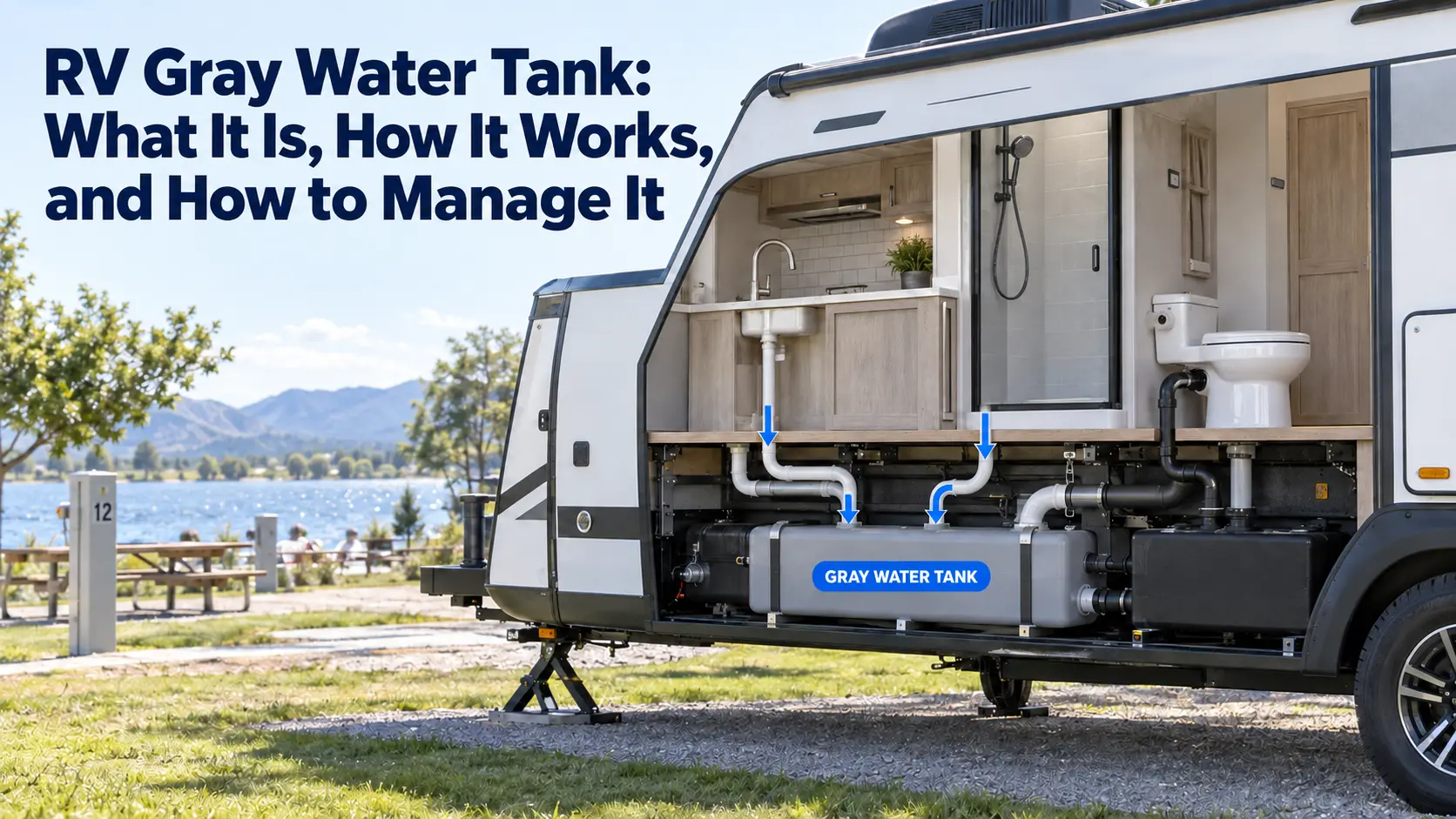
An RV gray water tank is the holding tank that collects wastewater from your sinks and shower, everything except toilet waste. It sits under your RV’s floor, connected by drain lines to each fixture, and holds that water until you empty it at a dump station or another approved location.
The name comes from the type of wastewater the tank holds, not from the tank’s physical color. It’s one of the main holding-tank systems in an RV, alongside the black tank (toilet waste) and the fresh water tank (your clean water supply).
What Goes Into an RV Gray Water Tank?
Commonly, the kitchen sink, bathroom sink, and shower or tub drain into one or more gray tanks, but plumbing layouts vary by RV. Anything that goes down one of those connected drains, dish water, shower runoff, toothpaste rinse, ends up there.
Washing machines are the exception worth checking. Some RVs with a washer or washer-dryer combo route that discharge into the gray tank too, and because a wash cycle can push out a large volume of water at once, some manufacturers recommend only running the machine when you’re connected to a sewer hookup with the gray valve open. Not every RV is plumbed this way, so check your owner’s manual before assuming.
RV Gray Water Tank vs Black Tank vs Fresh Water Tank
All three tanks work together, but they serve very different jobs.
| Tank | What It Holds | Common Sources | Main Concern |
|---|---|---|---|
| Fresh water | Clean, potable water | Potable-water fill inlet, onboard fresh tank | Freezing, contamination |
| Gray water | Wastewater (no toilet waste) | Kitchen sink, bathroom sink, shower | Grease buildup, odor, slow drains |
| Black water | Toilet waste | Toilet only | Clogs, sensor issues, odor |
How Does an RV Gray Water Tank Work?
Water leaves a fixture, drains through a trap and a line, and collects in the gray tank until you open the termination valve to empty it. A roof vent lets pressure and odor escape so the system doesn’t back up into your cabin.
Each fixture has its own drain line running to the tank, usually sloped so gravity does the work. The tank has an inlet where those lines connect, a vent that runs up through the roof, and a termination valve at the bottom that you open to dump. Some tanks also have a level sensor wired to a monitor panel inside the RV.
Where Is the RV Gray Water Tank Located?
Gray tanks are typically mounted beneath the RV floor or chassis near the fixtures they serve, but the exact location varies by floorplan. Your owner’s manual or plumbing diagram is the best way to confirm the tank’s position on your specific RV.
Keystone RV’s holding-tank walkthrough is worth watching if you want to see the tank, vent, sensors, and valves laid out on a real RV, rather than just described. Their master technicians point out where everything sits and how it connects.
How Big Are RV Gray Water Tanks?
There’s no standard RV gray water tank size. Capacity depends on your RV’s overall size, floorplan, number of fixtures, and whether it has one gray tank or two.
That said, published figures give a rough sense of scale. The RV Geeks note that small travel trailers commonly run 25 to 45 gallons, larger fifth-wheels can reach 95 gallons or more, and Class B campervans often sit at the small end, sometimes under 30 gallons. Current manufacturer specs show how much this can vary even within one travel-trailer line: Keystone lists 34 gallons of gray-water capacity for the Passport 160BHC and 68 gallons for the Passport 284QBC. Treat these as examples rather than design standards. Your RV’s specification sheet or owner’s manual is the only reliable source for your exact capacity.
Larger RVs, especially fifth-wheels, sometimes split gray water capacity across two separate tanks rather than one. In that setup, one tank might serve the kitchen sink while the other handles the bathroom sink and shower. Don’t assume every sink and shower in your RV drains into the same gray tank. Check your owner’s manual or plumbing diagram to see how your specific floorplan is set up, since it genuinely varies model to model.
How Do You Know When an RV Gray Tank Is Full?
The clearest sign is drainage. If your sink or shower starts draining slowly, or water pools instead of going down, the gray tank may be at or near capacity, although buildup or a drain restriction can cause the same symptom.
Your monitor panel is the first thing to check, but don’t treat it as gospel. Internal probe sensors can read inaccurately once they get coated with grease or soap film, which is common in a gray tank. A SeeLevel-style external monitor reads through the tank wall instead of relying on a probe inside it, which helps avoid fouling on internal probes. Garnet Instruments also states that SeeLeveL senders do not work on metal tanks, so a metal tank needs a different monitoring approach.
When in doubt, trust the drains over the panel. A full tank shows up in how your fixtures behave before it shows up on a screen.
What Happens If an RV Gray Water Tank Gets Too Full?
Once the tank is full, water has nowhere to go, so it backs up into whatever fixture you’re using. A shower pan that won’t drain or a sink that fills instead of emptying are the usual symptoms.
If you keep using fixtures after that point, water can back up further into the drain lines. Stop running water as soon as you notice slow draining and get to a dump station before it gets worse.
Emptying and Maintaining Your Gray Tank
How to Empty It
At a full hookup or dump station, empty the black tank before the gray tank so the gray water helps rinse the sewer hose. If you’re new to this process, follow our beginner-friendly dumping instructions for the complete sequence, including valve operation and cleanup.
If you’re boondocking without a sewer hookup nearby, a portable waste tank lets you haul gray (and black) water to a dump station instead of driving your whole RV there.
Basic Cleaning and Maintenance
Keep the gray valve closed between dumps rather than leaving it open at a hookup. Keystone RV recommends keeping termination valves closed until you’re ready to dump, and having a volume of gray water available also helps rinse the sewer hose after the black tank is emptied. A sink strainer can catch food scraps and hair before they reach the tank. If you use a gray-tank treatment, follow the product directions and your RV manufacturer’s guidance.
Why Does an RV Gray Tank Smell?
A gray tank that smells like rotten eggs is usually caused by bacteria breaking down soap, grease, and food residue, which releases hydrogen sulfide gas. That’s the most common cause, but it’s not the only one. A dry P-trap, a failed vent valve, or even your water heater’s anode rod can produce the exact same smell without the tank being the actual problem.
Because there are several possible sources, working through them in order matters more than reaching for a treatment right away. For a full diagnostic walkthrough covering all six common causes and how to tell them apart, see our guide on diagnosing a gray tank that smells like rotten eggs.
Can You Dump RV Gray Water on the Ground?
It depends entirely on where you’re camping. There’s no single nationwide answer, and an exception that applies on one type of federal land doesn’t automatically apply anywhere else.
The closest thing to a federal exception comes from the Bureau of Land Management. Under 43 CFR § 8365.1-1, BLM’s general rule against draining sewage or waste from a vehicle specifically excludes “wash water.” The regulation doesn’t define exactly what counts as wash water, and the exception isn’t a blanket permission slip. BLM field offices can and do issue supplemental rules that close this exception in specific areas.
For example, the BLM’s Long-term Visitor Area supplementary rules explicitly say not to dump sewage or gray water on the ground. State and local water-protection laws can also apply on top of the federal exception, regardless of what the CFR says. Before you dump anything on BLM land, check with the specific field office managing that area for current supplemental rules.
Other federal land agencies generally take a stricter stance. For example, the National Park Service campground rules at Assateague Island require gray and black water to be emptied at designated dump stations. U.S. Forest Service rules can also prohibit ground discharge at specific sites, so dispersed camping areas and developed campgrounds should be checked with the managing ranger district before assuming anything is allowed.
The practical takeaway: never assume gray water dumping is legal just because you’re on public land. Always check the rules for your exact location, whether that means a field office, a ranger district, or your state’s environmental regulations, before releasing any gray water outside a dump station.
Common RV Gray Tank Problems
A few issues come up often enough that they’re worth knowing before they surprise you. Slow drainage usually points to grease buildup in the tank or a nearly full tank rather than a mechanical failure. Inaccurate level readings are common with older probe-style sensors that get coated over time, which is one reason experienced owners tend to trust their drains over their monitor panel. Stuck or leaking termination valves can develop after years of use and are usually a straightforward repair.
If the odor problem shows up specifically at a sewer hookup rather than from your sinks or shower, that’s a slightly different diagnosis worth checking separately. Our guide on why an RV smells like sewer when connected to sewer walks through that scenario.
Final Takeaway
The gray water tank isn’t complicated once you know what it does: it collects sink and shower water, holds it until you dump it, and needs to be treated a little differently than your black tank because of the grease and soap it deals with. Check your specific RV’s capacity and plumbing layout, keep the valve closed between dumps, and always confirm local rules before you dump anywhere other than a designated station.
Frequently Asked Questions
Does a washing machine drain into the gray tank?
In some RVs, yes. It depends on your specific floorplan and plumbing, so check your owner’s manual. If your washer does drain into the gray tank, running it while connected to a sewer hookup with the valve open is usually the safer approach, since a wash cycle can add a large volume of water quickly.
Can different sinks in my RV drain into different gray tanks?
Yes, in RVs with two gray tanks, it’s common for the kitchen sink to feed one tank while the bathroom sink and shower feed another. This isn’t universal though. Some RVs share a single tank across all fixtures. Check your plumbing diagram to see how yours is set up.
Should I leave my RV gray tank valve open when connected to sewer?
Practices vary here. Many manufacturers recommend keeping holding tank valves closed until you’re ready to dump, since a tank that fills before draining flushes out more effectively and keeping gray water on hand gives you something to rinse the sewer hose with after dumping black water. Some RVers leave the gray valve open temporarily during heavy water use at a full hookup, like doing several loads of laundry back to back, then close it again afterward. When in doubt, follow your RV manufacturer’s guidance for your specific system.
How often should I dump my gray tank?
There’s no fixed schedule. Dump based on your tank level, water use, and travel plans. If possible, having a reasonable amount of water in the tank before dumping gives you stronger flow through the hose than dumping a nearly empty tank.
Does dumping the gray tank clean it?
Not completely. Dumping removes the stored wastewater, but routine maintenance may still be needed to deal with soap, grease, food particles, hair, and other residue that can collect in the system over time.