TL;DR
- A cassette toilet is a fixed toilet with a removable waste tank under it, called the cassette.
- Water rinses the bowl, a sliding blade valve opens, and waste drops into the cassette.
- You empty it through an outside hatch at an approved disposal point, using the additive your toilet’s manual calls for.
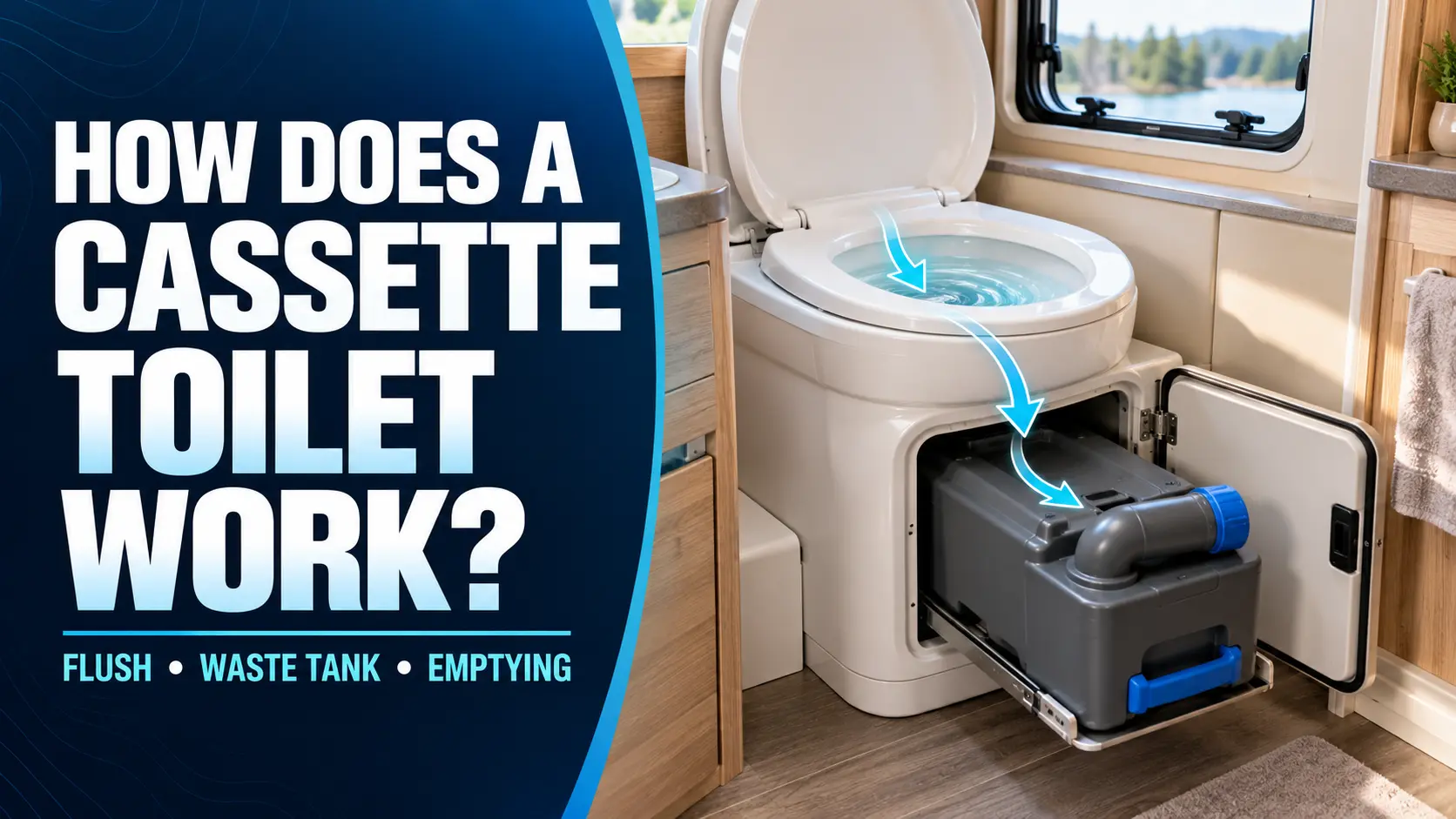
A cassette toilet has a fixed bowl above a removable waste tank. Clean water rinses the bowl, and opening a sliding blade valve lets everything drop into the cassette. You empty it through the RV’s outside service door at an approved disposal point. Here’s how the system works and how to care for it.
How Does a Cassette Toilet Work? (5 Simple Steps)
Clean water rinses the bowl. Opening the blade valve lets the contents fall into the removable cassette; closing it seals the waste tank again. This is the basic mechanism, whether the flush water comes from a built-in reservoir or the RV’s freshwater system.
Here is the flow, labeled by model.
The clean flush water joins the waste inside the cassette.
- Water goes into the bowl On the Thetford C2 and C3, you press a flush button that runs an electric pump. On the C4, you twist a flush handle, which is manual. The C224-CW has a manual push button and an integrated 2.37 gallon tank. Manual models can flush with no power.
- Open the blade On the C2/C3/C4 you turn the blade handle, and on the C2 and C3 one knob combines the blade and flush control. Thetford says the toilet can be used with the blade open or closed.
- Waste and water drop into the cassette The toilet sits above the tank, so gravity does the work. The waste falls by gravity into the removable tank underneath.
- Close the blade after use Thetford says not to leave water standing in the bowl when the toilet is idle, because it does not reduce smell and only risks flooding.
- The vent lets air out It releases air so pressure does not build up in the tank.
Where Does the Flush Water Come From?
There are two main flush-water designs. The Thetford C2 and C4 have their own flush-water tanks, while the C3 uses the RV’s central supply. Thetford also confirms that the C402C has an integrated flush-water tank and the C403L connects to the central fresh-water tank. Check your model label before filling or troubleshooting.
Dometic’s manual notes that its “fill freshwater tank” indicator is not always connected when you use on-board tanks. That means on some setups the light may not tell you anything useful about your water.
Either way, the flush water is clean water. It goes through the bowl and into the cassette along with the waste. It is not a separate liquid that stays apart.
What Is a Cassette Toilet?
A cassette toilet is a permanently installed toilet whose waste drops into a removable holding tank, the cassette. You pull the cassette out through a service door on the outside of the vehicle and empty it by hand. There is no sewer hose or built-in dump valve.
So there are two parts: the fixed toilet and the removable tank. Thetford’s C2/C3/C4 instructions describes it this way, and Thetford’s cassette toilet page and the Dometic manuals match. You will most often see these toilets in camper vans, truck campers, and small trailers. Thetford sells US-market models such as the C224-CW.
Capacity varies by model. The C224-CW has a 4.7 gallon waste tank and a 2.37 gallon flush tank. The C2/C3/C4 waste tank is 20 litres, which is about 5.3 gallons. Do not assume your toilet matches either number.
What Are the Parts of a Cassette Toilet?
Most cassette toilets have a bowl with seat, a flush control, a blade valve with a rubber seal, the removable waste tank, a vent button, a pressure-release vent, a level indicator, and an outside service door. Many also have a separate flush-water tank. Exact parts vary by model.
A blade valve is a sliding gate between the bowl and the tank. The list below follows the Thetford C2/C3/C4 manual unless noted.
| Part | What it does | Source scope |
|---|---|---|
| Flush knob or handle | Starts the flush | Thetford C2/C3/C4 |
| Valve blade and valve seal | Opens and closes the opening between bowl and tank | Thetford C2/C3/C4 |
| Waste tank | Holds waste; has a safety catch and handle | Thetford C2/C3/C4 |
| Wheels and retractable handle | Makes the full tank easier to move | Thetford C224-CW |
| Rotating pour-out spout and cap | Lets you pour out waste; cap has a measuring cup | Thetford C2/C3/C4 |
| Vent plunger | Used for splash-free emptying | Thetford C2/C3/C4 |
| Automatic pressure release vent | Prevents pressure build-up in the tank when it is inserted | Thetford C2/C3/C4 |
| Waste level indicator | Shows how full the tank is | Thetford C2/C3/C4 |
| Leakage tray | Catches flush-water drips when the tank is out | Thetford C2 and C3 only |
| Sliding cover | Covers the tank opening; opens when the tank goes in | Thetford C2/C3/C4 |
| Service door | Gives outside access; lockable | Thetford C2/C3/C4 |
| Flush-water tank, filling funnel, drain pipe or sight glass | Holds clean flush water | C2 and C4 only |
On the Thetford C2/C3/C4, the level indicator starts to change at about 3/4 full. Dometic’s CT/CTS 4000 series uses indicator lights instead: “cassette tank full,” “3/4 full,” “fill freshwater tank,” and “cassette tank removed.” Dometic calls its sliding valve a slider. “Lip seal” is Thetford’s wording for the seal, so your manual may use a different term.
Where Does the Waste Go, and What Does the Additive Do?
Waste ends up in the cassette, a sealed tank with a vent. Manufacturers tell owners to put a sanitary additive in the cassette and rinse it after every empty.
Think of two tanks doing two jobs.
| Flush-water tank | Waste cassette | |
|---|---|---|
| What it holds | Clean water for flushing | Everything you flush |
| Where it goes | Into the bowl | Emptied at an approved point |
Here is what the manufacturers say about the additive.
- Thetford C2/C3/C4: Pour the stated amount of toilet fluid into the waste tank through the pour-out spout, then add about 2 litres (about half a gallon) of water to cover the bottom. Never add it through the blade valve or the bowl.
- Dometic CT/CTS 4050 and 4110: Add sanitary additive into the cassette through the drain pipe and follow the additive’s directions. Dometic also says to use fast-dissolving toilet paper because ordinary paper can clog. See our note on RV toilet paper if you want to compare options.
- What it does: Thetford says additives break down waste and control odor. Its maintenance guide says they liquefy waste and reduce gas build-up.
Some blogs list “no special chemicals” as a perk of cassette toilets. The manufacturers say otherwise, so follow the manufacturer’s instruction. Follow the manufacturer’s additive guidance to help control odor and keep the cassette easier to empty.
Use the amount on the additive label, adjusted for your cassette size.
Household cleaners such as bleach, solvents, vinegar, and limescale removers can damage seals and plastic. Use only cleaners your manual names. If your disposal point is a septic system, Thetford says to use a septic-safe additive.
What Does Day-to-Day Use Look Like?
Fill the flush tank if your model has one, charge the cassette with additive and a little water, use the toilet, and watch the level indicator. Empty before it reads full, rinse the cassette, and recharge it. Every few days is typical, and the indicator is your real signal.
The daily loop is simple: charge, use, check the indicator, empty, rinse, recharge. Keep the blade closed when the toilet is not in use.
- The indicator: On the C2/C3/C4 it only starts to change at about 3/4 full, and Thetford says to empty by the time it is fully red at the latest. Empty earlier than that.
- How often: Thetford’s care guide points to two to three days with active use or warm weather. Our own emptying page notes that figures for this vary. So think “every few days” and let the indicator decide.
- Driving: Thetford says not to travel with water in the bowl or with a flush tank more than half full. For the C400 bench model, Thetford US advises not traveling with water in the flush tank.
- Weight: You carry the tank by its handles, and the C224-CW tank has wheels and a retractable handle. A full 5-gallon cassette can be heavy, so use the built-in wheels or handles where provided.
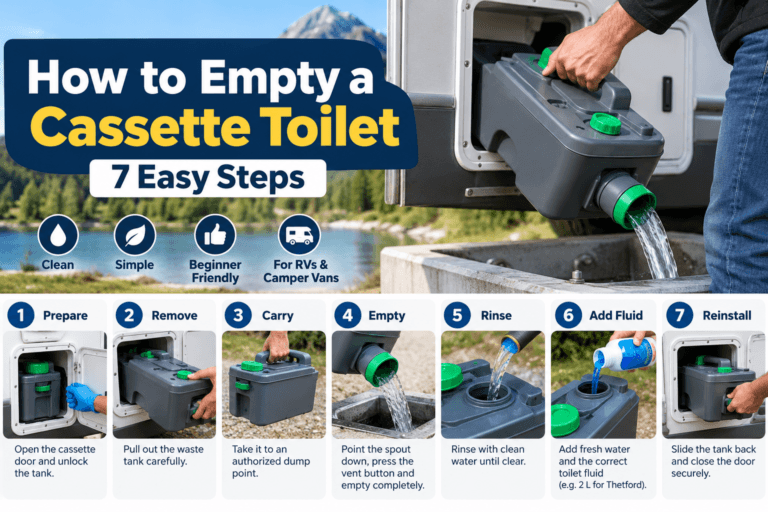
Emptying in brief: close the blade first, carry the tank by its handles to an approved disposal point, and when you pour, point the spout down before you press the vent button. Rinse it, and never force the tank back in. The full steps are in our guide to emptying a cassette toilet.
Safety
- Wear waterproof gloves when handling waste, keep your hands away from your face, and wash with soap and water afterward. Empty only at an approved disposal point. Local rules vary, so check the emptying guide.
How Is a Cassette Toilet Different From a Black-Tank Toilet and a Portable Potty?
A cassette toilet is fixed in place with a removable tank you carry out. A black-tank toilet is fixed and drains into a tank under the floor, which you empty through a sewer hose. A portable potty is a freestanding two-part unit you can lift and move.
| Cassette toilet | Black-tank toilet | Portable potty | |
|---|---|---|---|
| Installed? | Permanently installed | Fixed | Free-standing, no installation or water/power connection |
| Waste storage | Removable tank, accessed from outside | Sealed tank under the RV | Lower tank of the unit |
| How it is emptied | Pull the tank, empty by hand at an approved point | Sewer hose at a dump station | Separate the halves, pour through the spout |
| Flush water | Own tank or vehicle water | RV fresh water line, via pedal | Upper tank of the unit |
| Move the RV to empty? | No | Usually: the RV’s sewer outlet must be within hose reach of a dump inlet | No (inference) |
| Sourced tank size | 4.7 gal (C224-CW) or 20 L (C2/C3/C4) | Varies by RV | 21 L waste, 15 L flush (Porta Potti 365) |
The Porta Potti figure is from Thetford’s Australian page for that model only.
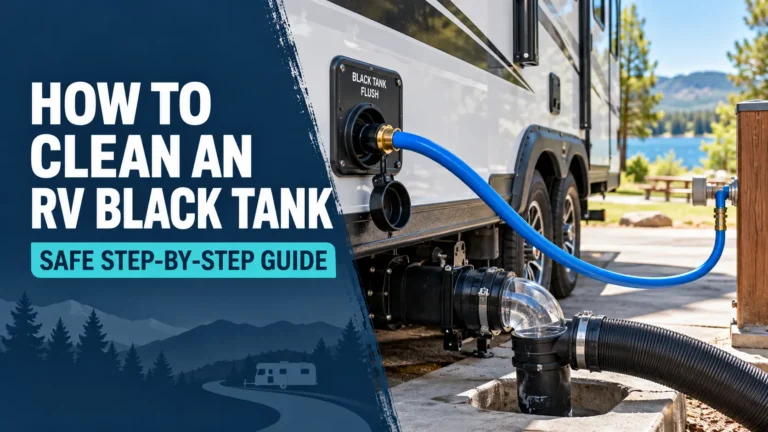
On mechanics, a black-tank toilet typically uses a pedal. On some models, pressing the pedal partly adds water and pressing fully opens the valve. Controls vary by toilet. A vent stack lets gases out of the tank. A cassette uses a sealed, vented removable tank instead. See our pages on the black tank flush system and dumping a black tank for that side.
Some web pages call portable potties “cassette toilets.” Thetford sells them as separate lines: a fixed cassette toilet and a Porta Potti. Here, “cassette toilet” means the installed type. A portable potty can look similar, since its waste tank also has a pour-out spout and vent button, but the unit itself is not installed. If a portable potty is what you want, see our page on portable camping potties.
What Are the Pros and Cons of a Cassette Toilet?
Pros:
- No sewer hose, and no need to move the RV to empty it.
- Its compact design can suit camper vans and smaller RVs.
- Manual models can flush without power.
Cons:
- A small tank means frequent emptying.
- You carry or roll the cassette to a disposal point.
- The blade seal wears and is the main suspect for odor and leaks.
- You need a disposal point, and US dump-site rules differ by place.
Odor can become noticeable if the cassette is overdue for emptying or the seal needs cleaning. Plan on regular tank handling.
The simple rule: a cassette suits a small rig where you are fine carrying a small tank.
What Can Go Wrong, and When Should You Stop?
Most problems trace back to the seal, the seating of the tank, or the blade. These are the causes the manuals support.
| Symptom | Likely cause | What to check |
|---|---|---|
| Tank will not come out | Blade partly open | Check the blade, then loosen the spout cap |
| Tank will not slide back in | Misaligned or obstructed | Stop and do not force it |
| Leak or damp around the cassette | Tank not seated, or worn seal | Reseat the tank and check the lip seal |
| Odor with the blade shut | Worn or dirty lip seal, scale, heavy heat and use | Clean and inspect the seal |
| Stiff blade | Dirty or dry seal | Clean it and lubricate as your manual says |
| Weak flush or no water | Low flush tank, or no power on powered models | Check the water level and power supply |
On lubricant, the Thetford C2/C3/C4 manual says olive oil only and warns that vaseline and other vegetable oils can cause leaks. Dometic’s manual names a different product, so give no universal recommendation and use the one your manual names. Our toilet seal lubrication guide explains the model-specific differences.
For odor beyond cassette toilets, see our page on a toilet that smells when flushed for black-tank odors and general causes.
Stop and get help
- Do not force the tank in or out. If the blade is stuck and the tank still will not release after you check the blade position and loosen the spout cap, stop and contact a service center. If a leak continues after you reseat the tank and check the lip seal, stop using the toilet and consult your manual or a Thetford or Dometic service center. On a powered model, if you see a blown fuse, smell burning, or lose the indicator lights, disconnect power and call a qualified technician. A cracked tank or a visibly torn seal means replacing the part, since Thetford calls the blade seal a wear item.
Safety
- On Dometic models, closing the slider during cleaning or greasing is a crushing risk, so keep your hands clear.
Frequently Asked Questions
Can you put toilet paper in a cassette toilet?
Yes. Choose fast-dissolving paper approved for your toilet where recommended, use modest amounts, and never flush wipes. For details, see our RV toilet paper comparison.
Can you use a cassette toilet without chemicals?
Some people avoid conventional chemicals, but many toilet manufacturers recommend a compatible waste-tank additive to limit odors and make emptying easier. Follow your model’s care guide, empty frequently, and never mix household cleaners in the cassette.
Does a cassette toilet need an RV black tank?
No. The removable cassette itself stores the waste, and you empty it at an approved disposal facility rather than using a fixed black tank and sewer hose.
Conclusion
Three things to remember:
- A cassette toilet has a fixed bowl over a removable waste tank. Clean flush water begins in its own supply, but mixes with waste after flushing.
- Follow your own model’s manual for additive, lubricant, and level signals.
- Close the blade, empty before the tank is full, and never force the tank.
Your next step is to find your toilet’s model number and manual, then read our guide to emptying a cassette toilet. If you would rather avoid carrying a waste tank, see how composting toilets work, which is another toilet type to consider, not a recommendation.