The SeeLevel II tank monitor swaps factory probe sensors for external strips that read levels through the tank wall, avoiding the direct fouling that causes most false full readings. Accuracy can still be affected by installation, tank shape, grounding, and nearby metal. At publication, Garnet lists a 709-BTP7 system with three senders at about $265, before extra senders or installation, and SeeLevel works only on compatible plastic or poly tanks. For RVs with accessible tanks and a genuine false-reading problem, it’s a strong upgrade. For a simply dirty sensor, cleaning is cheaper.
You dumped the black tank. You watched the elbow run clear. The panel still says full.
If that sounds familiar, you’ve probably already seen SeeLevel come up as the fix. It’s the most recommended tank monitor upgrade in the RV world, and for good reason. But it isn’t free, it isn’t a five-minute install, and it isn’t the right move for everyone with a stuck gauge.
This SeeLevel RV tank monitor review breaks down how the system works, how accurate it really is, and what installation involves. It also covers which current model fits which RV, and who should try a cheaper fix first.
SeeLevel RV Tank Monitor Review Quick Verdict
A worthwhile upgrade for RVers with a genuine, persistent false-reading problem and reasonably accessible tanks. Not a fix for a simply dirty sensor.
Boondockers and full-timers who need trustworthy percentage readings and have plastic tanks they can reach.
Cleaning already fixes your readings, your tanks are metal, or your tank bay has very tight clearance around the tanks.
External sensors never touch tank contents, so they avoid the direct probe-fouling mechanism that ruins factory readings.
Cost, plus accuracy that still depends on correct sender placement, tank shape, grounding, and staying clear of nearby metal. It isn’t a stick-it-on-and-forget-it fix.
How We Researched This Review
RVFlushGuide has not personally tested or installed the SeeLevel system. This review is based on current Garnet Instruments manuals and specifications, current pricing, installation documentation, and independent long-term owner reports. Where manufacturer claims and owner experiences differ, we point that out.
What Does the SeeLevel Tank Monitor Actually Do?
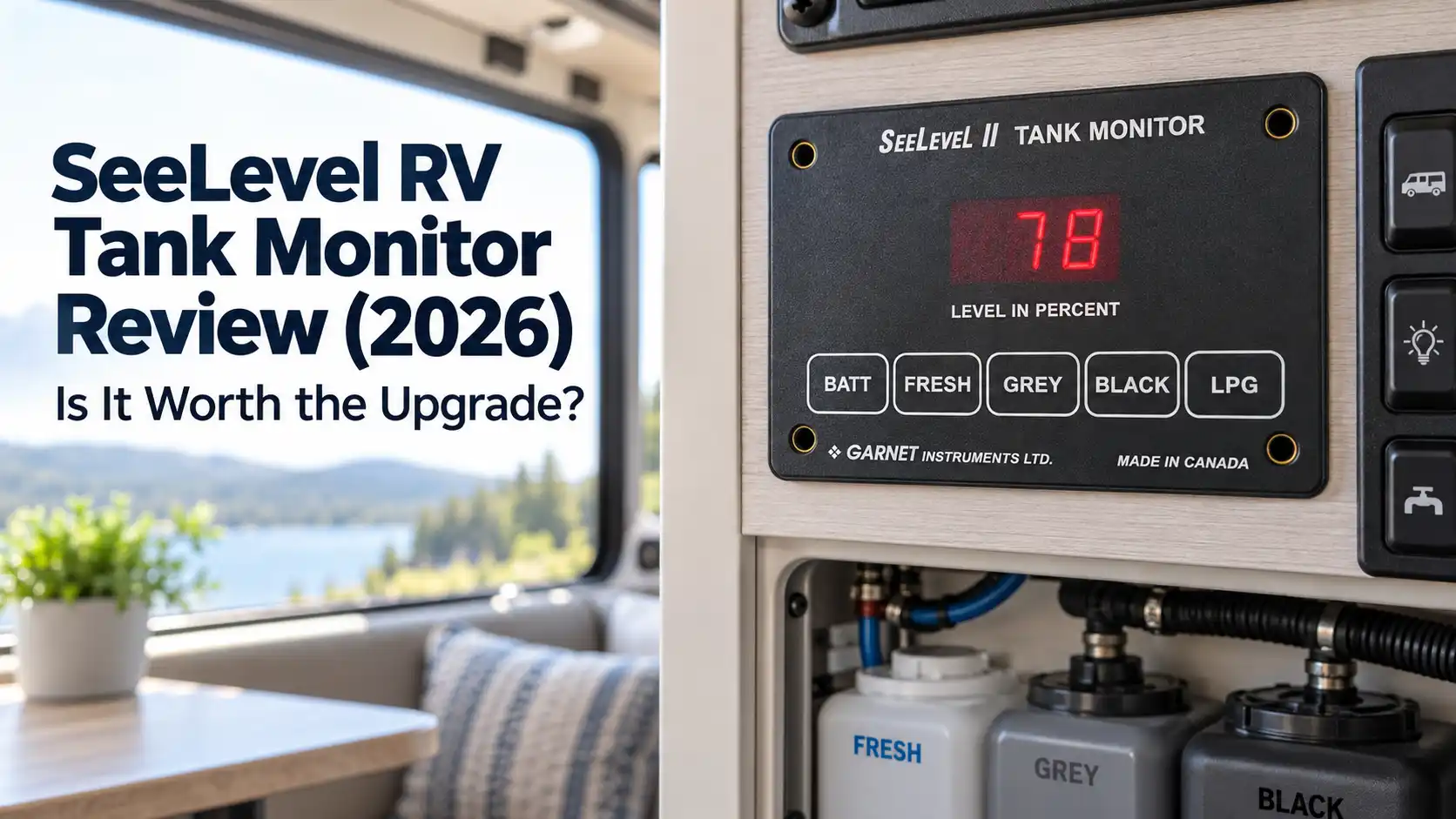
SeeLevel replaces your factory tank gauge with a display panel and a set of flexible sender strips. The strips stick to the outside of each tank and read the liquid level through the tank wall itself.
If you’re unfamiliar with holding-tank basics, this guide explains how the RV gray water tank works and why its capacity matters
Garnet Instruments, the Canadian company that makes SeeLevel, calls this external sensing technology. Instead of metal probes poking into the tank at fixed heights, a SeeLevel sender is a thin, self-adhesive circuit board mounted on the tank’s exterior. It reads the fluid level in small increments along its length and reports a percentage, from 0 to 100, on a digital display or a phone app.
That’s the core difference from a factory setup: continuous percentage readings instead of a handful of dummy lights for empty, one-third, two-thirds, and full.
Why Does SeeLevel Read Differently Than Factory Tank Sensors?
SeeLevel’s external senders avoid the direct probe-fouling mechanism that causes most factory sensors to fail. They never touch the tank’s contents, so waste, paper, and sludge can’t physically coat them the way those materials coat an internal probe.
Most factory tank gauges use probe sensors: short metal studs that go through the tank wall and sit inside the tank itself. When waste, toilet paper, or sludge coats those probes, the circuit can stay closed even after you dump, and the panel reads full when the tank is empty. It’s one of the most common complaints in RV ownership. RVFlushGuide’s own troubleshooting guide walks through exactly why that happens, and how to try fixing it before spending money on new hardware.
That removes the single biggest cause of false full readings. It does not make the system immune to every accuracy problem, though. Installation quality, tank shape, sender placement, grounding, and metal near the sensor can all still affect what the display shows. A tank that genuinely didn’t drain will still read high, and that’s a different problem entirely, one RVFlushGuide’s guide to a black tank that won’t drain covers separately. SeeLevel changes the failure mode. It doesn’t eliminate every possible reading error.
How Accurate Is SeeLevel in Real-World Use?
Garnet’s own installation and specification manual lists SeeLevel accuracy at plus or minus 8 percent or better, limited by the sender’s resolution and the tank’s height and shape. Some retailers advertise tighter figures, such as eighth-inch accuracy or 1 percent increments. Garnet’s own manual is the more conservative and authoritative number, and it’s worth knowing both figures exist so a marketing claim doesn’t set the wrong expectation.
Resolution also varies by sender size. The smallest sender reads in roughly quarter-inch increments, the mid-size sender in roughly three-eighths of an inch, and the tallest sender in roughly half-inch increments, according to Garnet’s published specifications. A shorter, better-matched sender on a shallow tank generally gives a more useful reading than a tall sender trimmed way down.
Independent, real-world reports back up the general accuracy claim, with some nuance. One full-time RV couple published a one-year review in January 2026. Their SeeLevel II 709-BTP7 readings matched actual tank levels closely. The readings hadn’t drifted or needed recalibration after a full year of regular dumping and boondocking.
Another long-time reviewer’s multi-year account tells a more mixed story. Fresh water and one grey tank stayed accurate for years. But the black tank and a galley grey tank became inaccurate again over time, and needed repeated deep cleaning to stay reliable. Both accounts describe genuine, disclosed owner experience rather than manufacturer marketing, and both are worth weighing.
For a closer look at what a SeeLevel install and first read looks like in practice, this video from Love Your RV & Boat! walks through an owner’s hands-on installation and initial review of the SeeLevel II system:
That video covers the original external-sensor design, which hasn’t fundamentally changed. It predates the current Bluetooth-enabled 709-BTP7 model, though. Treat it as a look at the sensing technology and the installation process, not a review of today’s flagship display.
One more factor is worth knowing before you install. A built-in black tank flush system helps keep a factory probe sensor cleaner for longer. It won’t rescue a sensor that’s already fouled, though. And it has no effect on SeeLevel senders either way, since they never contact the tank’s contents in the first place.
Which SeeLevel II Model Should You Buy?
Garnet sells the SeeLevel II line under the 709 Series name. The model you need depends mostly on how many tanks you have, and whether you want Bluetooth, an RV-C network connection, or a pump switch built into the panel.
| Model | Tanks | Bluetooth | RV-C | LPG | Pump Control | Best For |
|---|---|---|---|---|---|---|
| 709 (Base) | 3 | No | No | Via existing sender | No | Simplest, lowest-cost upgrade path |
| 709-P3W | 3 | No | No | Via existing sender | Yes | Owners who also want a pump switch on the panel |
| 709-RVC PM | 3 | No | Yes (RV-C/CAN bus) | Via existing sender | Yes | RVs with an existing RV-C multiplex system |
709-BTP7
Recommended | Up to 7 2 fresh, 3 grey, 2 black | Yes | No | Via existing sender | Yes | Current flagship; phone monitoring, most tank capacity |
The 709-BTP7 is Garnet’s current flagship, released in late 2024. It’s the model most owners land on today, and the only one in this table with Bluetooth. Its SeeLeveL RV 2.0 app lets you check every tank and battery voltage from a phone. It also sets high and low alarms, and shows diagnostic detail for each sender.
If your RV has a dedicated galley or kitchen-sink tank in addition to fresh, grey, and black, the current 709-BTP7 is the better fit because it can monitor up to seven holding tanks, including up to three grey tanks. Garnet has placed the older 709-4 and 709-4P models under End of Life status, with the 709-BTP7 listed as the suggested replacement for the 709-4P. For RVs already running a Victron Cerbo GX or an NMEA 2000 network, the 709-N2K model integrates directly.
SeeLevel systems use matching sender strips in a few sizes to fit different tank heights. Some system bundles include senders, while display-only listings do not. Check the current SeeLevel 709-BTP7 price and configuration at Garnet Instruments. Prices can change, and additional senders or installation can raise the total cost.
What SeeLevel Installation Actually Involves
Installation breaks into three jobs: finding a usable flat spot on each tank, mounting the sender strips, and wiring everything back to the display.
Tank access is the real variable. Some RVs have an open underbelly where every tank is easy to reach. Others have a fully enclosed, coroplast-wrapped underbelly, and owners regularly report having to drop panels just to see the tank walls. This is the single biggest factor in how long the job takes, and it’s worth checking before you buy.
Metal clearance is a real, specific requirement, not a rough guideline. Garnet’s current sender installation manual sets two separate distances. Metal must stay at least 1 inch away from the sides, top, and bottom of the sender. And it must stay at least 2 inches away from the flat face, the side that presses against the tank wall. A steel cross-brace, a frame rail, or a metal shroud closer than that can throw off the reading, since the sensor reads through the tank wall electrically. Owners with tight, metal-framed tank bays have had to hunt for an alternate mounting side, or call Garnet’s support line to confirm a marginal clearance will still work.
The adhesive is largely a one-shot install. SeeLevel senders use a strong 3M adhesive backing. Garnet’s own documentation and independent owners both recommend the same approach: tape a sender in place first, confirm it reads correctly, then peel the backing and press it on for good.
Wiring reuse is common but not guaranteed. SeeLevel senders connect over a simple 2-wire bus. Many owners successfully splice into the wiring already run to their factory sensors. One current owner’s January 2026 install account specifically noted reusing the original tank sensor wiring as a real bonus. Other owners have needed to pull new wire when the existing harness didn’t work with the new system.
Plan on filling and draining each tank at least once during setup, since senders need water in the tank to confirm they’re reading correctly before you commit to the adhesive.
Pros
- External senders never touch tank contents, removing the probe-fouling cause behind most false full readings
- Continuous percentage readout (0 to 100 percent) instead of four vague lights
- Sender strips can be trimmed or stacked to fit a wide range of tank heights
- The 709-BTP7’s Bluetooth app lets you check every tank from a phone, without walking outside
- Often reuses existing sensor wiring, which can shorten the install
- Per-sender diagnostic information can flag a failing or disconnected sender before it causes a bad reading
Cons
- Not compatible with metal holding tanks at all , per Garnet’s own FAQ page
- Requires at least 1 inch of clearance from metal on the sides and top/bottom of the sender, and 2 inches from the face, which is a hard constraint in some tank bays
- Adhesive mounting gives you one realistic shot at final placement
- At the time of this review, Garnet lists the 709-BTP7 system with three senders at about $265 . Extra senders or installation can raise the total, and prices can change
- Long-term accuracy isn’t guaranteed to hold on every tank; at least one multi-year owner account reports drift on specific tanks over time
- Bluetooth availability and firmware have had gaps in the past , based on owner forum reports, and the app’s in-app configuration has been described as clunky on earlier hardware revisions
Consider SeeLevel if:
- You’ve already tried cleaning your factory sensor and the false readings keep coming back
- You boondock or dry camp regularly and need to trust your gray and black tank levels without guessing
- Your tank bay gives you real access to a clean, flat mounting surface at least 2 inches from any metal
- Your tanks are compatible plastic or poly tanks, not metal
- You want phone-based monitoring and are willing to pay for the 709-BTP7’s Bluetooth features
Consider skipping it, at least for now, if:
- You haven’t tried cleaning the sensor yet. A dedicated black tank sensor cleaner costs a fraction of a SeeLevel kit and may restore accurate readings when residue buildup is causing the false-full problem.
- Your holding tanks are metal. SeeLevel senders simply won’t work.
- Your tank bay is tightly framed in metal with no clearance to meet the 1-inch and 2-inch spacing Garnet specifies.
- You rarely leave full-hookup sites and don’t actually need precise percentage readings day to day.
Final Verdict: Is the SeeLevel Tank Monitor Worth the Upgrade?
For an RV with accessible, plastic holding tanks and a genuine, persistent false-reading problem, SeeLevel is one of the more reliable upgrades available. The current 709-BTP7 is the pick most owners should start with. It solves the specific failure mode that ruins factory sensors: internal fouling.
It’s not a universal fix. Cost, tank access, metal clearance, and sender placement all matter, and real-world accuracy still depends on getting those details right rather than the technology alone. If a dirty sensor is your actual problem, try cleaning it first. If the false readings keep coming back after a genuine cleaning attempt, SeeLevel is the upgrade worth making.
Frequently Asked Questions
Are SeeLevel tank sensors accurate?
Garnet’s own installation and specification documentation lists SeeLevel accuracy at plus or minus 8 percent or better, limited by the sender’s resolution and the tank’s height and shape. That’s a manufacturer figure, not an independent lab test, and it’s more conservative than some retailer marketing claims of eighth-inch accuracy. Real-world owner reports generally back up strong accuracy, though at least one long-term account describes some tanks drifting inaccurate again after several years of use.
Does SeeLevel work on black tanks?
Often, yes. SeeLevel senders connect over a simple 2-wire bus, and many owners successfully splice into the wiring already run to their factory sensors. Wiring layouts vary by RV, though, and some owners have needed to run new wire when the existing harness didn’t reach a workable path or used a different number of conductors.
Can SeeLevel use existing RV wiring?
No. Garnet Instruments states plainly on its own FAQ page that SeeLevel senders are not compatible with metal holding tanks. They’re designed for plastic or polyethylene tanks up to about three-eighths of an inch thick.
Is the SeeLevel tank monitor worth the money?
For an RV with accessible plastic tanks and a real, persistent false-reading problem, most independent owner accounts and this review’s own buying framework point toward yes. If the tank just needs a cleaning, that’s a far cheaper fix to try first.