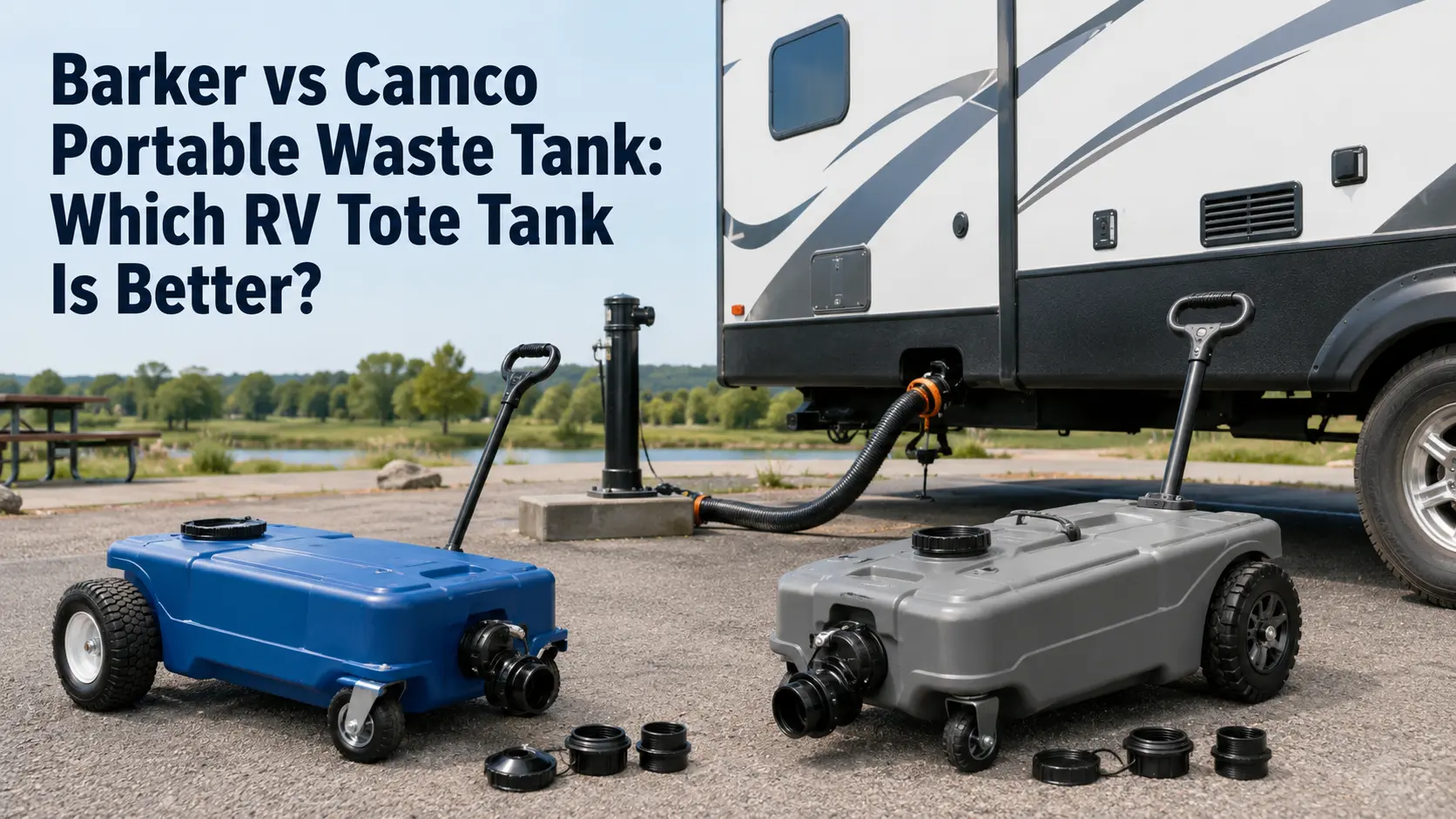
Camco’s Rhino Tote Tank line (15 to 36 gallons) includes no-flat wheels on every size, a built-in rinse fitting across the whole line, and a gate valve on the 28 and 36-gallon models. Barker’s 4-Wheel Tote-Along line (16 to 42 gallons) puts a 3-inch side gate valve on every size and adds pneumatic tires on the 25, 32, and 42-gallon models. For many RV setups with holding tanks up to 36 gallons, the Rhino 36 is the easier all-around choice. Barker’s 42-gallon model gives you more capacity than the current Rhino line offers, at the cost of more bulk and weight.
Standing at a dump station wondering whether your tote tank is big enough, or whether it’s going to survive another season of towing, is a familiar moment for RV owners without full hookups. The Barker vs Camco portable waste tank decision is a common one, since these brands appear frequently in RV tote-tank comparisons and buying guides.
Neither brand sells just one tank. Barker’s 4-Wheel Tote-Along line runs from 16 to 42 gallons, and Camco’s Rhino Tote Tank line runs from 15 to 36 gallons, each with different wheels, valves, and accessories depending on the size you pick. This guide breaks down the real differences between current models so you can pick the tank that actually fits how and where you dump.
Barker vs Camco Portable Waste Tank: Quick Verdict
For most RV owners, the Camco Rhino 36-gallon tote tank is the easier all-around choice. It has no-flat wheels, a built-in rinse fitting, and a gate valve, so there’s less to maintain and nothing to keep aired up. Barker’s 4-Wheel Tote-Along line is worth choosing instead if you need more than 36 gallons of capacity or you tow over rough, uneven ground on a regular basis.
Neither tank is a bad purchase. Both brands have long-running owner discussions and reviews, and the two lines overlap enough in price and features that the decision usually comes down to two or three specific factors: how much capacity you actually need, what kind of ground you’re rolling the tank over, and whether you’d rather deal with air pressure or a no-flat wheel design instead.
Which Barker and Camco Models Are We Comparing?
This comparison covers Barker’s current 4-Wheel Tote-Along line and Camco’s current Rhino Tote Tank line, since these are the two four-wheel options most shoppers are actually choosing between. Don’t assume every size in either lineup shares the same features.
Barker’s own product page lists four capacities: 16, 25, 32, and 42 gallons. Only the 25, 32, and 42-gallon models come with pneumatic tires. The 16-gallon model uses a smaller, hard rubber wheel setup instead. Every size in the 4-Wheel line includes a 3-inch side gate valve, so you don’t have to lift any of them to empty.
Camco’s Rhino line runs 15, 21, 28, and 36 gallons, and it splits differently than Barker’s. According to a copy of Camco’s owner manual for the 15 and 21-gallon models, archived on ManualsLib, those two sizes use a low drain hole design rather than a gate valve. The diagram in a copy of Camco’s manual for the 28 and 36-gallon steerable models shows a labeled gate valve, and Camco’s own 28-gallon and 36-gallon product pages describe the same gate valve on the standard (non-steerable) versions too. Camco also sells the 28 and 36-gallon Rhino with an optional steerable front-wheel upgrade, which adds two 6-inch steerable no-flat wheels ahead of the standard rear wheels.
The takeaway: a “Barker” or a “Camco” isn’t one product. Match the specific size and version you’re comparing, not just the brand name.
Barker vs Camco Specifications at a Glance
Camco’s Rhino 36-gallon and Barker’s 4-Wheel 32-gallon land closest in overall size, but the full lineups spread out quite a bit in capacity, weight, and included hardware. The tables below break down each brand’s current sizes.
As an Amazon Associate, we may earn from qualifying purchases.
Dimensions and wheel details come from Barker’s 4-Wheel Tote-Along product page, which lists the tanks with the handle removed and front wheels turned 90 degrees for shipping. Barker’s own site doesn’t publish empty tank weight, so treat any weight figure for these tanks as a retailer estimate or owner report rather than a manufacturer spec.
| Capacity | Dimensions (Approx.) | Published Weight | Valve |
|---|---|---|---|
| 15 gal | 32.25″ × 20.5″ × 13″ | 33 lb | Low drain hole, no gate valve |
| 21 gal | 40.63″ × 20.25″ × 12.81″ | 35 lb | Low drain hole, no gate valve |
| 28 gal | 44″ × 24″ × 14.5″ | 44 lb (53 lb steerable) | 3″ gate valve |
| 36 gal | 44.875″ × 24.125″ × 14.75″ | 46 lb | 3″ gate valve |
Note: Camco labels these figures as published or shipping weights on current product listings. Actual empty tank weight may be slightly lower depending on the model and included accessories.
As an Amazon Associate, we may earn from qualifying purchases.
Weight and dimensions come from Camco’s own product pages for the 15-gallon, 21-gallon, 28-gallon, and 36-gallon Rhino models, which label this figure “Shipping Weight,” not empty tank weight. Shipping weight typically includes the box and accessory kit, so the bare tank likely weighs somewhat less. Don’t treat this as a confirmed empty weight. Amazon and Walmart list slightly different numbers for the same tanks (31.5 lb for the 15-gallon, 43 lb for the standard 28-gallon, 45 lb for the standard 36-gallon), a small conflict worth knowing about rather than one to quietly paper over. The 28-gallon steerable version weighs more due to its added front-wheel assembly, per its Amazon listing.
Which Tank Has Better Capacity Options?
Barker offers a 42-gallon model, while the current Camco Rhino line tops out at 36 gallons. If you’re matching a tote tank to a large black or gray tank, or you want fewer trips to the dump station during a long boondocking stretch, Barker’s larger sizes give you more room to work with.
That extra capacity is not free. A bigger tank means more weight to tow, more bulk to store, and a longer, heavier pull every time it’s full. For RVs with roughly 30 to 36-gallon holding tanks, a Barker 32 or Rhino 36 can often handle a typical dump in one trip. A 40-gallon holding tank may require transferring before the tank is completely full or making a second trip, since a 36-gallon tote can’t hold a full 40 gallons on its own.
The 42-gallon Barker mainly makes sense if your RV’s black or gray tank is unusually large, or if you deliberately want to combine gray and black water into one dump run without doing it twice. If your real problem is moving waste over a longer distance rather than carrying more of it, our Flojet RV Macerator Pump Review covers a powered alternative that may fit that setup better.
How Much Does a Full Tote Tank Actually Weigh?
A tote tank’s gallon rating only tells part of the story. Total loaded weight equals liquid weight plus the tank’s own weight, and that liquid weight adds up fast. One US gallon of water weighs about 8.34 pounds. Treat that figure as a planning approximation, not an exact number for RV waste specifically. Black and gray water carry solids and other material, so their density isn’t necessarily identical to pure water, even though it’s close enough for estimating how heavy a load you’re about to tow.
Here’s what the liquid alone weighs at common capacities:
| Capacity | Liquid Weight (approx.) |
|---|---|
| 15 to 16 gallon | 125 to 133 lb |
| 21 gallon | 175 lb |
| 25 gallon | 209 lb |
| 28 gallon | 234 lb |
| 32 gallon | 267 lb |
| 36 gallon | 300 lb |
| 42 gallon | 350 lb |
The tank itself adds more weight on top of the liquid. At 36 gallons, the liquid alone weighs about 300 pounds, and Camco’s published weight for that tank is 46 pounds, though that figure is labeled shipping weight rather than confirmed empty weight, so treat the true combined total as somewhere in that neighborhood rather than an exact number. Barker doesn’t publish an empty weight for the 42-gallon model at all. A few owners have informally estimated it at around 40 pounds empty, which is anecdotal rather than a manufacturer figure. Either way, a full 36 to 42-gallon tote lands well past 300 pounds total, a serious pull for a small tow vehicle, a golf cart, or your own arms if the ground doesn’t allow towing.
Pneumatic Tires vs No-Flat Wheels: Which Rolls Better?
Barker’s pneumatic tires generally roll smoother over gravel, dirt, and uneven campground surfaces because air-filled tires absorb bumps that a solid wheel transmits straight into the tank and handle. This advantage only applies to Barker’s 25, 32, and 42-gallon models, since the 16-gallon size uses hard rubber wheels instead.
Camco’s no-flat wheels trade that smoother ride for zero maintenance. There’s no air pressure to check and no risk of a flat leaving a loaded tank stuck at the dump station. Camco’s 28 and 36-gallon Rhino models can also be upgraded with a two-wheel steerable front kit, which trades some rough-ground smoothness for easier turning in tight spots like a crowded dump station lane.
Neither setup is wrong. If you mostly roll a loaded tank across paved or gravel dump station lanes, no-flat wheels are one less thing to think about. If you’re regularly crossing rutted dirt roads or boondocking sites, Barker’s pneumatic tires on the 25, 32, and 42-gallon models absorb more of that punishment before it reaches the tank body.
Which Is Easier to Dump and Clean?
Every current Barker 4-Wheel size dumps through the same 3-inch side gate valve, so you never have to lift or tip a full Barker tote to empty it, regardless of size. Camco only puts a gate valve on the 28 and 36-gallon Rhino models, confirmed both in a copy of Camco’s owner manual and on Camco’s own 28-gallon and 36-gallon product pages. The 15 and 21-gallon Rhino tanks use a low drain hole design instead, which still empties without a full lift but works a bit differently than a side valve.
At the dump station itself, both brands connect through a short included hose to the same 4-in-1 style inlet adapter that a standard RV sewer hose uses. If that included hose is too short for your setup, any standard 3-inch sewer hose extension works as a substitute.
Cleaning is close to a wash between the brands. Copies of Camco’s manuals for both the 15/21-gallon and 28/36-gallon Rhino models, archived on ManualsLib, show a built-in flusher with a backflow preventer at a dedicated water hose rinse connection. Camco’s own product pages for all four current sizes describe the same “integrated tank rinser” feature, so this checks out as a genuine feature across the line rather than marketing language for just one size. Barker’s tanks include a top-mounted garden hose fitting that serves as both a vent while filling and a flush port for rinsing after a dump, per Barker’s own product page. Both approaches get the job done. Neither is a true internal spray nozzle system like the aftermarket rinsers made for built-in RV black tanks, covered in our guide to the RV black tank flush system.
Barker 32 vs Camco Rhino 36: Closest Large-Tank Comparison
These are two of the closest large-capacity options to compare because their capacities, dimensions, and intended use overlap. Both represent the largest size many owners actually need before jumping up to Barker’s 42-gallon model.
Barker 32 vs Camco Rhino 36
The two tanks are very close in length and width (Barker’s 32-gallon measures 45″ x 24″, Camco’s 36-gallon measures about 44.9″ x 24.1″), but the Barker 32 has a lower profile at 11.5 inches tall against the Rhino’s roughly 14.75 inches, while the Rhino 36 adds four gallons of capacity. The Barker 32 carries pneumatic tires as a standard feature at this size. The Rhino 36 brings a gate valve and a built-in flusher, matching the Barker’s own gate valve and flush port feature for feature. Filled weight runs close between the two once you factor in liquid weight, with the Rhino 36 carrying slightly more due to its larger capacity. For many owners choosing between these two, the decision comes down to wheels: no-flat convenience with the Rhino, or a smoother ride over rough ground with the Barker.
Barker 42 vs Camco Rhino 36
The Barker 42 gives you a real capacity advantage, six gallons more than the Rhino 36 offers, which matters if your RV’s holding tanks run larger than average. That capacity comes with a real cost. A full Barker 42 weighs more, takes up more space in storage, and demands more from whatever’s towing it. Bigger is not automatically better here. If your holding tanks are in the 30 to 36-gallon range, the extra Barker capacity mostly sits unused on a normal trip, adding bulk without adding value. Owners with 40-gallon-plus tanks, or those who want to combine gray and black water into a single dump run, are the ones who actually benefit from stepping up to the 42.
Owner-Reported Problems: What to Watch For
Manufacturer specs describe how these tanks are designed to work. They don’t always match what shows up after months or years of real use, so it’s worth separating confirmed specs from what owners report on forums.
A small number of Camco Rhino owners, across a handful of RV forum threads, describe cracking near the fill neck or tank seams after extended use, along with wheels that came loose from their axles on some earlier tanks. One RV forum thread notes that Camco addressed the wheel-mounting issue around 2021, with tanks built after that date reportedly not showing the same problem. This is a handful of posts from a handful of owners, not a controlled study, and it doesn’t establish how common cracking or wheel failure actually is across the full range of Rhino tanks sold.
Camco’s own 36-gallon product page also shows two customer reviews reporting cracks near the fill-neck area. That’s worth noting, but two reviews are far too few to estimate how common the problem is across all Rhino tanks sold.
Barker owners report a different set of issues on a similarly small scale. In one iRV2 forum thread, an owner describes the tow handle coming off the hitch ball during a pull, and other threads mention early wheel-axle assemblies that some owners reinforced themselves as a precaution. Again, these are individual reports rather than a measured failure rate, and Barker owners in the same threads also report a decade or more of trouble-free use from the same tank line.
Take both sets of reports as things to watch for, not confirmed defects. Inspect wheels, valves, and hitch connections before each trip regardless of which brand you buy.
Which Tank Should You Buy?
If you want the lowest-maintenance option and your holding tanks are 36 gallons or smaller, the Camco Rhino 36 is the easier choice. No air pressure to manage, a confirmed gate valve, and a built-in flusher cover most owners’ needs without any extra parts to buy.
Choose a Barker 4-Wheel Tote-Along instead if you need more than 36 gallons of capacity, you frequently tow over gravel or rutted dirt, or you specifically want a gate valve on every size rather than just the two largest. Barker’s pneumatic tires on the 25, 32, and 42-gallon models can absorb bumps better on rough or uneven ground, while Camco’s no-flat wheels remove tire-pressure and puncture concerns entirely.
Still comparing options beyond Barker and Camco? Our guide to the best portable RV waste tanks also covers Thetford and smaller-capacity options for different camping setups.
Either way, a tote tank solves a different problem than a macerator pump does. A tote tank moves waste when your RV sewer hose won’t reach a dump connection at all. A macerator pump solves a different problem, an uphill or long-distance connection your RV is already parked next to. If your situation is more about distance and elevation than access, our comparison of an RV macerator pump vs sewer hose walks through when a pump earns its cost instead.
If a pump sounds like the better fit, our roundup of the best RV macerator pump options compares several portable and built-in models side by side.
Frequently Asked Questions
Is Barker better than Camco?
Neither brand is better in every situation. Camco’s Rhino line is easier to maintain thanks to no-flat wheels and a gate valve on its two largest sizes, while Barker’s 4-Wheel line offers more capacity at the top end and pneumatic tires on three of its four sizes. The better choice depends on your capacity needs and the terrain you’re towing over.
What size portable waste tank should I get?
Match the tote tank’s capacity to your RV’s largest holding tank, or slightly larger if you want to empty gray and black water in one trip. RVs with roughly 30 to 36-gallon tanks do well with a 32 to 36-gallon tote. Owners with 40-gallon-plus holding tanks, or those who boondock for extended stretches, may prefer Barker’s 42-gallon option, or should plan on a second trip with a smaller tote.
Can you tow a portable RV waste tank?
Yes, both Barker and Camco 4-wheel models include a tow handle designed to hook onto a hitch ball, letting you pull the loaded tank behind a vehicle or golf cart at low speed. Always check that the handle is fully seated on the ball before pulling away, since a handful of owners report it coming loose during transport.
Do Camco Rhino tanks have gate valves on every size?
No. According to copies of Camco’s owner manuals and Camco’s own product pages, only the 28 and 36-gallon Rhino models include a gate valve. The 15 and 21-gallon models use a low drain hole design instead, which does not require lifting the tank but works differently than a side valve.
Do Barker tote tanks have pneumatic tires on every size?
No. Per Barker’s own product page, the current 25, 32, and 42-gallon 4-Wheel Tote-Along models use pneumatic wheels. The 16-gallon model uses a hard rubber wheel setup instead.