Most guides tell you to flush your gray tank with bleach the moment it smells like rotten eggs. That’s the wrong first step.
If the smell mainly appears after connecting at a full-hookup campsite, compare it with the sewer-hookup odor guide before assuming the gray tank itself is the source.
The rotten egg smell in your RV can come from at least six different sources — and the gray tank is only one of them. If you treat the wrong source, the smell comes back within days.
If the odor seems centered on the toilet rather than the sink or shower, use the RV toilet odor hub to separate black-tank, seal, vent, and hookup causes.
If you’re new to RV plumbing, our guide to how an RV gray water tank works explains what it collects and how the system operates.
This guide helps you confirm where the smell is actually coming from before you do anything else. Then it walks you through the right fix for each source, in the right order.
(Searching for “grey water tank smells like rotten eggs”? Same tank, different spelling — this guide covers both.)
TL;DR
The rotten egg smell in your RV is caused by hydrogen sulfide gas. It most commonly comes from bacteria in a dirty gray water tank, a dried-out P-trap, a failed air admittance valve (AAV), a blocked roof vent, a dirty drain line, or a corroded water heater anode rod.
Before treating your gray tank, spend 2 minutes running through the diagnosis table below. It will tell you exactly which source to fix first.
Quick Diagnosis: Where Is the Smell Coming From?
Use this table before doing anything else.
| Symptom You Notice | Most Likely Source |
|---|---|
| Smell only appears when running hot water | Water heater anode rod |
| Smell is strongest inside the cabinet under the sink | Failed AAV (air admittance valve) |
| RV sat unused for 1–3 weeks, then started smelling | Dry P-trap |
| Smell comes from kitchen sink only, not shower | Drain line buildup or galley gray tank |
| Smell from all drains, all the time | Blocked roof vent stack |
| Smell only outside, near the sewer connection | Gray tank gas escaping at the valve |
| Smell exists even with fresh, clean water running | Campground water supply has sulfur |
| General smell inside the RV from all drains, gray tank has been full and warm | Gray tank bacterial buildup |
Start with the row that best matches your situation. Jump to that section below.
Why Does It Smell Like Rotten Eggs?
The short version: hydrogen sulfide gas (H₂S) — the same compound responsible for the smell of swamps, sewers, and rotten organic matter.
When bacteria break down organic material — food particles, grease, soap scum, hair, body oils — they produce H₂S as a byproduct. That gas smells exactly like rotten eggs. It’s the same gas that makes swamps and sewers smell bad.
In an RV gray tank, the conditions are perfect for this: warm temperatures, no oxygen, organic waste sitting in a small enclosed space. The longer the gray tank sits without being dumped or treated, the more H₂S builds up.
The tricky part is that the same gas can come from several different places in your RV’s plumbing system — not just the tank itself.
The 6 Real Causes — and How to Identify Each One
1. Bacterial Buildup in the Gray Tank
This is the most common cause — but only after you’ve ruled out the others.
The gray tank collects everything that goes down your kitchen and bathroom sinks and shower drain. That means food particles, cooking grease, soap scum, hair, and body oils. Over time, a layer of biofilm builds up on the tank walls. Bacteria in that film produce hydrogen sulfide, especially in warm weather.
The galley (kitchen) side of the gray tank is almost always the worst offender. Cooking grease coats the tank walls and acts as a long-term food source for anaerobic bacteria.
You’ll recognize this cause if: The smell comes from multiple drains, gets worse as the tank gets fuller, and is strongest in warm weather or after a few days of cooking.
If the smell seems to be coming from the toilet bowl itself rather than your sinks or shower, that’s a separate issue — see why your RV toilet smells when flushed.
2. Dry P-Trap
A P-trap is the curved section of pipe directly under every sink and shower drain. It holds a small amount of water that acts as a physical barrier between your living space and the gray tank. That water seal blocks tank gases from rising up through the drain.
When an RV sits unused — even for just one to two weeks — that water evaporates. The seal disappears. Tank gas rises straight through the drain and into your cabin.
This is extremely common and extremely easy to fix.
You’ll recognize this cause if: The smell appeared after the RV sat parked and unused. It’s often strongest right after you walk in for the first time, and it may improve after you’ve run water for a day.
The fix: Run water down every sink and shower drain for 30–60 seconds. That refills the P-trap and restores the seal. If the smell drops significantly within an hour, a dry P-trap was the problem.
3. Failed Air Admittance Valve (AAV)
This is the cause that most articles don’t mention — and it’s more common than people think.
An air admittance valve is a small, mushroom-shaped valve typically found under the kitchen sink. Its job is to let air into the drain system when water rushes down (this prevents suction and gurgling), and then close tightly to block tank gases from coming back in.
When an AAV fails, it either sticks open — letting gray tank gas vent directly under your sink cabinet — or sticks closed, which prevents proper airflow and causes slow drains and smell to back up through the drain itself.
RV AAVs fail more frequently than household ones because of constant vibration, temperature swings, and inferior components used by some manufacturers.
You’ll recognize a stuck-open AAV if: The smell is strongest when you open the cabinet under the sink, not when you run water or stand near the drain.
You’ll recognize a stuck-closed AAV if: The smell comes directly out of the drain, the sink drains slowly, and you sometimes hear gurgling. This is the same venting issue that causes RV toilet bubbles when flushed — a blocked air path forces gas the wrong direction.
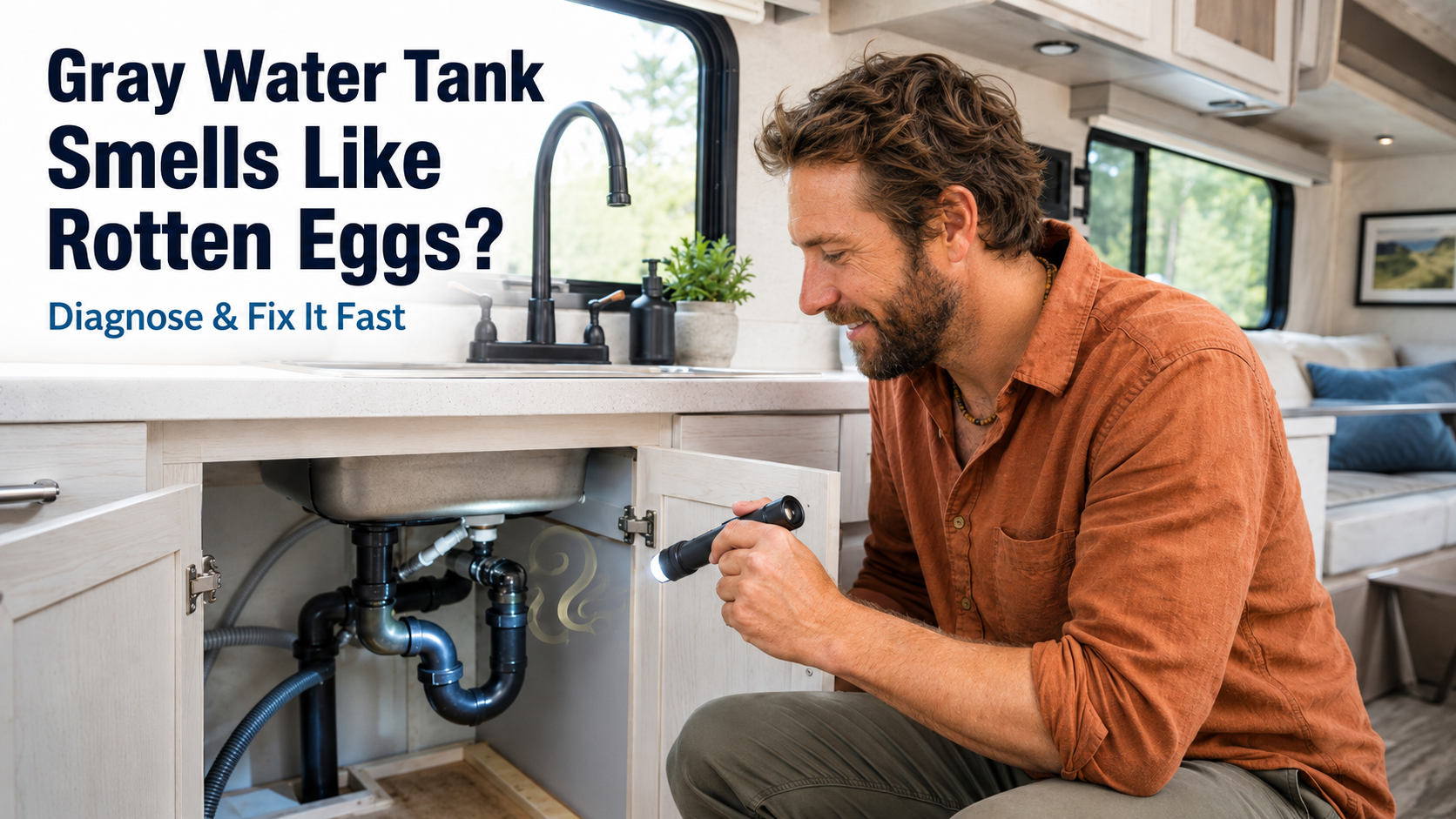
The fix: Open the sink cabinet and locate the AAV — it looks like a small black or white cap on a short pipe. Pull it off and check if it’s cracked, warped, or stuck. A replacement AAV (the Studor Mini-Vent is a reliable option) costs around $10–$20 at any hardware store and takes only a few minutes to install.
4. Blocked Roof Vent Stack
Your RV has a vent pipe that runs from the gray tank up through the roof. Its job is to let gases escape outside rather than building up in the tank and backing into the cabin.
If that vent gets blocked — by a dead leaf, a bird nest, a piece of debris, or ice in winter — gases have nowhere to go up and out. They take the next available path: back down through your drains.
You’ll recognize this cause if: You smell rotten eggs from multiple drains at once, the smell is constant rather than intermittent, and it doesn’t improve much after you refill the P-traps. The same blockage affects the black tank too — the full symptom list is covered in RV black tank vent clogged symptoms.
The fix: Get on the roof and locate the gray tank vent pipe (usually a short white pipe near the rear of the RV). Look down inside it with a flashlight. Clear any blockage with a garden hose from the top or a flexible plumber’s auger. Some RV owners add a vent cap with a screen to prevent future blockages.
5. Dirty Drain Lines
The drain lines themselves — the pipes between your sink or shower and the tank — can develop a layer of biofilm over time. Hair, soap, and grease build up inside the pipe wall. That buildup harbors bacteria and produces H₂S independently of what’s in the tank.
This means you can have a clean gray tank and still smell rotten eggs from a sink or shower.
You’ll recognize this cause if: The smell comes from one specific drain, not all drains. Often, the shower, because hair and soap scum accumulate there faster.
The fix: Pour a full bottle of an enzyme-based drain treatment directly down the problem drain. Let it sit overnight before running water. Do this monthly if drain smell is recurring. Do not use standard Drano-style chemical drain cleaners in RVs — they can damage RV-specific pipe fittings and seals.
6. Water Heater Anode Rod (Commonly Confused for Gray Tank Smell)
If the rotten egg smell only appears when you run hot water — from any faucet — the gray tank is not your problem at all.
Most RV water heaters have a magnesium anode rod that protects the tank from corrosion. When that rod reacts with sulfur-containing minerals in the water supply, it produces hydrogen sulfide. The smell comes out of your hot water lines, not your drains.
This is one of the most common misdiagnoses in RV plumbing.
You’ll recognize this cause if: The smell is only present with hot water running. Turn on cold water only — no smell. Turn on hot water — smell returns immediately.
The fix: Drain the water heater and replace the magnesium anode rod with an aluminum/zinc combination rod. Do not remove the anode rod entirely unless your water heater manual specifically allows it — on most models, the anode rod protects the tank from corrosion and removing it can shorten the water heater’s life significantly. Check your manual before making that call.
What You May Need
Depending on which source you identify, you may need one or more of the following:
What You May Need
Sink strainer — prevents food from entering the drain
Enzyme-based gray tank treatment — breaks down organic waste in the tank
Enzyme drain cleaner — for treating individual drain lines
Replacement AAV (air admittance valve) — if the valve under your sink has failed
Flashlight — for inspecting the roof vent and under-sink plumbing
Flexible drain brush — for scrubbing inside drain lines
Water heater anode rod (aluminum/zinc) — only if hot water is the source of the smell
You may not need all of these. Work through the step-by-step fix order below and only buy what your diagnosis points to.
Step-by-Step Fix Order
Work through these steps in order. Stop when the smell is gone.
Step 1: Refill all P-traps. Run water down every sink and shower drain for 60 seconds each. Wait one hour. If smell drops significantly, you found the cause. You’re done.
Step 2: Inspect the AAV under the kitchen sink. Open the cabinet, find the valve, and check for cracks or stuck position. Replace if damaged. Takes 10 minutes.
Step 3: Check the roof vent for blockages. Do this from the roof with a flashlight. Clear any obstruction. Run water from the top with a garden hose if needed.
Step 4: Treat the drain lines. If one specific drain is the problem, use an enzyme drain cleaner overnight.
Step 5: Flush and treat the gray tank. Only after ruling out steps 1–4. Use the method described in the next section.
Step 6: Check the water heater anode rod. Only if the smell is present with hot water running. Replace the rod, not the whole heater.
Do not skip to Step 5 if you haven’t run through Steps 1–4 first. Treating the gray tank when the real cause is a dry P-trap or a bad AAV wastes time and money.
How to Clean the Gray Tank (When the Tank Is the Problem)
Once you’ve confirmed the gray tank is the source, here’s how to clean it properly.
Don’t use bleach. Bleach can degrade rubber seals, kill beneficial bacteria in enzyme-based treatment systems, and the smell of bleach mixing with sulfur compounds can make things temporarily worse.
Use an enzyme-based treatment instead. Enzyme treatments break down the organic material — grease, soap, food particles — that bacteria feed on. No food source means the bacteria can’t produce H₂S.
Gray tank cleaning method:
- Dump the gray tank completely at a dump station.
- Add 2–4 gallons of fresh water to the empty tank.
- Add one dose of enzyme-based RV tank treatment. Follow the product label for dosage.
- Let it sit for 12–24 hours if possible (or drive to your next stop — movement helps slosh the water against the tank walls).
- Dump again at your next dump station.
- Repeat the treatment dose with fresh water after each dump until the smell is gone.
Should You Leave the Gray Tank Valve Open at Full Hookups?
No — and this is one of the most common gray tank mistakes.
When you leave the gray valve open all the time, wastewater drains continuously instead of collecting. The tank never fills enough to flush itself clean when dumped. Grease and residue dry onto the tank walls, biofilm builds up faster, and odor gets worse over time — not better.
Keep the gray valve closed. Let the tank fill to about half or two-thirds, then dump. The volume of water rushing out in one go helps push residue off the walls and toward the drain.
Dump order: Always dump black tank first, then gray tank. The gray water rinses the sewer hose. If smell returns right after a dump, read RV toilet smell after dumping — the cause is usually residue in the tank or hose, not a new problem.
For a cleaner dump every time, using an RV black tank flush system rinses the black tank thoroughly before you open the gray valve.
Why Your Gray Tank Smells Worse After Dumping
Dumping empties the tank — it does not clean it.
After you open the valve and drain, a film of grease, soap scum, food residue, and biofilm stays behind on the tank walls and floor. That film still contains active bacteria. As soon as the tank warms up again, those bacteria keep producing hydrogen sulfide — even with almost nothing in the tank.
This is why the smell can seem stronger right after dumping, or return quickly after a treatment that appeared to work.
The fix is to flush, not just drain. After dumping, add 2–4 gallons of fresh water plus an enzyme treatment before you move on. The sloshing motion during travel helps the water scrub the walls. Dump again at your next stop. Repeat until the tank stops smelling between dumps.
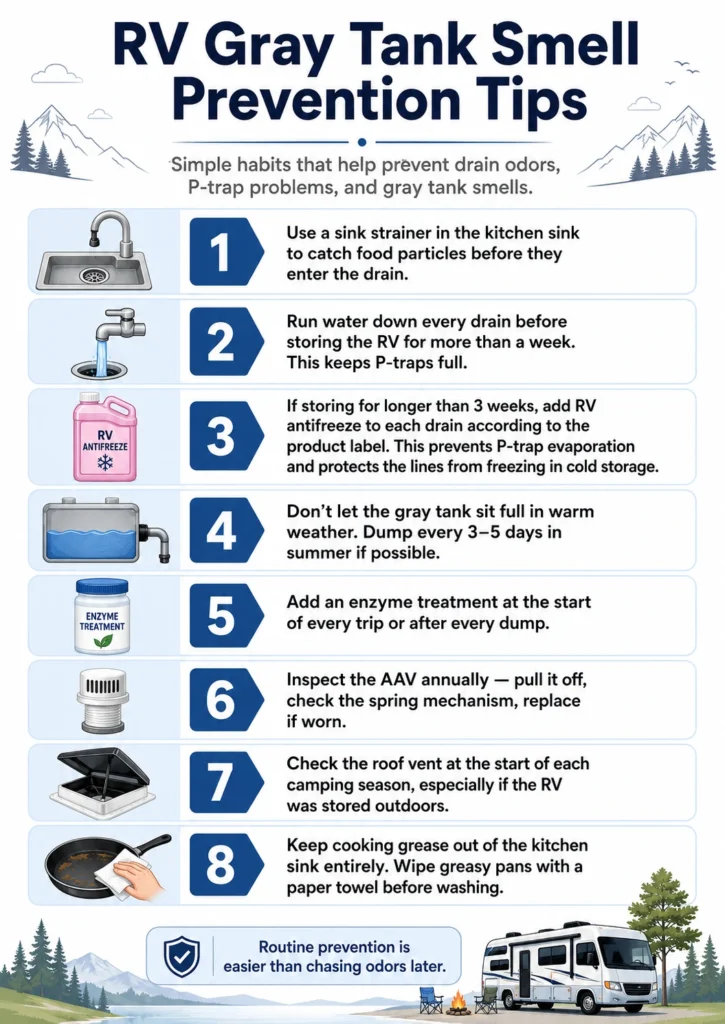
How to Prevent the Rotten Egg Smell From Coming Back
These habits take less than 5 minutes and prevent the smell from returning.
Is the Rotten Egg Smell in Your RV Dangerous?
A faint rotten egg odor that clears after ventilating is usually a maintenance issue — a dry P-trap, a neglected gray tank, or a failing AAV. Unpleasant, but not an emergency.
A strong, persistent smell is a different matter and should be taken seriously.
- If the smell is strong enough to notice throughout the RV, open all windows and doors immediately and ventilate before doing anything else.
- If you feel a headache, dizziness, or nausea, leave the RV right away and stay outside until you’ve identified and fixed the source.
- Do not sleep inside the RV until you’ve confirmed where the smell is coming from and addressed it.
- Do not confuse rotten egg smell with propane. Propane has a skunk-like, mercaptan odor. If you suspect a propane leak, leave immediately, don’t operate any switches, and call for service.
A rotten-egg smell alone cannot identify the gas or establish whether the air is safe. Understanding gas exposure symptoms can help you recognize when to leave the RV and seek help.
Once you fix the source and ventilate, the smell clears quickly. The goal is to find and fix it — not to ignore it.
Frequently Asked Questions
Is “grey water tank” and “gray water tank” the same thing?
Yes — same tank, two spellings. American English uses “gray,” British English uses “grey.” Both refer to wastewater from sinks and showers (not the toilet).
Why does my gray tank smell worse in summer?
Bacteria multiply much faster in heat. A gray tank that smells fine in spring can develop a strong odor in just 2–3 days during a hot summer. Dump more frequently in warm weather and use enzyme treatment on every trip.
My RV smells like rotten eggs, but the smell isn’t coming from the drains. What else could it be?
Check the water heater anode rod — especially if the smell only appears with hot water running. Also, check your campground water supply. Some well water sources have natural sulfur content that smells before it even reaches your tank.
Should I leave my gray tank valve open when I’m at a full-hookup site?
No. Leaving the valve open permanently dries out the tank, which concentrates waste and bacteria on the tank walls and causes worse odor long-term. Keep it closed, let it fill, then dump.
Can I use regular Drano or drain cleaner in my RV?
No. Standard chemical drain cleaners can damage RV-specific plumbing fittings, seals, and drain components. Use only enzyme-based treatments designed for RV use.
How often should I treat my gray tank?
Add an enzyme treatment dose after every dump, or at a minimum every 2 weeks during active use. In summer, treat more frequently if you’re cooking regularly.
My gray tank smells fine, but my shower drain smells like rotten eggs — why?
The shower drain line has its own biofilm buildup — hair, soap, and skin cells that sit in the pipe. Treat the shower drain directly with an enzyme drain cleaner. The tank itself may be fine.
I fixed the gray tank but the smell came back in two weeks. Why?
The most common reason is that the root cause wasn’t the tank. Go back to the diagnosis table at the top and work through steps 1–4 again, particularly the P-trap and AAV. A recurring smell that returns quickly usually points to a mechanical cause (dry P-trap, bad AAV) rather than the tank itself.
Why does my RV smell like rotten eggs only when I run the sink?
If the smell appears only at one specific sink, the problem is usually a dirty drain line, a dry P-trap under that sink, a failed AAV in that cabinet, or sulfur in the water supply coming through that faucet. It’s often not the gray tank at all. Check the P-trap first — run the water for 60 seconds and see if the smell fades. If not, inspect the AAV under that sink.
The Bottom Line
If your gray water tank smells like rotten eggs, don’t reach for bleach until you know what you’re actually dealing with.
Spend two minutes with the diagnosis table at the top of this guide. In most cases, the fix is a 5-minute job — refilling a dry P-trap or replacing a $15 AAV — not a major tank cleaning project.
When the gray tank truly is the source, enzyme treatment and better dumping habits will clear the smell and keep it gone. The key is dumping regularly, keeping the valve closed between dumps, and adding enzyme treatment every trip.