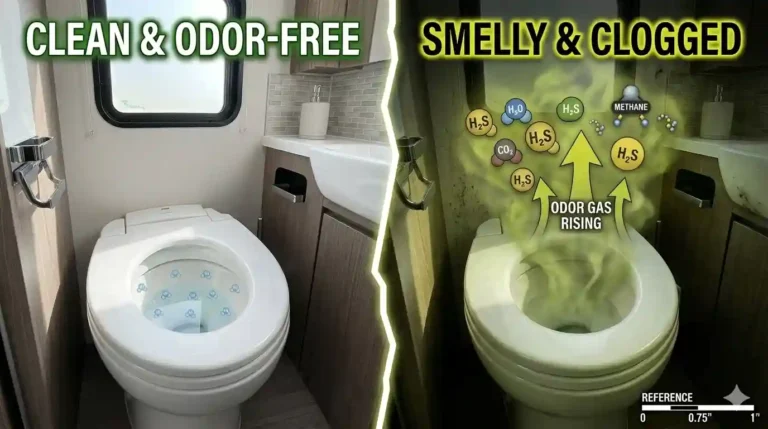
- If the smell started right when you hooked up, check your black tank valve first. It should stay closed at a sewer hookup, not open.
- Being connected doesn’t cause odor by itself. Gas needs an actual path in, like a dry P-trap, a stuck air admittance valve, or a bad hose seal.
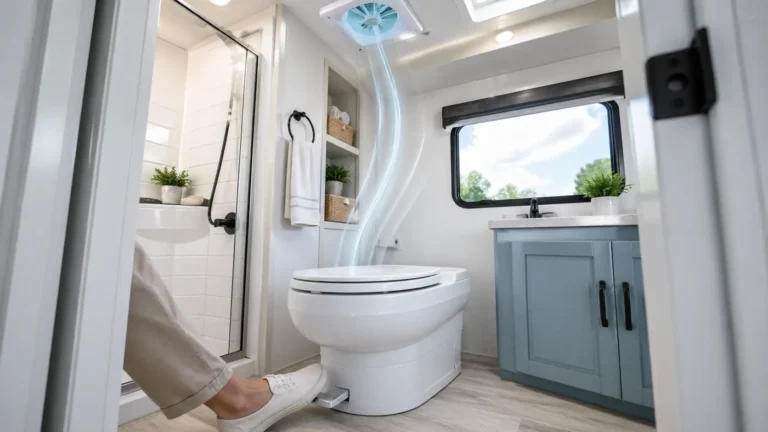
- Fans, range hoods, and wind can pull gas through that pathway, which is why the smell often comes and goes instead of staying constant.
- Fix the pathway instead of covering the smell with more chemical treatment.
Your RV didn’t smell like this while you were dry camping. Then you pulled into a full-hookup site, connected the sewer hose, and within a day or two the odor showed up. That timing matters, but it’s easy to draw the wrong conclusion from it.
Connecting to a sewer hookup doesn’t create odor by itself. Normally, your black tank, roof vent, and toilet seal work together to keep gas contained, with the vent channeling gas out through the roof and the toilet seal holding a water barrier at the bowl. Being connected adds one more line to that system, and it only becomes a problem when there’s an actual gap somewhere along it: an open valve, a dry trap, a worn seal, or a stuck air admittance valve. This guide walks through the causes tied specifically to that scenario, in the order you should check them.
Where Is the Smell Actually Coming From?
Smell near the toilet usually points to the black tank valve or the toilet’s own seal. Smell under a sink or in a cabinet points to a dry trap or a failing air admittance valve. Smell only outside, near the hose, points to a leak at the connection rather than anything inside.
Walk through the RV with the windows closed and note where the smell is strongest. If it’s tied to one specific area, skip ahead to that section below. If it seems to come from everywhere at once, start with the black tank valve, since that’s the single most common cause once you’re hooked up.
If your odor only happens when you flush the toilet, or only shows up after you dump, the cause is likely different from what’s covered here. See RV toilet smells when flushed or RV toilet smell after dumping instead.
Is Your Black Tank Valve Closed?
Check this first. If the black tank valve is open while you’re connected to sewer, liquids drain away immediately and solids stay behind on the tank walls, which causes both odor and eventual clogs. The valve should stay closed the entire time you’re hooked up.
Thetford’s own FAQ is direct about this: never leave the black tank valve open during use, even with a sewer hookup, because the liquid drains off and leaves a pyramid of solids behind that becomes a source of odor.
The fix is simple: close the valve and leave it closed until the tank is roughly two-thirds full, then dump. If solids have already built up from leaving it open, more than one closed cycle with added water may be needed to clear it. The buildup that results from this habit is covered in more detail below.
Left the Gray Tank Valve Open? Here’s What That Does (and Doesn’t) Cause
An open gray tank valve is a possible pathway for odor, not an automatic cause of it. On its own, it mostly leads to grease and residue drying inside an empty tank. For gas to actually reach the living space, a second failure point, like a dry trap or a worn AAV, is usually needed too.
For a clearer picture of how wastewater moves through the RV gray tank and its drain valve, see our gray water tank guide.
Thetford’s guidance allows leaving the gray tank valve open at a sewer hookup, though it notes the tank may need a rinse over time to clear grease and solids that build up along the walls. That buildup is a maintenance issue inside the tank itself, not a direct source of cabin odor.
The combination worth watching for is an open gray valve paired with a dry P-trap or a worn AAV at one of the sinks feeding that tank. Neither one alone is usually enough on its own, but together they give gas an unbroken path from the park’s line up through the fixture.
Dry P-Traps Under Your Sinks and Shower
Many RV sinks and showers use a P-trap that holds water to block sewer gas. Some RVs use a waterless trap such as a HepvO valve instead, so check which type your RV has before troubleshooting a dry trap.
Angi’s plumbing guide explains the mechanism: a P-trap holds water in its curved section specifically to block sewer gas, and once that water evaporates or leaks out, the gas has a clear path upward.
This dries out fastest on drains you don’t use often, like a guest bathroom sink or a shower you skip for a few days. Run a cup of water down each drain you haven’t used recently and see if the smell changes. It’s a fast, no-cost test, and it’s one of the more likely culprits if the odor is coming from under a specific sink rather than from the whole RV.
A Stuck or Worn Air Admittance Valve (AAV)
Many RVs use air admittance valves on sink drain lines. An AAV opens when draining creates negative pressure, then closes again to keep sewer gas from escaping into the living space. A worn or stuck AAV may fail to seal properly and let odor through.
Oatey, a plumbing manufacturer that makes these valves, explains the mechanism: the valve opens under negative pressure to equalize the line, then closes tightly to block sewer gas from entering the occupied space when the system isn’t in use.
Over time the internal sealing parts can wear out or stick, and once that happens the valve may stop sealing properly and let odor through. You’ll usually find these under the kitchen and bathroom sinks on the drain line. Inspect the valve for damage or poor sealing. If odor is strongest around the AAV and the valve is old or suspect, replacement is often a simpler diagnostic step than trying to repair the internal mechanism.
Why Fans, Range Hoods, and Wind Make It Worse Once You’re Hooked Up
If the smell seems to come and go rather than staying constant, this section probably explains why. A weak pathway, like a nearly-dry trap or a slightly worn AAV, might not leak enough gas to notice on its own. But running your bathroom fan or a vented range hood pulls air out of the RV, which drops the pressure inside and can pull gas through that weak point instead of letting it sit still. This is the same mechanism documented in home plumbing: exhaust fans create strong enough negative pressure to cause backdrafting through drain and vent systems, pulling gas in through whatever opening is available.
Wind can do something similar from the outside. Depending on the roof vent’s position and the wind direction, gusts can push down into a vent stack instead of letting gas escape upward, sending it back down toward whatever gap it can find, including a dry trap or a failing AAV. RV-specific write-ups describe the same pattern with bathroom fans and black tank vents: when the fan’s pull overcomes the vent’s normal airflow, gas gets drawn toward the fan instead of exhausted through the roof.
None of this creates odor by itself. It just means an existing weak pathway becomes noticeable under certain conditions and seems to disappear the rest of the time, which is why this symptom confuses so many owners.
Smell Only Outside, Near the Hose Connection?
If the odor is only noticeable outside near the hookup, inspect the hose seals and fittings first. A loose fitting, worn gasket, or connection that isn’t fully seated can let odor escape at the joint, but the smell may also be coming from the campground sewer inlet itself rather than your RV plumbing. Our dedicated guide on RV sewer hose leaking at connection walks through each of those connection points and how to reseal them.
Black Tank Buildup Made Worse by Hookup Habits
Leaving the black tank valve open, even briefly, encourages the kind of buildup that produces stronger odor over time, since solids that dry out stick to the tank walls instead of washing out. That buildup has fewer places to go if the roof vent is also partially blocked. DoItYourselfRV notes that a blocked vent pipe forces gas back up through the toilet instead of out through the roof, which compounds an odor problem that started with an open valve. For symptoms tied to buildup specifically, see RV black tank vent clogged and fixing a pyramid plug in a black tank rather than treating this as a separate problem.
How to Stop It From Coming Back
Once you’ve found and fixed the actual pathway, a few habits keep it from returning:
- Keep the black tank valve closed the entire time you’re hooked up, and only open it to dump.
- If you leave the gray valve open, rinse the tank periodically to clear grease and residue rather than assuming an open valve needs no maintenance.
- Run water through drains that haven’t been used for a while to maintain a water seal where a P-trap is used.
- Inspect the AAV if odor is strongest under a sink or cabinet, and replace it if it no longer seals properly.
- Inspect the hose connection at both ends before you walk away from setup, not just when you first notice a smell.
If you’re setting up a hookup from scratch, our guide on how to hook up a camper to sewer covers the correct valve sequence and hose slope from the start, which prevents several of these issues before they begin.
Most sewer odor that shows up right after connecting comes down to one of a handful of specific pathways, not the connection itself. Work through the checks in order, starting with the black tank valve, and you’ll usually find the source within a few minutes rather than needing to guess.
Frequently Asked Questions
Why does my RV only smell like sewer when it’s hooked up to a sewer connection?
Being connected gives gas a continuous line to travel through if a pathway already exists, such as an open valve, a dry trap, or a worn seal. Without an actual opening, the connection alone shouldn’t cause odor.
Should I leave my black tank valve open or closed when connected to sewer?
Closed. Thetford’s own guidance says never to leave the black tank valve open at a sewer hookup, since it drains liquid away and leaves solids behind that cause both odor and clogs.
Can leaving the gray tank valve open cause a sewer smell?
It can contribute to buildup inside the gray tank over time, but on its own it usually isn’t enough to bring odor into the RV. That typically requires a second failure point, like a dry P-trap or a worn air admittance valve, somewhere along the line.
Why does the smell come and go instead of staying constant?
A weak pathway, like a nearly-dry trap or a worn AAV, may only leak enough gas to notice when something else is pulling air through it, such as an exhaust fan, a range hood, or wind hitting the roof vent at the wrong angle.