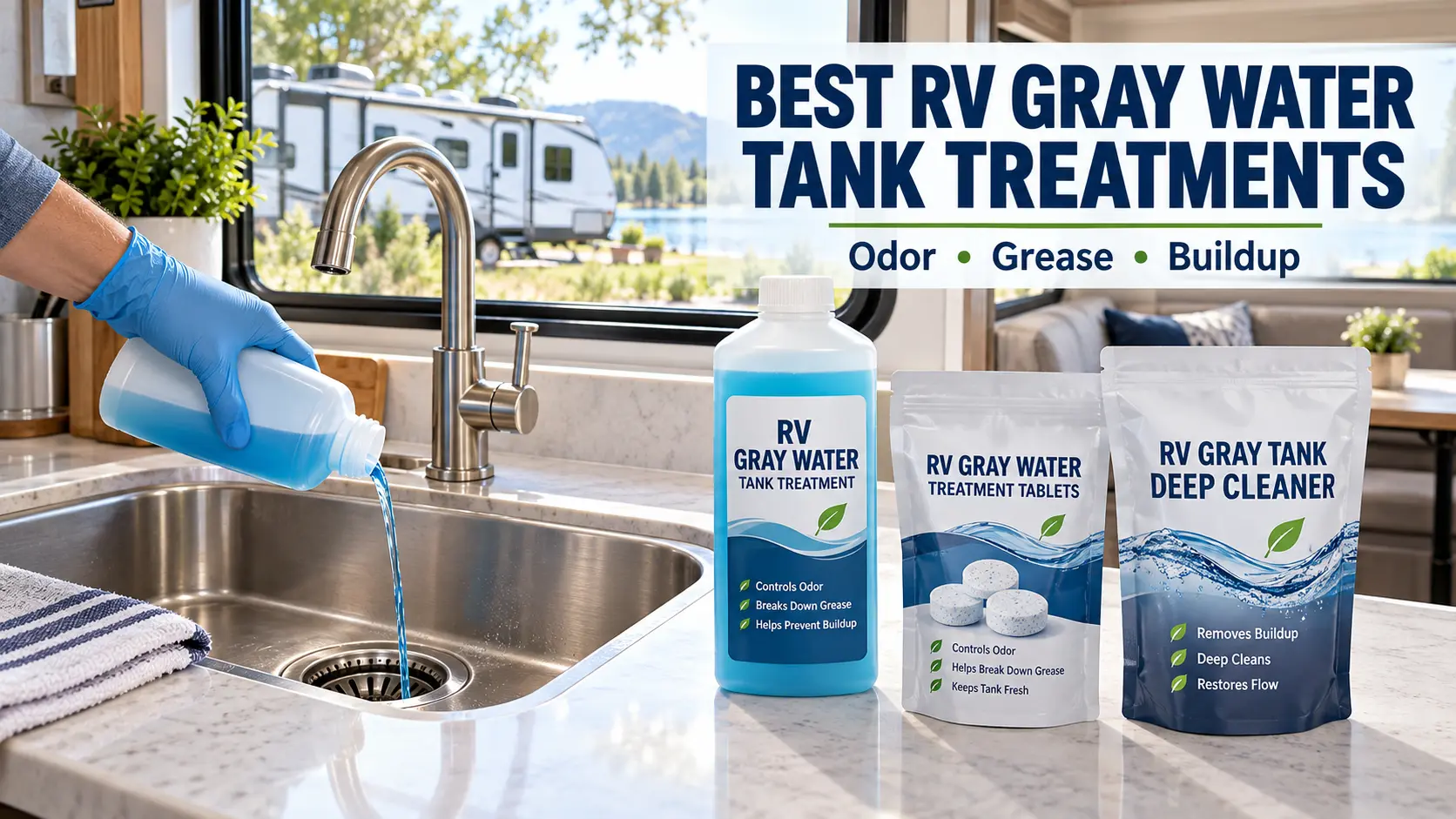
Four documented options for odor, grease, and buildup
Affiliate disclosure: RVFlushGuide.com participates in affiliate programs, including the Amazon Associates Program. If you buy through links on this page, we may earn a commission at no extra cost to you. As an Amazon Associate I earn from qualifying purchases. Read our full affiliate disclosure.
An RV gray water tank treatment can help control grease, soap film, and the odor they cause. It will not fix every gray tank smell. This guide compares four options by what the makers publish, and it shows when the real problem is a dry P-trap, a vent, or a valve habit instead.
We did not buy or test these products. We checked primary manufacturer instructions where available, distinguished retailer advice, and labeled our own reasoning. We found no independent lab or field test establishing which formula performs best.
- Best-documented routine treatment: Walex Elemonate. Walex publishes a dose, a use schedule, and a winterizing step. It is also the only tablet in this guide.
- Deep cleaner: Thetford Tank Blaster. Thetford says it is formulated for gray and black holding tanks and suggests quarterly use. Thetford does not publish a dose or tank-size limit on the pages we reviewed, so follow the pouch.
- Other routine liquids: Thetford’s official treatment FAQ includes Grey Water Odor Control at 8 oz per 40 gallons. A Camco product instruction sheet lists 4 oz per 40 gallons for item 40252. Confirm the directions on the bottle you purchase.
- You may not need a treatment if you take short trips, dump often, and smell nothing.
- If the smell is strong or keeps coming back, diagnose the plumbing first. Jump to when a treatment will not fix it.
Best RV Gray Water Tank Treatment Compared
| Product | Best for | Format | Verified dosing | Main limitation |
|---|---|---|---|---|
| Walex Elemonate | Routine use after each dump | Tablet or liquid | 1 tablet or 4 oz per up to 40 gallons (Walex) | No dose stated for larger tanks |
| Thetford Grey Water Odor Control | Routine odor and grease control | Liquid | 8 oz per 40 gal (Thetford FAQ); check current label | Bottle sizes and retailer advice vary |
| Camco TST Grey Water Odor Control | Routine odor control | Liquid | 4 oz per 40 gal (Camco 40252 instruction sheet) | Confirm directions for current formula |
| Thetford Tank Blaster | Periodic deep clean | Granule pouches | Single-dose pouch. Amount per tank size not published. | No dose or tank-size limit found |
- Best for
- Routine use after each dump
- Format
- Tablet or liquid
- Verified dosing
- 1 tablet or 4 oz per up to 40 gallons (Walex)
- Main limitation
- No dose stated for larger tanks
- Best for
- Routine odor and grease control
- Format
- Liquid
- Verified dosing
- 8 oz per 40 gal (Thetford FAQ); check current label
- Main limitation
- Bottle sizes and retailer advice vary
- Best for
- Routine odor control
- Format
- Liquid
- Verified dosing
- 4 oz per 40 gal (Camco 40252 instruction sheet)
- Main limitation
- Confirm directions for current formula
- Best for
- Periodic deep clean
- Format
- Granule pouches
- Verified dosing
- Single-dose pouch. Amount per tank size not published.
- Main limitation
- No dose or tank-size limit found
We list no prices because they change. Check the current price on Amazon.
Source key used in this guide: Maker means the manufacturer’s own page. Retailer means a store listing. Editorial means a news or blog article. Our reasoning means our own inference, not a source.
Reviews of the Best RV Gray Water Tank Treatments
Walex Elemonate
Best for: Owners who want the clearest published directions.
What it does: Elemonate is a lemon-scented drop-in treatment for the gray water system. Walex says its enzymes digest grease, organic sludge, and food particles that can lead to slow drainage and blockages. That describes prevention. The Walex page we reviewed does not say it clears an existing blockage.
Maker specs (Walex product page):
- Tablet: Drop it in a kitchen, bathroom, or shower drain and run water for a few seconds. One tablet treats up to a 40-gallon tank or any drain line with a P-trap.
- Liquid: Pour 4 oz into a drain. One dose treats up to a 40-gallon tank.
- When to use: After you empty the gray tank, or whenever a sink drain smells.
- Pre-storage cleaning: Walex says to use a tablet, run the faucet, wait 24 hours, and then empty the tank. This helps prepare for winter storage but is not antifreeze or freeze protection.
- Pack: 5 tablets per bag.
Maker claim, not independently verified: Walex says Elemonate “helps restore accuracy to gray tank level sensors” by dissolving residue that causes false readings.
Source conflict: Some retailer listings say one tablet treats 60 gallons. Walex says 40. We use the Walex figure.
Where it fits: Weekend trips and small to mid-size tanks, especially if you do not want to measure liquid.
- Dose, timing, and winterizing step come from the maker.
- Works as a drop-in through any drain.
- Walex does not say how to dose tanks over 40 gallons.
- The sensor benefit is a maker claim only.
Thetford Grey Water Odor Control
Best for: Owners who want a liquid from a major RV sanitation brand and will follow the bottle label.
What it does: Thetford says the product uses a strong surfactant package to remove oils and food particles that cause odor, plus a biologically based treatment and fragrance. It is sold for sink and shower drains, vents, and traps.
Maker specs (Thetford product page):
- Eliminates and prevents odors in gray water holding tanks.
- Dissolves cooking grease and cleaning residues.
- Contains no chlorine or solvents that could damage valve seals (maker claim).
- Called a 100% biodegradable formula (maker claim, not independently verified).
Manufacturer-supported dosage: Thetford’s official treatment FAQ explicitly includes Grey Water Odor Control in its recommended 8 oz per 40 gallons guidance. The product overview does not display this figure directly.
Some retailer listings describe smaller amounts or different bottle sizes. Because packaging and formulas can change, follow the directions printed on the current bottle if they differ from the website. Do not estimate a dose from the fraction of a bottle.
Where it fits: Routine treatment for owners who will read the label.
- Thetford explains what the formula is meant to do.
- Maker statement about valve seals.
- The manufacturer FAQ provides a general dose but the product overview does not repeat it.
- Bottle size and retailer advice vary, so verify current package directions.
Camco TST Grey Water Odor Control
Best for: Owners who want a liquid with a simple per-dose number, and will confirm it on the bottle.
What it does: Retailer listings describe it as a lemon-scented treatment that removes grease buildup in gray tanks, sinks, and shower drain lines.
Camco product details: Camco’s product page lists the 32 oz version (item 40252) and a separate 64 oz size. A Camco-branded instruction sheet for item 40252, hosted by Tractor Supply, gives these directions:
- Empty the gray holding tank.
- Shake the bottle, then pour 4 oz per 40 gallons through a sink or shower drain.
- Resume normal use. The sheet notes that hot weather or long retention times may call for additional freshening.
At that 4 oz dose, a 32 oz bottle provides eight measured treatments for a 40-gallon tank, assuming the bottle you purchase carries the same instructions. A retailer listing mentions reformulation. We cannot confirm that every current bottle matches the older sheet, so always check the current product label rather than relying on an older safety data sheet.
Where it fits: Routine treatment when you check the label.
- A Camco-branded instruction sheet supplies a clear 4 oz per 40-gallon reference.
- A 32 oz bottle could provide eight 40-gallon doses if current label directions match.
- The product web page does not repeat the dosage from the Camco-branded instruction sheet.
- A current or reformulated label may differ from older documentation.
Thetford Tank Blaster
Best for: A periodic deep clean, not daily odor prevention.
What it does: Thetford’s support page says Tank Blaster is “formulated for grey and black water holding tanks.” Thetford describes a super-concentrated enzyme blend with foaming action, plus additives aimed at hard water deposits on tank sensors (Thetford launch article).
Maker specs (Thetford support page):
- Format: Single-dose, tear-open pouches of granules, sold four to a pack.
- Contact time: Thetford says it works overnight and in hard water.
- Schedule: Use it quarterly, and most importantly at the end of the season before storage or winterizing. Use it any time odors are strong.
- Version note: These details apply to the version Thetford lists as item 96547. Check the pouch if you buy a different pack.
Not published: The amount per tank size and any tank-size limit. Thetford calls each pouch “single-dose,” but we found no maker statement about very large tanks. Read the pouch.
Maker claim, not independently verified: Thetford says its own side-by-side video shows it outperforming a competitor and plain water. The video page gives no measured results.
Deep cleaner, not routine treatment. Thetford’s schedule is quarterly and end of season. Elemonate, Thetford Grey Water Odor Control, and Camco TST are the routine options.
- Thetford states gray tank use and gives a schedule.
- Pouches are easy to store.
- No dose per tank size or tank-size limit on Thetford’s pages.
- Not meant for routine use.
Also Considered: Valterra Grey Water Treatment
Valterra’s 32 oz lemon-scent Grey Water Treatment (V23400) lists high and low temperature odor control, grease and oil buildup prevention, a biodegradable claim, and a lemon scent. The page gives no dose and does not say what kind of formula it uses. We left it out because we cannot tell you how much to use. It is a different product from Valterra’s Pure Power Blue line, which is sold for black tanks. We will revisit it if Valterra publishes directions.
Which Type Do You Need?
A gray tank treatment is something you add through a sink or shower drain. Thetford says gray tanks collect grease, food particles, skin cells, and body oils that cause odor, and that is the residue these products target. They do not replace dumping and rinsing, and they are not black tank products.
| Type | Job | How often | Example here |
|---|---|---|---|
| Routine treatment | Cuts grease and odor between dumps | After dumping, or as the label says | Elemonate, Thetford Grey Water Odor Control, Camco TST |
| Deep cleaner | Breaks down heavier buildup | Quarterly or before storage | Tank Blaster |
| Sensor cleaner | Removes residue from probes | When readings drift | See our black tank sensor cleaner guide |
- Job
- Cuts grease and odor between dumps
- How often
- After dumping, or as the label says
- Example here
- Elemonate, Thetford Grey Water Odor Control, Camco TST
- Job
- Breaks down heavier buildup
- How often
- Quarterly or before storage
- Example here
- Tank Blaster
- Job
- Removes residue from probes
- How often
- When readings drift
- Example here
- See our black tank sensor cleaner guide
Some products blur these lines. Elemonate and Tank Blaster both claim sensor benefits, but those are maker claims. For repeated false readings that cleaning does not fix, compare Gobius Pro and SeeLevel tank monitors before buying more treatment. For black tank products, see our black tank treatment guide.
Pick by Problem
| What you notice | Likely job | Product type to consider | Check this too |
|---|---|---|---|
| Faint sink or shower odor after dumping | Routine prevention | Routine treatment | Water in every P-trap |
| Grease or a slow drain | Diagnose the location of buildup first | Treatment may help tank residue; it will not reliably clear a clog | Check the sink trap and drain line for blockage |
| Storing the RV for the season | Final clean | Elemonate winterizing step or Tank Blaster | Dump and rinse first |
| Tank monitor reads full after dumping | Probe residue | Sensor cleaner first | The gauge itself |
| Strong rotten-egg smell that returns | Probably not a product problem | None yet | Diagnosis section below |
| Smell only when hooked up to sewer | Likely valve, hose, or vent issue | None yet | Valve section below |
- Likely job
- Routine prevention
- Product type to consider
- Routine treatment
- Check this too
- Water in every P-trap
- Likely job
- Diagnose the location of buildup first
- Product type to consider
- Treatment may help tank residue; it will not reliably clear a clog
- Check this too
- Check the sink trap and drain line for blockage
- Likely job
- Final clean
- Product type to consider
- Elemonate winterizing step or Tank Blaster
- Check this too
- Dump and rinse first
- Likely job
- Probe residue
- Product type to consider
- Sensor cleaner first
- Check this too
- The gauge itself
- Likely job
- Probably not a product problem
- Product type to consider
- None yet
- Check this too
- Diagnosis section below
- Likely job
- Likely valve, hose, or vent issue
- Product type to consider
- None yet
- Check this too
- Valve section below
Buying Checklist
- Is this a gray tank product, or a black tank product?
- Does the label give a dose for my tank size?
- Do I want a tablet, a liquid, or a pouch?
- Will I use it routinely or only as a deep clean?
- To compare cost, divide the current price by the number of doses per container. Doses per container equal the container size divided by the dose. We list no prices because they change.
Do You Really Need a Gray Tank Treatment?
Not always. It depends on how you use the RV.
Keystone RV’s owner guidance says to add tank chemicals to both gray and black tanks before use and after dumping, and notes that dirty tank probes can cause false readings. That is one RV maker’s advice for its own units.
Other owners report using nothing but water in the gray tank (forum anecdote). Practice varies. We found no independent test showing that treatments beat plain water plus regular dumping and rinsing.
Based on that evidence, here is our reasoning:
- A treatment is more likely to help if you cook a lot, camp in warm weather, store the RV for months, or smell odor at a drain.
- You may not need one if you take short trips, dump often, and smell nothing.
For the basics, see our guide on how an RV gray tank works.
How to Use an RV Gray Water Tank Treatment Safely
There is no universal dose. Every product has its own.
- Read the label. Use the dose for your tank size. If a website and the label disagree, follow the label.
- Dump the gray tank first. Walex says to treat after emptying, and Keystone says to add chemicals after dumping. Our tank dumping steps cover the process.
- Close the gray valve before you add product. This is our reasoning: with the valve open, product poured down a drain flows to the sewer with the water instead of working in the tank.
- Add the product through a sink or shower drain, and run water as the label directs.
- Use one product at a time.
Winterizing: Walex says to treat, wait 24 hours, then empty the tank. Thetford suggests Tank Blaster at the end of the season. A treatment is a cleaning step, not freeze protection. Follow your RV maker’s winterizing steps.
Safety rules:
- Never mix chemicals. The CDC says to never mix bleach with ammonia or any other cleaner. Do not combine products, bleach, or household cleaners in a tank or drain.
- Skip DIY chemical recipes. We found no RV maker support for homemade mixes, so we do not recommend them.
- Dump only where it is allowed. Use an approved dump station or sewer connection. Check local rules before dumping gray water anywhere else.
- Read the label for gloves, skin contact, and storage. Keep products away from children and pets.
- Treat “biodegradable” and “septic-safe” as label claims. They are maker statements, and they do not make it legal to dump on the ground.
Gray Tank Valve: Open or Closed at a Full Hookup?
No single rule fits every RV. Follow your RV maker’s manual first, then the campground’s rules.
- Maker guidance exists, and it leans closed. Keystone tells owners with full hookups not to leave termination valves open, so solids do not stick to the tank. It also says to dump when the level calls for it.
- Editorial advice splits. The Line of Doody says an open gray valve is acceptable because sink and shower traps block odors. RVtravel says to keep it closed except when dumping, and describes a hose P-trap for owners who leave it open anyway.
- Why some owners keep it closed: They can watch the tank level, dump on a schedule, and use gray water to rinse the sewer hose after the black tank. It also avoids a gas path from the sewer to the roof vent if the hose has no trap.
- Why some leave it open: Heavy water use, such as laundry, is easier. Some editorial sources also report fewer false sensor readings, but we found no test that shows this.
- Black tank rules do not carry over automatically. The black tank holds toilet solids that stay behind when liquid drains. A gray tank holds grease, soap, food, and skin oils instead. Those can still coat the tank, which is why treatments exist.
Priority order: (1) your RV maker’s manual, (2) campground and sewer connection rules, (3) freezing weather, which can break an open hose, (4) your hose setup, (5) general articles like these. If you leave the valve open and smell sewer gas, see our guide on RV sewer smells when connected.
When a Treatment Will Not Fix a Gray Tank Smell
A treatment cleans residue. It does not repair a plumbing fault. Check these first if the smell is strong or returns fast:
| Cause | Why a treatment will not fix it | What to do |
|---|---|---|
| Dry P-trap | The water seal is gone, so gas rises through the drain | Run water in every drain, especially the one you rarely use |
| Failed air admittance valve (AAV) | The valve may not seal | Inspect and replace if needed |
| Restricted tank vent path | Poor venting may cause odors or gurgling | Identify the vent routing in your RV manual before inspecting it |
| Open valve with no hose trap | Sewer gas can travel up the line | Close the valve or add a hose trap |
| Drain residue | Buildup sits in the line, not only the tank | Flush with plenty of water |
| Leak near the tank or fitting | Wet material smells | Find and repair the leak |
| Smell from hot water only | Can come from the water heater, not the gray tank | See the diagnosis guide below |
- Why a treatment will not fix it
- The water seal is gone, so gas rises through the drain
- What to do
- Run water in every drain, especially the one you rarely use
- Why a treatment will not fix it
- The valve may not seal
- What to do
- Inspect and replace if needed
- Why a treatment will not fix it
- Poor venting may cause odors or gurgling
- What to do
- Identify the vent routing in your RV manual before inspecting it
- Why a treatment will not fix it
- Sewer gas can travel up the line
- What to do
- Close the valve or add a hose trap
- Why a treatment will not fix it
- Buildup sits in the line, not only the tank
- What to do
- Flush with plenty of water
- Why a treatment will not fix it
- Wet material smells
- What to do
- Find and repair the leak
- Why a treatment will not fix it
- Can come from the water heater, not the gray tank
- What to do
- See the diagnosis guide below
Check in this order:
- Did you treat after dumping, with the valve closed?
- Are all P-traps wet?
- Is the valve open, and does the hose have a trap?
- Is the roof vent clear?
- Is there a leak or damp spot near the tank?
- Did you follow the label dose for your tank size?
If you reach step 6 and the smell remains, stop adding product. Our rotten egg smell guide walks through the causes in order, including the water heater. Vent configurations vary between RV models; some systems may use shared or different vent routing. Check your RV’s plumbing diagram or owner’s manual before identifying or inspecting a roof vent. Our black tank vent guide covers black-tank-specific examples, not a universal gray-tank procedure. If you worry about the gas itself, read is sewer gas in an RV dangerous.
How We Researched This Guide
We started with products sold for gray water or sink and shower drains, plus Tank Blaster, which Thetford says is formulated for gray and black tanks. We kept a product only if a maker or retailer identified it for gray tank use.
For each product, we used sources in this order:
- The manufacturer’s product or support page.
- RV maker guidance, such as Keystone.
- Safety data sheets, noting their dates.
- Retailer listings, always labeled.
- Owner posts, used only as labeled anecdotes.
We reviewed manufacturer pages and instructions for Walex, Thetford, Camco, and Valterra on October 13, 2026. We did not conduct hands-on tests. We used manufacturer-issued dosing information where it was accessible, clearly noting packaging differences and unknowns.
Final Verdict
If you want the clearest directions for a routine treatment, start with Walex Elemonate. For liquids, Thetford’s official FAQ lists 8 oz per 40 gallons for Grey Water Odor Control, while the Camco 40252 instructions list 4 oz per 40 gallons. Verify the current package label. Choose Thetford Tank Blaster for occasional deep cleaning, not routine deodorizing.
Before you buy anything, check your P-traps, valve habits, and vent. Those checks cost nothing, and a treatment cannot replace them.
FAQ
Can I use a black tank treatment in my gray tank?
Only if the label says so. Tank Blaster is the exception in this guide, because Thetford states it is formulated for gray and black holding tanks. Do not assume other black tank products are safe for gray tanks.
Will a gray tank treatment unclog a slow drain?
These makers describe preventing grease and residue buildup. None of the pages we reviewed promises to clear a blockage. A slow drain can have other causes, so use the diagnosis checks above.
Should I add treatment if I leave my gray valve open?
Product poured down a drain will flow out with the water, so it may not work in the tank. Our reasoning is to close the valve, dump first, then add product as the label directs.