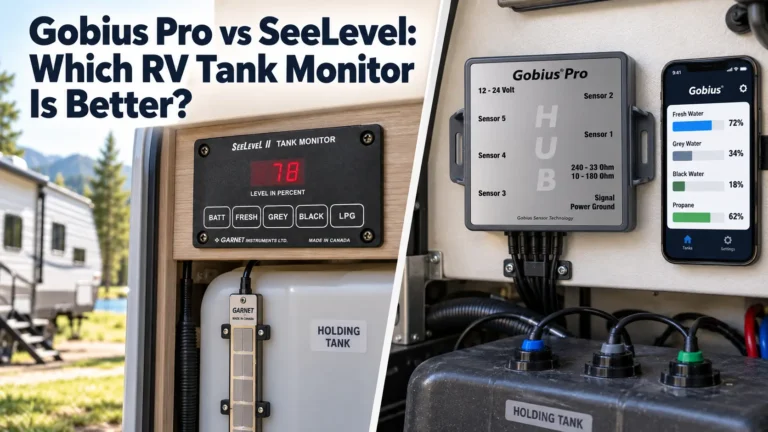
If your black tank is empty but the monitor still reads Full or 2/3, the best pick for most RVers is Unique Restore-It , a purpose-built black tank sensor cleaner that works parked. Need results fast? Try Walex Commando (12 to 24 hours). For sensors on both tanks, use Thetford Level Gauge Cleaner. No cleaner can fix a broken probe or a wiring fault.
You Dumped the Tank. Why Does It Still Say Full?
You dumped the black tank, watched the hose run clear, and closed the valve. Then you checked the monitor, and it still read Full or 2/3. That’s usually the moment RVers start searching for the best RV black tank sensor cleaner, since a mismatch like this rarely means anything is actually broken.
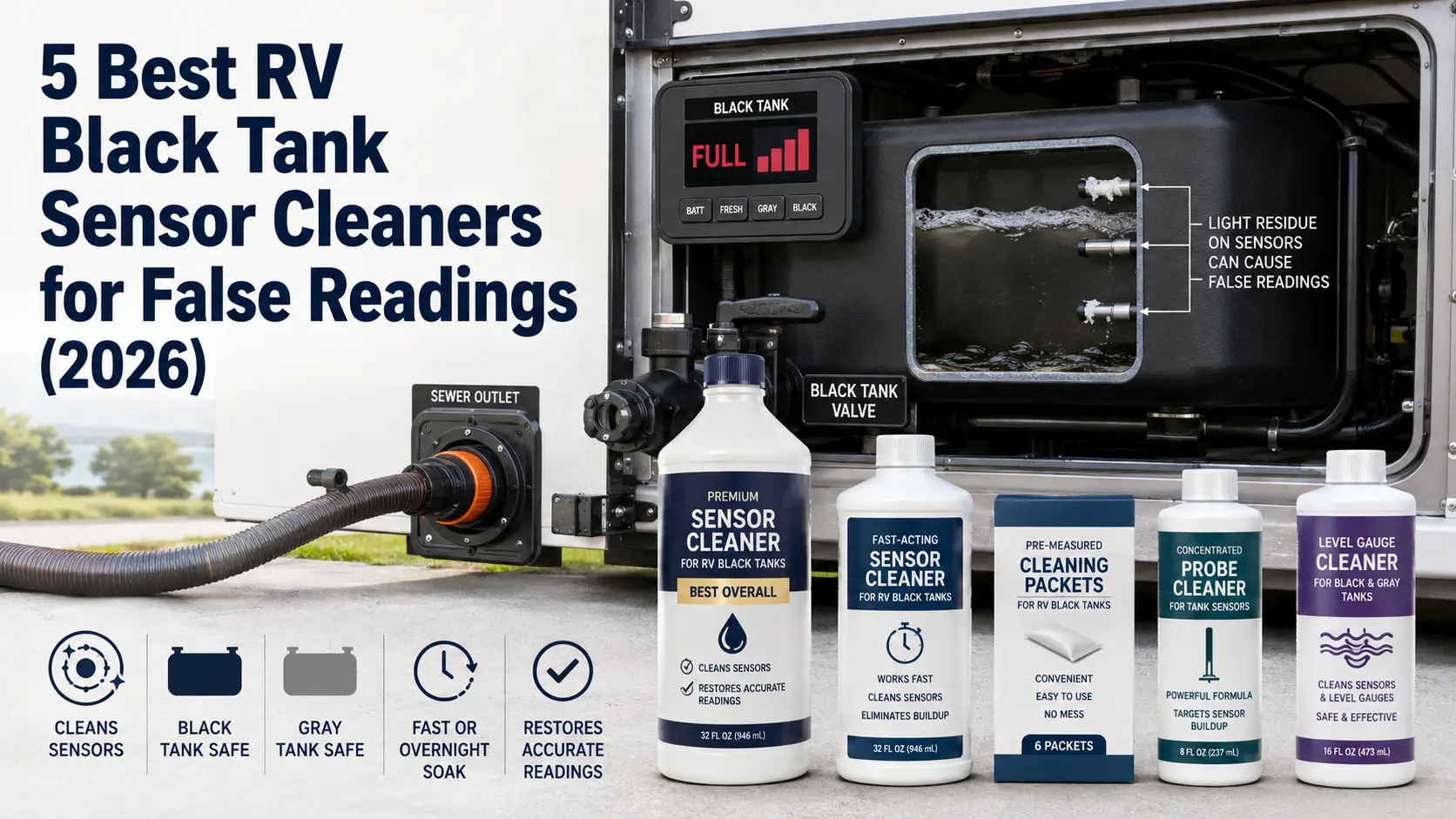
Waste, wet toilet paper, and sludge can stick to the tank’s level sensors and keep the circuit “closed,” so the panel reports a tank that isn’t there. A dedicated sensor cleaner is built to strip that residue off the probes and restore an honest reading. This guide compares five options, what each one actually claims to do, and when a bottle of cleaner won’t be enough to fix the problem.
Quick Comparison: Best RV Black Tank Sensor Cleaners
| Product | Best For | Sensor-Specific | Format | Black Tank | Gray Tank | Typical Cleaning Process |
|---|---|---|---|---|---|---|
| Unique Restore-It Check Amazon | Best Overall | Yes | Liquid, 32 oz | Yes | No | Fill above the sensor, soak 12 to 72 hours, no driving needed. |
| Walex Commando Check Amazon | Best Fast-Acting Option | Yes | Liquid or dissolvable packet | Yes | Check label | Fill above the sensor and soak for 12 to 24 hours. |
| Thetford Tank Blaster Check Amazon | Best Easy-to-Use Packet | Yes | Tear-open packet, 1.6 oz | Yes | Yes | Add packet, fill with water, and soak overnight. |
| Camco TST Probe Cleaner Check Amazon | Best Dedicated Probe Cleaner | Yes | Liquid, 32 oz | Yes | Yes | Fill above the sensor and soak according to the label. |
| Thetford Level Gauge Cleaner Check Amazon | Best for Black and Gray Tank Sensors | Yes | Liquid, 19 oz | Yes | Yes | Use half a bottle per tank, drive to mix, then soak for 24 hours in warm weather. |
Unique Restore-It
Fill above the sensor, soak 12 to 72 hours, no driving needed.
Walex Commando
Fill above the sensor and soak for 12 to 24 hours.
Thetford Tank Blaster
Add the packet, fill with water, and soak overnight.
Camco TST Probe Cleaner
Fill above the sensor and soak according to the product label.
Thetford Level Gauge Cleaner
Use half a bottle per tank, drive to mix, then soak for 24 hours in warm weather.
All five are marketed by their manufacturers specifically for cleaning level sensors, not just general odor control. If your reading is stuck and the tank is genuinely empty, start with Unique Restore-It or Walex Commando. If both tanks are giving you trouble, the Thetford Level Gauge Cleaner treats black and gray sensors in one pass.
The 5 Best RV Black Tank Sensor Cleaners
Here’s a closer look at each pick, including how it’s used, how long it needs to sit, and where it falls short.
Unique Restore-It, Best Overall
Restore-It is a liquid formula made only for black tank sensor probes, and Unique Camping + Marine describes it as targeting the waste buildup that causes sensors to misread. It’s a purpose-built sensor cleaner rather than a general treatment, which is why it tops this list.
How to use it: Pour one 16 oz dose into the toilet, then fill the tank with water until the level covers the affected sensor. Unique’s product instructions list a 12-hour minimum soak, though the company’s FAQ notes it typically takes 48 to 72 hours to fully restore stubborn sensors. A 32 oz bottle holds two treatments.
Best scenario: A parked RV with a stuck reading, since Restore-It doesn’t require driving to work.
Watch out for: Unique is upfront that a completely dry tank with a bad reading points to a hardware problem, not buildup, and the product won’t fix that.
- Built specifically for black tank sensors, not general odor control
- Works without driving
- Two treatments per bottle
- Black tank only, not labeled for gray tanks
- Longer soak time than some competitors for full results
Bottom line: For most readers whose tank is empty but the panel disagrees, this is the first product to try.
Walex Commando-Best Fast-Acting Option
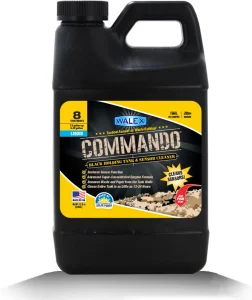
Walex markets Commando as a way to restore black tank sensor accuracy and fix stuck readings like a false “2/3 full.” It comes as a 32 oz liquid or as dissolvable packets, and it’s the quickest-acting option on this list.
How to use it: For the liquid, add 4 oz per 50-gallon tank. For the RV packets, Walex’s own product page states one packet treats a holding tank up to 50 gallons, not the larger dose used in its commercial portable-restroom product line. Fill the tank until water covers the sensors and let it sit.
Contact time: 12 to 24 hours. Walex says driving can speed things up but isn’t required.
Best scenario: You need the tank usable again quickly, since results can show up in half a day.
Watch out for: Commando is marketed for black tanks; check the label before using it in a gray tank.
- Fastest documented soak time on this list
- Choice of liquid or no-mess packets
- Formaldehyde-free and biocide-free per the manufacturer
- Gray tank use isn’t clearly documented
- Packet dosing is easy to mix up with Walex’s other product lines, so double-check the label
Bottom line: A solid pick when you’re short on time and just need the sensors working again.
Thetford Tank Blaster-Best Easy-to-Use Packet
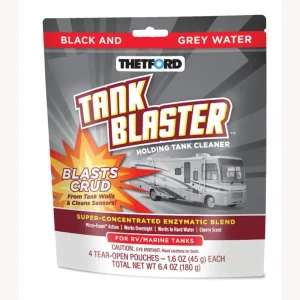
Tank Blaster comes as four tear-open pouches, and Thetford’s official support page markets it as a level sensor cleaner for black tanks, gray tanks, and portable tanks. There’s nothing to measure, which makes it the simplest option here.
How to use it: Empty the tank, tear open one pouch, add it through the toilet, and fill with water above the sensor. Thetford’s granule formula is designed to work overnight, even in hard water. Check the label for guidance if your tank is larger than average.
Best scenario: Beginners who want a no-measuring, drop-and-go product.
Watch out for: The listing carries a California Proposition 65 warning, so follow label handling instructions.
- Pre-measured, single-use pouches
- Works on both black and gray tanks
- Overnight soak fits an average camping stop
- Only four treatments per box
- Prop 65 warning on the label
Bottom line: The easiest product on this list for anyone who doesn’t want to measure liquid.
Camco TST Probe Cleaner-Best Dedicated Probe Cleaner
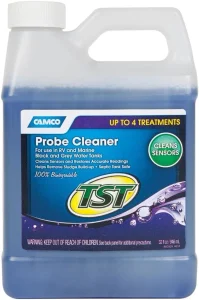
Camco’s TST Probe Cleaner is a 32 oz liquid built to work on the sensor probes themselves, and retailer copy describes it as helping reinstate accurate sensor readings in both black and gray tanks.
How to use it: For a black tank, use 16 oz per treatment (two treatments per bottle for a 40-gallon tank). For a gray tank, a lighter 4 oz dose stretches to roughly eight treatments. Fill above the sensor and let it soak per the label.
Best scenario: Owners who want one dedicated probe cleaner that also handles the gray tank.
Watch out for: The product carries a California Prop 65 warning for one of its ingredients, so read the label before handling it.
- Works in both black and gray tanks
- Long shelf life, not sensitive to storage temperature
- Can provide multiple gray-tank treatments from one bottle
- Prop 65 warning to be aware of
- Formula is concentrated, so measuring matters
Bottom line: A practical dedicated cleaner if you want one bottle that treats both tanks.
Thetford Level Gauge Cleaner, Best for Black and Gray Tank Sensors
This patented formula is designed to dissolve tissue, sludge, and soap scum that build up on level sensors in both black and gray tanks. This makes it one of the clearest choices here when both your black and gray tank sensors are misreading, especially because Thetford provides specific directions for treating both tanks.
How to use it: Pour half of the 19 oz bottle into the black tank through the toilet, and the other half into the gray tank through a sink or shower drain. Fill both tanks with water above the sensors, then drive to mix the solution.
Contact time: Let it sit 24 hours, then drive again briefly to loosen deposits before dumping and rinsing. Thetford notes the formula works best on a warm day above 75°F, and effectiveness roughly doubles between 75°F and 85°F.
Best scenario: Both tanks are misreading and the weather is warm enough for the treatment to work well.
Watch out for: Cold-weather camping limits how well this product performs, and it requires driving to mix properly.
Bottom line: The most efficient choice if you’re fighting sensor problems in both tanks at once.
- Treats black and gray sensors from a single bottle
- Manufacturer-documented dosing and soak time
- 100% biodegradable formula
- Needs warm weather for best results
- Requires driving, unlike some competitors
Do You Actually Need a Black Tank Sensor Cleaner?
You probably need one if the tank is empty but the monitor still reads high, and rinsing hasn’t fixed it. Other signs include a reading stuck at 1/3 or 2/3 for several dump cycles, a reading that improves slightly after rinsing but never clears, or a tank that hasn’t had a deep clean in a long time.
You likely don’t need a sensor cleaner if a bone-dry tank still reads Full. That points to wiring, a damaged monitor panel, or a failed sensor rather than residue. For a full walkthrough of causes and fixes, see RVFlushGuide’s black tank sensor troubleshooting guide.
Black Tank Sensor Cleaner vs Regular Black Tank Treatment
They solve different problems. A sensor cleaner is a strong, one-time soak meant to strip existing buildup off the probes. A regular black tank treatment is a lighter dose you use every time you dump, meant to control odor and keep new waste from sticking in the first place.
Think of it as correction versus prevention. A routine treatment won’t rescue a sensor that’s already fouled, and a sensor cleaner isn’t meant for weekly use. Some products, like Walex Commando, can do a bit of both, but their main job is still the deep clean.
Sensor Cleaner vs Black Tank Flush
They’re not the same tool, and one doesn’t replace the other. A black tank flush system uses pressurized water to physically rinse the tank walls. A sensor cleaner relies on enzymes or surfactants and soak time to dissolve what the flush leaves behind.
The two work best together. Run the flush first to clear loose waste, then add a sensor cleaner if the reading is still wrong. Skipping the flush and going straight to a chemical soak can mean starting with a dirtier tank than necessary.
How Do You Clean an RV Black Tank Sensor?
Dump the tank, add the cleaner, and let it soak above the sensor line before dumping again. The general steps look like this:
Dump the black tank completely before starting the cleaning process.
Rinse with a flush system or garden hose wand if you have one.
Close the valve and add your chosen sensor cleaner through the toilet.
Add water until the level fully covers the affected sensor.
Let the product sit for its required contact time, usually 12 to 72 hours depending on the brand.
Drive or agitate the tank only if the product label calls for it.
Dump the cleaning solution and rinse the tank thoroughly.
Check the monitor again to see whether the sensor reading has returned to normal.
Exact directions vary by product, so always follow the label instead of these general steps. RV Upgrade Store’s cleaning guide also notes that the water level needs to sit above the highest problem sensor, or the cleaner never touches the residue causing the false reading.
Why Does an RV Black Tank Sensor Read Full After Dumping?
Often, waste, toilet paper, or sludge is stuck to the sensor probe, closing the circuit even though the tank is empty. Mineral buildup can add to the problem in hard-water areas. Less often, the cause is a wiring fault, a damaged monitor panel, or a probe that has failed outright.
Since a fouled probe and a broken one can look identical from the driver’s seat, see RVFlushGuide’s full causes and fixes guide for a step-by-step diagnosis. Using RV-safe toilet paper also cuts down on the paper buildup that causes many of these false readings in the first place.
What If the Sensor Still Reads Full After Cleaning?
If several soaks don’t fix it, the problem is probably not residue anymore. Try one more treatment if the label allows it, then move on to checking the hardware.
Mineral scale called struvite can form a hard crust that a standard cleaner won’t dissolve. Wiring and ground connections can also corrode over time, especially in RVs that see a lot of moisture. If the tank is completely dry and still reads Full, that’s a strong sign the probe or the wiring has failed and needs to be inspected or replaced.
Don’t keep buying more cleaner once the evidence points to a hardware issue. At that point, either a probe replacement or an upgrade to a different sensor style is usually the more effective fix.
Conclusion
For most RVers dealing with a false Full or 2/3 reading, Unique Restore-It is the best first pick, since it’s built specifically for black tank sensors and works without driving. If you’re short on time, Walex Commando can clear things up in as little as 12 to 24 hours, and Thetford Level Gauge Cleaner is the better call when both black and gray sensors are acting up.
Keep in mind that no bottle of cleaner can repair broken wiring, a cracked monitor panel, or a sensor that’s simply worn out. If a couple of treatments don’t fix your reading, that’s your cue to check the hardware instead of buying another bottle. Check current pricing on Amazon to get started with the top pick.
Frequently Asked Questions
What is the best RV black tank sensor cleaner?
Unique Restore-It is the best overall choice for a stuck reading in a parked RV, since it’s built specifically for black tank sensors and doesn’t require driving. If you need results faster, Walex Commando works in as little as 12 to 24 hours.
Can a black tank cleaner fix inaccurate sensors?
Yes, if the cause is residue on the probe. It can’t fix a broken sensor, damaged wiring, or a faulty monitor panel, no matter how many times you treat the tank.
Why does my RV black tank show Full after dumping?
Waste, wet toilet paper, or sludge is usually stuck to the sensor probe. Less often, the cause is a wiring or hardware failure that a cleaner can’t fix.
How long should black tank sensor cleaner sit?
Contact time varies by product. Walex Commando calls for 12 to 24 hours, Unique Restore-It allows 12 to 72 hours, and Thetford Level Gauge Cleaner uses a 24-hour soak.
What if the black tank sensor still reads Full after cleaning?
Try one more soak if the label allows it. If the reading still doesn’t clear, especially in a completely dry tank, the sensor, probe, or wiring likely needs to be inspected or replaced.