TL;DR
- The Air Head is a urine-diverting composting toilet with a 12V vent fan. The manufacturer rates the Classic’s solids tank at about 80 uses, roughly a month for two people.
- Owners report anywhere from 2 weeks to 2 months. The Classic’s 1 or 2 gallon urine bottle is the daily chore, and the Tejo replaces it with a remote urine line.
- Buy one if you accept daily urine handling or can plumb a remote line.
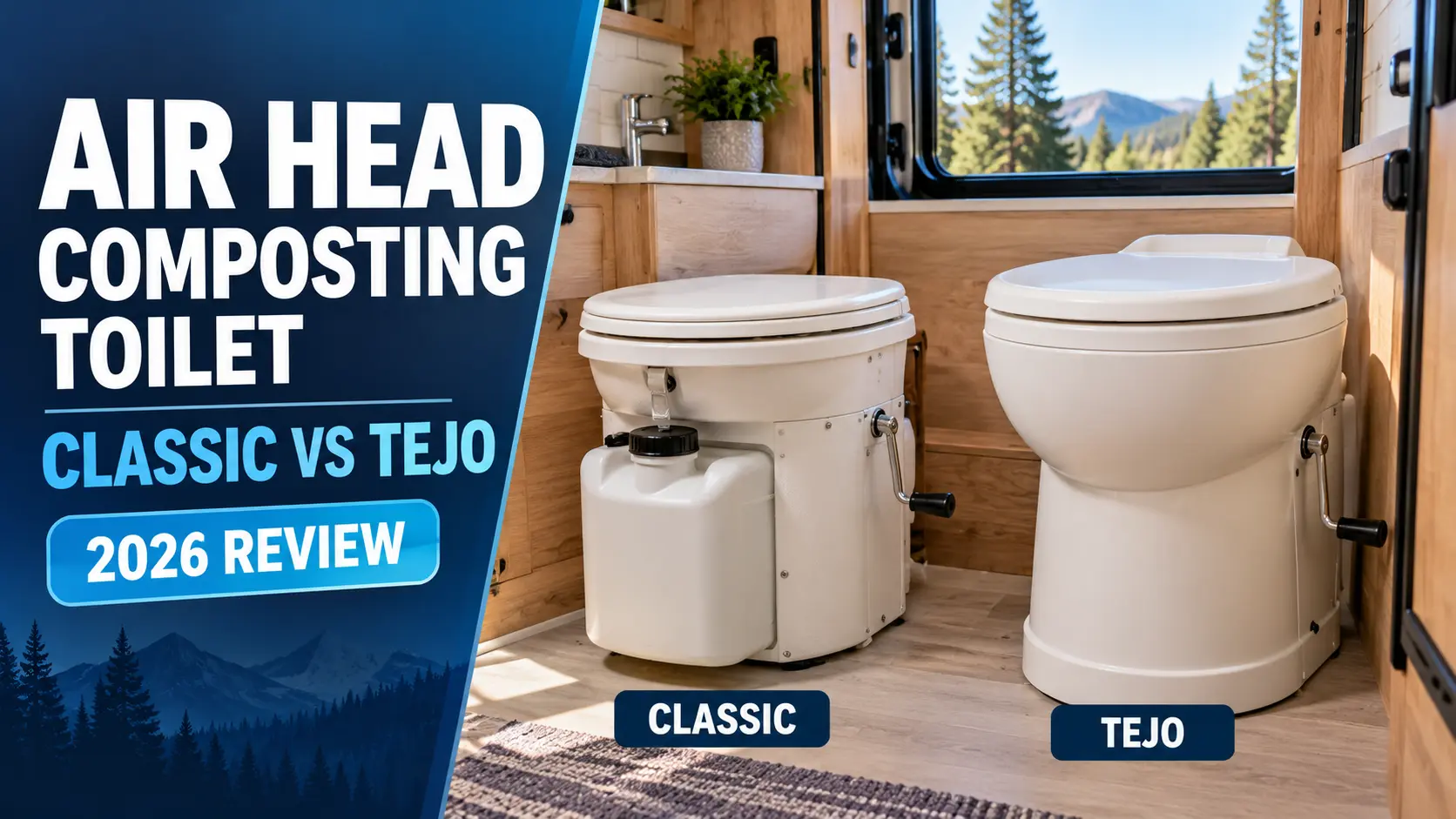
An Air Head composting toilet can reduce reliance on a conventional RV black-tank toilet, but it comes with new upkeep: frequent urine-bottle emptying on the Classic and careful management of the solids bin. This review compares the Air Head Classic’s Comfort and Compact seat options with the newer Tejo for different RV bathrooms. We checked the manufacturer’s specifications and compared them with owner experience where available. We did not test these toilets hands-on. Check current options and pricing with the manufacturer before ordering.
Three Air Head Configurations to Consider
These picks are based on published specifications and compatibility, not hands-on performance tests.
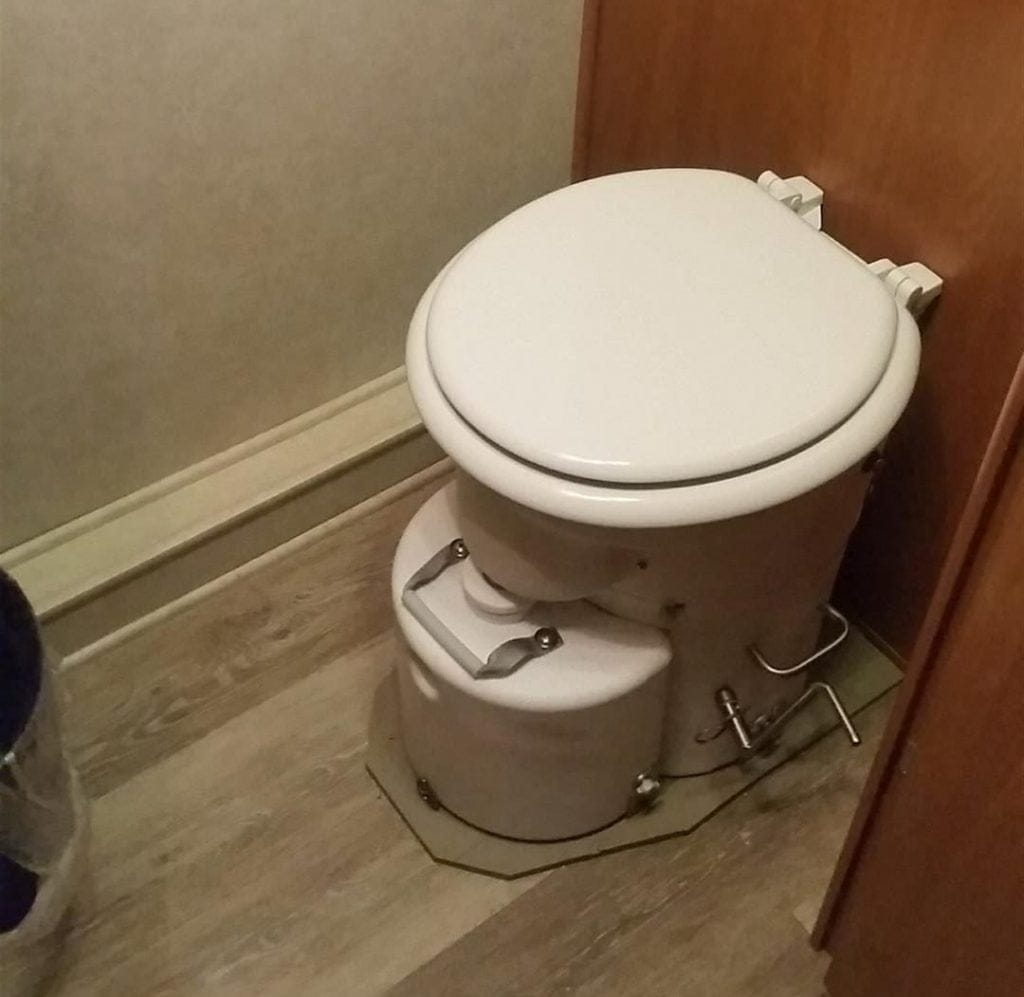
Air Head Classic, Comfort Seat
Model: Air Head Classic Comfort Seat
5 gal solids tank · Up to 80 uses · 1 or 2 gal urine bottle · 12V fan
- Household-style seat
- Urine bottle comes out without lifting the solids tank
- Handle side and fan options
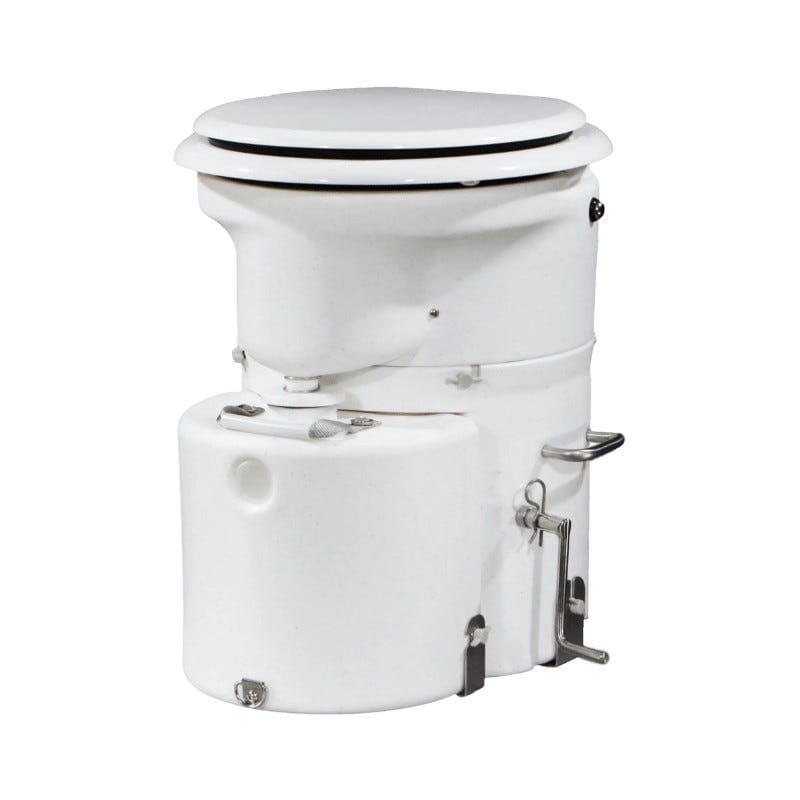
Air Head Classic, Compact Seat
Model: Air Head Classic Compact Seat
5 gal solids tank · Up to 80 uses · 1 or 2 gal urine bottle · 12V fan
- Smaller footprint for RV and van bathrooms
- Same capacity as the Comfort Seat
- Sits closer to the wall
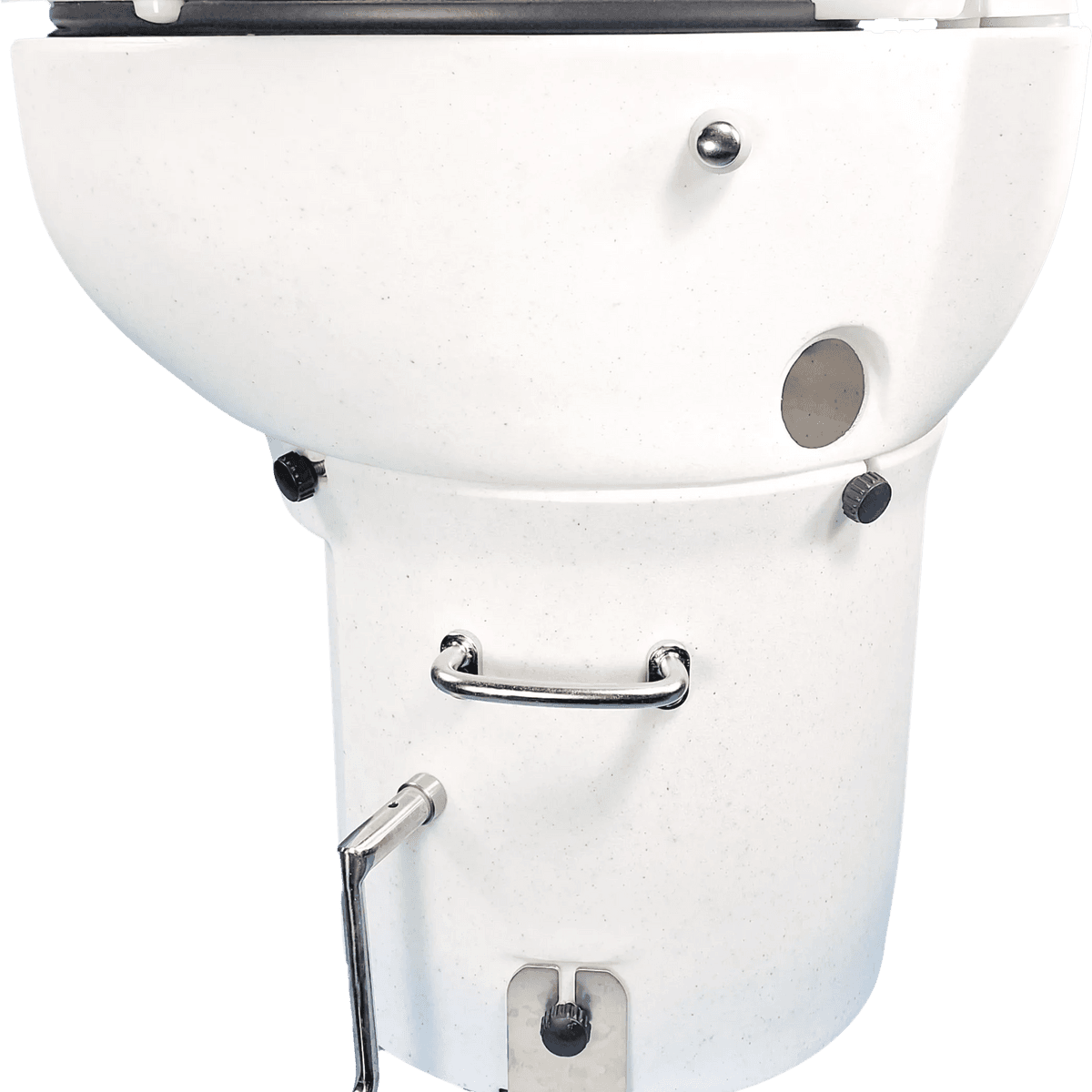
Air Head Tejo
Model: Air Head Tejo
No onboard urine tank · About 80 solids uses · Vapor-proof seals · Remote urine line
- No front urine bottle when connected to a suitable holding tank
- Larger bowl and double seals
- Vapor-proof seals for wet-bath installs
Product photos are illustrative of Air Head configurations; confirm the exact seat and tank options with the manufacturer. Photo credits: Mortons on the Move; FINN seller listing; The Harbour Chandler. Check dimensions, seat choice and the installation plan before ordering. Amazon availability varies. The Air Head Classic, Compact, Tejo and Nature’s Head Weekender links open model-specific Amazon search results because exact Amazon product listings could not be verified. Check the product name, model and seller before purchasing; search results may include alternatives. The Nature’s Head Standard button opens its verified product page. Prices and star ratings are deliberately omitted.
Air Head Classic, Comfort Seat: Best Overall Air Head for Roomier Layouts
This is the household-style seat version of the Classic. It pairs a 5 gallon solids tank with a removable urine bottle and a 12V fan, and the ordering options include handle side, fan style and tank size.
Air Head Classic Comfort Seat Specs
Sources: Air Head Classic, Air Head for RVs and Campers, My Airhead Composting Toilet Review (After 4 Years).
What We Like
- Household-style seat
- Bottle removable without lifting the solids tank
- Flexible handle and fan options
What Could Be Better
- Urine bottle needs frequent emptying
- Opaque sight glass makes the level hard to judge
- Owner reports bugs and exposed solids when the bottle comes out
The Comfort Seat is the roomier of the two Classic seats, so it suits bathrooms with a little floor space to spare. Dimensions here are one owner’s measurements, so check the manufacturer’s drawings against your bathroom before ordering.
Real-world suitability: This toilet fits RVers who want a self-contained unit with no plumbing change and can handle a urine bottle daily. One four-year van owner empties liquids every 1 to 1.5 days and solids every 1 to 2 months, mostly using public restrooms elsewhere. Her complaints were the opaque sight glass, an occasional overflow, and bugs getting in when the bottle is removed. These are individual reports, not failure rates.
Comparison insight: Against the Compact seat, you get the same tank, bottle and fan and trade floor space for a more familiar seat. Against the Tejo, you keep a simple self-contained setup but accept the bottle chore.
Our verdict: A sensible default for roomier layouts if daily urine handling is acceptable to you. Award labels on this page are editorial fit labels based on published specs.
Air Head Classic, Compact Seat: Best for Tight Spaces
The Compact seat shares the Classic’s tank, bottle and fan. The manufacturer says it fits tighter spots such as RVs and boats.
Air Head Classic Compact Seat Specs
Sources: Air Head Classic options, Air Head Classic (UK retailer), My Airhead Composting Toilet Review (After 4 Years).
What We Like
- Smaller footprint
- Same capacity as the Comfort Seat
- Fits RV and van bathrooms
What Could Be Better
- Smaller seat
- Still needs room to turn the crank
Real-world suitability: In a narrow bathroom or van, the few centimeters saved can decide whether the toilet fits at all. Do not forget the crank. A UK retailer states a minimum width of about 488 mm (roughly 19 in) for the handle sweep, so measure that clearance and not just the base.
Comparison insight: The capacity and bottle are identical to the Comfort Seat. The main trade-off is seat comfort against floor space and crank clearance.
Our verdict: Pick this one when floor space is the limiting factor, and confirm the handle clearance before you buy.
Air Head Tejo: Best for RVs with a Black Tank or Remote Urine Tank
The Tejo uses a hose to divert urine into a remote holding tank rather than a bottle on the front of the toilet. Air Head confirms that it can connect to an existing holding tank. Boat installations are a separate use case; do not interpret marine thru-hull arrangements as suitable for RVs.
Air Head Tejo Specs
Sources: Air Head Tejo, Help Me Choose, Air Head Tejo Edition (EU).
What We Like
- No front urine bottle when connected to a suitable holding tank
- Larger bowl, suits non-level use
- Built for wet-bath installs
What Could Be Better
- You plan the urine route, vent and tank yourself
- Independent long-term Tejo ownership data are limited
- US dimensions, weight and fan draw not verified
Real-world suitability: The Tejo suits RVs that can send urine somewhere other than a front bottle. The catch is planning a reliable, leak-free urine line and a suitable receiving tank. Sending urine to an existing black tank means that tank still needs proper venting and periodic servicing. A single owner reported a clog in a modified Classic’s remote drain, but that does not establish a failure rate for the Tejo. Confirm installation requirements and clearances with Air Head.
Comparison insight: Solids capacity is rated about the same as the Classic. The difference is entirely in how urine is handled.
Our verdict: A good fit when you already have a place for urine to go. Independent evidence on the Tejo is thin, so lean on the manufacturer’s documentation.
Nature’s Head Composting Toilet (Spider Handle): Best Alternative with a Bigger Urine Bottle
Nature’s Head is a similar urine-diverting toilet. The standard model lists 60 to 80 uses and a 2.2 gallon bottle.
Nature’s Head Standard, Spider Handle Specs
Sources: Nature’s Head model comparison, Nature’s Head Composting Toilet.
What We Like
- Larger bottle than the Air Head’s 2 gal
- Foot spider handle option
- Manufacturer lists a 5-year warranty
What Could Be Better
- Bottle still needs regular emptying
- Width figures differ between manufacturer pages
Real-world suitability: It addresses the bottle problem a little with extra volume, but you still empty a bottle. Plan the same daily routine.
Comparison insight: The Air Head Classic has a 5 gallon solids tank and a 1 or 2 gallon bottle, and the Nature’s Head has a 2.2 gallon bottle. See the comparison table above.
Our verdict: Worth a look if bottle size is your main concern. For a wider ranking, use our composting toilet roundup.
Nature’s Head Weekender: Best for Short Trips and Light Use
The Weekender is the shorter, lighter, lower-capacity model.
Nature’s Head Weekender Specs
Sources: Nature’s Head Weekender, Nature’s Head model comparison.
What We Like
- Shorter and lighter
- Fits small spaces
What Could Be Better
- Half the solids capacity of the full-size model
Real-world suitability: Good for occasional use or short trips, not full-time living.
Comparison insight: Capacity is about half of the full-size Nature’s Head and well under the Air Head Classic’s rating.
Our verdict: Choose it only when trips are short and counter space is tight.
| Model | Label | Solids capacity (claim) | Urine handling | Weight | Dimensions (source) | Best for |
|---|---|---|---|---|---|---|
| Air Head Classic, Comfort | Best Overall Air Head for Roomier Layouts | 5 gal, up to 80 uses (manufacturer) | 1 or 2 gal bottle | 29 lb (manufacturer) | 19 D x 19.75 H x 18.75 W in (owner-reported) | Roomier layouts |
| Air Head Classic, Compact | Best for Tight Spaces | Same capacity and bottle | 1 or 2 gal bottle | Not verified | About 3 cm closer to the wall (UK retailer) | Tight spaces |
| Air Head Tejo | Best for RVs with a Black Tank or Remote Urine Tank | About 80 uses (manufacturer) | Remote tank | Not verified (US) | Not verified (US); EU figures in the product card above | RVs that can route urine away |
| Nature’s Head Standard | Best Alternative with a Bigger Urine Bottle | 60 to 80 uses (manufacturer) | 2.2 gal bottle | 23 lb (manufacturer) | 21 H x 19 to 20 W x 19 D in (manufacturer) | Bigger bottle |
| Nature’s Head Weekender | Best for Short Trips and Light Use | 30 to 40 uses (manufacturer) | 1.7 gal bottle | 19 lb (manufacturer) | 16.75 H x 18 W x 18 D in (manufacturer) | Short trips |
For a wider ranking beyond these models, see our composting toilet roundup.
How We Compared Air Head Models and Alternatives
We compared published specifications and clearly identified owner accounts; no product was tested hands-on. Capacity figures are manufacturer estimates, not guarantees, and European Tejo dimensions may not match US units. The labels here reflect the most likely RV fit, not independent lab results.
How to Choose an Air Head Composting Toilet
Is the Air Head worth it for an RV?
The Air Head suits RVers who want a waterless toilet and accept urine-bottle emptying or a carefully installed remote urine line. A Tejo connected to a holding tank still requires tank maintenance. The solids tank is rated for about a month for two people. If you want zero daily chores or rarely have hookups, test whether you can live with urine bottles first.
The Classic can eliminate pump-outs when the original black tank is no longer used; a Tejo routed into an existing holding tank does not eliminate tank servicing. Owners pay a premium for a simple mechanical design, so check the manufacturer page for current pricing. Composting toilets also involve handling human waste, so wash your hands and follow local rules for disposal. Our composting toilet pros and cons guide covers the tradeoffs in more depth.
How does an Air Head composting toilet work?
An Air Head splits urine and solids. Urine drains to a bottle (Classic) or a remote tank (Tejo). Solids fall into a tank with a hand-crank agitator, mixed with coir or peat. A 12V fan pulls air through a vent hose to the outside, which dries the solids and carries away smell.
The manufacturer says separation reduces moisture, speeds composting and cuts odor, and that the optimal composting range is 55 to 100°F. Owners use paper bowl liners, turn the crank after use, and open the trapdoor with a lever. One independent summary notes the design was built mainly for marine use and works in RVs. For the full explainer, see how composting toilets work.
Classic vs Tejo: which Air Head fits your RV?
Choose the Classic if you want a self-contained urine bottle and can install the required fan vent. Consider the Tejo if your RV has a suitable receiving tank and you can install the urine hose safely. The Tejo removes the front urine bottle, but you must plan the urine path and vent. Solids capacity is rated about the same.
Use this checklist:
- I have a working holding tank. Air Head says the Tejo can discharge urine into an existing holding tank, but confirm routing, venting, slope and local disposal requirements for your RV.
- I also use a boat. Marine discharge arrangements have different rules; Air Head warns that untreated urine may not be discharged into US waterways. This is not an RV installation method.
- I have neither. The Classic with its bottle is the simpler path.
Other points to weigh:
- Bottle size: the manufacturer says the 1 gallon bottle needs emptying every 1 to 2 days and the 2 gallon every 2 to 4 days for two people.
- Seat: Comfort or Compact on the Classic.
- Wet baths: the Tejo’s vapor-proof seals are meant for wet-head or shower installs.
- Unknowns: Tejo US dimensions, manual and fan draw are unverified, so check the manufacturer page before buying.
If you permanently remove a conventional RV toilet, ask a qualified technician how to safely cap unused plumbing and manage any remaining black-tank venting. Never leave an open sewer connection. See our composting toilet install guide for planning details.
How often do you empty an Air Head? Claims vs owner reports
The manufacturer says the solids tank lasts about a month for two people using it daily, and the urine bottle needs emptying every 1 to 4 days depending on size. Owners report anywhere from 2 weeks to 2 months for solids. Household size, public-restroom use and bottle size explain most of the gap.
| Source | Setup | Solids | Liquids |
|---|---|---|---|
| Manufacturer FAQ and Classic page | Two people, daily use | About 80 uses, about 1 month | 1 gal every 1 to 2 days, 2 gal every 2 to 4 days |
| Manufacturer EU site | Two people, daily use | About 70 uses or more | Usually 1 to 3 days |
| Owner review (about 3 years old) | Two full-time RVers | About every 2 weeks with regular use | Daily |
| UK retailer and reviewer | Two full-time | Retailer says 3 to 4 weeks; reviewer about every 4 weeks | Not stated |
| Four-year van owner | Mostly public restrooms | Every 1 to 2 months | Every 1 to 1.5 days |
| Owner blog (about 6 years old) | 1 gal bottle | Not stated | About 3 times a day |
The gap comes down to solo vs couple, how often you use public restrooms, bottle size, and weekend vs full-time use. The manufacturer says weekend use can stretch to a season. We did not find evidence on humid climates, so we make no claim there.
Air Head suggests further composting solids at home or sealed-bag disposal away from home where permitted. Material removed after only a few weeks is not necessarily fully composted or pathogen-free. Treat it as human waste, avoid contact with edible crops, wash your hands, and follow local waste-disposal rules.
What problems do Air Head owners report, and how do you fix them?
Owners most often report urine bottle overflow, an opaque sight glass, bugs when the toilet is opened, and urine odor in the bottle. These are individual accounts, not failure rates. Fixes are mostly habit changes: empty more often, swap in a second bottle, and keep the fan running.
| Problem | Likely cause | Fix (source type) |
|---|---|---|
| Liquids overflow | Small bottle for the household | Second bottle swap (owner) or a larger bottle (manufacturer) |
| Hard-to-read sight glass | Opaque material | Check the level by habit rather than by sight (owner reports) |
| Bugs when the toilet is opened | Opening the unit to reach the bottle | Owner-reported, no sourced fix |
| Urine odor and a dirty bottle | Urine sitting in the bottle | Empty often and clean with natural cleaners per the manufacturer’s winterizing steps |
For wet solids and a fan that will not run, see composting toilet smells, too-wet compost and fan not working.
For cold weather, the manufacturer says to empty both containers, clean the unit, keep the fan running, and add non-toxic antifreeze to the urine bottle if you use it occasionally.
Safety
- Wash your hands after emptying and clean spills right away. Use only the cleaning products the manufacturer names, never mix chemicals, and do not use automotive antifreeze. For anything beyond that guidance, ask the manufacturer.
What does installing and owning an Air Head in an RV involve?
Plan for floor space to turn the crank, a short vent hose to the outside, 12V power for the fan, and your urine route. Ownership extras include coir or peat, bowl liners and possibly a second urine bottle or remote line. Check the manufacturer’s installation guide for your exact seat and tank option.
One owner’s box list included the bowl, solids tank with agitator, lid, bottle, crank, seat, brackets, a 5 ft hose, fan and housing, 50 paper liners, and a peat brick on US orders. Treat that as owner-reported and confirm on the manufacturer page.
- Vent: the manufacturer says extra hoses can lengthen the vent path, while a UK retailer advises keeping the run short.
- Handle clearance: about 488 mm, per a UK retailer.
- Fan power: the EU version is listed at 12V, 60 mA, 0.72 W. We could not verify the US fan draw or fuse details, so follow the manual.
- Consumables: coir or peat, paper liners, and possibly a second bottle.
Stop and get help
- Contact a qualified RV technician if you are unsure of the fan wiring, notice heat or a burning smell, or see urine back up or leak at the hose. Stop using the affected setup and call the manufacturer if odor persists or liquid stands in the solids tank. If you are replacing an existing toilet, see our RV toilet replacement guide.
Air Head vs Nature’s Head and who should look elsewhere
The Air Head Classic has a 5 gallon solids tank and a 1 or 2 gallon bottle. Nature’s Head lists 60 to 80 uses and a 2.2 gallon bottle. Both carry 5 year warranties. We do not rank them, since each wins on different specs.
A retailer comparison says the Air Head has a residential-style seat and a front-access bottle, and is sold direct from the manufacturer. That is a retailer claim. Nature’s Head wins on bottle size.
Look elsewhere if you cannot empty a bottle daily or plumb a remote line, or if you want a cassette-style option. Our OGO composting toilet review covers another single-brand option, and we explain how to empty a cassette toilet for readers considering that route.
Final Verdict
The Air Head is a straightforward waterless, urine-diverting toilet. The Classic’s biggest ongoing chore is frequent urine-bottle emptying. Emptying intervals vary widely between owners, so plan for the low end of the range. The Tejo suits RVs that can route urine away, but independent evidence for it is thin.
Before ordering, check the exact model options on the manufacturer’s page, and measure your bathroom, the crank sweep and your vent route.