TL;DR: The best RV toilet treatment helps break down waste, control odor at the source, and reduce residue that can cause false black tank sensor readings. For most RVers, an enzyme-and-bacteria liquid is the safest all-around choice. But the right option depends on how you camp, how often you dump, the weather, and whether you prefer liquids, powders, or drop-in pods. This guide covers every treatment type, picks by use case, and how to use them so they actually work.
You buy a bottle of treatment from the campground store. You drop it in. The tank still smells. Or the sensors still read full two days after you dumped.
Here’s what most articles skip: when treatment doesn’t work, the product usually isn’t the problem. People tend to blame the product, but the real issue is almost always one of three things. Wrong formula for the camping situation. Not enough water per flush. Or adding treatment at the wrong point in the dump cycle.
The best treatment in the world needs enough water, a closed black tank valve, and correct timing to deliver results. It does not replace good dumping habits. It won’t clear a clog that has already formed. And it won’t fix a failing flush seal or a blocked roof vent. Those are mechanical problems that need mechanical solutions.
What treatment can do, used correctly, is control odor at the source, help break down solid waste and toilet paper before it hardens, and reduce the residue that builds up on tank walls and sensor probes over time.
This guide covers every formula type and format, how to match one to how you actually camp, and how to use it so it delivers real results.
What Does an RV Toilet Treatment Actually Do?
An RV toilet treatment is added to the black tank to control odor, help break down waste and toilet paper, and reduce buildup on tank walls and sensor probes. It is a maintenance tool, not a repair tool. It cannot replace enough water, correct dumping habits, or mechanical repairs when something is already clogged or damaged.
There are two very different approaches to odor control. Some products use perfume or chemical deodorizers to mask the smell. Others use bacteria, enzymes, or mineral compounds to address odor at the source by breaking down the gases that cause it. The second approach lasts longer and works better over multiple days between dumps.
Water is still the single most important factor in black tank maintenance. According to Unique Camping + Marine, using enough water with every flush keeps solids suspended, prevents dry buildup on tank walls, and gives any treatment a liquid medium to work in. Treatment amplifies good habits. It cannot substitute for them.
- Treatment = a maintenance tool. It supports good tank health during normal use.
- Water = the main working ingredient. No treatment performs well in a dry or near-dry tank.
- Masking odor vs. eliminating it are two very different things. Products that use fragrance only hide the problem. Enzyme, bacteria, and mineral treatments break down the compounds that cause the odor.
- Treatment will not dissolve a hardened pyramid plug on its own, clear an active clog, or repair a failing seal.
RV Toilet Treatment Types: Formula vs. Format
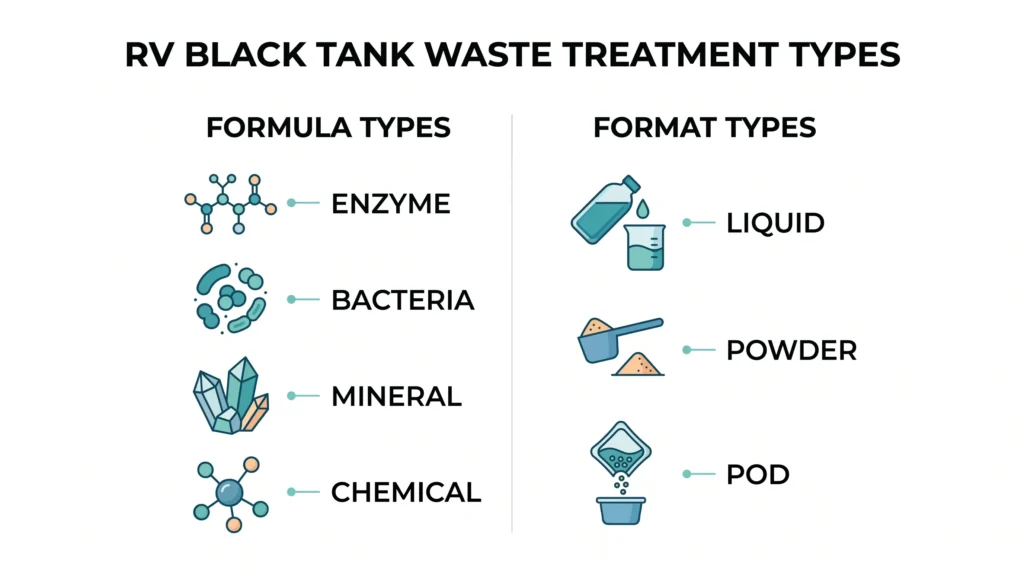
Before picking a product, understand two separate things: the formula (how it works chemically) and the format (how it’s delivered). Most shoppers pick based on format and never think about formula. That’s usually why they end up with the wrong product for their situation.
By Formula
Enzyme-and-bacteria treatments are the most widely recommended formula type for regular black tank maintenance. They introduce live bacteria and enzymes into the tank. Enzymes rapidly break down solid waste and toilet paper into smaller components. The bacteria then consume the waste and convert odor-causing gases like hydrogen sulfide into odorless byproducts.
According to published research by Walex, enzyme-and-bacteria combinations can start working faster than bacteria-only products because active enzymes begin digesting immediately, without waiting for bacteria to multiply first. These treatments work best at moderate temperatures with plenty of water per flush.
Chemical and mineral deodorizing treatments take a different approach. Instead of using living organisms, they use compounds to neutralize odor-causing gases directly. As The Fit RV explains, newer mineral-salt formulas can control odors without masking them with heavy fragrance, and they tend to be more stable in high heat than enzyme-based products. Always check the current label for active ingredients, as formulas can change between production runs.
Older formaldehyde-based treatments are now widely discouraged. They suppressed odor by killing tank bacteria, but also eliminated beneficial bacteria and could damage rubber seals over time. California Senate Bill 317 restricts certain RV and marine holding tank products that contain chemicals such as formaldehyde, bronopol, glutaraldehyde, benzene, toluene, and xylene in specific waste-system contexts. Even outside California, look for “formaldehyde-free,” “bronopol-free,” and “septic-safe” on the label before buying any treatment.
By Format
Liquid treatments are the most flexible option. You can adjust the dose based on tank size, temperature, and how long waste will sit before the next dump. Liquid activates quickly when mixed with water and is easy to measure. It is the best format for regular maintenance on full hookups or any situation where tank conditions vary.
Powder treatments are a compact and lightweight alternative to liquid. Concentrated powders often provide more treatments per dollar and take up almost no storage space, which makes them a practical choice for boondocking or long trips where packing light matters. Like liquids, they allow flexible dosing. The key difference from pods is that powders require measuring, which gives you more control but also one more step in the process.
Drop-in pods are the easiest format for beginners and occasional campers. No measuring, no spills, no second-guessing the dose. One pod goes into the toilet at the start of a new tank cycle after dumping. Our Campfire Unplugged notes that pods can run around $1 per treatment, which adds up over longer trips. The trade-off for that convenience is that you cannot adjust the dose when temperatures spike, the tank fills faster than expected, or the dump interval stretches longer than planned.
How to Choose the Right RV Toilet Treatment
Not everyone has the same problem. Matching the treatment to your actual situation saves money and frustration. Here’s a quick guide by use case.
If odor is your main problem
Start by confirming where the odor is coming from before spending anything. If the smell rises only when flushing, see our guide on why your RV toilet smells when flushed: the cause may be a failed bowl seal or a blocked vent pipe, not a tank treatment issue at all. If the odor appears between flushes and in the general cabin, a good enzyme-and-bacteria liquid treatment used consistently right after every dump is the right starting point.
If toilet paper breakdown is your main problem
Enzyme-and-bacteria treatments are the best formula choice here. The enzyme component actively digests cellulose fibers in toilet paper. Using more water per flush and switching to RV-safe toilet paper will both make a bigger difference than upgrading your treatment brand. Make sure you are flushing for at least 10 seconds per use to push paper fully into the tank rather than leaving it sitting at the mouth of the drain.
If your sensors read full after dumping
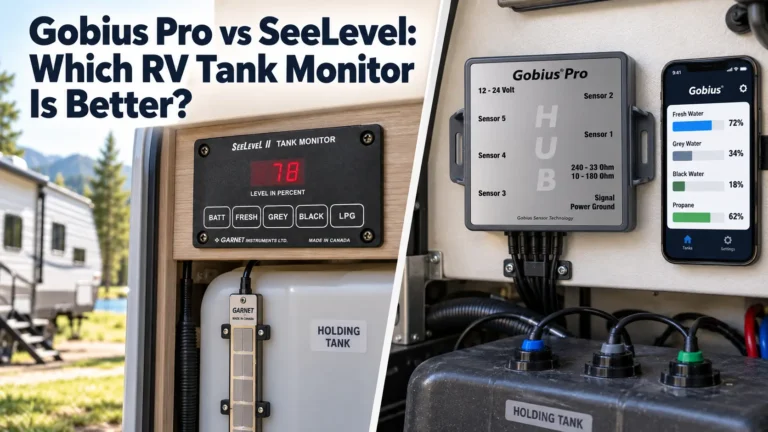
Sensor probes get coated with waste residue over time, which causes false readings. Regular treatment may help reduce new buildup, but it rarely clears existing coating quickly enough to fix an ongoing sensor problem. A dedicated tank rinse soak using a cleaning formula designed to strip residue, left in the tank for 12 to 24 hours before draining, is a more effective approach. If sensors continue reading incorrectly after repeated cleaning, an external aftermarket sensor system is a permanent fix. If the bowl itself will not hold water between flushes, see our guide on Dometic RV toilet not holding water. That is a seal or valve issue, not a tank treatment problem.
If you camp in hot weather
Odor builds faster in high heat, and some enzyme-based bacteria lose activity when tank temperatures rise significantly. If you camp regularly in desert conditions or during summer in hot climates, a mineral-based deodorizing treatment may hold up better between dump cycles. Alternatively, stick with an enzyme-and-bacteria liquid but increase your water use per flush, shorten dump intervals, and consider retreating every few days rather than only after dumping.
If you boondock and conserve water
The format matters more than the formula here. A concentrated powder or liquid is easier to pack and lighter than multiple bottles. The harder challenge is that effective treatment needs enough water to work. Going too light on water per flush risks dry waste buildup that no treatment can reliably prevent. Even in water-conservation mode, aim for at least 5 to 7 seconds of flushing per use.
If you want the easiest beginner option
Drop-in pods are the most foolproof starting point. Drop one into the toilet at the start of a new tank cycle after dumping, flush it in with several gallons of water, and you are done. Once you are comfortable with the basics of black tank maintenance, switching to a liquid or powder gives you more flexibility and better cost per treatment.
How These Picks Were Chosen
There are dozens of products on the market, and most roundups recommend whichever pays the highest commission. The picks below are based on a different approach.
- We did not rank products by commission rate or brand name recognition.
- We prioritized formula fit over brand popularity.
- We separated formula type from format because they are different decisions with different trade-offs.
- We looked for formaldehyde-free, bronopol-free, and septic-safe labeling where available.
- We avoided claiming that any treatment repairs mechanical failures like failed seals, cracked bowls, or valve problems.
- Where a product’s exact formula could not be independently verified, we used cautious wording such as “verify the label before buying” or “this product style.”
- Odor control method, waste and toilet paper breakdown ability, heat performance, ease of dosing, and cost per treatment were all considered in each recommendation.
These picks are not the result of independent lab testing. They are based on manufacturer technical documentation, published formula comparisons from RV industry sources, and real-world feedback from long-term campers. Product formulas can change between production runs, so always check the current label before buying.
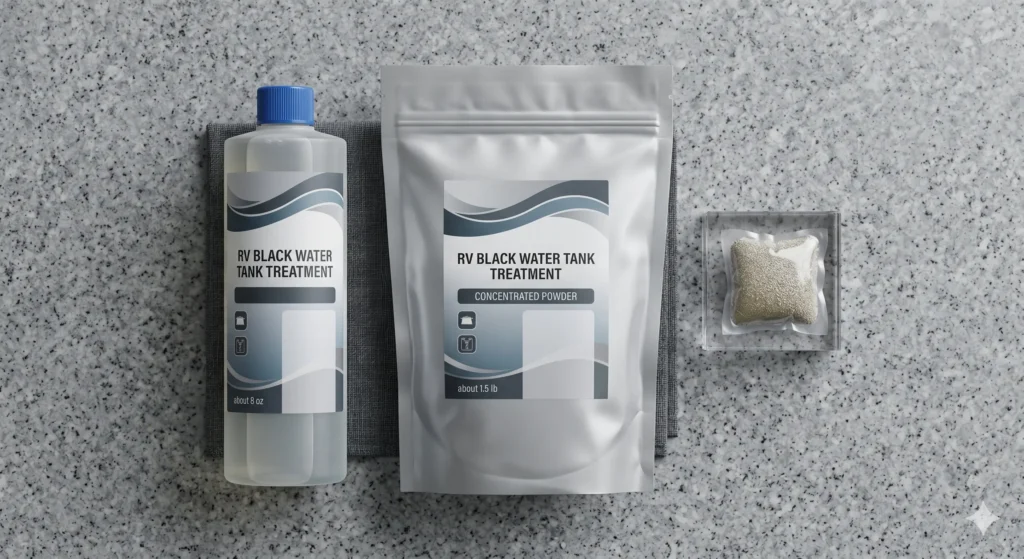
Quick Picks: Best RV Toilet Treatment by Use Case
| Use Case | Recommended | Why It Fits | Watch Out For | Shop |
|---|---|---|---|---|
| ⭐ Best Overall | Enzyme-and-bacteria liquid (RV Digest-It style) | Handles odor, waste, and residue in one | Needs adequate water and contact time | Check Amazon |
| Weekend Campers | Drop-in pods (Bio-Pak or TST MAX style) | Pre-measured and extremely easy to use | Cannot adjust dose mid-trip | Check Amazon |
| Boondocking | Concentrated powder or liquid drops | Lightweight and saves storage space | Needs water per flush to activate | Check Amazon |
| Hot Climates | Mineral or deodorizing formula | More stable in high tank temperatures | Performance varies by brand in heat | Check Amazon |
| Full-timers | High-strength Enzyme/Bacteria (Ultra style) | Handles heavy daily use consistently | Not a substitute for deep cleaning | Check Amazon |
| Sensor Residue | Dedicated tank rinse/residue stripper | Strips coating from probes (12-24hr soak) | Doesn’t clear old hardened buildup quickly | Check Amazon |
Best RV Toilet Treatments by Camping Style
Here is a closer look at what fits each use case and why, with honest trade-offs for each pick.
Best Overall: Enzyme-and-Bacteria Liquid Treatment
Most RVers who want one reliable product for odor, waste breakdown, and sensor residue reduction
Liquid
✅ Why it works:
Combines active enzymes for fast digestion with live bacteria for ongoing waste conversion and odor elimination at the source
⚠️ Watch out:
Needs enough water and several hours of contact time; effectiveness drops in high heat or when the tank runs too dry
An enzyme-and-bacteria liquid is the most widely recommended formula for everyday black tank maintenance. It handles odor elimination, toilet paper breakdown, waste digestion, and residue reduction in a single product. You can adjust the dose by tank size and temperature, and liquid activates quickly when flushed into the tank right after dumping.
Unique Camping + Marine, with more than 30 years in RV wastewater products, positions enzyme-and-bacteria liquid as the foundation of healthy black tank maintenance because it works with the natural biological process of waste breakdown rather than suppressing it. Products like RV Digest-It and Liquified are commonly cited examples in this category, though formula specifics can vary by production run. Always check the current product label before buying.
One honest limitation: enzyme-and-bacteria products are temperature-sensitive. They perform best at moderate temperatures with plenty of water. In extreme heat or in a tank with very little water per flush, performance will drop. If you camp regularly in high heat, consider the hot-climate option below.
Best for Weekend Campers: Drop-In Pod Treatments
Occasional campers who want a no-measure, no-spill option for short trips
Pre-measured drop-in pod
✅ Why it works:
Simple to use at the start of every tank cycle: no tools, no measuring, no bottles to manage on the road
⚠️ Watch out:
Fixed dose means you cannot adjust for longer trips or hotter conditions
For campers who are out for a weekend and want to spend zero time thinking about their black tank, drop-in pods are the right call. Drop one pod into the toilet at the start of a new tank cycle after dumping, flush it in with several gallons of water, and you are done. No measuring, no spills in the cabinet, no second-guessing the amount.
Common pod-format products include Walex Bio-Pak style pods and TST MAX style drop-ins. Formula types vary across these products, so check the current label for the active ingredient list before buying, especially if you are dumping at a campground with a septic system rather than a municipal sewer connection.
Happy Campers’ published treatment cost comparison data places pod-format products in the $0.57 to $0.93 per treatment range. That is reasonable for occasional trips.
Best for Boondocking: Concentrated Powder or Liquid Drops
RVers who camp off-grid and need a lightweight, compact treatment format
Powder or concentrated liquid drops
✅ Why it works:
Far lighter and more compact than liquid bottles; multiple treatments fit in a small pouch or bottle
⚠️ Watch out:
Enzyme-based powders still need sufficient water per flush to activate effectively
When packing for a long boondocking trip, space and weight matter. A month’s worth of liquid treatment takes up meaningful cabinet space. The same number of treatments in powder form takes up a fraction of that. Concentrated powder formats are also easy to portion, so you can adjust the dose based on how long the tank will sit before the next dump.
The main challenge for boondockers is water. Enzyme-based treatments of any format need adequate water to activate and stay effective. If you are conserving water aggressively, aim for at least 5 to 7 seconds of flushing per use and consider a double dose of treatment to compensate for shorter flushes.
Best for Hot Climates: Mineral or Deodorizing Formula
Summer camping in desert or very hot conditions where tank temperatures run consistently high
Liquid, powder, or pod; formula matters more than format here
✅ Why it works:
Mineral-based formulas can maintain odor control when rising temperatures slow bacterial activity in enzyme products
⚠️ Watch out:
Verify the current label for formula type and heat performance claims before buying
For hot climates, odor control matters more than slow waste digestion. Some RVers prefer mineral-based deodorizing treatments because they can be more stable when tank temperatures rise, while enzyme-and-bacteria products may need more water, more frequent dosing, or shorter dump intervals in extreme heat.
According to Happy Campers’ published formula comparison data, mineral-based treatments can outperform enzyme options for odor control in extreme heat scenarios. That said, neither formula type universally wins in all situations. The better approach in consistently hot weather is to use any treatment combined with more water per flush, shorter intervals between dumps, and parking in shade when possible to keep tank temperatures down.
Best for Full-Timers: Higher-Strength Enzyme-and-Bacteria Liquid
RVers who live in their RV full time and dump several times per week
Concentrated liquid
✅ Why it works:
Handles heavier daily waste loads and provides consistent maintenance between frequent dump cycles
⚠️ Watch out:
Not a substitute for a full deep clean once or twice a year
Full-time RV living puts consistent, heavy daily demand on the black tank. A higher-concentration enzyme-and-bacteria liquid used reliably after every dump keeps the system in good shape between cycles. Products positioned as “ultra” or “concentrated” versions of standard enzyme treatments are commonly used in this category.
Regular maintenance treatment helps, but it does not clean a tank that has been accumulating residue and biofilm for months. Full-timers especially need a full deep clean twice a year using a dedicated residue remover, not just standard maintenance dosing. The process is covered in the usage section below.
Best for Sensor Residue: Dedicated Tank Cleaner
RVers whose sensors consistently read full even after dumping and treating normally
Liquid cleaner (soak & strip)
✅ Why it works:
Extended contact time strips waste coating from probe surfaces more effectively than a standard treatment cycle
⚠️ Watch out:
This is a cleaning product, not a maintenance treatment. Do not confuse the two categories
Sensor probes get coated with waste, grease, and mineral deposits over time. Standard maintenance treatments may help reduce new buildup, but they rarely restore already-coated probes quickly enough to fix a sensor reading problem. A dedicated tank cleaning product, left in the tank for 12 to 24 hours before dumping, is a much more targeted approach for this specific issue.
If sensors continue reading incorrectly after several dedicated cleaning cycles, the probes themselves may be permanently fouled.
How to Use RV Toilet Treatment Correctly
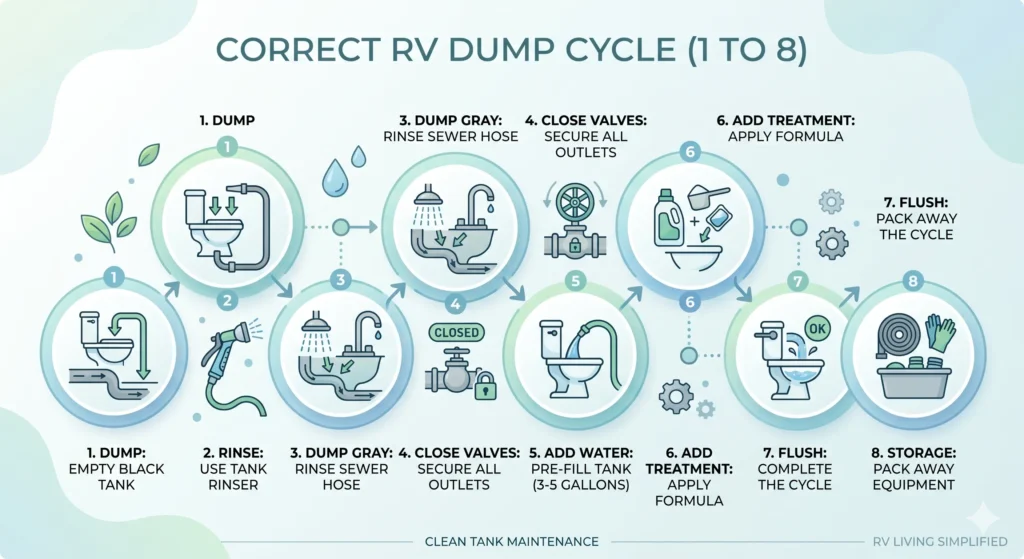
How to Use RV Toilet Treatment Correctly
Add 3 to 5 gallons (11 to 19 liters) of water to the black tank first, then add treatment immediately after dumping. Keep the black tank valve closed, flush with plenty of water on every use, and dump only when the tank is about two-thirds full. Treatment works best when waste stays wet and has enough time to break down before the next dump.
Follow this sequence on every dump cycle:
Dump the black tank completely at an approved dump station.
Rinse the tank if you have a built-in flush port or a tank wand.
Close the black tank valve fully.
Add 3 to 5 gallons (11 to 19 liters) of fresh water through the toilet.
Add your treatment, liquid, powder, or pod, into the toilet bowl.
Flush to send the treatment into the tank with the water.
Hold the flush pedal down for at least 10 seconds on every subsequent use to push waste fully into the tank.
Dump again when the tank reads about two-thirds full, or after 4 to 5 days during active use.
One common timing mistake: adding treatment at the end of a trip, then parking the RV for two weeks. By that point, liquid has evaporated, waste has dried and hardened, and the treatment has nothing useful to work with. Treat immediately after dumping, at the very start of the next tank cycle, not before storage.
Unique Camping + Marine’s treatment guidance recommends keeping tank temperatures below around 85°F (30°C), dumping every 4 to 5 days during active use, and flushing for a full 10 seconds per use as the three most important variables for consistent performance from any enzyme-based treatment.
How to do a full deep clean (once or twice a year)
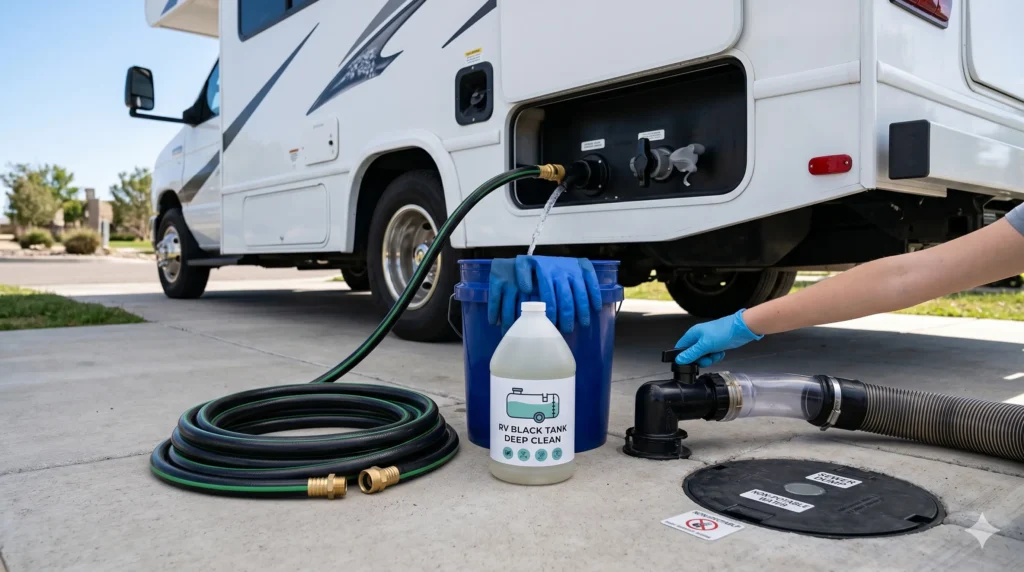
Regular treatment maintains a healthy system, but it does not clean a tank that has been accumulating residue and hardened waste over many months. Plan a full deep clean at least once a year. Plan twice a year for full-timers or heavy users.
- Dump and rinse the black tank as thoroughly as possible.
- Close the black tank valve and add fresh water until the tank is at least half full.
- Add a dedicated tank cleaning or residue-stripping product according to the label directions. This is a different product from your standard maintenance treatment.
- Let it soak for 12 to 24 hours to allow the cleaner to work on residue and probe surfaces.
- If practical, drive the RV on a short trip to agitate the solution inside the tank.
- Dump and rinse thoroughly, repeating until the drain water runs clear, before starting a normal treatment cycle again.
What RV Toilet Treatments Can’t Fix on Their Own
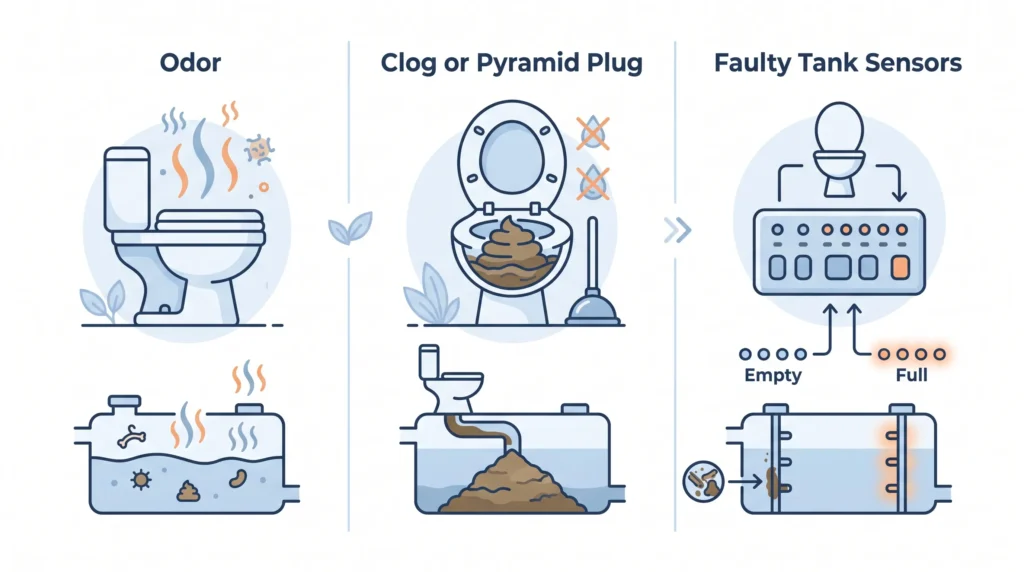
Important Note
Treatment is a maintenance tool. When something has already gone wrong mechanically or structurally, treatment alone is usually not enough. Use the symptom table below to find the right next step before spending more money on a product that won’t solve the actual problem.
If your black tank has a hardened pyramid plug, an enzyme soak is a useful first step. It typically takes 48 to 72 hours of contact time and usually needs a double dose to make progress on dried, compacted waste. But enzyme soaking alone often cannot finish the job on a fully hardened mass. Our guide on how to fix a pyramid plug in an RV black tank walks through the full sequence of methods beyond enzyme soaking.
If your toilet smells even when treating regularly, the issue may not be the tank at all. A failed flush ball seal, a blocked roof vent, or a bathroom exhaust fan pulling air the wrong direction can all cause persistent odor that no treatment will resolve. Our guide on why your RV toilet smells when flushed covers all the common causes and how to test for each one.
| Symptom | Will treatment help? | Better next step |
|---|---|---|
| Mild odor after dumping | Yes | Add water and treatment right after every dump; see our guide on RV toilet smell after dumping |
| Toilet smells only when flushing | Sometimes | Check bowl seal, bathroom fan direction, and roof vent; see why your RV toilet smells when flushed |
| Waste piled under toilet, nothing drains | Not alone | See our pyramid plug guide for the full removal process |
| Sensors always read full after dumping | Partly, over time | Tank rinse soak with a dedicated cleaner left for 12 to 24 hours before draining |
| Water won’t stay in bowl between uses | No | See our guide on Dometic RV toilet not holding water: this is a seal or valve issue |
| Water continues running into bowl after flushing | No | See our guide on replacing an RV toilet water valve |
If the smell spikes specifically right after dumping, that is a separate and documented problem from what maintenance treatment addresses. Our guide on RV toilet smell after dumping explains why odor often peaks during the dump process and what actually fixes it.
For toilet problems that go beyond tank odor or clogs, our RV toilet repair guide covers every common mechanical issue from flush pedals and water valves to cracked bowls and loose bases.
What Not to Put in Your Black Tank
Some products actively damage your system or cancel out whatever treatment you are using.
Bleach and antibacterial cleaners kill the bacteria in enzyme treatments, making them ineffective. They also dry out rubber seals over time and can damage tank components. Our guide to unclogging an RV toilet without a snake explains why harsh drain chemicals are especially risky in RV plumbing compared to residential systems.
Formaldehyde-based treatments suppress odor by killing tank bacteria, including the beneficial bacteria that enzyme-based maintenance depends on. They can degrade rubber seals over time and are restricted by California’s SB317 in specific waste-system contexts, as noted in the formula section above. Look for “formaldehyde-free” and “bronopol-free” on any label before buying.
Flushable wipes do not break down in a holding tank the way they do in a municipal sewer system. They bind with solid waste and accelerate clog formation. Skip them regardless of what the packaging claims.
Slow-dissolving household toilet paper can cause buildup in the tank, especially if you are not using enough water per flush. Not all household toilet paper is a problem. Thicker, multi-ply varieties that do not break down quickly are the ones to watch out for. If you are unsure about your current paper, do the shake test: put several sheets in a jar of water, seal the lid, shake for 30 seconds, and see if the paper breaks into fine pieces. If it holds together in clumps, switch to a faster-dissolving brand while traveling.
Too little water is the most damaging habit of all. Dry waste hardens within hours and is extremely difficult to remove once it sets. Every major treatment manufacturer recommends holding the flush pedal for at least a full 10 seconds on every use: not a quick tap-and-release.
The Bottom Line
The best RV toilet treatment is the one that matches how you actually camp. For most RVers, a formaldehyde-free enzyme-and-bacteria liquid used consistently at the start of every tank cycle is the right call. Weekend campers do well with drop-in pods. Boondockers benefit from the compact format of concentrated powders. Anyone camping regularly in extreme heat should look at a mineral-based deodorizing formula that can hold up when bacterial activity slows down.
And across all of those situations, water is still the most important variable. No treatment performs well in a dry or near-dry tank. Add enough water on every flush. Keep the black tank valve closed between dumps. Treat immediately after dumping, at the start of the next cycle, not before storage.
If you have already tried treatment and odor or sensor problems are still there, the issue is usually not the product you picked. Work through the symptom table above to identify the actual cause. If the problem is a pyramid plug, see our pyramid plug repair guide. If the smell comes from the toilet itself rather than the tank, see our guide on why your RV toilet smells when flushed. And if there is a mechanical issue, our RV toilet repair guide covers everything from valve replacement to full toilet swaps. Treatment is the beginning of a healthy black tank system. Not the finish line.
Frequently Asked Questions
How often should I add RV toilet treatment to my black tank?
Add treatment at the start of every new tank cycle, immediately after dumping. Pour it into the toilet, then flush to send it into the tank along with 3 to 5 gallons (11 to 19 liters) of fresh water. Unique Camping + Marine recommends dumping when the tank reaches about two-thirds full, or every 4 to 5 days during active use. Adding treatment more often than once per cycle is generally not necessary unless you are in very high heat, which accelerates odor production.
Can I use regular dish soap or household chemicals instead of RV toilet treatment?
Dish soap like Dawn is sometimes used as part of the DIY Geo Method for breaking up waste buildup, and it can help in a pinch. But it does not control odor at the source the way enzyme or mineral treatments do. Avoid bleach, Drano, and antibacterial cleaners in your black tank entirely. These damage rubber seals, kill the beneficial bacteria that enzyme treatments depend on, and can harm the septic systems used by many campgrounds.
Do RV toilet treatments work in extreme heat?
It depends on the formula. Enzyme-and-bacteria treatments can lose effectiveness when tank temperatures rise significantly above around 85°F (30°C), because heat slows bacterial activity. Mineral-based treatments may hold up better in high heat for odor control specifically. If you are using an enzyme product in extreme heat, increase water use per flush, shorten dump intervals, and consider retreating every few days rather than only at each dump cycle.
Why do my tank sensors still read full after I dump and treat?
Sensors that read incorrectly after dumping are almost always blocked by residue coating the probe surfaces inside the tank. Standard treatment may help reduce new buildup over time, but it rarely clears existing hardened coating quickly. A dedicated tank cleaner left to soak for 12 to 24 hours is more effective at restoring sensor accuracy. If cleaning does not resolve it, an external aftermarket sensor kit is a permanent fix. If the toilet bowl will not hold water between uses, see our guide on Dometic RV toilet not holding water. That is a separate seal or valve issue.
Is RV toilet treatment safe for septic systems and campground dump stations?
Most modern formaldehyde-free, enzyme-based, and mineral-based treatments are labeled septic-safe. This matters because many campgrounds and state parks use sensitive septic systems rather than municipal sewer connections. Treatments containing formaldehyde, bronopol, or other restricted biocides can disrupt septic bacteria and may be prohibited at certain dump stations. Look for “septic-safe” and “biodegradable” on the label, and avoid any product that does not clearly list its active ingredients.
Do I need RV toilet treatment if I use plenty of water?
Water is the single most important factor in black tank health. With enough water, consistent dumping, and a closed black tank valve, many RVers avoid serious odor or clog issues without regular treatment. Treatment still adds real value for odor control in hot weather, waste breakdown during longer stretches between dumps, and reducing the residue that accumulates on tank walls and probes over time. Whether you need it depends on your camping style, climate, and how long waste typically sits before the next dump.