An RV black tank not draining usually comes down to one of seven issues: a clog at the valve outlet, too little water in the tank, a poo pyramid, a blocked roof vent, a valve that is not opening fully, a frozen tank, or a bad sensor reading.
Before you touch anything, make sure the sewer hose is connected and sealed. A kinked hose, wrong valve, or poor dump setup can look just like a real blockage.
Work through the checks below in order, and only backflush with the right fitting — never with a loose hose or an open cap.
You pull the black tank valve at the dump station, and nothing happens. Or maybe a thin trickle comes out, then stops. Either way, your RV black tank isn’t draining, and you need to figure out why before you drive off with a tank still half full of waste.
This is different from a toilet that drains slowly when you flush it. That’s usually a water, paper, or vent problem showing up during normal use. Here, the tank itself won’t empty when you open the dump valve, which points to a different, more specific set of causes, and sometimes it isn’t the tank at all.
Most of the time it’s a clog right at the valve, too little water, a poo pyramid, a blocked vent, a valve that won’t open all the way, a frozen tank, or a sensor reading wrong. Work through the checks below in order, and check your sewer hose setup before you assume the worst.
Important: Do not remove sewer caps, loosen fittings, or force a stuck valve if the tank may be full. A pressurized or blocked black tank can release waste suddenly. Keep the sewer hose connected before you check anything, wear gloves and eye protection, and stop if a valve or fitting feels like it’s about to break instead of open.
Why Is My RV Black Tank Not Draining?
An RV black tank that won’t drain almost always comes down to one of seven things: a clog at the valve outlet, too little water in the tank, a poo pyramid, a blocked roof vent, a valve that isn’t opening fully, a frozen tank, or a sensor that’s reading wrong. Before you assume any of these, rule out a sewer hose or setup problem outside the tank itself.
None of these are rare or mysterious. They’re the same handful of causes RV techs check first, in roughly the order you should check them yourself. A surprising number of “clogged tank” calls turn out to be a kinked hose or a valve mix-up instead, so start outside the tank before you assume the worst is happening inside it.
Quick Diagnosis Table
Match your symptom to the most likely cause, then try the first step before reading further.
| Symptom | Most Likely Cause | First Thing to Try |
|---|---|---|
| Nothing drains and the hose looks fine | Clog right at the valve outlet | Check for resistance, then try a warm water flush from the toilet |
| Valve trickles but never opens up fully | Poo pyramid or too little water | Add water and let it soak before trying again |
| Toilet gurgles or bubbles while draining | Blocked roof vent | Check the vent cap for debris or nests |
| Valve handle won’t pull, or feels loose | Valve isn’t opening fully | Feel for resistance or a cable that’s pulling air instead of metal |
| Grey tank drains fine, black tank doesn’t | Clog or valve issue specific to the black tank | Confirm you’re pulling the black valve, not the grey one |
| Water pools under the RV or backs up at the hose | Kinked or unsupported sewer hose | Check the hose for a low spot or a bend |
| Nothing drains and it’s below freezing | Frozen tank or frozen valve | Warm the tank first, never force the valve |
| Sensor still reads full after you dump | Sensor misread, not a real blockage | See our notes on black tank sensor problems |
| Tank was fine, then nothing after storage | Waste dried out and hardened | Fill with water and let it soak overnight |
Black Tank Valve Open But No Flow: What It Usually Means
If the valve is open and nothing is coming out, the handle moving doesn’t guarantee the gate inside actually opened. A worn or disconnected cable can let the handle pull smoothly while the gate underneath barely moves. After that, a clog sitting right at the outlet or a tank that’s already empty but still reading full are the next most likely explanations.
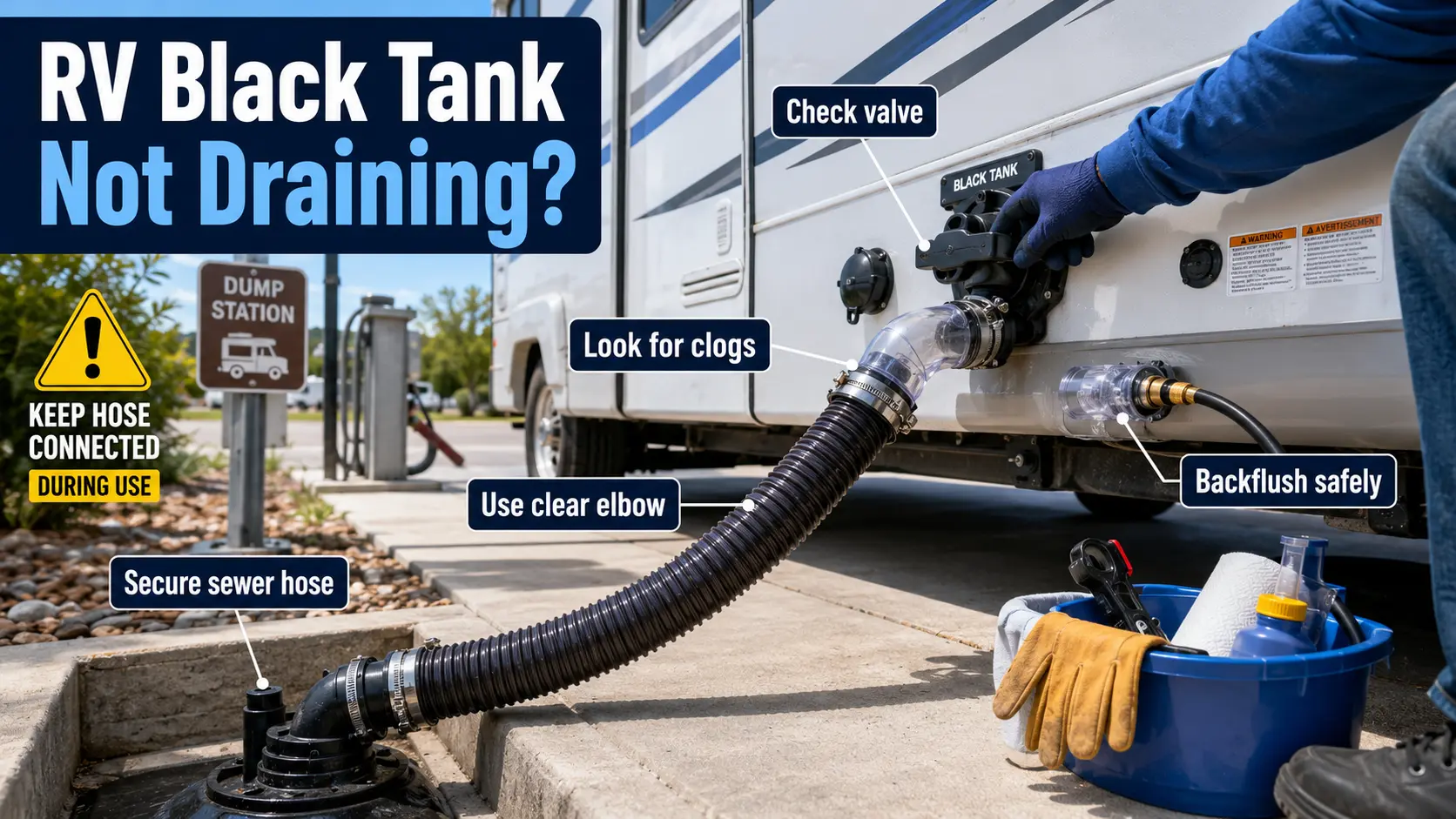
A clear elbow fitting at the sewer connection takes the guesswork out of this. Instead of judging by how the handle feels, you can actually watch what comes out, or doesn’t, when you pull the valve. If you see nothing at all, not even a trickle of clear liquid, that points to the cable or gate rather than a clog, since even a badly clogged tank usually lets some liquid through around the blockage.
Check the Sewer Hose Before You Blame the Tank
Before you assume your tank is clogged, rule out a problem with the hose and connection outside the RV. A kinked hose, a blocked dump station inlet, or grabbing the wrong valve handle can all look exactly like a tank that won’t drain.
- Check for kinks or low spots. A sewer hose that dips in the middle can trap waste and air, which slows or stops the flow even when the tank itself is fine.
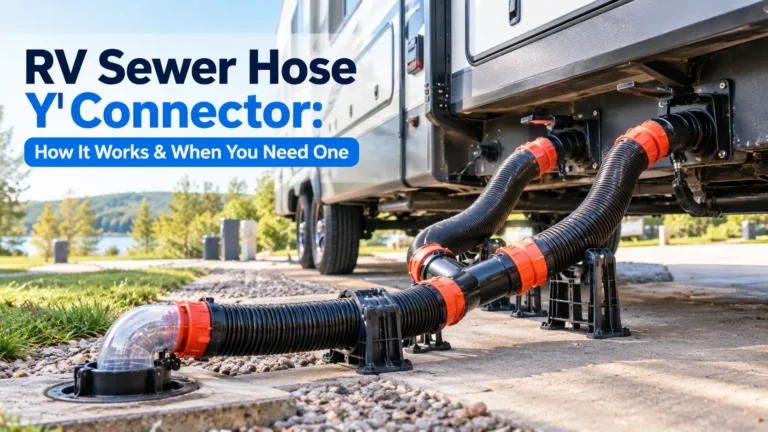
- Confirm the hose has a downhill slope. Waste needs gravity to move through the hose. A proper RV sewer hose support helps maintain a steady downhill run and reduces low spots.
- Look at the clear elbow, if you have one. A clogged or kinked elbow right at the RV’s outlet can block flow before it even reaches the rest of the hose.
- Check the dump station inlet itself. Some inlets back up, especially at busy campgrounds, and that backup can push waste toward your RV instead of away from it.
- Watch for sudden pressure when you remove the cap. If air or liquid pushes out forcefully the moment you open the cap, the tank has been building pressure, which usually points to a vent problem rather than a hose problem.
- Double check which valve you’re pulling. Black and grey valve handles sit close together on a lot of RVs, and pulling the grey valve by mistake looks exactly like the black tank not draining.
Tools and Supplies You May Need
You won’t need all of these for every situation, but it helps to have them ready before you start.
- Rubber gloves
- Clear elbow fitting, so you can see what’s actually draining instead of guessing
- Flashlight
- RV-safe black tank treatment
- Built-in tank flush, a tank wand, or a dedicated backflush adapter with its own shutoff valve
- Extra jugs of water, if you’re not near a hookup
- Hair dryer or heat gun, only for a frozen valve, never an open flame
- Eye protection
Cause 1: Clog at the Valve Outlet
A clog at the valve outlet is toilet paper or solid waste packed into the narrow opening where the tank meets the valve. This is the single most common reason nothing comes out when you pull the handle, since it’s the tightest point in the whole system.
Waste and paper don’t have to fill the entire tank to cause this. A relatively small clump sitting directly over the outlet is enough to block the exit even in a tank that’s mostly liquid.
A warm water flush through the toilet, followed by a short soak, clears a lot of these clogs without any tools. If that doesn’t work, a flexible RV-safe wand inserted through the toilet can reach down and break it up from above.
Cause 2: Too Little Water in the Tank
Too little water in the black tank is one of the most common reasons it won’t drain, even without anything technically clogging it. RV toilets use less than a gallon per flush, and without enough liquid backing it up, solid waste sits dry and heavy at the bottom instead of moving toward the outlet.
This is different from a hard clog, since there’s no single blockage to point to. The waste is just too dry and too dense to slide through the valve opening on its own, especially in a tank that sits close to level or has any low spots where solids can settle.
The fix is usually simple. Add several gallons of water through the toilet, let it sit for 20 to 30 minutes, and try the valve again. If you dump often but only add a splash of water back each time, check this before you assume anything is actually clogged.
Cause 3: Poo Pyramid Blocking the Drop Pipe
A poo pyramid is solid waste that has built up into a cone shape directly under the toilet’s drop pipe instead of spreading out across the tank floor. If it grows tall enough, it can block the drop pipe itself, and in bad cases it reaches all the way down to block the outlet near the valve too.
This usually forms from leaving the black tank valve open at a campsite, or from dumping too often with too little water each time. Either habit leaves solid waste without enough liquid underneath it to settle flat.
If your valve trickles instead of flowing freely, or if you can see waste sitting right under the toilet opening, this is the likely cause. Our full walkthrough on fixing a pyramid plug covers the drive-and-slosh method that uses your own tank water to break it apart.
Cause 4: Blocked Roof Vent
A blocked roof vent can stop a black tank from draining even when nothing else is wrong. Without air coming in through the vent to replace the waste leaving through the valve, the tank creates a partial vacuum that slows or stops the flow, the same way a sealed bottle glugs instead of pouring cleanly.
The vent is a narrow pipe that runs from the top of the tank up through the roof. Leaves, insect nests, or a cracked cap can all block it, and you often won’t know until you’re standing at the dump station wondering why the valve is fighting you.
A simple test, outlined by Park and Purge: have someone flush the toilet while you check for a slight puff of air at the roof vent opening. If you don’t feel one, and you’re also hearing gurgling from inside, the vent is worth checking before you assume anything’s actually clogged. Our guide to a clogged black tank vent covers how to clear it safely from the roof.
Cause 5: Black Tank Valve Isn’t Opening Fully
A cable-operated black tank valve can stick without opening all the way, which restricts drainage even though the tank and toilet are otherwise fine. The valve doesn’t have to be fully stuck to cause a problem. Even a partial opening is enough to turn a normal dump into a slow, frustrating trickle.
Dried-out seals, debris packed around the gate, and a cable that’s stretched or come loose at one end are the usual culprits. Daisy RV’s troubleshooting guide notes that buildup around the gate mechanism gets worse without enough water at each flush, and that cold weather makes an already-worn valve stick even more.
Pull the handle and pay attention to how it feels. A valve that offers no resistance at all, like it’s pulling air instead of metal, often means a disconnected cable rather than a stuck gate. Our guide on fixing a stuck black tank valve walks through diagnosis and safe lubrication.
Cause 6: Frozen Tank or Valve
In freezing temperatures, the waste and water inside a black tank can freeze into a solid mass, and the valve itself can freeze shut even if the tank isn’t frozen all the way through. If nothing drains and the temperature has been below freezing, treat this as a frozen tank before you assume it’s a clog.
Thaw the tank gradually rather than the valve first, since frozen plastic fittings turn brittle and can crack under pressure. RV LIFE’s guide to frozen holding tanks recommends a hair dryer or heat gun kept in constant motion rather than an open flame, since RV tank walls can melt with too much direct heat in one spot. Work from the top of the tank down, and handle the valve itself last, once things have warmed up.
Once everything’s thawed, adding a small amount of RV antifreeze through the toilet helps keep the tank from refreezing on your next cold night out.
Cause 7: Bad Sensor Reading (Tank Not Actually Full)
Sometimes the tank isn’t clogged at all. It’s just reading wrong. Waste and paper residue sticking to the sensor probes can make a tank show full when it’s actually empty, or show normal when it’s packed solid, and that misread can send you looking for a blockage that isn’t really there.
A few signs point to a sensor problem instead of a real physical blockage:
- The clear elbow shows little or nothing coming out, even though the monitor read full, because the tank was already close to empty.
- The toilet bowl water level and flush strength are normal, which rules out a water flow problem upstream.
- There’s no odor or backpressure at the toilet, which you’d usually notice if waste were genuinely stuck somewhere.
- You dumped recently and the monitor already reads full again, often within minutes, which points to residue on the probes rather than a fast refill.
If this matches what you’re seeing, the tank is probably draining just fine and the sensor is the real problem. Our guide to a black tank sensor that reads full after dumping covers cleaning and fixing the probes directly.
How Do You Safely Backflush a Black Tank That Won’t Drain?
Backflushing means forcing water in through the outlet to break up a clog from below, but it only works with the right equipment. Simply opening your grey tank valve at the same time as the black valve usually won’t push water backward into the black tank, since a connected sewer hose gives the water an easy path straight out instead. A real backflush needs the outlet closed off, using something like a twist-on gate valve or a dedicated backflush adapter, so the water has nowhere to go but back into the tank.
You’ll see a grey-tank trick described a lot online: open the black valve, crack the grey valve, and let grey water push the clog loose. In practice this only works if the sewer hose outlet is blocked downstream, for example with a twist-on valve capped off at the far end. Without that, the grey water just runs straight through the open hose the same way the black water did, and nothing backs up into the tank at all.
There’s also a real reason not to improvise this without the right fitting. Forcing water backward through an open system risks pushing waste back up through the grey tank’s plumbing instead of into the black tank, since grey tank drains connect to your sink and shower with less of a seal than the toilet’s flush ball. That’s not worth risking to save a few dollars on a fitting.
The safer, more reliable options:
- A built-in black tank flush system, if your RV has one, since it sprays water directly at the tank walls and outlet through its own dedicated line. Our guide to the black tank flush system covers how to use it without flooding anything.
- A tank wand inserted through the toilet, which reaches the clog from above instead of trying to force water backward.
- A dedicated backflush adapter, like a reverse-flush valve with its own gate. Products built for this use a gate valve specifically to seal the hose outlet before backfilling the tank, which is the part an improvised grey-tank trick is usually missing. A clear adapter also lets you watch the water directly until it actually runs clear, instead of guessing.
Whichever method you use, keep a few things non-negotiable: the sewer hose stays securely connected on both ends the entire time, a clear elbow lets you see what’s happening instead of guessing, and you never use a pressure washer, an open or uncapped connection, or a loose hose fitting to force water into the tank. Any of those can blow a fitting loose or send waste somewhere you don’t want it.
What to Do If Your Black Tank Won’t Drain at the Dump Station
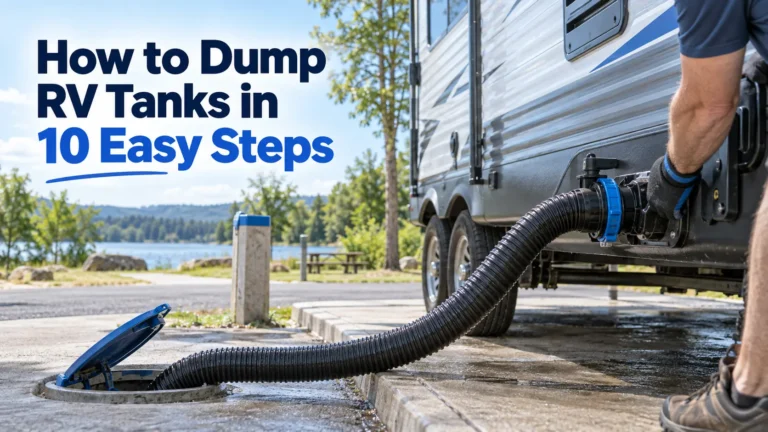
If this is happening right now and you’re standing at the dump station, work through these steps in order instead of forcing anything.
- Stop pulling or forcing the valve. Repeated forcing is how a simple clog turns into a cracked valve.
- Make sure the sewer hose is connected and sealed on both ends before you do anything else.
- Check the handle for resistance. Heavy resistance points to a clog or a partly frozen valve. No resistance at all points to a cable problem.
- Add water through the toilet if you can, even a few gallons.
- Let it sit for 20 to 30 minutes. Time and water solve more of these problems than any tool does.
- Try a controlled backflush only if you have the right fitting, like a backflush adapter or built-in flush system. Skip this step if you don’t have the equipment for it.
- If the tank is full and still won’t budge, stop and call a mobile RV tech rather than continuing to force it. Driving away with a full tank is safer than cracking a valve or a fitting.
What Not to Do
A few habits turn a manageable problem into an expensive one.
- Don’t force a stuck or frozen valve. A brittle or frozen fitting can crack under pressure, turning a clog into a leak.
- Don’t use household drain cleaner. Dometic’s own toilet manual warns against chlorine or caustic chemicals, including drain-opening products, since they damage the rubber seals in toilets and plumbing valves. Thetford’s owner’s manuals carry the same warning against scouring powders, acids, and concentrated cleaners, for the same reason.
- Don’t backflush with an open hose, a pressure washer, or a loose fitting. Without a properly closed-off outlet, you’re pushing water and waste somewhere you don’t want it instead of clearing the clog.
- Don’t keep opening and closing the valve hoping it clears on its own. Repeated cycling wears out the gate seal faster than it clears a clog.
- Don’t drive off with a full tank assuming the road will sort it out. Movement helps loosen buildup, but it won’t fix a real blockage at the outlet.
- Don’t use a rigid metal snake in the drop pipe or valve. RV plumbing is shorter and more fragile than home plumbing, and a stiff snake can puncture a fitting.
Prevention: Keep This From Happening Again
- Add enough water with every flush, not just when you remember to. This is the single easiest way to prevent dry waste and poo pyramids at the same time.
- Keep the valve closed until the tank is at least two-thirds full whenever you’re hooked up at a campsite.
- Add water back to the tank after every dump, before you use the toilet again.
- Use RV-safe toilet paper, or less of it, so it breaks down before it reaches the outlet.
- Support your sewer hose so it runs downhill without dips or kinks, especially at sites with an awkward sewer connection.
- Flush the tank thoroughly after dumping, using a built-in flush system or a wand, rather than just closing the valve and moving on. A tank that drains fully also smells better, which our guide on odor after dumping the black tank covers in more detail.
- Use enzyme tank treatments on a regular schedule, not just when something’s already wrong. Walex explains that enzyme-based treatments start breaking down paper and waste immediately, unlike bacteria-only products that need time to build up effectiveness first. Keep in mind that enzyme treatments can leave a sticky film on tank sensors if the waste doesn’t fully break down, so pair them with regular water and full dumps rather than relying on chemicals alone.
- Insulate exposed valves and check them before cold trips if you camp anywhere near freezing temperatures.
When to Call an RV Tech
Most drainage problems are a DIY fix. Call a professional if you run into any of these:
- Nothing drains no matter what you try, and you’ve confirmed the tank isn’t frozen.
- The valve handle or cable feels broken, disconnected, or comes out entirely.
- You suspect a cracked tank, a damaged fitting, or a leak you can see or smell.
- If an inspection confirms that the tank itself is cracked beyond repair, check our black tank replacement costs guide to compare tank prices, labor, and DIY expenses before approving the work.
- The toilet itself needs to come off to access a deeper blockage.
- You’re not confident working under the RV, especially around cold, frozen, or corroded fittings.
If it turns out the toilet itself is the real problem rather than the tank, whether it’s old, cracked, or just past its useful life, our porcelain RV toilet buyer’s guide can help you pick a solid replacement before you call anyone out.
Conclusion
A black tank that won’t drain is almost always one of seven things: a clog at the valve, too little water, a poo pyramid, a blocked vent, a valve that isn’t opening fully, a frozen tank, or a sensor reading wrong. Rule out your sewer hose and setup first, since that’s an easy fix that gets overlooked under pressure.
Most of these clear up with water, time, and the right fitting, not force. Keep your valve closed between dumps, add enough water with every flush, and use a proper backflush adapter or built-in flush system instead of improvising with an open hose. When you do hit a stubborn one, work through the dump station steps above calmly, and call a tech before you force anything that could crack.
Frequently Asked Questions
Why won’t my RV black tank drain even though the valve is open?
The most likely causes are a clog right at the valve outlet, too little water, a poo pyramid, a blocked roof vent, a valve that isn’t opening all the way, a frozen tank, or a sensor reading wrong. Check your sewer hose connection first, then the valve handle for resistance.
Can a frozen black tank valve be forced open?
No. Frozen plastic fittings become brittle, and forcing a frozen valve can crack it. Thaw the tank gradually with a hair dryer or heat gun, working from the top of the tank down, and handle the valve last.
Is it normal for grey water to drain but not black?
Yes, this is common and usually points to a black-tank-specific problem rather than something wrong with your dump setup overall. It also means opening the grey valve during a black tank dump usually won’t backflush the black tank on its own, unless the hose outlet is closed off with the right fitting.
How do I know if my black tank is actually full versus clogged?
A clear elbow fitting at the sewer connection is the most reliable way to tell. If your tank monitor reads full but the clear elbow shows little or nothing coming out, that points to a sensor reading residue on the probes rather than a real blockage. If nothing comes out at all no matter what the monitor says, that points to a physical clog, vent, or valve problem instead.
Can I use Drano or a chemical drain opener on a stuck RV black tank?
No. Dometic’s and Thetford’s toilet manuals both warn against chlorine, caustic, or concentrated cleaning chemicals, since they damage the rubber seals in toilets and plumbing valves. Stick to RV-safe tank treatments, water, and a proper backflush adapter instead.