TL;DR
The best composting toilet for RV use is the Nature’s Head for most people. It has proven durability, a compact footprint, and strong odor control when installed correctly. A composting toilet is worth it if you boondock often or want to skip black tank dumping. But it is not maintenance-free. You still need to empty it, manage moisture, and install a vent line.
If you spend any time at RV dump stations, you already know the drill. You pull up, connect the hose, and hope nothing splashes back. It is one of the least enjoyable parts of RV life.
Composting toilets for RVs promise a cleaner alternative. No black tank. No dump station runs. Better off-grid freedom. That pitch is mostly true, but the wrong best composting toilet for RV choice can leave you with smell problems, an overflowing solids bin, or a unit that simply does not fit your bathroom.
This guide covers seven real options. We compare them by RV bathroom size, odor control, power needs, capacity, and emptying style. We will tell you who each toilet is good for, and who should skip it.
Quick Answer: Best Composting Toilet for RV Buyers
Short answer: Nature’s Head is the most proven and widely used composting toilet for RV owners. If you have a compact bathroom or want a no-install option, the Cuddy Lite is the easiest starting point. For automatic mixing, the OGO Origin is the most popular newer option.
| Use Case | Best Pick |
|---|---|
| Best overall | Nature’s Head |
| Best for compact full-time RV use | Air Head |
| Best automatic mixing | OGO Origin |
| Best easy-empty small RV option | Cuddy (CompoCloset) |
| Best compact portable option | Trelino Evo L |
| Best budget or weekend option | Boxio |
| Best for larger fixed installs | Separett Tiny |
Best Composting Toilets for RV Compared
Short answer: Every composting toilet on this list separates liquid from solid waste. That separation is what controls odor. The differences come down to how solids are mixed, how power is used, how much space you need, and how often you empty each chamber.
| Toilet | Best For | Vent/Fan Needed? | Power | Liquid Capacity | Solid Capacity | Install Difficulty | Full-Time Use? | Avoid If |
|---|---|---|---|---|---|---|---|---|
| Nature’s Head | Most RV owners, boondockers | Yes, 12V fan included | 12V (0.07A draw) | 2.2 gal | 60-80 solid uses | Moderate | Yes | You want zero power draw |
| Air Head Classic | Full-time RV couples | Yes, 12V fan included | 12V | Compact tank | Up to 80 weekend uses; 60 uses/month for couple | Moderate | Yes | You need max solids capacity |
| OGO Origin | Auto mixing preference | Yes, fan included | 12V DC | 2.4 gal | 25-30 solid uses | Moderate | Yes (empty more often) | You hate tech-dependent parts |
| Cuddy Lite (CompoCloset) | Shorter trips, no-install setups | Optional (not included) | 9V battery for LED only | 1.7 gal | 5-10 uses (about 1 week) | Zero | Light use only | Full-time couples |
| Trelino Evo L | Compact van or RV, no-power use | Not required | None | 2.6 gal urine | 2.6 gal solids (11-20 uses) | Zero | Light to moderate | Full-time families or couples |
| Boxio Toilet | Weekend campers, tight budget | Not required | None | 5L urine canister | 8-10 solid uses | Zero | No | Regular or full-time use |
| Separett Tiny | Larger RVs with reliable power | Yes, fan required | 12V or 110-240V | 7.1L tank | 14.5L solids container | Moderate | Yes (if space allows) | Small bathrooms |
1. Nature’s Head Composting Toilet: Best Overall for RVs
Best for: Full-time RV owners, boondockers, and anyone who wants a well-tested unit with strong community support.
Avoid if: You need zero electrical draw or want automatic mixing without a manual crank.
Why it works in an RV
The Nature’s Head was designed with small spaces in mind. According to the Nature’s Head product page, it measures 21″H x 19″W x 19″D with the Spider handle, or 21″H x 20″W x 19″D with the Foot Spider handle, and weighs 23 lbs. That footprint fits most standard RV bathrooms. The fan draws just 0.07 amps, which is low enough to run for weeks off a standard marine battery or small solar setup.
It separates urine and solids at the point of use. The liquid bottle holds 2.2 gallons and needs emptying every few days for a couple. The solids bin uses a manual spider handle to mix the composting medium. The solids bin holds approximately 60 to 80 uses before emptying.
Pros
- Long track record among RV and boat owners
- Compact footprint fits most standard RV bathrooms
- Very low 12V fan draw (0.07A) works on small solar setups
- Strong spare parts availability
- Large, active owner community for troubleshooting help
Cons
- Manual crank mixing (not automatic)
- Recessed bolt pattern can make installation tricky on some RV floors
- Higher upfront cost compared to budget options
Installation notes
You need to run a vent line from the unit to the outside of the RV. The unit attaches to the floor with two L-brackets and a single 12V power hookup. The vent line is typically routed through a sidewall or roof. The Nature’s Head vent kit uses 1.25″ PVC pipe connection fittings.
Odor-control notes
When installed correctly with a working vent fan, the Nature’s Head should not smell like sewage. A faint earthy smell is normal. The key is keeping the solids bin dry. Too much liquid in the solids bin is the number one cause of smell problems.
Emptying notes
The liquid bottle needs emptying every 2 to 5 days depending on use. The solids bin holds approximately 60 to 80 uses before emptying. For a couple using it full time, the manufacturer notes this works out to roughly 4 to 6 weeks between solids empties. Solids can typically be bagged and placed in trash receptacles where allowed or composted off-site according to local regulations.
Verdict
The Nature’s Head is the safest choice for most RV owners. It is well-tested, widely supported, and fits most RV bathrooms. If you want something that works reliably and has a large owner community, start here.
2. Air Head Composting Toilet: Best for Compact Full-Time RV Setups
Best for: Full-timers with tight bathroom layouts who want a proven unit with a slightly smaller profile.
Avoid if: You want the largest possible solids capacity or plan to skip the vent installation.
Why it works in an RV
The Air Head has been made in the USA since 2001. Like the Nature’s Head, it separates urine and solids, uses a 12V fan, and requires a vent line. It comes with stainless steel hardware and rubber seals between the lid, bowl, and tank. According to Air Head’s product page, the solids tank holds approximately 5 gallons and is rated for up to 80 uses.
Per the Air Head functionality page, that 80-use rating is based on two persons using it twice per weekend across a five-month camping season. For a full-time liveaboard couple, the same page notes about 60 uses per month before the solids bin needs emptying.
Pros
- Compact design built for RV and marine use
- Rubber seals make it effective in wet bath or shower-adjacent installations
- Made in the USA with stainless steel hardware
- Good documentation and customer support
- 5-year warranty
Cons
- Similar price range to Nature’s Head
- Smaller user community means fewer online troubleshooting discussions
- Still requires a vent line installation
Odor-control notes
The 12V fan draws air through the unit and out the vent. Keep the solids dry and the vent clear and you will not have sewage smell.
Verdict
If the Nature’s Head does not fit your space or you prefer the Air Head’s design and mixing mechanism, this is a strong alternative for full-time use. The two toilets are closely matched in quality and performance.
3. OGO Origin: Best Automatic Mixing Composting Toilet for RVs
Best for: RV owners who want a modern compact design and automatic electric mixing without a manual crank.
Avoid if: You want the highest solid capacity in its size class, or you dislike depending on electric parts.
Why it works in an RV
The OGO Origin is one of the most compact composting toilets available. According to the OGO product page, it measures 16″ wide, 15″ deep, and 18.375″ tall. The electric agitator mixes solids automatically with the push of a button.
The OGO runs entirely on 12V DC power, which is important to get right. Per the OGO power guide, the fan draws approximately 0.48 Ah per day and the motor draws approximately 0.3 Ah per day. A 12V power cable is included. A separate adapter is required if you are connecting to a 110V household outlet.
One important note on capacity: the OGO holds approximately 25 to 30 solid uses before the solids bin needs emptying. That is less than Nature’s Head or Air Head. For a couple, plan to empty the solids bin more frequently than with those units.
Pros
- Automatic mixing with electric agitator
- One of the smallest footprints available in a powered composting toilet
- Modern design fits well in van builds and compact RVs
- Built-in urine level sensor indicator
- Growing owner community
Cons
- Smaller solids capacity (25-30 uses vs 60-80 for Nature’s Head and Air Head)
- Electric agitator adds a component that can eventually fail
- Replacement parts less available in remote locations compared to Nature’s Head
Odor-control notes
The continuously running fan exhausts moisture and odor through the vent line. The built-in urine trap door keeps liquid out of the solids bin, which is the main odor control mechanism.
Verdict
The OGO Origin is the best pick if automatic mixing and a compact footprint are your priorities. Just plan for more frequent solids emptying than Nature’s Head or Air Head. It is a well-built unit with a modern design.
4. Cuddy: Best Easy-Empty Toilet for Full-Trip RV Use
Best for: RV owners who want a portable or semi-permanent install with a true composting system and simpler emptying than traditional fan-based units.
Avoid if: You have multiple full-time users or need continuous ventilation already set up.
What is the Cuddy, and who makes it?
The Cuddy and Cuddy Lite are both made by CompoCloset, a UK/USA company founded in 2021. They are separate products with different systems. This is an important distinction to get right before buying.
Cuddy (full version): Has a built-in manual agitator and a true composting system. According to the CompoCloset comparison page, it holds approximately 20 to 25 solid uses before the bin needs emptying. An optional fan and carbon filter are available. When installed with the fan, it works well for extended trips and full-time use.
Cuddy Lite: No agitator. Uses a bag-and-layer method for solids instead. It holds approximately 5 to 10 solid uses (about 1 week for a couple). A fan is not included and not required. It is simpler and more portable. It is not designed for full-time couple use without very frequent emptying.
According to the CompoCloset comparison page, both models share the same 1.7-gallon urine container and the same urine level LED indicator.
Pros
- No tools, no floor screws required for basic use
- Carbon filter option means no vent hose through the wall is required
- Agitator supports real composting in the solids bin
- Compact dimensions fit small RV bathrooms
Cons
- Smaller solids capacity than Nature’s Head or Air Head
- Cuddy Lite (bag-and-layer) needs emptying about weekly for a couple
- Fan and filter are optional add-ons, not included with base Cuddy Lite
Verdict
Choose the full Cuddy if you want an easy-to-install composting toilet with real composting capacity for weekend to extended trips. Choose the Cuddy Lite only for solo or light use on shorter trips. Do not choose the Cuddy Lite as your only toilet for full-time couple use.
5. Trelino Evo L: Best Compact Portable Composting Toilet for RVs
Best for: Van lifers, solo weekend campers, and RV owners who want a lightweight, no-power separating toilet.
Avoid if: You camp as a couple or family full-time, or want a permanent installation.
Why it works in an RV
Trelino makes a range of urine-diverting separating toilets in three sizes: S, M, and L. They are produced in Germany from recyclable materials. None of the Evo models require a fan or power.
The Evo S measures 13″W x 15.4″D x 11.7″H and weighs just 8.6 lbs. It holds 1.2 gallons of urine and 1.6 gallons of solids. Because the containers are so small, Trelino notes an emptying cycle of 1 to 3 days depending on use.
For an RV install, the Evo L is a better fit. It holds 2.6 gallons of urine and 2.6 gallons of solids and measures 13″W x 15.4″D x 16.9″H. Trelino specifically recommends the Evo L for RVs, Skoolies, and large vans.
Pros
- No power required
- Very compact and lightweight
- Clean, modern design produced in Germany
- No fan means no vent hose installation
- Water resistant exterior
Cons
- Small S and M models need very frequent emptying (1-3 days)
- No built-in fan means you rely on short emptying cycles for odor control
- Not designed for full-time couple use without the Evo L
Verdict
The Trelino Evo L is the right model for RV use if you want no-power simplicity. The Evo S is too small for more than one person unless you are on a very short trip. For solo travelers and weekend campers, the Evo S or M is a good fit.
6. Boxio: Best Budget Composting Toilet for Weekend RVers
Best for: Weekend campers who want a simple, inexpensive separating toilet with no installation and no power.
Avoid if: You camp more than a few nights at a stretch, or want a permanent install.
Why it works in an RV
The Boxio is a German-made separating toilet built around a stackable Eurobox format. It requires zero installation and zero power. According to the Boxio product page, the unit measures 15.7″ x 11.8″ x 11″ and handles approximately 8 to 10 toilet visits before emptying. It weighs 6.2 lbs. Solid waste goes into a separate container with a biodegradable bag and hemp litter for odor control.
At roughly $179, it is the most affordable option on this list by a wide margin.
Pros
- Very low cost
- Zero installation and zero power
- Easy to clean and store when not in use
- Made in Germany from recycled plastic
Cons
- 8 to 10 uses between empties is very limited
- Low seat height requires an optional booster seat for comfort
- Not a full composting system
- Not suitable for full-time use
Verdict
The Boxio is ideal for weekend campers who want to avoid a cassette toilet without spending much. Do not use it as a primary toilet for any trip longer than a weekend. For anything beyond short trips, the Trelino or Cuddy Lite is a better investment.
7. Separett Tiny: Best for Larger RVs and Fixed Installations
Best for: RV owners with larger dry bathrooms, reliable power access, and a need for a high-capacity, low-maintenance unit.
Avoid if: Your RV bathroom is compact, or you do not have reliable power at your toilet location.
Why it works in an RV
The Separett Tiny is a Swedish-made urine-diverting toilet designed for small spaces including vans, boats, and RVs. It does not require composting medium or cranking. Solid waste goes directly into a compostable bag inside a 14.5L solids container. The urine container holds 7.1 liters.
According to the Separett product page, the fan runs on 12V or 110-240V AC power. The fan draws 1.6W and 210mA, making it suitable for solar and battery setups. A 12V 100Ah battery can power the fan for approximately 3 to 4 weeks. The vent pipe is 50mm in diameter and includes a connector to standard 1.5″ PVC pipe.
Pros
- Large 14.5L solids container
- No composting medium, no cranking
- Runs on 12V or 110-240V (flexible power options)
- View screen hides waste from sight
- 5-year warranty
Cons
- Requires more bathroom space than Nature’s Head or OGO
- Biodegradable bags are an ongoing cost
- More complex install than portable options
- Best suited to larger dry bathrooms
Verdict
The Separett Tiny is a good fit for larger Class A or Class C motorhomes with a proper, separate dry bathroom, reliable power, and enough clearance for the vent pipe. For smaller rigs or boondocking setups, the Nature’s Head or OGO is a better fit.
Is a Composting Toilet Actually Good for RV Use?
Short answer: Yes, for the right owner. A composting toilet works best for boondockers, solo travelers, and couples who want to skip black tank dumping. It is not maintenance-free, and it is not ideal for families with young children or people who dislike handling waste.
Best use cases
Composting toilets work well when you are off-grid for extended periods. Without a black tank to manage, you can stay longer in remote spots without planning around dump stations. They also use very little water, since most require no flush water at all.
For full-time RV dwellers, a composting toilet can simplify the routine. You empty the liquid every few days and the solids every few weeks, depending on use.
Not always the right fit
A composting toilet is not maintenance-free. You need to manage moisture in the solids bin, keep the vent working, and empty both chambers regularly. If you expect to install it and forget about it, you will end up with smell problems.
Families with multiple children will find most composting toilets fill up faster than advertised. Guests who are unfamiliar with the system can use it incorrectly, which also causes problems. For family RVs with heavy use, a standard RV toilet connected to a well-maintained black tank may be simpler. See our full breakdown of the tradeoffs in our article on RV composting toilet pros and cons
Composting Toilet vs Regular RV Toilet vs Cassette Toilet
Short answer: Each toilet type has a different set of tradeoffs. The right choice depends on how you camp, how many people use the bathroom, and how much maintenance you are willing to do.
| Toilet Type | Best For | Main Benefit | Main Downside | Who Should Choose It |
|---|---|---|---|---|
| Composting toilet | Boondockers, off-grid campers | No black tank, no dump station | Cost, maintenance, learning curve | Full-timers, boondockers, eco-minded RVers |
| Regular RV toilet | Most RV owners | Familiar, simple, works with black tank | Requires dump station access | Campground users, families, beginners |
| Cassette toilet | Weekend or van campers | Portable, no permanent install | Small tank, frequent emptying | Van lifers, weekend campers |
| Portable toilet | Backup or budget use | Zero install, very low cost | Small capacity, less comfortable | Emergency backup, very short trips |
If you are thinking about switching from a standard RV toilet to a composting model, read our guide on best RV toilet replacement before you buy.
How to Choose the Best Composting Toilet for Your RV
Short answer: Measure your bathroom before anything else. After that, think about power access, vent path, how many people use the toilet, and how often you camp.
Measure your RV bathroom first
Get the exact width, depth, and height available at your toilet location. Include clearance for the seat to open fully. Most composting toilets are wider than a standard RV toilet. Check the manufacturer’s dimension specs carefully before ordering.
Check front clearance for urine bottle removal
The liquid bottle on most composting toilets removes from the front of the unit. You need enough floor space in front of the toilet to pull the bottle out and carry it to a disposal point without spilling. If your bathroom door swings inward and blocks the front, this can be a real problem.
Decide if you can install a vent
Almost every fan-based composting toilet needs a vent line routed to the outside of the RV. Nature’s Head and Air Head use 1.5″ or 1.25″ connections. Separett Tiny uses a 50mm pipe with a 1.5″ PVC adapter. The Cuddy uses an optional vent or carbon filter. You need to plan a route from the toilet to an exterior wall or roof before buying.
Check 12V fan or power needs
If you camp off-grid, you want a toilet with a low-draw 12V fan. The Nature’s Head fan draws just 0.07A, and the Separett Tiny fan draws 210mA at 1.6W making both very solar-friendly. The OGO Origin runs on 12V DC and draws 0.48 Ah/day for the fan and approximately 0.3 Ah/day for the motor.
Think about full-time vs weekend use
Weekend campers can use smaller options like the Trelino or Boxio. Full-time users or couples need the higher capacity of the Nature’s Head, Air Head, or Cuddy (full version). Manufacturer capacity claims are typically based on one adult. Adjust your expectations when two or more people use the toilet daily.
Choose between manual crank, electric agitator, and liner system
Manual crank: Nature’s Head, Air Head, Cuddy. Simple and nothing to break. You turn a handle or crank after each solid use.
Electric agitator: OGO Origin. Convenient but adds one more electric component.
Bag-and-layer system: Cuddy Lite, Separett Tiny. Simplest emptying. No loose compost to handle.
Consider dry bath compatibility
Composting toilets are not designed to get wet. If your toilet sits in a wet bath where the shower sprays across the floor, the toilet needs to be protected or you need a model with rubber seals (Air Head). Check your bathroom layout carefully.
Check emptying frequency
Match the toilet’s capacity to your camping style. The OGO’s 25 to 30 solid uses per bin means more frequent empties than the Nature’s Head’s 60 to 80 uses. The Boxio’s 8 to 10 uses means daily or near-daily empties for couples.
Think about guests and family use
Guests who have never used a composting toilet often aim incorrectly, sending liquid into the solids bin. This is the fastest way to create smell problems. Plan to brief every new user before they use it.
Does an RV Composting Toilet Smell?
Short answer: A properly maintained composting toilet should not smell like sewage. A faint earthy smell is normal. Actual sewage smell means something is wrong.
| Smell Problem | Likely Cause | Fix |
|---|---|---|
| Urine smell | Bottle too full, spillage, or poor sealing | Empty more often, clean bottle seals, check divider alignment |
| Earthy or musty smell | Normal composting process | Acceptable; add more composting medium if very strong |
| Sewage smell | Too much liquid in solids bin | Empty, dry out solids bin, improve aiming, add more medium |
| Bathroom smell near base | Poor vent seal or fan not working | Check vent connection, confirm fan is running |
| Fruit flies or gnats | Solids too wet, uncovered bin | Dry the bin, check for cracks, use diatomaceous earth if needed |
The most important rule is to keep liquids out of the solids bin. The fan and vent only work well if the solids stay dry. If liquid gets into the bin regularly, the composting process becomes anaerobic and that is when you get sewage smell. For more on smell problems, see our full guide on RV toilet smell problems.
What Happens to Your RV Black Tank?
Short answer: When you switch to a composting toilet, you leave the black tank behind. Most owners cap the toilet flange and leave the black tank in place. Some repurpose it as additional gray water capacity. Neither change is simple, and you should understand your RV plumbing before attempting either.
Capping the toilet flange
The toilet flange is the drain opening in your RV bathroom floor. When you remove the standard RV toilet, the flange is exposed. It must be capped or sealed to prevent black tank gases from entering the RV. A proper cap is inexpensive, but the flange must be cleaned and sealed correctly or you will have a persistent odor problem.
Repurposing the black tank
Some full-time RV owners convert their black tank to a second gray water tank after switching to a composting toilet. This requires modifying your RV’s plumbing to re-route gray water lines. This is not a beginner project. If you are not familiar with RV plumbing, hire an RV technician for this work.
How Often Do You Empty an RV Composting Toilet?
Short answer: The urine bottle needs emptying every 1 to 5 days depending on use and model. The solids bin varies widely by toilet: from every few days for the smallest models to every 4 to 6 weeks for the larger ones.
| User Type | Urine Bottle | Solids Bin |
|---|---|---|
| Solo weekend camper | Every 3 to 5 days | Every 6 to 8 weeks (Nature’s Head/Air Head) |
| Couple weekend camper | Every 1 to 3 days | Every 3 to 5 weeks (Nature’s Head/Air Head) |
| Solo full-timer | Every 2 to 4 days | Every 5 to 8 weeks (Nature’s Head/Air Head) |
| Couple full-timer | Every 1 to 2 days | Every 3 to 4 weeks (Nature’s Head/Air Head); every 1 to 2 weeks (OGO) |
| Family of 3 to 4 | Daily or more | Every 2 to 3 weeks |
These estimates apply to Nature’s Head and Air Head. The OGO Origin has a smaller solids bin at 25 to 30 uses, so empty more often. The Air Head’s own page notes a full-time couple can expect about 60 uses per month.
If zero installation matters more than long-term off-grid capacity, compare these portable RV toilet options before committing to a composting system.
Where Do You Empty Composting Toilet Waste?
Short answer: Urine can typically be emptied at a dump station, into a regular toilet, or diluted and poured onto soil away from water sources where local rules allow. Solid waste disposal rules vary by location. Always check local and campground rules first.
Urine disposal
Treat urine as liquid human waste. Empty it into a flush toilet, at an RV dump station, or an approved disposal point. Only pour diluted urine on soil where local rules allow it, and never near water, trails, or campsites. According to Leave No Trace principles, waste of any kind should be disposed of at least 200 feet from water, camp, and trails. Some national parks and campgrounds have specific rules, so check before you empty.
Solid waste disposal
Solid waste from a composting toilet is not the same as finished compost. It takes more time to break down. Most RV owners bag the solids in a biodegradable bag and place it in a trash receptacle where this is permitted. Check campground and local rules before doing this, as some locations do not allow human waste in trash containers.
Do not apply partially composted human waste to edible garden plants. Do not empty any composting toilet waste near lakes, rivers, streams, or trails. Rules vary by campground, city, state, and public land area. Check the rules where you camp before you empty solids.
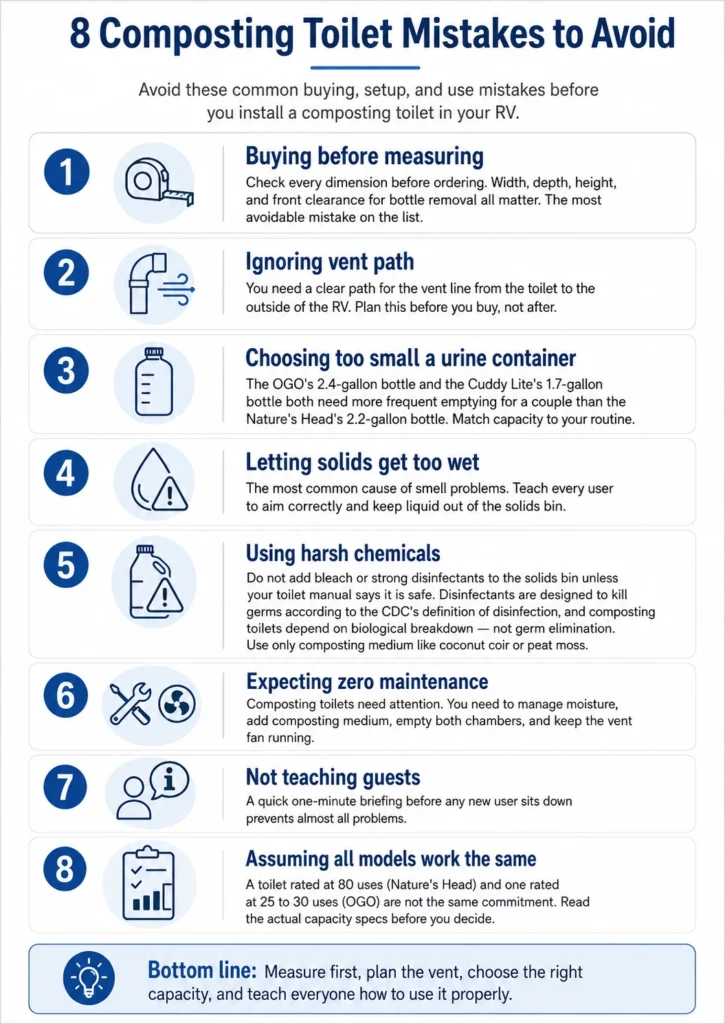
Common Beginner Mistakes
Short answer: Most composting toilet problems come from a few avoidable mistakes. Buying before measuring, ignoring vent paths, and letting solids get too wet are the top three.
Final Verdict: Which RV Composting Toilet Should You Buy?
Short answer: For most RV owners, the Nature’s Head is still the safest choice. It has the longest track record, the best community support, and the highest solids capacity in its size class. Match the toilet to how you actually camp.
- Choose Nature’s Head if you want a proven, reliable unit with a large support community, 60 to 80 uses per solids bin, and very low 12V draw.
- Choose Air Head if the Nature’s Head does not fit your space or you need wet-bath rubber seal protection, and a 5-gallon capacity solids tank.
- Choose OGO Origin if you want automatic mixing and a compact 15″ x 16″ footprint and are OK with more frequent solids emptying (every 25 to 30 uses).
- Choose Cuddy (full version) if you want zero-screw installation, optional ventilation, and a real composting system good for 2-plus weeks for a couple.
- Choose Cuddy Lite only for solo or very light use on shorter trips. Its 5 to 10 solid uses before emptying is not practical for full-time couple use.
- Choose Trelino Evo L if you want a no-power, no-vent option for a campervan or weekend RV with one or two users.
- Choose Boxio if you are a weekend camper with a tight budget and can empty the 8 to 10 solid uses capacity frequently.
- Choose Separett Tiny if your RV has a larger, separate dry bathroom, reliable 12V or AC power, and you want a no-crank bag-based system with a large 14.5L solids container.
Before you buy anything, measure your bathroom, plan your vent path, and decide whether you want a portable or permanent installation. Read our guide on best RV toilet replacement and our article on RV composting toilet pros and cons before you spend $300 to $1,000 on any unit.
A composting toilet is a real upgrade for the right RV owner. Take the time to research your specific rig before buying.
Frequently Asked Questions
What is the best composting toilet for an RV?
The Nature’s Head is the best overall composting toilet for most RV owners. It measures 21″H x 19-20″W x 19″D (width varies by handle model), holds 2.2 gallons of liquid and 60 to 80 solid uses, and runs on a 0.07A 12V fan that is easy on solar setups. For automatic mixing in a smaller footprint, the OGO Origin is the best alternative. For portable use with no installation, the Cuddy Lite is the easiest to start with.
Are composting toilets worth it in an RV?
Yes, for the right owner. If you boondock often, dislike dump station runs, or want to use less water, a composting toilet is worth the upfront cost. It is not worth it if you mostly stay at full-hookup sites, travel with a large family, or do not want to manage waste directly. The maintenance is manageable but real.
Do RV composting toilets smell?
A properly maintained composting toilet should not smell like sewage. Most users notice a faint earthy smell at most. Sewage smell is a sign that too much liquid has gotten into the solids bin, the vent fan is not working, or the vent line is blocked. Good user habits and a working fan vent prevent almost all odor problems.
How often do you empty an RV composting toilet?
For a couple using the toilet full-time, the urine bottle needs emptying every one to two days and the solids bin roughly every three to four weeks for a Nature’s Head or Air Head. The OGO Origin needs its solids bin emptied sooner, about every 25 to 30 uses. Solo users empty less often. Always check the specific capacity of your model before assuming.
Can you replace an RV toilet with a composting toilet?
Yes. Most RV toilets can be replaced with a composting toilet. You need to cap the existing toilet flange, plan a vent line path to the outside of the RV, and confirm the new unit fits your bathroom dimensions. If you are also removing the black tank from service, the flange must be sealed properly to prevent odors from entering the RV.