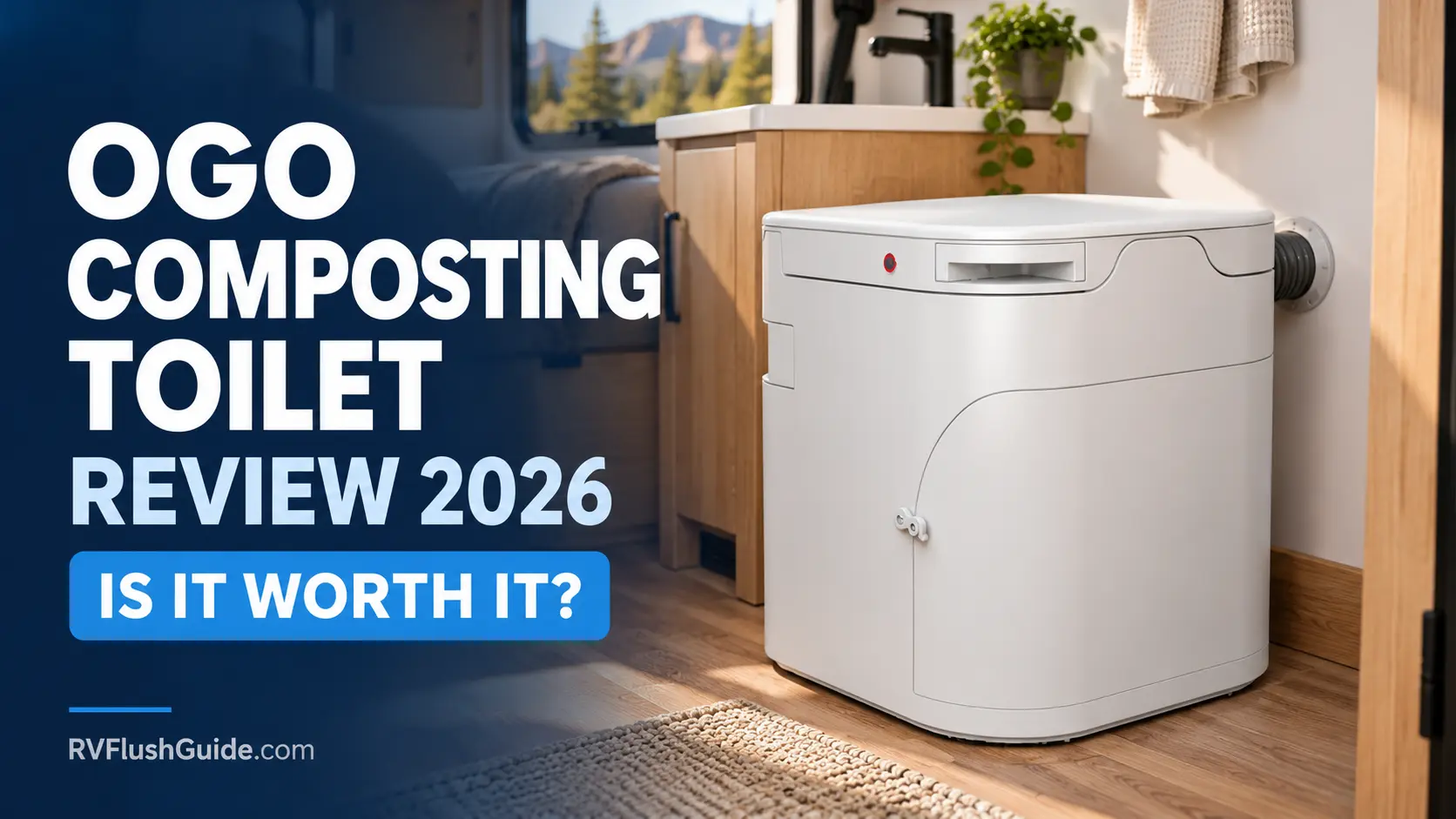
This OGO composting toilet review answers one question: is the OGO Origin worth buying for an RV, given its price, size, 12V power needs, upkeep and the alternatives? It fits small RV bathrooms and camper vans well. It fits less well if you want a large solids bin or a toilet that mixes with no power at all.
We have not installed or used the Origin ourselves. This review draws on OGO’s documentation, Nature’s Head’s published specs, and independent reviews and owner reports, and it names the source behind each claim that matters.
TL;DR
- Overall: Worth it for the right buyer. It suits tight bathrooms and vans, but at its price it is not the default pick for every RV.
- Biggest advantage: A 16 by 15 inch footprint and a push-button electric agitator, so there is no crank to find room for.
- Biggest limitation: The solids bin holds 25 to 30 uses, about half or less of Nature’s Head’s 60 to 80, and the agitator needs 12V power.
- Best for: Camper vans and small rigs with a steady 12V system, and owners who want easy mixing and can empty solids every few weeks.
- Look at an alternative if: You want the longest gap between solids empties, mixing that works without power, or a lower price.
OGO Composting Toilet Review: Quick Verdict
The Origin is a good buy when three things are true. Your bathroom or van is tight enough that size matters. You have a fused 12V circuit that stays on, because the fan runs all day. And you are fine emptying the solids bin every two to four weeks, which is OGO’s own estimate for typical use. If one of those is not true for you, other RV composting toilets will probably fit better.
No source we found tracks how often Origin parts fail. This verdict rests on specs, documented setup rules and a small set of independent reviews, so it is a buying guide, not a durability rating.
OGO Origin Specifications and Features
The OGO Origin composting toilet is a self-contained, urine-diverting unit. Urine goes to a bottle and solids go to a bin.
OGO Origin: Key Specifications
- Price
- $984.99 on OGO’s site (checked Oct. 17, 2026)
- Size (W x D x H)
- 16 x 15 x 18.375 in
- Weight
- 28 lb
- Urine bottle
- 2.4 gal (9.08 L), removable
- Solids bin
- 25 to 30 uses before emptying
- Mixing
- Push-button electric agitator, 45 seconds per press (older units: 2 minutes, per OGO)
- Ventilation
- 12V fan that runs continuously, about 4.3 CFM, per OGO; 3 ft vent hose included
- Power draw
- Fan 0.02 A; motor 1.5 to 5.5 A while running; under 1 Ah per day in total, per OGO
- Solids medium
- Coco coir or sphagnum peat moss, 24 oz per fill
- Mounting
- Four screws or bolts through the base into the subfloor
- Warranty
- 3 years when bought directly from OGO
- Return window
- 60 days, unused and in original packaging
- Optional parts
- Urine drain kit, wet bath cover, floor riser plate, flange adapter, charcoal pucks, 110V adapter
Specs come from OGO’s product page, resource pages and refund policy. Manufacturers revise details, so confirm the numbers that matter to you before you buy.
Interested in the OGO Origin? Compare the seller, shipping, and final checkout price. Amazon’s listing did not show a featured offer when checked, so availability may vary.
As an Amazon Associate, RV Flush Guide earns from qualifying purchases.
What Makes the OGO Origin Different?
Push-button mixing instead of a crank
Nature’s Head uses a hand-turned agitator. The Origin has a button, and OGO says the electric agitator runs for 45 seconds per press. That helps in a tight space and for anyone who dislikes cranking.
Some older reviews describe a two-minute cycle, and they are not necessarily wrong. OGO’s resource page lists 45 seconds per press and adds that older units ran for 2 minutes. OGO does not say which production run changed, so check the cycle length on the unit you buy.
The price of that convenience is a power dependency. Reviewers at Inverse and RV LIFE both point out that the Origin has no manual backup for the agitator.
A small footprint, with a catch
At 16 by 15 inches, the Origin’s footprint is about a third smaller than the standard Nature’s Head with the Spider handle at 19 by 19 inches. It is also about 2.6 inches shorter. The catch is weight: the Origin is listed at 28 lb, and the Nature’s Head at 23 lb.
Small does not mean you can ignore clearance. OGO recommends a 2 inch gap between the back of the toilet and the wall, and Inverse noted that the front panel and solids bin need room to come out.
Urine diverter and level sensor
OGO calls its separator a patented trap door mechanism. A sensor lights the side button when the urine bottle is nearly full, so you get a warning before it overflows. RV LIFE’s writer adds that you need to sit to use it so the diverter works properly.
OGO Composting Toilet Problems and Limitations
We did not find enough verifiable long-term owner reports to estimate how often Origin parts fail. So this section sorts issues by how well they are documented, not by how common they are.
Trade-offs built into the design
- A smaller solids bin. The Origin holds 25 to 30 uses. Nature’s Head lists 60 to 80. You will empty the Origin more often.
- It needs power to work fully. The fan runs around the clock and the agitator needs 12V. The load is small, but a drained battery means no ventilation and no mixing. The OGO pages we read do not explain what to do if the supply fails while you are off the grid.
- You sit to use it. RV LIFE says the diverter works properly only when you are seated.
Problems OGO documents itself
- The wrong power supply. OGO says low-amp adapters (1 A or 2 A) will not run the motor, and that many power supplies deliver only 1 to 3 A. For 110V use, it specifies a 12V DC supply rated up to 10 A with a center-positive 5.5 x 2.5 mm plug. The wrong adapter can cause motor trouble, timer failure or weak performance.
- Connectors, cog and timer. When the motor is silent, OGO points to a corroded or loose power jack and snap connectors. When the motor runs but the agitator does not turn, it points to a stripped plastic cog. A dead timer on a unit made before August 2022 is likely a damaged original, and OGO names reverse polarity as one cause.
- The wrong bin material. OGO recommends coco coir or sphagnum peat moss, not soil or potting mix, and warns that too much medium can clog the agitator.
- Odor and venting. OGO says the Origin is odor-free when used correctly, and we would not promise more than that for any composting toilet. A sharp smell usually points to a specific fault, such as a weak fan, a blocked vent hose or urine reaching the solids bin. OGO’s hose guidance is covered under installation below.
- Cold weather. OGO says composting slows a lot below freezing. The toilet keeps working as long as it does not freeze.
Complaints from reviewers and owners
These are individual experiences, not patterns.
- Sealing and flies. Morton’s on the Move installed three Origins in 2022 and wrote that the Origin "does not seal as well as the Air Head." They also cautioned about fruit flies near the bin. Flies are a risk with any composting toilet.
- Weight. RV LIFE’s writer found the Origin fairly heavy and awkward to move.
Reliability claims we could not verify
Some third-party guides mention motor complaints without documenting a representative sample. These reports cannot establish how often a failure occurs. We found no verified failure rate, typical lifespan or complaint count for the motor, timer or any other part, so this article does not state one.
How repairable is the Origin?
OGO publishes a motor troubleshooting and maintenance reference for an agitator that will not run. Check the power source and polarity, then the power jack and connectors, then bypass the timer to test the circuit, then power the motor directly. If it does not turn on direct power, OGO says the motor is the problem and it will send a replacement. OGO states a 3-year warranty for units bought directly from it.
OGO also lists replacement components in its parts catalog. The following were listed prices checked October 17, 2026, not guaranteed checkout prices:
| Part | Listed price |
|---|---|
| Mixing cog replacement kit | $7 |
| 12V power jack | $5 |
| Standard ventilation fan | $10 |
| Timer (45-second) | $30 |
| 12V DC gear motor | $135 |
OGO notes that its wiring has changed over the years, so keep your serial number and purchase details when you ask for help. A parts list shows what you can replace. It does not say how often anything fails.
How Often Does the OGO Need Emptying?
| Metric | OGO Origin | Nature’s Head |
|---|---|---|
| Urine bottle | 2.4 gal | 2.2 gal |
| Solids bin capacity | 25 to 30 uses | 60 to 80 uses |
| Typical solids interval, per maker | 2 to 4 weeks | About 1 month for two users |
Urine. OGO estimates the bottle needs emptying every 2 to 3 days for one person and every 1 to 2 days for two. The sensor light tells you when it is nearly full.
Solids. Neither maker defines a "use" on the pages we read, so we assume one use is one solids deposit. If two people each go once a day, 25 to 30 uses lasts about 12 to 15 days, which is the short end of OGO’s 2 to 4 week range. Morton’s on the Move reported going more than three weeks between solids empties with urine plumbed to the black tank. Your own interval depends on how many people use it and how often.
What Does Regular OGO Maintenance Involve?
- Coco coir. Start each fill with 24 oz of dry coco coir or sphagnum peat moss, lightly dampened but never soupy, and add it after every full emptying. OGO says 24 oz typically gets 25 to 30 uses. It lists wood chips, straw, cat litter, sawdust, soil and ash among materials to avoid. If the bin turns wet between empties, check the usual causes of a soggy solids bin, such as urine reaching the bin, over-wetted coir or weak airflow.
- Urine bottle. When the sensor light comes on, unlock the drawer hooks, pull the drawer forward, lift out the bottle and cap it before you carry it. Rinse it with hot, soapy water after dumping. Dumping rules vary by city and state, and campgrounds may add their own limits, so check before you pour.
- Toilet paper. OGO says the agitator helps break paper down, and we found no ply limit on its pages. Retailer and reviewer guidance points to thin, biodegradable paper in small amounts. Morton’s on the Move put lightly soiled paper in a lidded trash bin to fill the solids bin more slowly.
- Solids bin. Lift the lid and housing and take the bin straight out, or unhook the drawer locks, remove the urine bottle and slide the bin out the front. OGO’s bag method puts a 4 to 6 gallon bag over the bin, flips it and taps the bin to loosen the contents. Then refill with fresh medium.
- Hygiene. Treat the contents as untreated human waste. OGO recommends rubber gloves when handling solids and the compost mixture. CDC guidance for people who handle human waste adds washing hands with soap and water right after, keeping hands away from your face and eyes, and covering open cuts.
- Disposal. What you remove is not finished compost. OGO says waste keeps breaking down after it leaves the bin and that full composting takes 6 to 12 months. Its instructions list the trash "if allowed" or a long-term compost pile. Rules for disposing of solids vary by campground, park and county, so check before you dump.
- Common mistakes. Using the wrong medium or too much of it. Soaking the medium. Blocking or unplugging the fan while the toilet is in use. Using a low-amp adapter. Spraying the urine sensor directly instead of wiping it. Letting water pool under the unit in a wet bath. Leaving the bin and bottle full during a long absence: OGO says to empty both if you will be away more than a week or two, and freezing can crack the bottle.
Installing an OGO Composting Toilet in an RV
OGO says some installations take under an hour, although RV conversions involving electrical work, sealing an existing flange and routing a new vent can take considerably longer. Allow longer if you are cutting a vent hole and running new 12V wiring. Fit depends on your floor, walls and plumbing, so measure your own space.
Understand the electrical numbers first
| Item | OGO’s figure | What it means |
|---|---|---|
| System voltage | 12V DC; motor range 9 to 15V | Run it from a 12V battery system, or a 12V DC adapter on a wall outlet |
| Fan current | 0.02 A, running around the clock | About 0.48 Ah per day |
| Motor current | 1.5 to 5.5 A during a 45-second cycle | About 0.3 Ah per day at 4 to 5 uses |
| Total daily use | Under 1 Ah | Fan plus 4 to 5 mixing cycles |
| Power supply rating | 12V DC, up to 10 A, center-positive, 5.5 x 2.5 mm plug | What the supply can deliver, not what the toilet draws all the time |
| Fuse | 10 A recommended if inline | Use a properly rated fuse |
A 10 A supply does not mean the motor draws 10 A all day. The motor draws 1.5 to 5.5 A only while it runs, but a supply that delivers just 1 to 3 A cannot run it, so OGO asks for a 10 A-capable one. OGO also says local codes, fuse ratings and battery type all play a role, and to consult a licensed electrician or off-grid installer if you are unsure.
Ventilation: what OGO says, and what it leaves open
OGO says the fan pulls excess moisture out of the solids bin and keeps the contents dry and active. Without enough airflow, it says waste can clump or turn anaerobic, because the microbes that break it down need air.
OGO’s published guidance is not fully consistent about whether an exterior vent hose is necessary. One answer says the Origin can run without a hose in many setups, especially a van or RV with natural airflow, and that a hose helps in fully enclosed spaces. Another, for wet baths, calls a hose out through the wall or ceiling the standard method. OGO also sells a High-CFM fan upgrade for humid, enclosed or low-vent installs.
OGO does not define enough natural airflow. A small RV bathroom with a shower is humid and often enclosed, so we would route the hose outside. That is our reading, not an OGO requirement. Good airflow lowers the odor risk but does not promise there will be none.
Installation steps
- Check clearances first. The footprint is 16 by 15 inches. OGO recommends a 2 inch gap behind the toilet and at least 2 inches behind the vent outlet for hose routing. Leave room to plug in the power cable and, if the vent swivels sideways, for the hose’s full arc. OGO does not publish front, side or top clearances. The bin comes out through the top or the front, so keep at least one path clear. The urine bottle measures 14.5 by 5.375 by 11.25 inches.
- Remove the old toilet. The general job, removing the old toilet and capping the water line and black tank inlet, is the same for any composting toilet. OGO’s sequence is to turn off the water, cap the line, unbolt the toilet from the floor flange and lift it out with gloves. Then clean the flange and cover it with OGO’s flange adapter. The black tank stays empty unless you route urine into it.
- Mount the base. OGO says to bolt to the subfloor, not only the finish flooring. The mounting holes are 11.04 inches apart side to side and 9.04 inches front to back, center to center. OGO includes sheet metal screws and suggests bolts with washers for heavier-duty use.
- Run the vent. OGO includes a 3 ft hose with hose ends. The exterior shell vent is not on the product page’s included-items list and may need to be purchased separately; verify current stock before planning the installation. For a thin RV wall, OGO calls for a 1-5/8 inch hole, with the vent pointing down at about 45 degrees to keep out wind and water.
- Wire the power. Use a fused 12V circuit that stays live, because OGO says the fan should stay powered at all times. Connect red to positive and black to negative, since OGO says wrong wiring has damaged timers on older units. If the toilet will not power on, OGO suggests checking for 12 to 14V DC with a multimeter. If the fan stops later, the cause is more often electrical than mechanical, such as a blown fuse, a loose connector or an unreliable power source.
- Choose where urine goes. The default is the 2.4 gal bottle. OGO’s drain kit replaces it with a hose that routes urine to a sealed external container, a greywater tank or a drain field where permitted.
OGO discusses tying the toilet’s vent into an RV’s existing black-tank vent stack, but calls it an advanced, non-standard modification. Shared venting can create backdraft, odor, moisture and airflow problems if designed poorly. A separate exterior vent route is the simpler default; have an experienced RV plumbing professional assess any shared-vent proposal rather than cutting into the stack yourself. For the manufacturer’s cautions, consult OGO’s installation resources.
Wet bath installs
OGO says the Origin is water-resistant but not waterproof. Water can enter through the lid, mounting holes or motor access ports, and pooled water can corrode the wiring and power jack. OGO’s advice:
- Raise the toilet on a lip, waterproof riser, slatted mat or marine platform. Even 1 inch helps.
- Use the wet bath cover while showering. It shields the seat and electronics and lets you keep the power cable and vent hose connected.
- Never trap the fan, and run the vent hose out through a wall or ceiling.
- Do not seal the unit to the floor, so you can lift it and check for dampness.
- Seal wiring holes with marine-grade silicone if needed, and let the floor dry between showers.
Pre-purchase compatibility checklist
- Floor space: 16 by 15 inches plus about 2 inches behind.
- Removal path: room to lift the bin up or slide it out the front. OGO does not publish the height or front clearance, so ask OGO if your space is tight.
- Floor: solid subfloor to bolt into.
- Old toilet: a flange you can cover, a water line you can cap and a plan for the black tank.
- Power: a fused 12V circuit that stays on, or a 10 A-capable 12V adapter.
- Vent: a route through a wall or ceiling, plus a shell vent you may need to buy.
- Wet bath: room to raise the unit and use the cover.
- Waste plan: somewhere you can legally empty urine and dispose of solids on your routes.
When to bring in a professional
OGO tells owners to consult a licensed electrician or off-grid installer if they are unsure about the wiring. We would extend that advice to cutting through structural walls or floors and to any change to black tank plumbing. No checklist replaces measuring your own RV.
OGO vs Nature’s Head: Which Is Better?
| Feature | OGO Origin | Nature’s Head (standard) | Nature’s Head Weekender |
|---|---|---|---|
| Price (checked Oct. 17, 2026) | $984.99 | $965 | $965 |
| Size (W x D x H) | 16 x 15 x 18.375 in | 19 x 19 x 21 in with Spider handle; 20 in wide with Foot Spider | 18 x 18 x 16.75 in |
| Weight | 28 lb | 23 lb | 19 lb |
| Urine bottle | 2.4 gal | 2.2 gal | 1.7 gal |
| Solids capacity | 25 to 30 uses | 60 to 80 uses | 30 to 40 uses |
| Typical solids interval, per maker | 2 to 4 weeks | About 1 month for two users | About 2 weeks for two users |
| Mixing | Push-button electric | Hand-turned Spider or Foot Spider handle | Hand-turned Spider handle |
| Fan | About 0.02 A, runs continuously | About 0.07 A, runs continuously | 12V; amps not published separately |
| Needs 12V for | Fan and agitator | Fan | Fan |
| Warranty | 3 years (direct purchase) | 5 years | 5 years |
| Rear clearance | About 2 in recommended | 2 in for bowl removal | 2 in for bowl removal |
| Upkeep | 24 oz of coir per fill; electric parts to check | Empty solids when the handle gets hard to turn | Hand crank, as on the standard model |
Nature’s Head figures come from its model comparison page, product pages and FAQ. We kept the three models separate and did not mix figures from other variants.
There is no universal winner. The OGO wins on footprint, a larger urine bottle and push-button mixing. Nature’s Head wins on solids capacity, warranty length and mixing that works without power. Both fans use very little power. The Origin’s fan uses about half an amp-hour a day, and Nature’s Head says its fan draws less than 1.8 Ah in 24 hours.
The standard Nature’s Head is not the only relevant size comparison. The Weekender is 16.75 inches tall with an 18 by 18 inch footprint, so the Origin’s footprint is still about a quarter smaller. But the Weekender’s capacity is closer to the Origin’s, and it keeps the hand crank.
- Full-time couple who boondocks: the standard Nature’s Head, for fewer solids empties, a hand crank and a longer warranty. The Origin only if footprint rules out the larger unit and your 12V system is solid.
- Solo traveler or couple in a small van: the Origin or the Weekender. The Origin has the larger bottle and push-button mixing. The Weekender weighs less and has a hand crank, but holds less.
- Anyone who wants mixing without power: either Nature’s Head model.
Is the OGO Origin Worth the Money?
When we checked on Oct. 17, 2026, OGO listed the Origin at $984.99 on its own site, and Nature’s Head listed both its standard model and the Weekender at $965 on its site. That puts the Origin $19.99, or about 2 percent, above the standard Nature’s Head, so price rarely separates them. OGO’s site calculates shipping, taxes and promotions at checkout, and we did not check Nature’s Head’s shipping, so compare final totals.
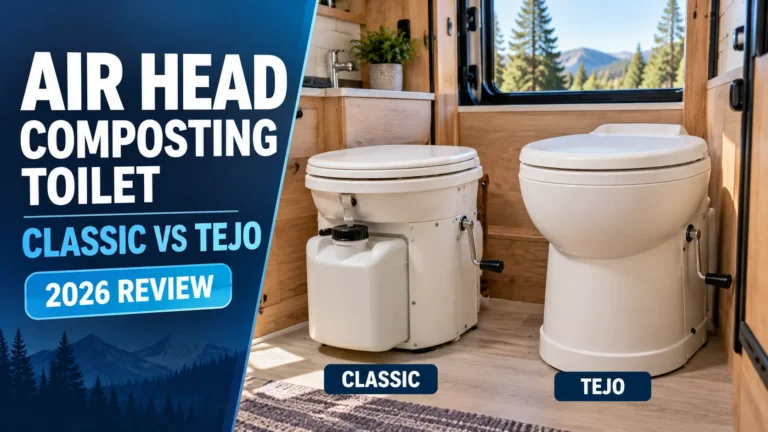
At nearly the same price, the Origin gets you a footprint about a third smaller than the standard Nature’s Head, push-button mixing, a slightly larger urine bottle and a level sensor. You give up about half or more of the solids capacity, two years of direct warranty (3 versus 5) and mixing that works without power, and you carry 5 lb more. Against the Weekender at the same price, the Origin has a smaller footprint, a larger bottle and an electric agitator, but a slightly smaller bin. It is also 9 lb heavier and 1.6 inches taller. Another manual-agitation alternative is the Air Head Classic, with the Tejo’s remote-urine option for RVs that can route liquid to a suitable holding tank.
OGO lists a 110V adapter ($45) and a wet bath cover ($49) separately (prices checked October 17, 2026). The adapter matters only if you power the toilet from a wall outlet instead of a 12V system. Both makers have advertised discounted cosmetic-blemish units, but availability changes. OGO’s blem listing was sold out when checked October 17, 2026; its displayed $675.99 price is not a currently available purchase option. Nature’s Head also lists blemished units, but confirm current stock, final-sale conditions and warranty coverage before considering either.
Part of the cost is not the toilet. Any composting toilet adds chores a flush toilet never did, such as emptying a urine bottle and replacing coir, and that work belongs in the price.
OGO’s return policy covers unused items in original packaging for 60 days. Once the toilet is installed and in use, a return is unlikely, so confirm fit and power before you order. Also read the warranty terms from your seller, because OGO states its 3 year coverage for direct purchases.
| Buyer | Fit | Why |
|---|---|---|
| Solo weekend camper | Often more toilet than needed | The small bin rarely fills, but the cost and 12V wiring are hard to justify for a few trips a year. |
| Full-time RV couple | Possible, with more chores | Expect solids empties every two weeks to a month. A larger bin means fewer chores. |
| Small camper van owner | Strong fit | The footprint, 12V design and push-button mixing all suit a van. Confirm clearance for the bin and bottle. |
| RV owner avoiding electrical complexity | Weak fit | Both toilets need 12V for the fan. The Origin also needs a stronger supply for the motor and has no hand backup. |
| Compact install priority | Good fit | Its footprint is smaller than any Nature’s Head model we compared. Check clearances, and compare the Weekender. |
| Budget-conscious buyer | Weak fit | Premium price, and returns only cover unused units. Blem units cost less but OGO’s are final sale. Lower-priced options exist. |
Final Verdict
The OGO Origin is worth it if you want a compact composting toilet with push-button mixing and your RV or van has a dependable 12V system. It earns that case on size and ease of mixing. It does not earn it on capacity, price or a public track record we could verify.
Skip it, or compare Nature’s Head closely, if you want fewer solids empties, mixing that works with the power off, or a longer warranty.
Before you order, check four things. Measure your space, including a clear path to lift out the bin and bottle. Confirm a fused 12V supply that can deliver up to 10 amps for the motor. Plan where the vent hose will exit. And read the warranty terms from the seller you plan to use.