TL;DR: If your RV toilet only smells when you press the flush pedal, the cause is physical, not random. Opening the flush valve creates a pressure change inside the black tank system. If your bathroom fan is running during the flush, your roof vent is blocked, your flush ball seal is no longer holding water, or the floor flange seal has failed, that pressure change pushes sewer gas straight up through the open bowl. This guide covers all nine causes, how to test for each one, and how to fix them in the right order.
You press the flush pedal and get hit with sewer smell. Your RV bathroom was fine two minutes ago. That is not a coincidence — it is a clue.
This is a completely different problem from RV toilet smell after dumping, which covers odor that starts after you empty the tank — things like exposed waste residue, poor rinsing, or a dry black tank. What you are dealing with here is flush-triggered odor. The smell appears specifically when the valve opens, because of what happens to air pressure inside the system at that moment.
There are nine specific reasons this happens. Each one has a clear test and a clear fix. Work through them in order and you will know exactly what you are dealing with before you spend anything.
Quick Diagnosis Table
Start here. Match your symptom to the most likely cause, then jump to that section.
| Symptom | Most Likely Cause | First Thing to Try |
|---|---|---|
| Smell only happens when pressing the flush pedal | Flush valve opens a path to black tank gas | Turn off fan and test again |
| Smell gets worse when bathroom fan is on | Negative pressure pulling odor upward | Turn fan off before flushing |
| Bowl water disappears between uses | Dry or worn flush ball seal | Fill bowl and wait 10 minutes |
| Smell strongest near the toilet base | Floor flange seal leak | Check for rocking, moisture, or odor at base |
| Toilet burps or drains slowly | Vent blockage or partial clog | Check roof vent and black tank flow |
| Smell near sink or shower drain | Gray tank odor or failed air admittance valve | Smell-test drains and check under-sink valve |
| Smell worse in hot weather or after storage | Tank gases building faster | Add water, clean tank, use correct treatment |
| Smell mainly starts after dumping, not during flushing | Dry tank or leftover waste residue | Read the separate RV toilet smell after dumping guide |
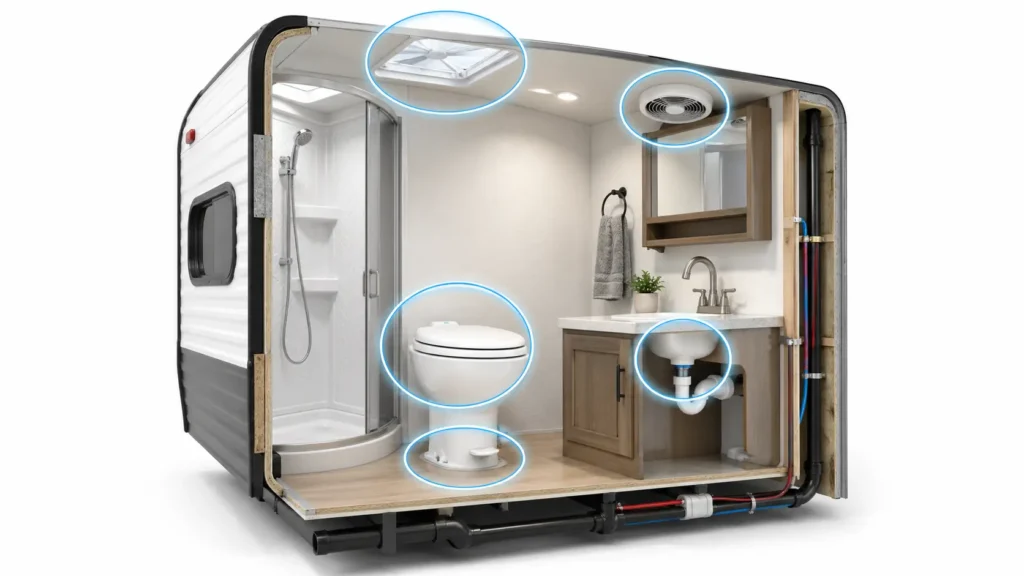
Why Does an RV Toilet Smell Only When You Flush?
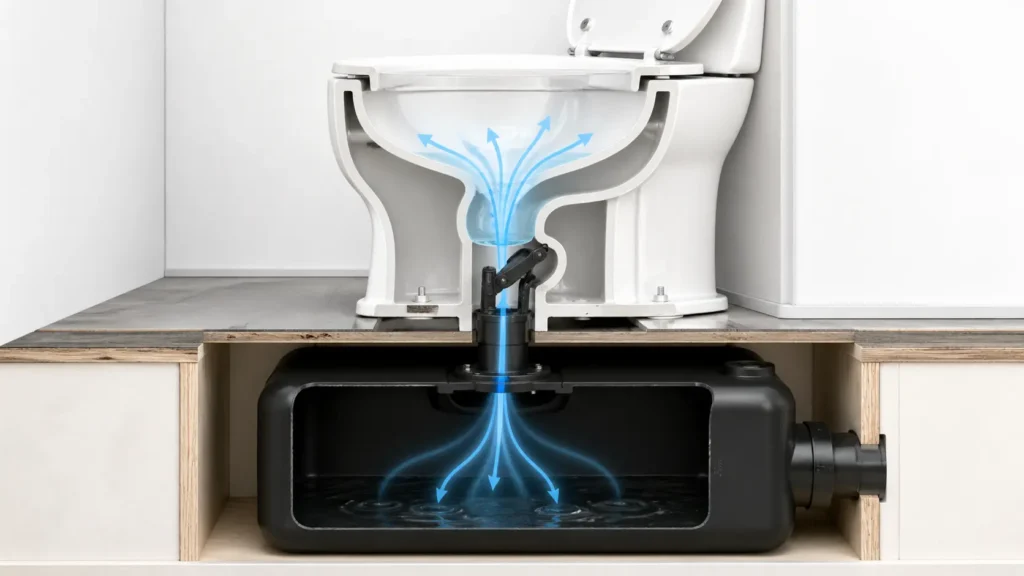
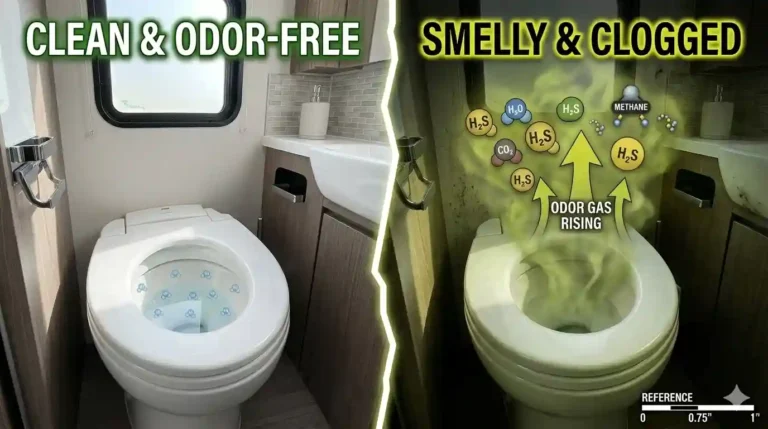
When your RV toilet smells specifically during flushing, the valve opening — not the waste itself — is triggering the odor. Pressing the flush pedal opens a ball or blade valve at the bottom of the bowl, creating a direct pathway between the bowl and the black tank. If your vent system is blocked, your bathroom fan is running, or your flush ball seal is not holding water, that open pathway lets black tank gases travel upward into the cabin at the exact moment the valve opens.
The rest of the time, you do not smell anything because the valve is closed and a shallow pool of water sits in the bowl above the seal. That water acts as an odor barrier — similar to the water in a home toilet’s P-trap. The smell only surfaces during flushing because that is the only moment the barrier is removed and a direct path opens between the bowl and the tank.
This is why treating the black tank alone rarely fixes flush-triggered odor. The tank is not always the problem. The pathway is.
Cause 1: Your Bathroom Fan Is Pulling Odor Up
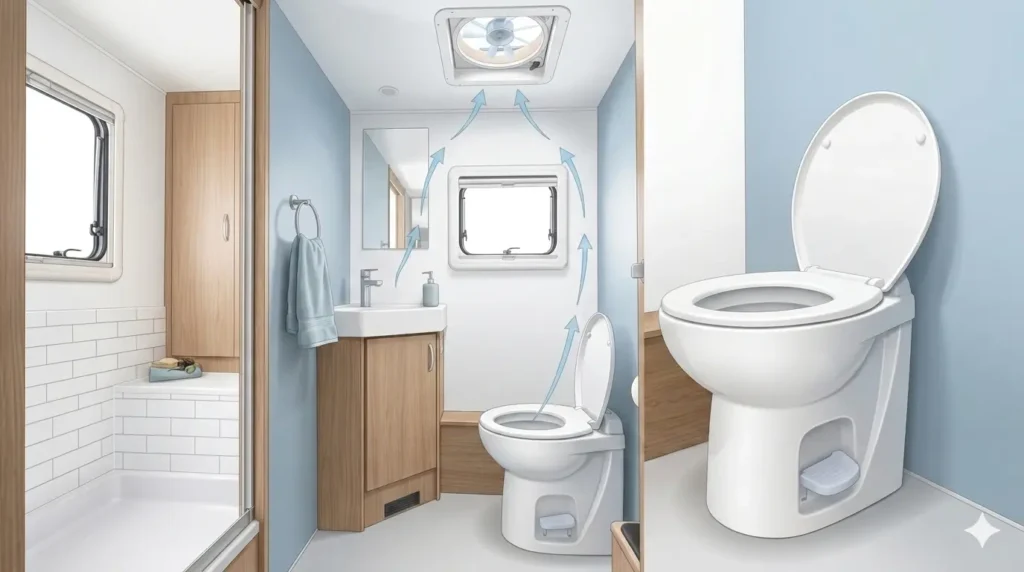
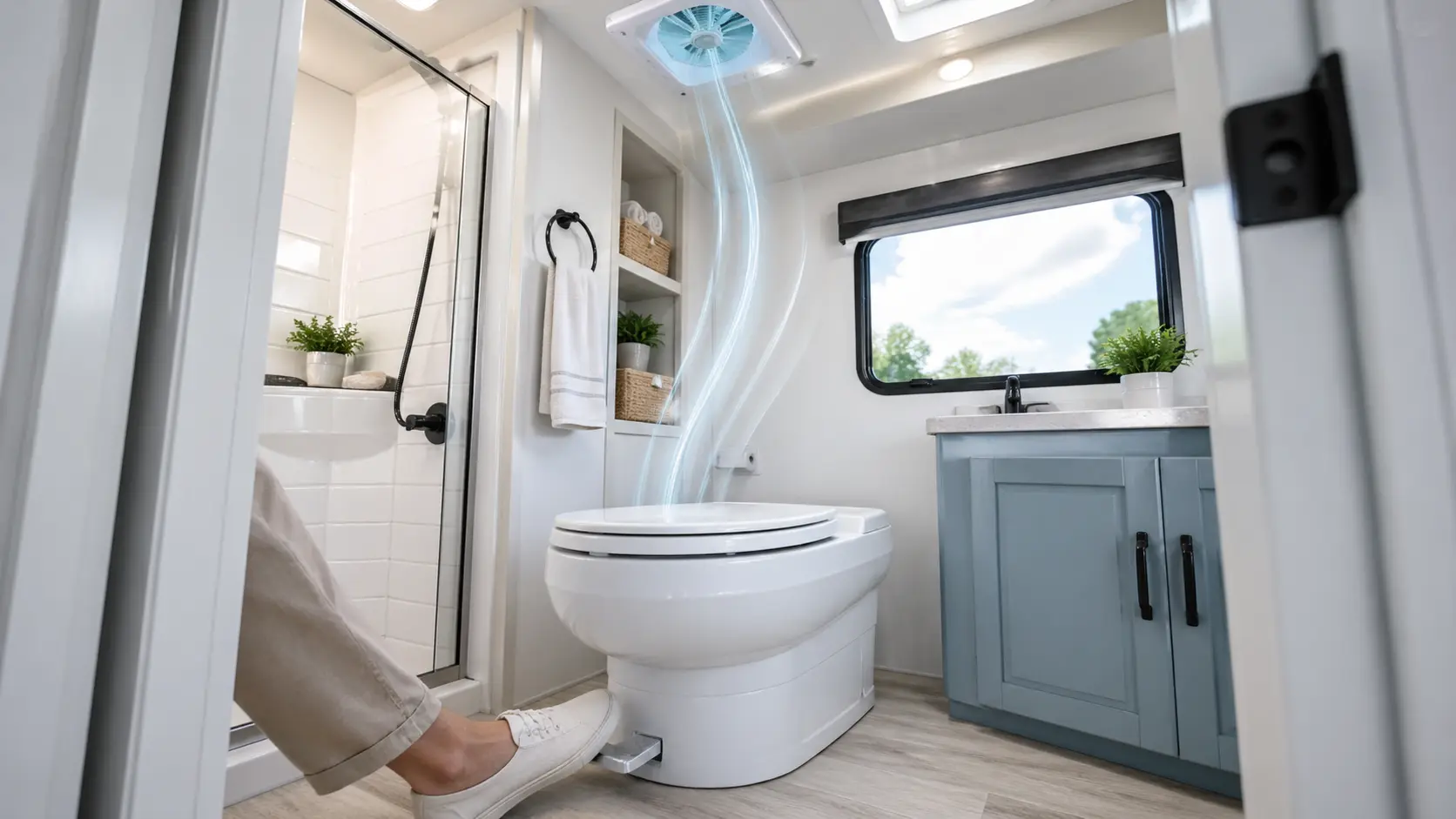
Running your bathroom exhaust fan while you flush creates a negative pressure zone inside the bathroom that actively pulls black tank gas up through the open toilet valve. The fan pulls air out of the bathroom faster than the RV can replace it through gaps and cracks. When the toilet valve opens during a flush, the path of least resistance for incoming replacement air is straight up through the black tank — dragging sewer gas with it.
This is one of the most commonly documented flush-odor causes in RV owner forums. Multiple threads on Forest River Forums and Alliance RV Owners Forum confirm the same pattern: the bathroom smells fine with the fan off, then reeks the moment the fan runs during a flush.
How to test it: Turn the bathroom fan completely off before your next flush. If the smell drops significantly or disappears, the fan is your culprit.
The fix:
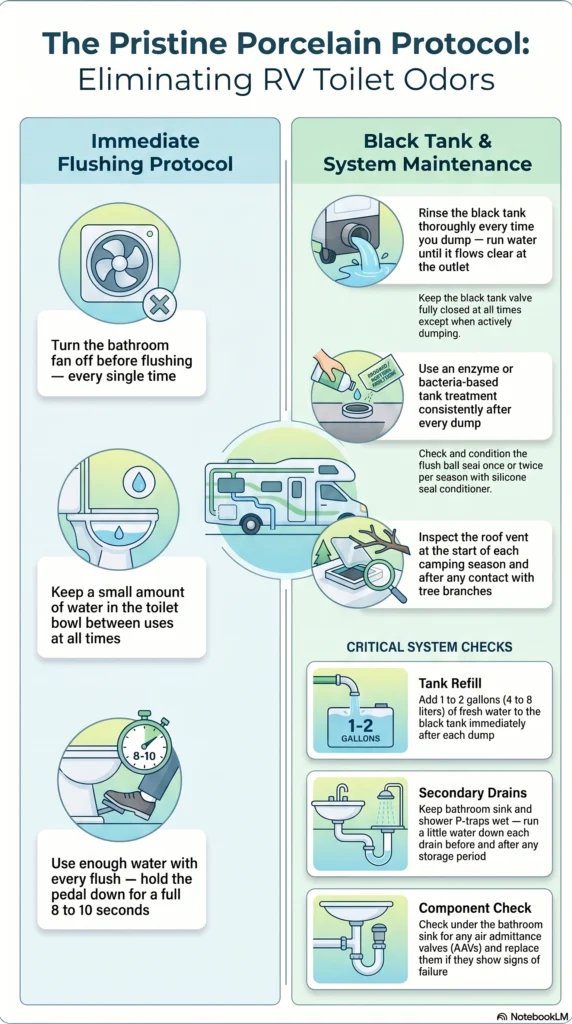
Turn the fan off before pressing the flush pedal — every time
Crack a window or open the bathroom door slightly to allow fresh air in before flushing
Run the fan before or after flushing, not during
If you have a reversible fan (such as some Fantastic Fan models), try reversing it to push air into the bathroom rather than pulling it out
This is the fastest test on the list. Do it first.
Cause 2: Your Roof Vent Pipe Is Blocked
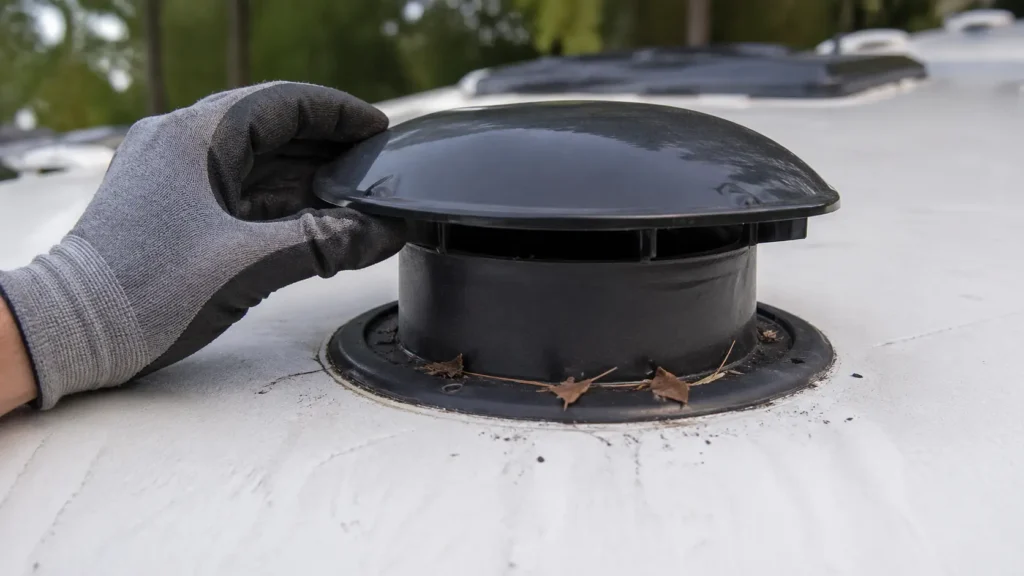
A blocked vent pipe is one of the most common causes of sewer smell during flushing. Every RV has a vertical pipe that runs from the top of the black tank through the roof. Its job is to let tank gases escape outside and allow replacement air to flow in when the toilet flushes. If the vent is blocked, the pressure change during flushing has nowhere to go — and the open toilet valve becomes the path of least resistance for gas to escape upward.
As documented by Camp Addict, the most common blockers are mud dauber wasp nests, insect debris, and leaves that collect inside the vent cap at the roof. Some rigs have also shipped from the factory with vent pipes cut too short, which can cause persistent pressure issues that mimic a blockage.
How to test it: Run a garden hose slowly down the vent pipe from the roof. The water should flow freely into the black tank below. If it backs up or overflows onto the roof, there is a blockage.
Safety note: Only inspect the roof when it is safe to do so. Do not climb a wet, sloped, or unstable roof without proper support. If roof access is not safe for you, contact an RV technician for this step.
The fix: Clear any nests or debris using steady water pressure from the hose. A long flexible brush can dislodge material deeper in the pipe. Once clear, check whether the vent cap is cracked or failing — a 360-degree rotating vent cap (such as the Camco Siphon Vent) maintains better airflow and reduces future nesting. Wear nitrile gloves when working around the vent system.
Cause 3: Your Flush Ball Seal Is Dry or Not Holding Water
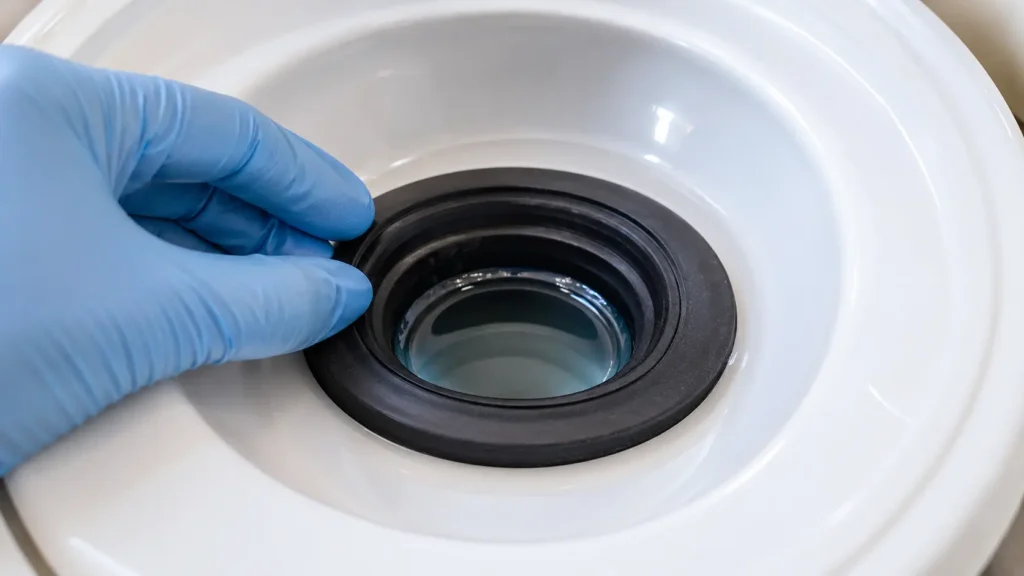
If the flush ball seal is worn or dried out, there is no water in the bowl when the valve opens — and black tank gas rises straight through the empty bowl with nothing to stop it.
Under normal conditions, a shallow pool of water sits in the bottom of the bowl above the closed flush valve. That is your odor barrier. But if the seal is dried out, cracked, or dirty, the water slowly drains away between uses. By the time you flush, the bowl is already dry. The moment the valve opens, gas comes straight up through the empty bowl with nothing in the way.
According to RV Upgrade Store, a failing flush ball seal is one of the most overlooked causes of flush-triggered odor in RV toilets. The seal can fail gradually, losing its ability to hold water long before it looks obviously damaged.
How to test it: Fill the bowl with water, then walk away for 10 minutes. Check back. If the water level has dropped noticeably or the bowl is dry, the seal is not holding. That confirms a missing odor barrier before each flush.
The fix: Start with cleaning before replacing anything. Wipe around the seal surface with a gloved finger or soft cloth to clear any debris or hard water buildup. Then apply a thin coat of silicone-based seal lubricant — Thetford makes a specific toilet seal conditioner that is inexpensive and widely available. Avoid petroleum-based products like Vaseline or WD-40, which degrade rubber seals over time.
If cleaning and lubrication do not restore a proper water seal, the seal needs to be replaced. Our guide on Dometic RV toilet not holding water covers the full replacement process with model-specific steps for Dometic 300, 310, and 320 toilets.
Cause 4: The Floor Flange Seal Is Letting Odor Out
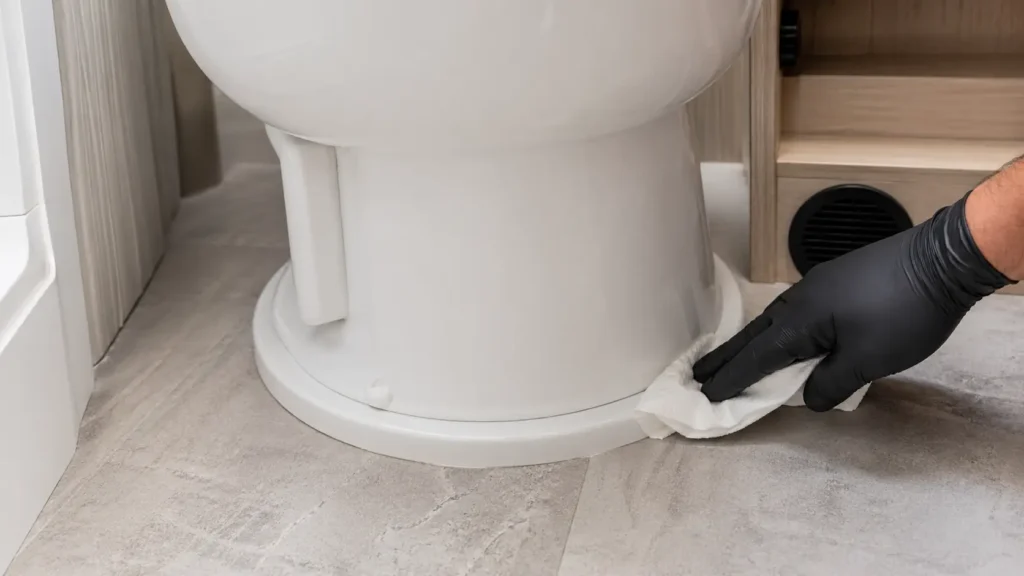
The flush ball seal is not the only seal that matters. There is also a floor flange seal — a rubber or foam gasket that sits between the bottom of the toilet and the floor flange below it. If that seal fails, odor can escape around the toilet base instead of through the bowl.
The smell from a failed floor flange seal often gets worse during and after flushing because that is when the most air movement and pressure happen inside the system. But the smell is usually strongest near the toilet base itself, not at the bowl opening. That is the key detail that separates this cause from the others.
Signs of a floor flange seal problem:
- Smell is strongest near the toilet base, not at the bowl
- Toilet rocks or shifts slightly when you sit on it or push it
- Staining, moisture, or a damp smell at the base of the toilet
- Bowl holds water fine, but the bathroom still smells during or after flushing
How to test it: Try gently rocking the toilet at the base. Any movement means the mounting bolts are loose or the seal is compromised. Dry the base completely, then wrap a dry paper towel around the joint between the toilet and the floor. Flush once. Check where the paper towel picks up moisture first.
The fix: Check the mounting bolts before replacing anything. Snug them carefully — do not overtighten, especially on plastic-base toilets like the Dometic 300 series, where too much pressure can crack the base. If tightening the bolts stops the problem, you may not need new parts. If the seal itself has failed, it will need to be replaced. Our full guide on Dometic RV toilet leaking at base walks through the diagnosis and seal replacement process step by step.
Cause 5: There Is Not Enough Water in the Black Tank
A black tank needs enough water to keep waste suspended and break down correctly. When the tank runs too dry, solid waste sits exposed on the tank floor, dries out, and creates a much more concentrated gas environment. Every time the flush valve opens, more of that concentrated odor has a direct path upward into the bowl.
This is most common in two situations: when RVers use very little water per flush to conserve tank space, and when the black tank valve has been left open at a full-hookup campsite, which drains liquid out while solids stay behind and harden.
The fix:
- Add 1 to 2 gallons (4 to 8 liters) of fresh water to the black tank immediately after each dump
- Use enough water with every flush — hold the pedal for a full 8 to 10 seconds per use
- Keep the black tank valve closed at all times except when actively dumping a full tank
- Never leave the black valve open at a full-hookup campsite, even when it seems convenient
If the tank has been running dry for a while and waste has hardened near the drop tube, you may be dealing with a pyramid plug. That is a separate problem covered in our guide on how to fix a pyramid plug in an RV black tank.
Cause 6: Dirty Black Tank or Waste Buildup Is Creating Strong Gas
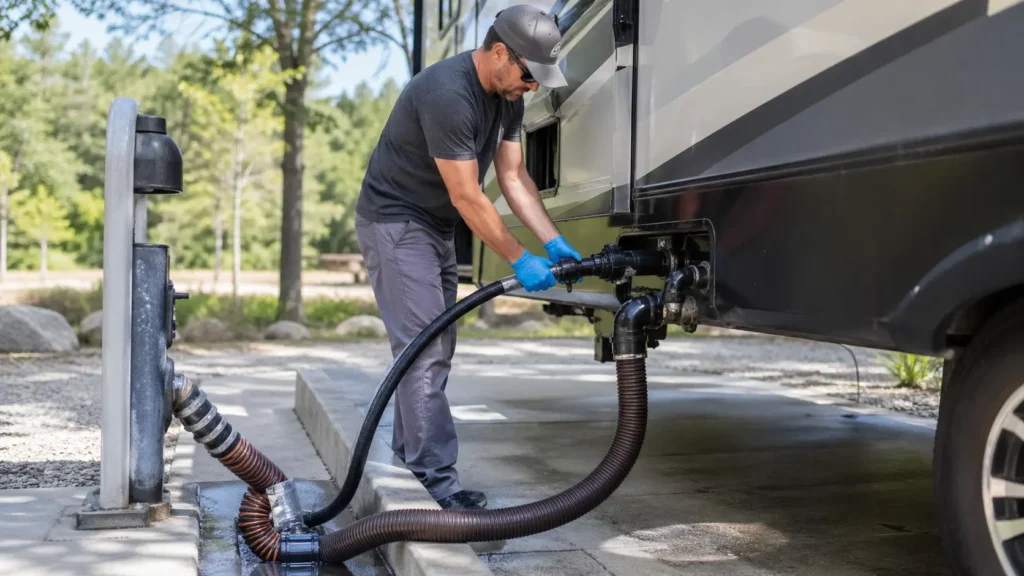
Even when the tank is not full, old waste residue clinging to the tank walls can produce strong odor gases. That residue builds up with regular use, especially if the tank has never had a deep rinse or if the treatment routine has been inconsistent.
The gas this residue produces is mostly hydrogen sulfide — the rotten egg smell — released by anaerobic bacteria as they break down waste without oxygen. As Unique Camping + Marine explains, aerobic bacteria from enzyme-based tank treatments produce carbon dioxide and water instead of noxious gases. A tank dominated by anaerobic bacteria will smell much worse every time the valve opens, even when the tank is only partially full.
The fix:
- Do a deep rinse using a tank wand or backflush tool — run water through until it flows clear
- Use an enzyme or bacteria-based tank treatment (such as Unique RV Digest-It or Happy Campers) consistently after every dump
- Avoid perfume-only deodorizers, which mask odor temporarily without breaking down waste
- If the tank has not had a deep clean in a long time, run a dedicated cleaning cycle before resuming regular treatment
Cause 7: A Pyramid Plug or Partial Clog Is Trapping Odor Near the Toilet
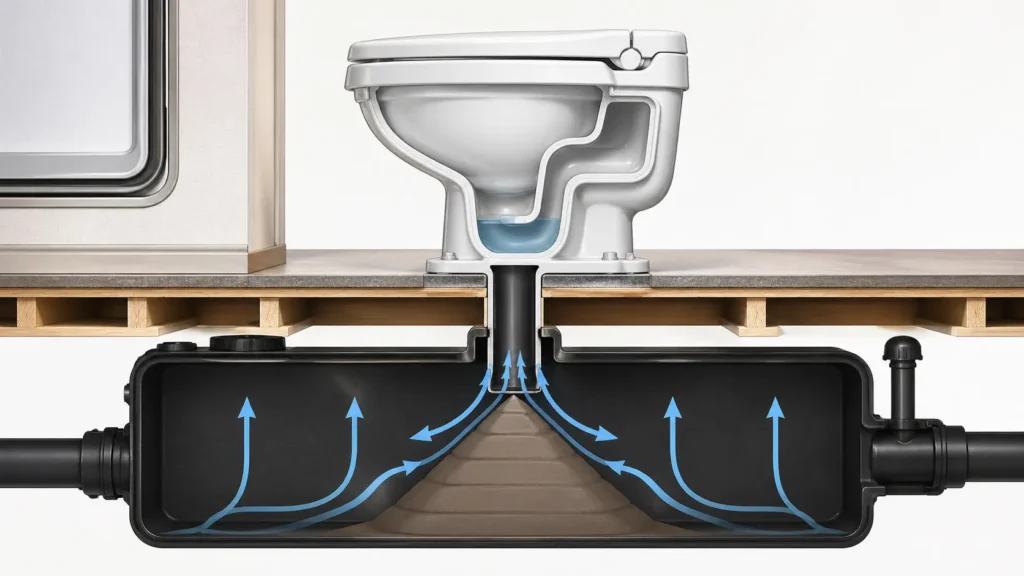
A pyramid plug is a hardened mass of solid waste that forms directly below the toilet’s drop tube inside the black tank. It happens when too little water is used per flush, or when the black tank valve is left open and liquid drains out while solids stack up and dry into a solid mass.
When a pyramid plug or partial pipe clog is present, waste and gas get trapped near the toilet opening. The moment the flush valve opens, that concentrated, trapped odor has a direct path upward through the bowl. The smell can be noticeably stronger and more sudden than typical flush odor.
Signs you may have a pyramid plug or clog:
- Toilet drains slowly or makes a gurgling sound when flushed
- Tank sensor reads full even though the tank was recently dumped
- Visible dark material or waste just below the toilet opening when you look down
- A stronger odor burst when the valve opens compared to what it used to be
- Waste rises in the bowl instead of draining normally
The fix: Add several gallons of water through the toilet and allow it to soak. Use an enzyme-based digesting treatment and give it 24 to 48 hours to work before dumping. A tank wand or backflush tool can help break up material closer to the tank outlet. Our full guide on how to fix a pyramid plug in an RV black tank covers the full process. For a pipe clog between the toilet and the tank, see our guide on how to unclog an RV toilet without a snake.
Cause 8: The Smell Is Actually Coming from the Gray Tank
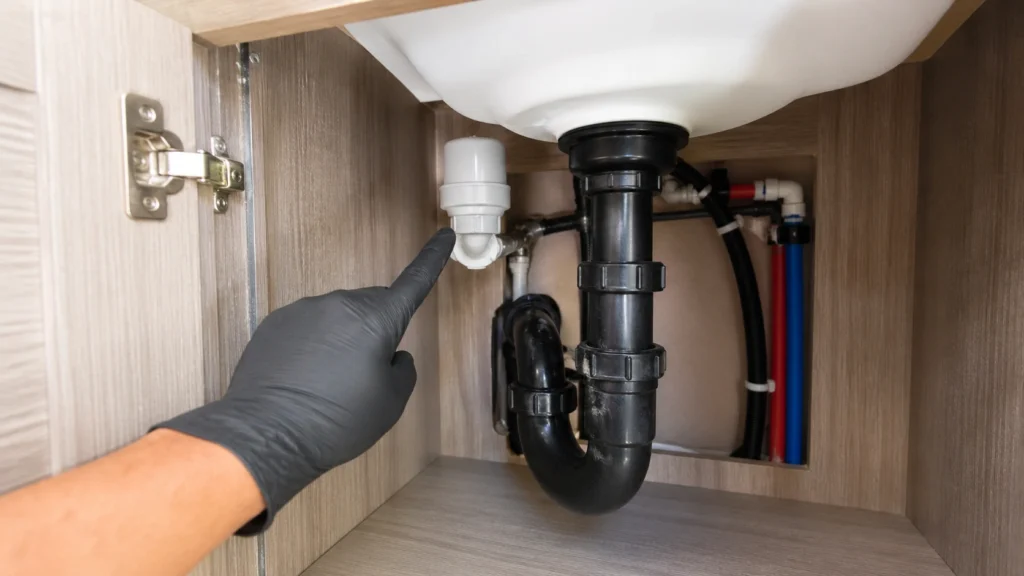
Not every smell in your RV bathroom comes from the black tank. Gray tank odor — from the bathroom sink, shower, or kitchen drain — can smell remarkably similar to sewer gas. Many beginners assume any sewage-type smell near the toilet is coming from the black tank. It might not be.
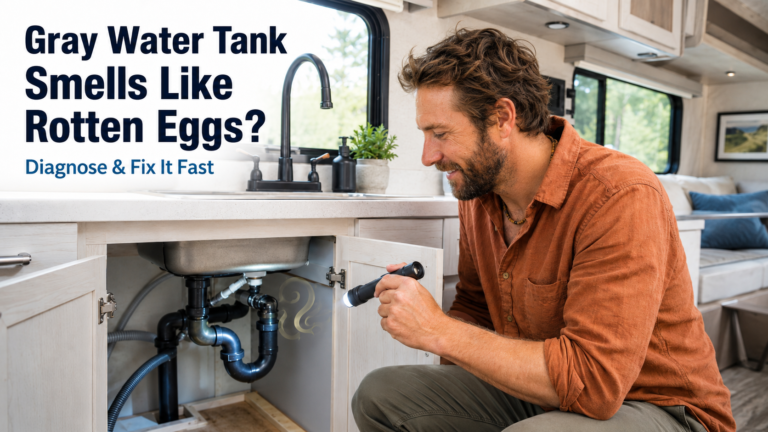
Gray tank water contains soap, food particles, hair, and grease that decompose and release hydrogen sulfide — the same rotten egg compound as the black tank. A failed air admittance valve (AAV) under the bathroom sink can also allow gray tank gases to leak directly into the cabinet below the sink and from there into the bathroom.
How to test it:
- Lean close to the bathroom sink drain and the shower drain and smell each one separately
- Look under the bathroom sink cabinet for a small cylindrical valve — usually white or grey plastic, capped on top. This is the AAV. Place a plastic bag loosely over it. If odor passes through the bag, the valve has failed
- If the smell is clearly strongest at the sink or shower rather than at the toilet bowl, gray tank odor is the more likely source
The fix: Pour a cup of water down any drain that looks or smells dry — a dry P-trap allows gray tank gases straight into the bathroom. A failed AAV unscrews directly from the pipe and can be replaced with a matching unit from any plumbing or RV supply store. If gray tank buildup is causing the odor, dump and rinse the gray tank and reduce grease going down the drain.
Cause 9: Hot Weather, Storage, or Wrong Tank Treatment Is Making Odor Worse
Even with a clear vent and a working seal, some situations push baseline odor high enough that it becomes noticeable every time the valve opens. Heat is one of the biggest factors.
RV Upgrade Store notes that rising temperatures cause anaerobic bacteria to produce odor gases at a much faster rate and increase internal tank pressure. The smell at 95°F (35°C) can be noticeably worse than the same tank at 65°F (18°C), even with the same contents and treatment habits.
RVs coming out of storage often have this problem for the same reason. If the tank sat with residual waste and limited treatment for weeks or months, anaerobic bacteria had time to dominate — and the smell reflects that.
Using the wrong type of tank treatment compounds the issue. Perfume-based chemical deodorizers mask odor temporarily but do nothing for the bacteria producing the gas. Some formaldehyde-based products can kill beneficial bacteria, making long-term odor worse rather than better.
The fix:
- Use more water per flush and add extra water to the tank in hot weather
- Deep rinse the tank after any storage period before resuming normal use
- Use an enzyme or bacteria-based treatment consistently — not a fragrance deodorizer alone
- Do not mix random chemical products in the tank; some combinations kill the beneficial bacteria doing the actual work
- Make sure the bathroom has some ventilation during hot days without leaving the black tank valve open
How to Diagnose Which Cause You Have
Run through these steps in order. Most people find the answer before reaching step 6 or 7.
- Turn the bathroom fan off and flush again. If the smell drops or disappears, the fan is your culprit. That is an immediate, free fix.
- Check whether the bowl holds water. Fill the bowl and wait 10 minutes. If the water drains away, the flush ball seal is not holding. Clean and lubricate it first; replace it if the problem continues.
- Smell around the toilet base. Get close to the joint between the toilet and the floor. If the smell is strongest there rather than at the bowl opening, the floor flange seal may have failed. Check for rocking and moisture at the base.
- Smell-test the sink and shower drains. If the odor is strongest at those drains and not at the toilet bowl, gray tank odor or a failed air admittance valve is likely the actual source — not the black tank.
- Add water to the black tank. If the tank has been running dry, pour 2 to 3 gallons (8 to 11 liters) of water down the toilet and see whether the odor reduces over the next few flushes.
- Watch for slow draining or gurgling. If the toilet drains slowly, gurgles, or waste rises in the bowl, a partial clog or pyramid plug may be trapping odor near the toilet opening.
- Check the roof vent safely. If all earlier steps check out, inspect the roof vent when it is safe to do so. Look for blockages and run a hose down the pipe to test for flow.
- Deep flush and treat the black tank. If odor persists after fixing vent and seal issues, a full tank cleaning cycle with a tank wand and enzyme treatment may be needed to clear residue buildup.
- Consider seal replacement or professional inspection. If nothing above resolves the problem, a cracked toilet body, a loose base connection, or a plumbing issue between the toilet and the black tank may need hands-on diagnosis.
How to Fix It in the Right Order
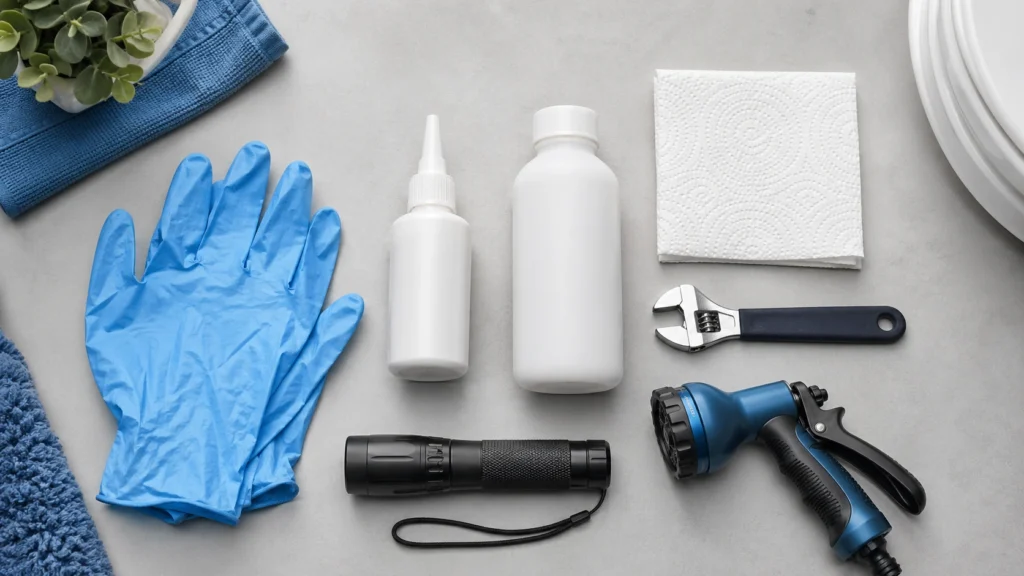
Start cheap, start simple. Here is the priority order that resolves the majority of flush-triggered smell problems without pulling the toilet or buying expensive parts.
- Turn the bathroom fan off before flushing. Free. Takes two seconds. Do this first.
- Clean and lubricate the flush ball seal. A $6 to $10 bottle of silicone seal conditioner fixes many seal problems before a full replacement is needed.
- Add water to the black tank if it has been running dry. One to two gallons (4 to 8 liters) can make a noticeable difference right away.
- Smell-test the sink and shower drains to rule out gray tank odor or a failed air admittance valve as the actual source.
- Check and clear the roof vent when it is safe to access the roof. A garden hose and 20 minutes on the roof is often all it takes.
- Deep flush and treat the black tank. Use an enzyme-based treatment after each dump and rinse with a tank wand until the water runs fully clear.
- Replace the flush ball seal if the bowl still will not hold water after cleaning and lubrication. Seal kits cost $10 to $30 on most Dometic and Thetford models.
- Check the floor flange seal if the smell is near the base of the toilet. Tighten the mounting bolts carefully before ordering a new seal.
- Replace the vent cap if it is cracked or blocking airflow even after clearing debris.
- Get a professional inspection if all of the above have been addressed and the smell remains. A cracked tank, a disconnected vent section inside the wall, or an internal plumbing issue can require hands-on diagnosis to find.
What Not to Do When Your RV Toilet Smells During Flushing
Getting this wrong does not just fail to fix the problem — it can make things worse or create new ones.
Do not leave the black tank valve open at a full-hookup site. It drains liquid and leaves solids behind to dry out, harden, and concentrate odor gases near the toilet opening.
Do not run the bathroom fan while flushing if odor is appearing during flushes. The fan is likely making the problem worse by actively pulling gas upward.
Do not rely only on fragrance deodorizer. Perfume-based products mask odor temporarily but do nothing for the bacteria producing the gas.
Do not flush wipes — even ones labeled “flushable.” They do not break down in RV black tanks and contribute directly to clogs and odor buildup.
Do not ignore a bowl that will not hold water. A dry bowl means no odor barrier. Every flush becomes a direct release of black tank gas into the cabin.
Do not overtighten toilet mounting bolts. Especially on plastic-base toilets like the Dometic 300 series, over-tightening can crack the base and create a far bigger repair job than a loose bolt.
Do not mix random tank chemicals. Some combinations kill beneficial bacteria or create reactions that make odor worse over time.
Do not assume every sewer smell is from the black tank. Gray tank odor, dry P-traps, and failed air admittance valves produce very similar smells and are often the actual source.
How to Prevent RV Toilet Smell When Flushing
Conclusion
Flush-triggered sewer smell is a pressure and pathway problem. Something is forcing or pulling black tank gas up through the open toilet valve when you flush. A bathroom fan creates the suction. A blocked vent removes the pressure relief. A dry flush ball seal removes the water barrier. A failed floor flange seal opens a gap around the toilet base. And a tank that is undertreated, too dry, or partially clogged puts more gas into the system than the vent can handle.
None of those causes are complicated to fix. Most cost nothing or very little once you know which one you are dealing with. Work through the diagnostic steps in order, starting with the fan test and the bowl water check. Do not just treat the tank and hope the smell goes away — close the pathway that is letting the gas in.
Fix the cause. Smell goes away. Camping gets better.
If the smell in your RV mainly starts after emptying the tank rather than during flushing, that is a different problem with different causes. Read the separate guide on RV toilet smell after dumping to diagnose that separately.
Frequently Asked Questions
Why does my RV toilet smell like rotten eggs when I flush?
A rotten egg smell during flushing is almost always hydrogen sulfide gas from the black tank. Anaerobic bacteria produce this gas when they break down waste without oxygen. You smell it specifically during flushing because the valve opening creates a direct pathway for tank gas to travel upward into the bowl. The most common causes are a blocked roof vent, a bathroom fan running during the flush, a dry flush ball seal, or a black tank that is undertreated or too dry. Run through the diagnostic steps above to identify which one you have.
Does running the bathroom fan cause sewer smell when flushing an RV toilet?
Yes — and this is one of the most commonly overlooked causes of RV toilet odor when flushing. When the bathroom exhaust fan runs during a flush, it creates low pressure inside the bathroom. The moment the toilet valve opens, the path of least resistance for replacement air is straight up through the black tank and out the bowl, pulling sewer gas with it. The fix is simple: turn the fan off before pressing the flush pedal. If you need ventilation, crack a window or open the bathroom door instead.
How do I know if my flush ball seal is causing the smell?
Fill the bowl with water and check it again after 10 minutes. If the water level has dropped or the bowl is dry, the seal is not holding. That means there is no water barrier between the bowl and the black tank before each flush — so when the valve opens, gas rises straight through the empty bowl. Start by cleaning the seal surface and applying a thin coat of silicone seal conditioner. If the bowl still will not hold water after that, the seal needs to be replaced. Most seal kits cost $10 to $30 and do not require removing the toilet on Dometic 300-series models.
Can a blocked RV roof vent cause smell only during flushing?
Yes. The roof vent allows air pressure to equalize when the toilet flushes. When it is blocked, the pressure change during flushing cannot exit through the roof, so it pushes tank gas back up through the open toilet valve and into the bowl instead. Between flushes, the smell is often absent because the valve is closed and the water seal is intact. To test it, run a garden hose down from the roof vent opening when it is safe to access the roof. If water backs up instead of flowing into the tank, the vent is blocked.
Can gray tank odor smell like RV toilet odor when flushing?
Yes, and this catches a lot of beginners off guard. Gray tank odor — from decomposing soap, food particles, and grease in the gray water tank — produces hydrogen sulfide, the same rotten egg compound as the black tank. If the smell is strongest at the bathroom sink or shower drain rather than at the toilet bowl, gray tank odor or a failed air admittance valve (AAV) under the sink is likely the source. Test the AAV by placing a plastic bag over it. If odor passes through the bag, the valve has failed and needs to be replaced.
Should I use tank treatment if my RV toilet smells when flushed?
Yes, but the type of treatment matters. Enzyme or bacteria-based treatments introduce aerobic bacteria that break down waste and produce carbon dioxide and water instead of noxious gases. Perfume-based or formaldehyde-based deodorizers only mask odor temporarily and can kill the beneficial bacteria doing the real work. Use an enzyme or bacteria-based product consistently after every dump, and add it with fresh water right after dumping — not hours later when the tank is already dry.
What is the difference between RV toilet smell when flushing and RV toilet smell after dumping?
These are two different problems. Flush-triggered smell appears at the moment the valve opens — caused by pressure dynamics, a blocked vent, a running fan, a dry seal, or high tank gas pressure. Post-dump smell appears after you empty the tank — caused by exposed waste residue on tank walls, a dry tank, leftover solids, or poor rinsing. If your smell mainly starts after emptying the tank.
When should I call a professional for RV toilet odor during flushing?
Call a professional if you have worked through all the diagnostic steps — fan, bowl seal, floor flange, gray tank, vent, and tank treatment — and the odor during flushing has not improved. A persistent smell after those checks can point to a cracked tank, a disconnected vent section inside the wall, a damaged toilet body, or a plumbing joint that has come apart between the toilet and the black tank. Those issues require hands-on inspection that goes beyond what most RVers can diagnose on their own.