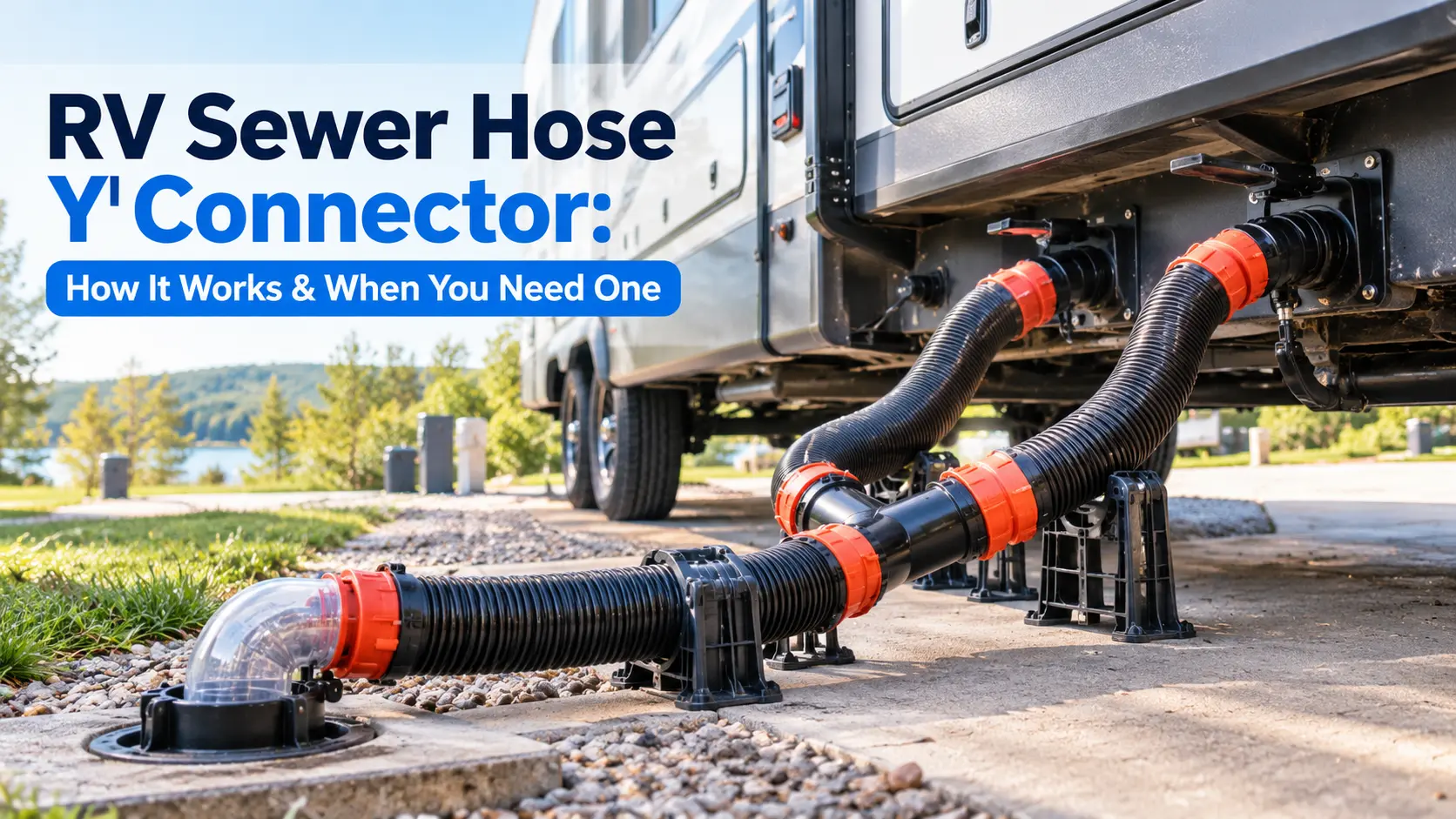
- An RV sewer hose Y connector combines two separate sewer hoses into one line so they can drain into a single campground sewer inlet.
- You typically need one only if your RV has two separate waste outlets.
- The two upstream hoses connect to the Y’s inlet arms, while a final hose or elbow connects the Y to the sewer inlet.
- Common leak causes include worn seals, loose or incomplete connections, and hose strain.
- Before buying, make sure the Y connector’s fittings match the ends on your existing hoses and elbow.
- If you only need extra hose length, use a coupler instead. A Y connector is designed to combine two drain lines.
Some RVs have two separate waste outlets instead of one. That’s common on larger fifth wheels, and on some motorhomes where the tanks drain through separate valves at opposite ends of the chassis. Most campground sewer inlets only have one opening, which creates a mismatch. An RV sewer hose Y connector solves this by joining two hose lines into one before it reaches the sewer inlet.
What Is an RV Sewer Hose Y Connector?
An RV sewer hose Y connector is a Y-shaped fitting with two inlet ends and one outlet end. You attach one hose to each inlet arm, and a single hose or elbow runs from the outlet arm to the sewer inlet. It turns two separate drain lines into one.
This setup shows up on RVs built with two separate waste valves instead of one shared drain point, most often on larger fifth wheels and some motorhomes with outlets at opposite ends of the chassis. Smaller travel trailers and most Class C motorhomes usually have a single combined outlet and never need one.
When Do You Need One?
You need a Y connector only if your RV has two separate waste outlets that don’t already merge into one drain point before they reach the outside wall. If your RV has a single combined outlet, you don’t need a Y at all.
Look for a Y connector if:
- Your RV has two separate gate valves, each with its own outside connection
- Both outlets need to reach one shared campground sewer inlet
- You’re currently running two hoses side by side and alternating which one drains
You don’t need one if you just want more hose length. That’s a job for a hose coupler, not a Y connector. And if your RV only has one outlet, the standard steps for connecting a single sewer hose apply just the same.
How to Connect Two RV Sewer Hoses With a Y Connector
- Find both waste outlets on your RV and confirm each has its own hose ready to go.
- If either hose run is long or uneven, set a hose support under it to keep a steady downhill slope.
- Twist each hose’s bayonet fitting onto its matching RV outlet until it locks.
- Connect both hoses to the Y connector’s two inlet arms.
- Connect the Y’s single outlet arm to your final hose section or a clear sewer elbow.
- Seat the elbow into the campground sewer inlet, or thread it in if the inlet is threaded.
- Check every bayonet and lug connection by hand. Each one should be fully twisted and seated, with no visible gap.
- Open the black tank valve first and let it drain fully, then close it and open the gray tank valve. Thor Industries , whose RV brands include Airstream and Jayco, notes that this order lets gray water rinse residue out of the hose on its way through.
- Close both valves, disconnect starting at the RV end, and rinse the hose before storing it.
For a full walkthrough of that valve order and the rest of the dumping process, see our guide on the right order for dumping both tanks. If you only have one outlet to deal with, the setup steps are covered in our guide to connecting a single sewer hose.
Y Connector vs. Sewer Hose Coupler vs. Elbow vs. Adapter
These four fittings get mixed up often, but each solves a different problem. A Y connector combines two separate hose lines into one. A coupler joins two sections of the same line to add length. A sewer elbow connects the final hose to the campground inlet. An adapter changes one fitting or thread type to another.
| Fitting | Main Purpose |
|---|---|
| Y connector | Combines two separate hose lines into one before the sewer inlet |
| Hose coupler | Joins two hose sections to extend a single line |
| Sewer elbow | Connects the final hose to the campground sewer inlet |
| Adapter | Changes one fitting or thread type to another |
What to Look for in an RV Sewer Y Connector
Before buying, check three things: which ends use bayonet fittings versus a lug fitting, whether the connector matches your hose’s standard 3-inch diameter, and whether the gaskets are intact. These details determine whether the fittings will actually seat and seal against your existing hose.
Best RV Sewer Hose Y Connector Options
A note on sourcing: product specifications below were checked against current manufacturer information where available. Retailer documentation is used only for details the manufacturer page does not list.
Camco RhinoFLEX Wye (model 39812)
Best for: RVs with two bayonet-style outlets that need a straightforward, widely stocked connector.
Why it stands out: Camco’s own product page confirms 360-degree swivel ends and built-in gaskets for an odor-tight connection between two hoses and one dump station. Tractor Supply’s listing adds that the two inlets use bayonet fittings and the outlet uses a lug fitting, with a translucent body for watching flow.
Key features: Built-in gaskets, 360-degree swivel ends, sized for standard 3-inch hoses.
Potential drawback: The Wye adds another connection point, so every gasket and twist-lock joint needs to be seated correctly before dumping.
Who should choose it: Owners who want a common connector with specifications confirmed directly by the manufacturer.
Valterra Rotating “Y” Sewer Connector (model F02-2030)
Best for: Setups where hoses need to lie flatter or route around an obstacle.
Why it stands out: Valterra’s own product page confirms it joins two outlet hoses into one sewer line for RVs with two separate tank valves, with rotating bayonet ends that help hoses lay flat. eTrailer’s listing adds dimensions Valterra’s page doesn’t list: 3-inch tubing diameter, a 3.5-inch bayonet and lug fitting diameter, and internal seals at the connections.
Key features: Rotating fittings, internal seals, sized for standard 3-inch hose systems.
Potential drawback: The connector still requires compatible downstream hose or elbow fittings, so check your existing hose ends before buying.
Who should choose it: Owners who want a connector built for dual-tank-valve setups, with specifications confirmed by the manufacturer.
Neither this article nor RVFlushGuide has tested either product firsthand. Claims above come from the manufacturer and retailer pages linked, not hands-on use.
How to Prevent RV Sewer Y Connector Leaks
Common Y connector leak causes include worn seals, fittings that aren’t fully seated, damaged components, and hose strain at the connection. Working through them in order usually finds the problem fast.
If the leak doesn’t stop after checking the Y itself, our guide to leaks around hose connections covers other causes further back in the system, including the tank’s own gate valve.
| RV Setup | Y Connector? |
|---|---|
| One combined sewer outlet | Usually no |
| Two separate outlets, one campground sewer inlet | Often yes |
| Two outlets, and the site has two separate inlets | Not necessarily |
| You just need more hose length |
No
Use a coupler or hose extension instead. |
If your RV only has one waste outlet, you can skip a Y connector altogether. If you’re dealing with two separate outlets and most sites only offer one sewer inlet, a Y connector solves that mismatch, as long as the bayonet and lug ends match your hose and the gaskets stay in good shape. Compatibility and a solid seal matter more than extra features. Check those two things first, and the rest of the setup is straightforward.