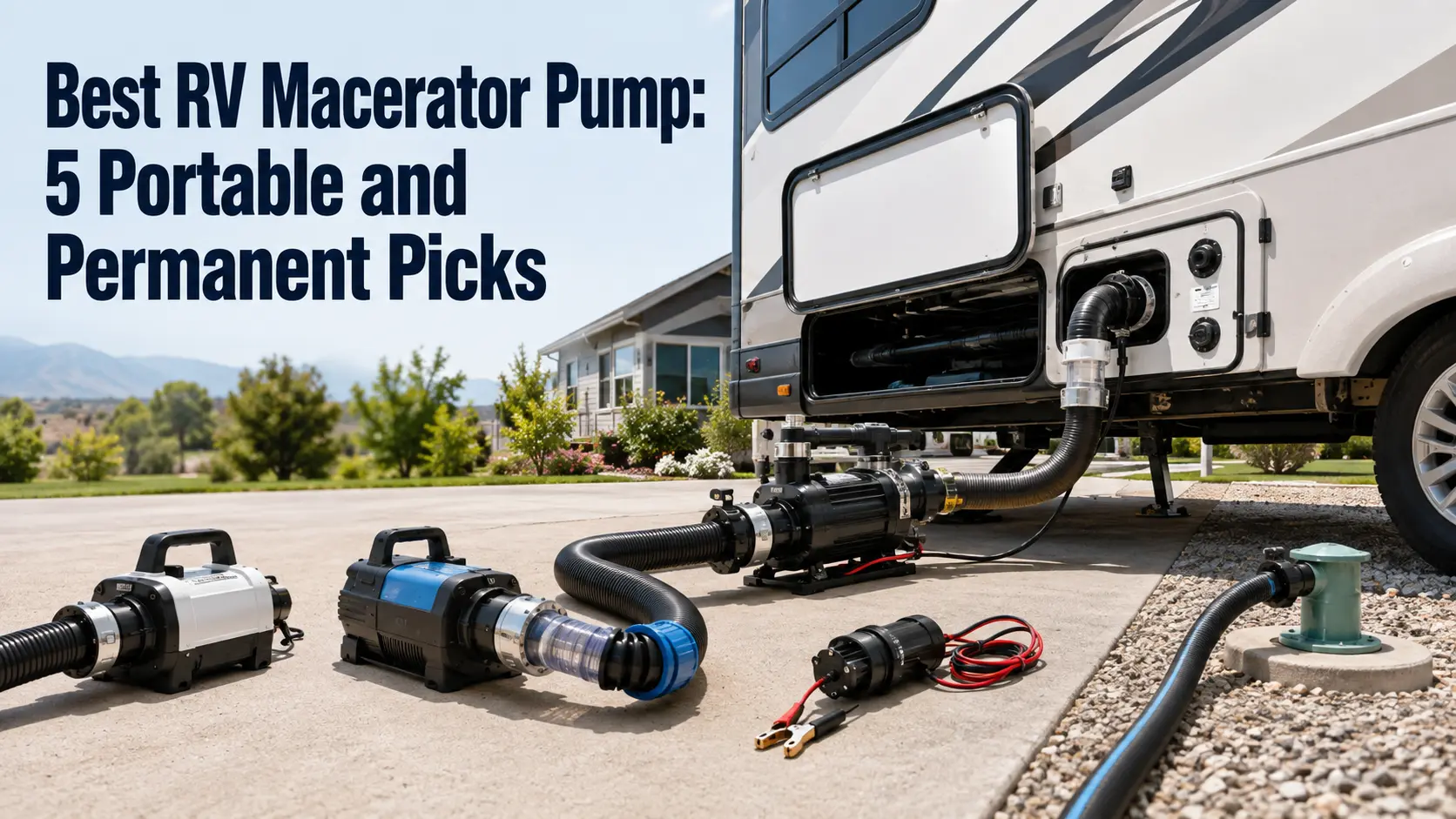
Finding the best RV macerator pump comes down to one question: how far, and how high, does your waste need to travel? If your sewer connection sits right below your outlet, you don’t need one. If you dump at home, pump uphill, or run a hose past 20 feet, the right macerator changes the job.
This guide covers external RV waste macerator pumps that attach to the holding-tank outlet. It does not cover the built-in pump inside a macerating RV toilet.
We have not tested these pumps ourselves. Instead, we compared manufacturer documentation, current specifications, replacement-part availability, retailer information, and recurring owner reports. Every technical figure links to its source, most of them official Flojet and Thetford manuals.
The Flojet 18555-000A is our best overall portable RV macerator pump because it is repairable, well documented, and capable of handling both short and long home-dumping runs. Flojet’s current manual rates it for up to 150 feet of horizontal discharge through reinforced 3/4-inch hose, although flow decreases as hose length increases. The motor is intermittent-duty and should not run for more than 30 minutes continuously.
Quick Comparison Table
Compare our top RV macerator pumps by hose setup, 12V power needs, heat or jam safeguards, best use case, and main drawback.
| Product | Hose & Power | Heat / Jam Safeguard | Best For | Main Drawback | Check Price |
|---|---|---|---|---|---|
| Flojet 18555-000A Portable Best Overall | 5/8″ or 3/4″ garden hose 12V, 20A circuit | Manual impeller release No thermal cutoff listed | Overall value and home dumping | 30-minute continuous-run limit; flow drops on long runs | Check Amazon |
| Thetford Sani-Con Turbo 300 Portable | 1.5″ × 21 ft 12V, 35A circuit | 90°C thermal cutoff | Fast dumps and premium setup | Premium price and thermal reset wait | View Product |
| Thetford Sani-Con Turbo 400S Permanent | 1.5″ × 21 ft 12V, 35A circuit | Thermal cutoff and relay | Permanent, frequent-use installations | 5-minute duty cycle and installation work | View Product |
| Clean Dump CDTO Portable System | 1″ pressurized hose 12V, 20A circuit | Manual impeller release No thermal cutoff listed | Long extension-hose runs | Higher cost and mixed stock | Check Amazon |
| RecPro 12V Macerator Pump Portable | 1″ barbed outlet 12V, 12A max draw | Sealed manual jam-release key | Budget buyers | Lighter-duty build | Check Amazon |
Affiliate note: Some links are affiliate links. RVFlushGuide may earn a commission at no extra cost to you. Product availability can change.
What Is an RV Macerator Pump?
An RV macerator pump is a 12-volt grinder pump that attaches to your RV’s 3-inch waste outlet. Blades shred waste and toilet paper into a slurry, then the pump pushes it through a small hose. That lets you dump uphill, over longer distances, or into a home sewer cleanout.
Think of it as a garbage disposal for your black tank. RV Lifestyle describes it the same way: an automatic grinder that lets waste travel through a much smaller hose than the 3-inch “stinky slinky.”
One clarification before you buy anything. Some electric RV toilets have a small macerating pump built into the toilet base. That internal pump is a different part; if the toilet itself won’t clear the bowl, the fault may be that built-in macerating toilet pump, covered in our guide on slow RV toilet drainage.
A macerator moves waste out. It doesn’t rinse the tank walls, so you’ll still flush an RV black tank after dumping.
Our Best RV Macerator Pump Picks
Flojet 18555-000A: Best Overall Portable
The Flojet 18555 has been the reference portable macerator for years. The official Flojet manual publishes what most budget brands never share: hose limits, wire gauge, fuse size, and a full parts list. It grinds waste to 1/8-inch particles and, per Flojet, empties a typical 40-gallon tank in under 5 minutes.
Thetford Sani-Con Turbo 300: Best Premium Portable
The Sani-Con Turbo 300 (SKU 97586) is what you buy when dump speed matters. Thetford’s support page lists a 1/2-hp pump, a 1.5-inch hose extending to 21 feet, and a nozzle fitting six dump-station inlet sizes.
The official owner’s manual includes a performance table no competitor covers. On the stock hose at ground level the pump moves 18.7 gallons per minute; at a 9-foot lift it holds 11.1 GPM. Add 100 feet of 3/4-inch garden hose to that lift and the same table shows 0.7 GPM. Technically possible, but impractical for a full tank because flow drops sharply and the pump’s thermal cutoff interrupts long runs.
Thetford Sani-Con Turbo 400S: Best Permanent Installation
The Turbo 400S (SKU 97650) uses the same 1/2-hp pump family as the 300 but mounts permanently, with no cutting of the sewer outlet per Thetford. Once it’s in, dumping means pulling the hose from its compartment and flipping a switch. The 400S manual publishes the same performance figures as the 300, verified in the 400S manual itself rather than borrowed.
Clean Dump CDTO: Best for Long Hose Runs
The Clean Dump CDTO is a complete portable system built around the Flojet 18555 pump. Clean Dump’s product page lists a 10-foot discharge hose with a drip-proof valve, a 20-foot power cord with battery clips, and all adapters.
What separates it from a bare Flojet is the hose. The CDTO pressurizes a 1-inch discharge hose and accepts Clean Dump’s extensions. PPL Motorhomes’ listing carries the marketing claim of pumping up to 100 feet and uphill, with gray water discharged last to rinse the hose. Treat that distance as a manufacturer claim, not a verified spec.
RecPro 12V Macerator Pump: Best Budget
Budget macerators are a crowded field of near-identical imports. The RecPro stands out because it publishes its numbers. RecPro’s product page lists 12 GPM flow, a 12-amp max draw, intermittent duty only, a 316 stainless double-cut blade, and a 3-year warranty: the longest in this guide, which matters more than a slightly cheaper sticker price on a pump handling sewage.
Portable vs Permanent RV Macerator Pumps
A portable macerator twists onto your 3-inch outlet each time you dump, then stores away. A permanent system stays mounted on the outlet with wired power and a stored hose. Portables cost less and move between RVs. Permanent systems dump faster to start but require real plumbing and electrical installation.
Portables win on flexibility and price, and all four work on any RV with a standard bayonet outlet. The trade-off: portable models require the pump, discharge hose, nozzle, and 12V connection to be set up at each dump, with setup time varying by wiring and hose configuration.
Permanent systems win on routine. The Turbo 400S runs on switched, fused power and stays on the outlet full-time. Thetford’s 400S manual shows the up-front cost: rated pipe, a mounting location rated to support at least 30 pounds, axle clearance, a dedicated 35-amp circuit, and annual coupling inspection.
On a Forest River Forums thread, owners who ran both styles generally preferred built-ins for convenience, though some noted residual waste at the outlet on external units. Owner reports, not universal findings.
How Far Can an RV Macerator Pump Move Waste?
RV macerator-pump distance varies dramatically by pump, hose diameter, and elevation. A short garden hose is not necessarily the limit. Flojet’s current manual for its portable RV waste pump rates reinforced 3/4-inch hose for horizontal runs as long as 150 feet, although flow falls as the hose gets longer.
Flojet publishes about 7.8 GPM at 50 feet, 7.0 GPM at 100 feet, and 5.1 GPM at 150 feet through 3/4-inch hose. Those figures are based on horizontal discharge with no bends or kinks. Vertical lift, fittings, kinks, lower voltage, and real tank waste can reduce performance, so treat the published numbers as controlled-condition ratings rather than a guarantee for every RV setup.
Horizontal distance and vertical lift work against the pump in different ways.
For horizontal runs, the Flojet manual caps hose length by diameter (the exact table is in the Flojet review above) and warns that longer runs raise resistance enough to overheat the motor.
For lift, Thetford’s performance table covered in the Turbo 300 review is the best public data: flow drops about 40% between ground level and a 9-foot lift, and collapses to 0.7 GPM with 100 feet of garden hose added.
Treat manufacturer maximums as ceilings, not promises. Real performance also depends on hose length, waste consistency, battery voltage, wiring, and tank size. A “100-foot capable” pump on marginal wiring will hit its thermal limit before a full tank is empty.
Hose Diameter Matters More Than Many Buyers Realize
Hose diameter often affects real dump speed more than pump ratings do. A wider hose usually creates less resistance and allows higher flow, but actual performance also depends on pump design, hose length, fittings, and lift. Thetford’s own tables show its stock 1.5-inch hose beating every garden-hose configuration.
Three hose classes show up here. Standard garden hose (5/8 or 3/4 inch) is cheap but the biggest bottleneck. One-inch hose, like Clean Dump’s, cuts resistance (their claimed 40% gain is a manufacturer figure, but the physics point that way). Proprietary 1.5-inch hoses, like Thetford’s, move the most waste.
Length multiplies the problem. Every added foot adds friction, which is why Flojet ties its length limits to diameter, and why both Thetford manuals set a hard floor of 0.75-inch inner diameter for garden hose extensions. A pump pushing a long, narrow hose also runs hotter and hits thermal limits sooner. For long runs, buy the widest hose your system supports before you buy a stronger pump.
Power, Wiring, Fuse and Battery Requirements
These pumps run on 12-volt DC power, and undersized wiring can reduce pump performance and increase heat. Flojet specifies a 20-amp circuit with 12 to 10 AWG wire. Thetford requires a dedicated 35-amp circuit with 10 to 6 AWG wire depending on distance. Voltage at the motor must stay at 12 volts.
Voltage drop is the concept to understand. Every foot of wire loses a little voltage. Too thin or too long a wire, and the motor sees less than 12 volts, runs slow, draws more current, and heats up. Thetford’s manuals tell installers to verify 12 volts at the motor while running, and warn that improper wiring can damage it.
Follow the manufacturer figures rather than generic advice. Flojet specifies a 20-amp circuit and fuse with 12 AWG wire to 10 feet and 10 AWG to 20 feet. Thetford requires a dedicated 35-amp circuit and fuse with 10 AWG to 18 feet, 8 AWG to 32 feet, and 6 AWG to 50 feet. Clean Dump specifies a 20-amp circuit; RecPro lists a 12-amp max draw with no published fuse size.
Battery condition matters as much as wire. A half-charged battery under load can sag below what these motors need. For home dumping, clips on a healthy battery beat a long, thin extension run.
RV Macerator Pump vs Sewer Hose
A gravity dump through a 3-inch sewer hose is faster, cheaper, and simpler when the inlet sits below your outlet and within hose reach. A macerator wins when the run is long, uphill, or ends at a home cleanout. Most full-hookup campers never need one.
| Comparison | Macerator Pump | 3-Inch Sewer Hose |
|---|---|---|
| Dump speed | Slower, pump-limited | Faster, full-bore gravity |
| Distance | 21 to 50+ ft depending on hose | Typically 15 to 20 ft per hose section |
| Uphill ability | Yes, with flow loss | No |
| Power needed | 12V circuit | None |
| Setup time | Moderate | Quick |
| Cleaning | Rinse pump and small hose | Rinse large hose |
| Storage | Compact | Bulkier |
| Clog risk | Can jam on wipes, rags, or hard objects | Low with proper use |
| Best use | Home dumping, uphill, long runs | Full-hookup sites, dump stations |
Two caveats favor the hose. The RV Geeks point out that a macerator’s slower flow can leave more solids behind, since a full 3-inch gravity rush helps pull solids out. And every macerator manual bans wipes and hygiene products, which jam impellers and void warranties.
If you camp mostly at full hookups, put your money into a quality kit from our best RV sewer hose guide instead. Many owners carry both.
Who Should Buy an RV Macerator Pump?
Buy a macerator if your waste regularly needs to travel farther or higher than gravity allows: home dumpers, uphill sites, distant cleanouts, and anyone tired of handling a 3-inch hose.
The strongest use cases:
- You dump at home. The Flojet manual lists a home sewer cleanout as an intended application, and owners on Thor Forums describe this exact setup.
- Your run is long, with the sewer inlet 25 to 100 feet away.
- You must pump slightly uphill, accepting the flow losses covered above.
- Sewer access is awkward: tight side yards or inlets you can’t park beside.
- You want a smaller, cleaner hose than the 3-inch standard.
- Your rig suits a permanent system, like a fifth wheel with an exposed outlet.
Who Should Stick With a Standard Sewer Hose?
Skip the macerator if you mostly camp at full-hookup sites with the sewer inlet at your feet. Gravity is faster, needs no power, and has nothing to jam. A macerator adds cost, wiring, noise, and a duty cycle you have to manage.
Stick with the 3-inch hose if:
- You camp at full hookups. Gravity wins.
- You want the fastest dump. Nothing here matches full-bore gravity flow.
- Your 12V power is unreliable. A weak battery means a weak pump.
- You value simplicity: no wiring, no fuses, no thermal resets.
- You’ve had solid-waste clogs. A portable macerator is a waste-transfer tool, not a shortcut for clearing a blocked tank or closed gate valve. If your tank won’t empty, start with our guide on a black tank not draining before buying anything.
- You rarely need extra distance. An occasional long run is cheaper to solve with an extra hose section.
Common Problems and Maintenance
Most macerator problems trace back to power, jams, heat, or hose faults.
Pump won’t start, blown fuse, or low voltage. Check the fuse, battery charge, and voltage at the pump, in that order (Thetford’s troubleshooting table runs this exact sequence). Repeat fuse failures usually mean undersized wire or a sagging battery.
Overheating and shutdowns. You’ve hit the duty cycle. Flojet allows 15 minutes continuous, the Turbo 300’s cutoff trips after 15 to 20 minutes with a 20-minute reset, and the 400S runs a stricter five minutes on, 20 minutes off, with its cutoff as backup only. Plan large tanks in stages.
Jammed impeller. Jams often come from wipes, hygiene products, or hard objects, and a Flojet impeller can also stick after a long period of storage. Free a Flojet impeller through the shaft slot. On Sani-Con units, remove obstructions through the inlet only; Thetford warns against opening the pump housing, and an uncleared jam can void the warranty.
Reduced flow or a leaking bayonet fitting. Check for a kinked hose or partial obstruction; Thetford suggests running a hand along the hose to feel where its expansion changes. For leaks, check the O-ring on the pump adapter, which Flojet says must be seated before locking on.
Leaving the pump running after the tank empties. Do not leave the pump unattended. Switch it off as soon as the tank empties or the expanding hose contracts. The manuals do not publish a general run-dry allowance for these models.
Winter storage. Thetford’s procedure runs RV antifreeze through the pump until it discharges at the nozzle, then drains the hose. Never store the system wet in freezing weather.
Lingering smells after dumping. Usually tank residue, not the pump. Rinse the pump and hose after every use, and see our guide on odor after dumping if smells persist.
Final Verdict
There’s no single best RV macerator pump for everyone, so match the pump to your dump situation. For most owners, the Flojet 18555-000A is the pick: documented, repairable, and adequate for home dumping within its hose limits. If dump speed matters, the Thetford Sani-Con Turbo 300 is the fastest portable by its own manual’s numbers. Frequent dumpers with compatible rigs should consider the permanent Sani-Con Turbo 400S. For genuinely long runs, the Clean Dump CDTO and its 1-inch extensions make the most sense. Testing the waters? The RecPro 12V has the clearest specs and longest warranty in the budget class.
Whichever you choose, respect the duty cycle, size the wiring to the manufacturer chart, and keep wipes out of the tank. As of August 2026, all five were orderable through at least one major retailer, though Clean Dump stock fluctuates; recheck availability before you buy.
Frequently Asked Questions
Is an RV macerator pump worth it?
It’s worth it if you dump at home, pump uphill, or need runs past 20 feet. It’s not if you mostly use full-hookup sites, where a gravity dump through a 3-inch hose is faster and needs no power. Match the tool to your dump routine.
Can an RV macerator pump move waste uphill?
Yes, with a real cost in speed. Thetford’s manual shows its Sani-Con Turbo pump losing about 40% of its flow between ground level and a 9-foot lift on the stock hose. Steeper lifts and longer hoses cut flow further and push the pump toward its thermal limits.
How far can an RV macerator pump discharge?
Flojet’s manual recommends 25 feet max on 5/8-inch hose and 50 feet on 3/4-inch. Clean Dump claims up to 100 feet through its 1-inch system, though that’s a manufacturer claim. Long runs slow flow and increase heat, so treat published maximums as ceilings.
Can you use a garden hose with an RV macerator pump?
Yes, and the Flojet 18555 is designed around one. Use 3/4-inch hose rather than 5/8-inch whenever possible, since the wider bore roughly doubles Flojet’s allowed length. On Sani-Con systems, Thetford requires a minimum 0.75-inch inner diameter for any extension, or you risk pump failure.
How long does it take to empty an RV black tank with a macerator?
Flojet states its 18555 empties a typical 40-gallon tank in under 5 minutes on a short garden hose. Thetford’s table shows 100 gallons in about 5 minutes on its stock hose at ground level. Distance and lift stretch those times fast, up to hours in extreme hose setups.
Can a macerator pump clear a clogged black tank?
No. A macerator grinds waste that already flows to it. It can’t break up a pyramid plug, force a stuck gate valve, or fix a blocked outlet, and hard obstructions will jam the impeller and can void the warranty. Clear the clog first, then dump normally.
Is a macerator pump better than an RV sewer hose?
Neither is better overall. Gravity through a 3-inch hose is faster and simpler when the inlet is close and downhill. A macerator is the only practical option for uphill runs, long distances, and home dumping. Many owners carry both.