TL;DR: For most campground and dump-station connections, a traditional 3-inch gravity sewer hose is faster to set up and costs less. It also has fewer parts that can fail, so it should stay the default choice. A portable macerator pump earns its cost when the sewer connection sits uphill, sits far from the RV, or when dumping into an approved home cleanout through a narrow hose. Even with a macerator, keeping a basic sewer hose as a backup can help if the pump, fuse, wiring, or discharge line fails.
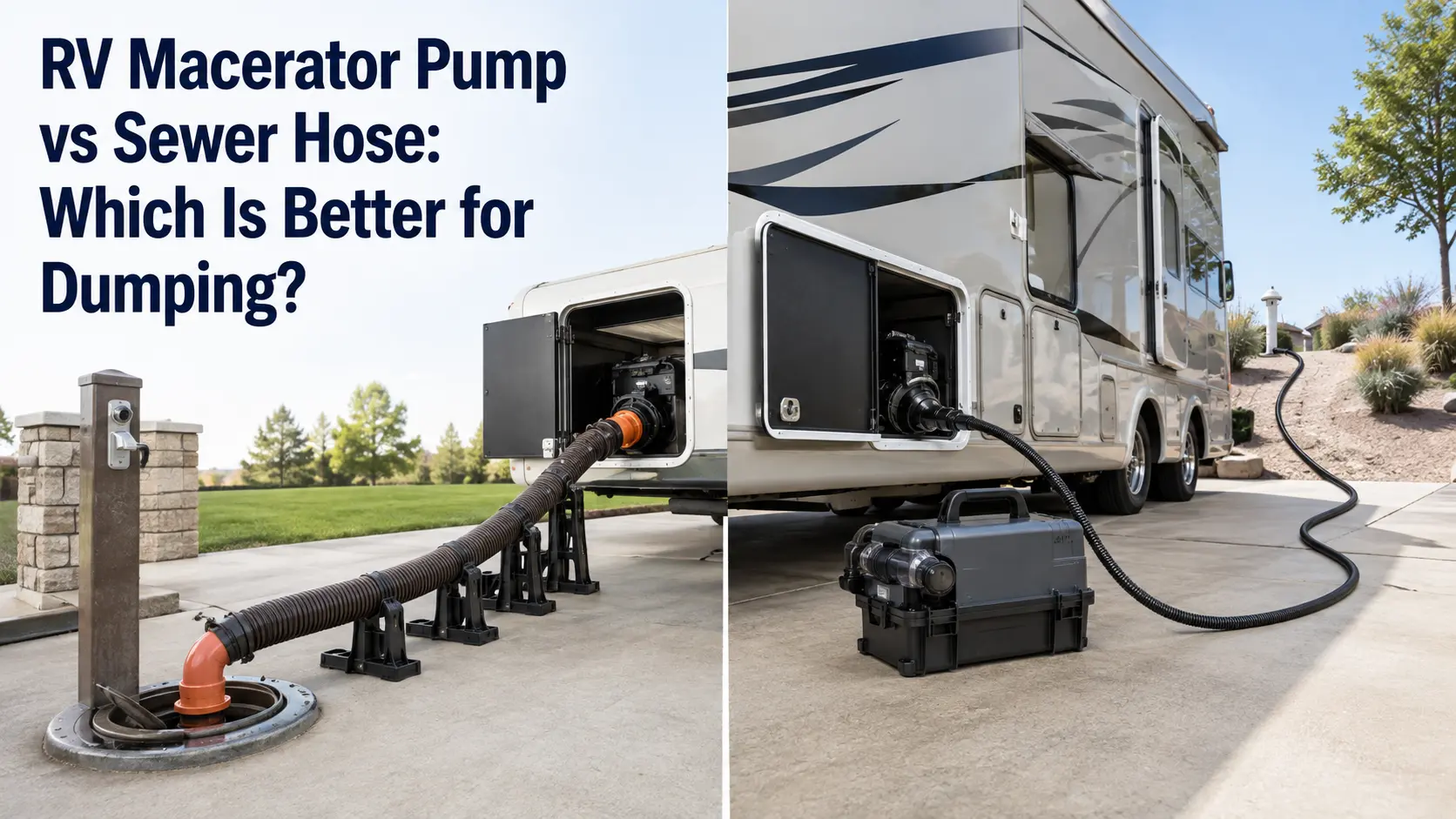
A regular sewer hose empties most RVs just fine at most dump stations, but it depends entirely on gravity: connect it, tilt it downhill, and let physics do the work. An RV macerator pump vs sewer hose comparison usually comes down to one question: does your setup actually fight gravity? A macerator pump grinds waste into a slurry and pushes it under power, which adds real flexibility, but it also adds cost, a power connection, and more parts that can eventually fail.
This guide compares a traditional 3-inch gravity sewer hose against a portable electric macerator pump, an aftermarket accessory that attaches at the RV’s waste outlet. Use it to decide which one actually fits how and where you dump.
RV Macerator Pump vs Sewer Hose: Quick Comparison
| Dimension | Sewer Hose | Portable Macerator Pump |
|---|---|---|
| Best use | Standard dump stations, short downhill runs | Uphill connections, longer distances, approved home cleanouts |
| Flow method | Gravity | Electric motor |
| Hose diameter | 3 inches | Commonly 3/4 to 1 inch. Built-in systems like Thetford’s Sani-Con use a larger hose, around 1.5 inches |
| Dumping speed | Fast with a real downhill slope | Varies by model; the advantage is distance and elevation, not guaranteed speed |
| Uphill capability | None | Varies by model; check the manufacturer’s published rating |
| Distance | Limited to hose length, typically 15 to 20 feet | Varies by model and hose length; some are rated well beyond a hose’s practical reach |
| Power requirement | None | 12V DC for most portable models, with a properly sized fuse |
| Setup | Attach, prop with a downhill slope | Attach, connect power, run |
| Cleaning | Rinse hose and elbow | Backflush pump and discharge line with fresh water |
| Storage | Bulkier, several feet compressed | More compact pump body; discharge hose still needs storage |
| Failure points | Pinholes, UV wear, kinks | Dry-run damage, blown fuse, wiring, clogged blades |
| Upfront cost | Lower | Higher |
| Ongoing maintenance | Low: mostly rinsing and inspection | Higher: more mechanical and electrical parts to maintain |
RV owners sometimes describe this choice as “macerator vs stinky slinky,” with the stinky slinky referring to the traditional flexible sewer hose.
What Type of RV Macerator Pump Are We Comparing?
It helps to separate two different products people lump together under “macerator.” A portable electric pump attaches at the RV’s waste outlet and comes off again after each dump. Flojet’s portable RV waste pump is one example. A built-in macerator system stays permanently plumbed into the RV and runs off the coach’s own wiring, like Thetford’s Sani-Con Turbo line, typically found on larger motorhomes with a dedicated storage bay.
This article focuses on the portable electric pump. It’s the direct alternative to a sewer hose: something you connect and disconnect by hand at each dump, the same way you would a hose. Built-in systems are noted separately wherever their specifications differ.
How Does a Traditional RV Sewer Hose Work?
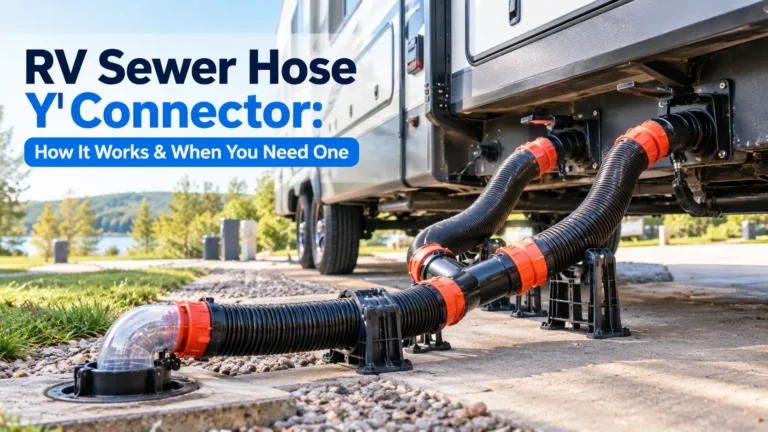
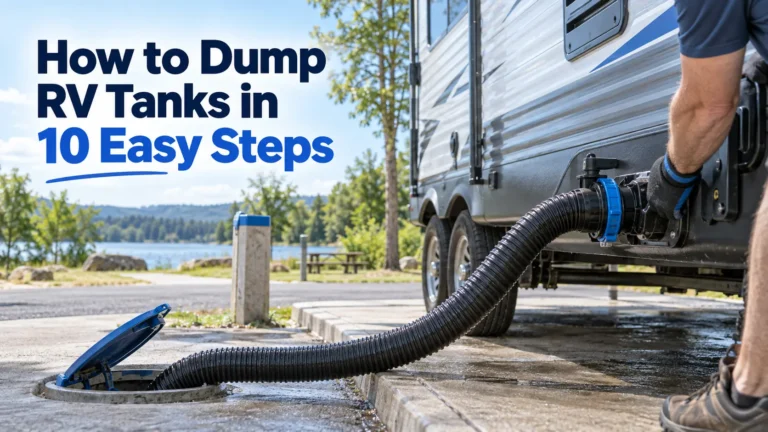
A traditional RV sewer hose is a flexible 3-inch tube that relies entirely on gravity to move waste from the RV to a dump station or sewer inlet. Because there’s no pump, the hose has to run with a steady downward slope the whole way. It’s usually supported off the ground with a hose stand to keep that slope consistent.
A traditional RV sewer hose connects to the RV’s 3-inch waste outlet with a bayonet fitting. At the dump-station end, most kits use a clear elbow or a multi-size adapter designed to fit common threaded and slip-style sewer inlets.
Wall thickness and material affect how well a hose survives being dragged and stored, but that’s a separate buying decision from the one this article covers. A hose this simple has very few things that can go wrong, which is a real advantage, not just a lack of features.
How Does an RV Macerator Pump Work?
A portable electric macerator pump connects to the RV’s standard 3-inch waste outlet, then uses spinning blades to grind waste and toilet paper into a fine slurry. An electric motor pushes that slurry through a much narrower discharge hose, commonly 3/4 to 1 inch on portable models. Because a motor does the work instead of gravity, the pump can move waste uphill or over a longer run than a hose alone.
For this specific model, Flojet’s portable waste pump (18555000) connects directly to a standard 3-inch RV outlet. It uses a stainless steel chopper that grinds waste down to 1/8-inch particles, then pushes it out through a garden-hose-style fitting. Per the manufacturer’s own instruction manual, the pump is built for occasional use, not constant running, and needs a 12V DC power source with a 20-amp fuse. It’s also not meant to be mounted permanently to the RV’s waste port. You connect it for a dump and disconnect it afterward, not leave it in place.
Built-in systems solve the same problem with permanently installed equipment. Thetford describes the Sani-Con Turbo 700 as an OEM-installed system with a 1.5-inch discharge hose that extends to 21 feet. The company says it can evacuate a 40-gallon tank of water in 50 seconds.
The related Sani-Con Turbo 600S uses a 1/2-hp pump, can run from a generator or 12V battery, and includes a 35-amp fuse. Thetford’s own page lists the same 1.5-inch, 21-foot hose for this model too. These specifications apply to built-in systems, not portable Flojet-style pumps.
Which System Dumps a Tank Faster?
Neither system is automatically faster in every setup. A properly sloped 3-inch gravity hose provides a wide, unrestricted flow path on a short, downhill connection. A macerator pump’s main advantage is its ability to move waste over distance or against elevation, not guaranteed faster dumping.
Thetford states that its Sani-Con Turbo 700 evacuates a 40-gallon tank in 50 seconds. That figure applies to a permanently installed system with a 1.5-inch discharge hose, though. It shouldn’t be used to estimate how fast a portable pump will empty a tank through a narrower garden hose.
If either system seems unusually slow, the cause is often the tank itself rather than the hose or pump. A partial clog, a blocked vent, or too little water in the tank can slow drainage no matter which dumping method you use. Our guide to an RV black tank not draining walks through that full checklist before you blame your equipment.
Can a Macerator Pump Move Waste Uphill or Over a Distance?
Yes, but exactly how far and how high depends on the specific pump. Check the manufacturer’s published rating before you count on a number you saw somewhere else. For this specific model, Flojet rates its 18555000 to move waste up to 150 feet horizontally through a reinforced 3/4-inch hose. Per that same official hose chart, flow drops as the hose gets longer, from around 7.8 GPM on a short run down to about 5.1 GPM at the hose’s longest rated length. The manual doesn’t publish a separate lift height for this model, a reminder that published limits vary by model.
Thetford doesn’t publish a separate uphill-lift figure for the Sani-Con Turbo 700 or 600S on their official pages, either. Both models list the same 1.5-inch hose extending to 21 feet, which describes reach at the dump station, not how far the pump can push waste uphill.
Published specifications vary by manufacturer and even by individual model within the same product line. Treat any lift or distance number as specific to that exact pump. Check the manual for the pump you plan to buy before relying on a stated reach.
Setup, Cleaning, and Storage Compared
Setting up a sewer hose means attaching it at both ends and propping it so it holds a downhill slope the whole way. Setting up a macerator pump means attaching it to the outlet, connecting a power source sized to the pump’s fuse and wire gauge, and running the discharge hose to the drain.
Cleaning differs more than setup does. A hose just needs a rinse through a clear elbow so you can see the water run clean. A macerator pump needs its own rinse cycle: Flojet’s manual for model 18555000 describes running fresh water through a dedicated rinse valve to flush the pump and discharge line before storing it, a step a plain hose doesn’t require. Our guide to your RV’s black tank flush system covers the tank side of that same routine.
Storage needs vary by RV. The pump body is compact, but its discharge hose, power cable, and fittings still need a clean storage space.
What Can Go Wrong: Failure Points and Maintenance
A sewer hose’s main failure points are pinholes from dragging on gravel, UV damage from sun exposure, and kinks that trap waste and slow the flow. A portable macerator pump adds electrical failure points on top of mechanical ones: a blown fuse, damaged wiring, a pump run dry too long, or blades clogged by something they can’t grind.
That last risk is worth taking seriously. Flojet’s own manual states plainly that model 18555000 will not handle hard solid objects, sanitary napkins, wet wipes, or rags. It also warns against running the pump dry for more than 30 seconds. The same manual notes the pump is built for occasional use, not continuous runs beyond 30 minutes.
A valve that won’t fully open can also mimic a hose or pump problem. If nothing drains well no matter which system you use, it’s worth ruling out a stuck black tank valve before assuming the hose or pump itself has failed.
Cost and Long-Term Value
A sewer hose costs less upfront and has fewer parts to maintain, since it’s just tubing and fittings with no motor, wiring, or fuse. A macerator pump costs more and adds an electrical system to maintain, but it can solve problems a hose simply can’t handle.
Ongoing maintenance also skews toward the hose: rinsing, inspecting for pinholes, and occasional replacement. A macerator pump needs that same rinsing routine, plus periodic checks on the fuse, wiring, and blades. It has more components that can fail outright rather than simply wear out.
Whether the added cost and upkeep are worth it depends less on the price tag and more on how often you’d actually use the pump’s uphill or long-distance capability. A pump that mostly sits in storage isn’t earning its keep, no matter what it cost.
Sewer Hose vs Macerator Pump: When Does Each One Win?
A sewer hose wins whenever gravity can do the job on its own: a close connection, a downhill slope, and a standard dump station or full hookup site. A macerator pump wins when gravity can’t. That usually means an uphill sewer connection, a long distance to the drain, or dumping into an approved home cleanout through a smaller line than a standard hose can offer.
Neither system is an automatic upgrade over the other. A macerator pump adds real capability in specific situations, but it adds cost, wiring, and moving parts in every situation, even the ones where a hose would have worked fine.
Practical Decision Checklist
- Your dump inlet sits level with or below your RV’s outlet
- You’re usually a short distance from the connection
- You want the fewest possible electrical or mechanical parts to maintain
- Cost and simplicity matter more than flexibility
- You mostly dump at full-hookup sites or standard dump stations
- Your sewer connection sits uphill from your RV
- The connection is too far away for a standard hose to reach
- You want to dump into a smaller line, such as an approved home sewer cleanout
- Storage space for a full-length sewer hose is limited
- You’re comfortable maintaining a 12V electrical connection, fuse, and motor
Even with a macerator, keeping a basic sewer hose as a backup can help if the pump, fuse, wiring, or discharge line fails.
Neither setup eliminates a trip to the dump station when your campsite has no sewer connection. For that situation, consider a portable waste tank for your RV instead.
Final Verdict
A 3-inch gravity sewer hose is the best default for most campground and dump-station use. It costs less, sets up in minutes, and has the fewest parts that can leave you stuck if something breaks mid-trip. A portable macerator pump is a specialized tool, not an automatic upgrade. It earns its place when your situation genuinely fights gravity: an uphill sewer connection, a long run to the drain, or dumping into an approved home cleanout through a narrow line.
If your sewer hose itself is overdue for an upgrade regardless of which system you add, our best RV sewer hose guide breaks down which kits hold up best.
Frequently Asked Questions
Is an RV macerator pump worth it?
It depends on your setup rather than being worth it for everyone. A portable macerator pump earns its cost and added maintenance when you regularly deal with an uphill sewer connection, a long distance to the drain, or dumping into a home cleanout. For a standard, nearby, downhill-sloped connection, a sewer hose alone does the job for less money and less upkeep.
Is a macerator pump slower or faster than a sewer hose?
Neither is automatically faster. A well-sloped 3-inch gravity hose on a close connection often empties a tank quickly with nothing limiting the flow. A macerator pump’s real advantage shows up when gravity alone can’t do the job, such as an uphill or long-distance run, not as a general speed upgrade over a hose that already works well.
Can an RV macerator pump push waste uphill?
Yes, most electric macerator pumps are built to move waste against gravity, which is one of their main advantages over a hose. Exactly how far uphill depends on the specific pump’s published rating, and manufacturers don’t all publish the same specifications, so check the documentation for the model you’re considering rather than assuming a general number applies.
How far can an RV macerator pump move waste?
This varies significantly by model, hose diameter, and hose length. For this specific model, Flojet’s portable waste pump is rated by the manufacturer to move waste up to 150 feet horizontally through a reinforced 3/4-inch hose, with flow decreasing as the run gets longer. Other pumps and built-in systems publish different figures, so treat any specific distance as tied to that exact model, not the category as a whole.
Can you dump an RV into a home sewer cleanout?
Use a home cleanout only when the connection is approved for RV wastewater and local sewer, septic, sanitation, and environmental rules allow it. Confirm the requirements with the relevant local authority or septic provider before connecting. Rules vary by location and by whether the property is on municipal sewer or septic.
Do you still need a sewer hose if you own a macerator pump?
Keeping a basic sewer hose as a backup is sensible. It works without a motor, fuse, wiring, or electrical connection, so it still gets you dumped if the pump, fuse, wiring, or discharge line ever fails.
Can toilet paper clog an RV macerator pump?
Portable RV macerator pumps are designed to process normal RV waste and toilet tissue, but they are not designed for wet wipes, sanitary products, rags, or hard objects. Follow the paper and waste restrictions in the manual for your specific pump. Never assume an item is safe for the pump simply because its packaging describes it as flushable.