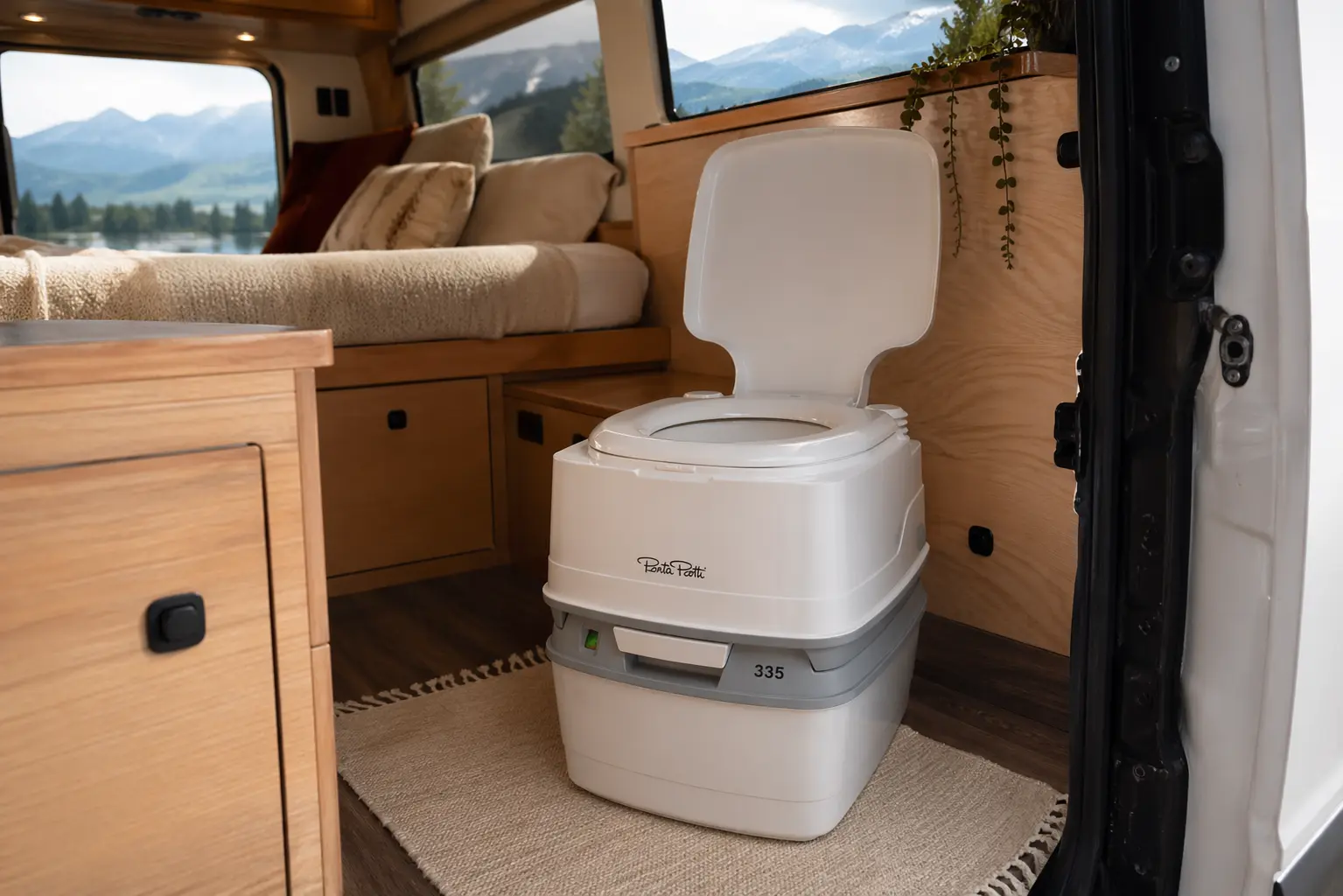
Not every RV has a built-in toilet. And even when it does, there are plenty of situations where a portable camping potty makes your life a lot easier.
Maybe you’re in a camper van with no bathroom space. Maybe you’re boondocking miles from the nearest dump station. Or maybe your RV toilet needs repair, and you need a backup fast. A portable camping potty is a self-contained unit — no hookups, no plumbing. Fill the flush tank, do your business, empty the waste tank at a dump station later.
This guide covers the 5 best options for 2026 — honest reviews, a buying guide, smell control tips, and step-by-step emptying instructions.
What is a portable camping potty?
A self-contained, freestanding toilet that requires no plumbing or hookups. It has a flush mechanism, a fresh water tank, and a sealed waste cassette you empty at a dump station or campsite toilet. Designed for RVs, camper vans, boats, and off-grid camping.
Quick Comparison: 5 Best Portable Camping Potties
Quick Comparison: 5 Best Portable Camping Potties
| Product | Type | Tank | Flush | Best For | Rating | Check Price |
|---|---|---|---|---|---|---|
|
Thetford Porta Potti 565E Best Overall | Cassette | 21L / 5.5 gal | Electric | Full-time RVers | Check Price | |
|
Camco 5.3 Gallon Best Budget | Cassette | 20L / 5.3 gal | Manual pump | Budget campers | Check Price | |
|
Dometic 972 Best for Vanlife | Cassette | 18.9L / 5 gal | Bellows pump | Vanlife | Check Price | |
|
Cleanwaste GO Anywhere Best Lightweight | Bag-based | No tank | None | Emergency / backup | Check Price | |
|
Thetford Porta Potti 365 Best Compact | Cassette | 15L / 4 gal | Manual pump | Weekend campers | Check Price |
5 Best Portable Camping Potty for RV (Full Reviews)
1 Thetford Porta Potti 565E (Best Overall)
⭐⭐⭐⭐⭐ | Editor’s Choice — Best for full-time RVers and comfort seekers
Specs
- 21L (5.5 gal) waste tank
- 15L (4 gal) fresh tank
- Electric flush
- 41 cm (16 in) seat height
- Tank level indicator
- Locking latch
The Porta Potti 565E is the gold standard in portable RV toilets. It combines the largest waste tank in its class with a battery-powered electric flush that feels genuinely close to a home toilet. The built-in tank level indicator removes guesswork, and the locking latch keeps things secure during transport.
Why we picked it: If you’re using a portable toilet regularly, the 565E removes most of the friction. Electric flush, large capacity, tank indicator — this one has everything. It costs more than manual models, but the convenience pays off quickly. View full specs on the Thetford Porta Potti 565E product page.
Who it’s for: Full-time RVers, motorhome owners, and anyone who values comfort and wants the fewest possible trips to the dump station. Also ideal for taller users — the seat sits at 41 cm, close to a standard home toilet.
- Electric flush feels close to residential toilet
- Largest tank in its class — fewer dump trips
- Tank level indicator removes guesswork
- Tall seat height — comfortable for adults
- Trusted brand, chemicals widely available
- Pricier than manual models
- Requires batteries for flush
- Heavy when full — solo carry can be awkward
Bottom line: The best portable camping potty for regular daily use. The extra cost pays off in convenience and comfort.
2 Camco 5.3 Gallon Portable Toilet (Best Budget Pick)
⭐⭐⭐⭐ | Best value for beginners and weekend campers
Specs
- 20L (5.3 gal) waste tank
- 11L (3 gal) fresh tank
- Manual bellows flush
- Rotating pour spout
- No level indicator
- No batteries needed
Camco is one of the most trusted RV accessories brands, and their portable toilet delivers solid performance at an accessible price. The standout feature is the rotating pour spout — a small detail that makes emptying noticeably cleaner and less stressful than most budget options.
Why we picked it: The rotating pour spout alone sets this apart from other budget cassette toilets. If you’re new to portable toilets, this is the low-risk entry point — good brand support, no batteries needed, and a design that makes the least pleasant part of the job (emptying) much more manageable.
Who it’s for: First-time portable toilet users, weekend campers, and anyone who needs a reliable backup without a large upfront investment. Compact enough for smaller vans and campers.
- Best value in this roundup
- Rotating pour spout makes emptying cleaner
- No batteries needed
- Compact for smaller spaces
- Good brand support and spare parts availability
- Manual flush needs more effort
- Seat sits lower than Thetford models
- No tank level indicator
Bottom line: A solid, well-priced first portable toilet. The rotating pour spout alone justifies choosing this over cheaper alternatives.
3 Dometic 972 Portable Toilet (Best for Vanlife)
⭐⭐⭐⭐ | Best portable toilet for camper van builds and vanlife
Specs
- 18.9L (5 gal) waste tank
- 10L (2.6 gal) fresh tank
- Bellows pump flush
- Sliding valve seal
- ~3.4 kg empty weight
- No level indicator
Dometic makes excellent RV gear, and the 972 earns its place on this list with one standout feature: an outstanding sliding valve seal that genuinely keeps odour contained between uses. For van dwellers sleeping close to their toilet, that matters more than any other spec. Light at 3.4 kg empty, it fits tight builds easily.
Why we picked it: The sliding valve seal on the Dometic 972 is noticeably better than the basic rubber flap designs on most budget cassette toilets. If you’re living in a van and sleeping within a few metres of your toilet, smell control is everything. See full product specs on the Dometic portable toilet page.
Who it’s for: Vanlife travellers, camper van conversions, and off-grid campers who prioritise odour control and compact dimensions above all else.
- Sliding valve gives strong odour control
- Compact footprint for tight van builds
- Excellent Dometic build quality
- Lightweight when empty
- Easy-to-clean interior bowl design
- Fresh water tank is smaller than competitors
- Bellows flush can feel stiff in cold weather
- No waste level indicator
Bottom line: If odour control is your top priority in a van, nothing at this price point beats the Dometic 972’s sliding valve seal.
4 Cleanwaste GO Anywhere (Best Lightweight Option)
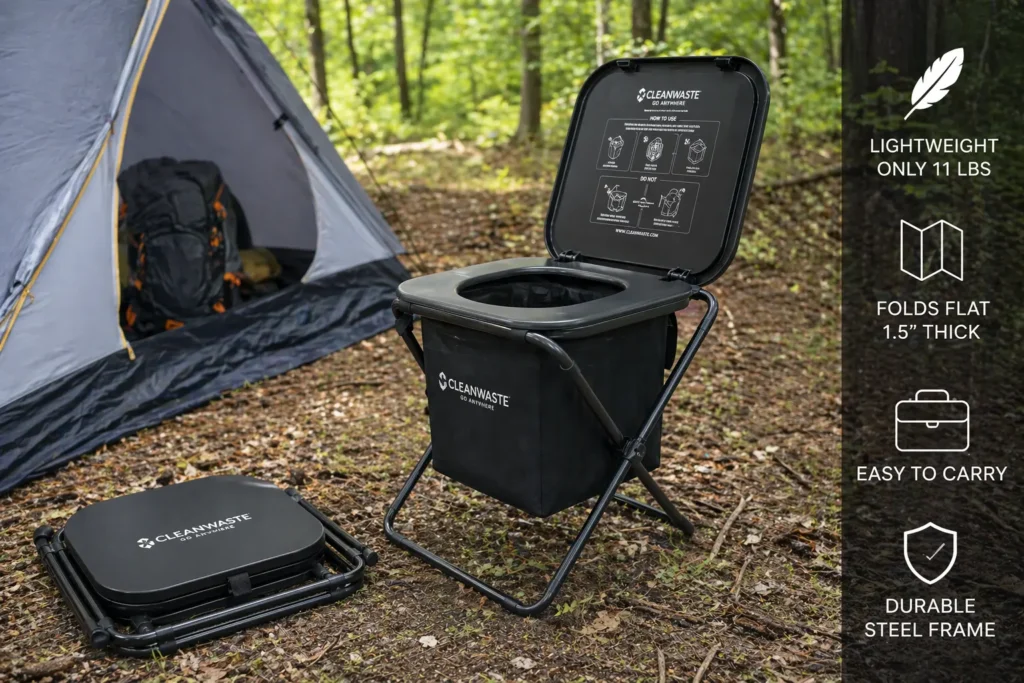
⭐⭐⭐⭐ | Best for emergency backup and ultralight off-grid situations
Specs
- WAG bag system
- No water tank
- No flush
- Under 1 kg weight
- No chemicals needed
- 5-gallon bucket compatible
The GO Anywhere is a fundamentally different product — a foldable steel frame and seat that uses disposable WAG bags instead of a cassette tank. Under 1 kg assembled, it packs flat and requires zero chemicals, no emptying procedure, and no plumbing. The simplest portable toilet on this list.
Why we picked it: For situations where you genuinely cannot empty a cassette tank — remote wilderness, national parks with pack-out rules, or pure emergency backup use — nothing else on this list competes. Just factor in the ongoing cost of bags before you buy.
Who it’s for: Backpackers, off-grid campers, and RVers who need a compact emergency backup. Not recommended as a full-time daily toilet.
- Ultralight and packs flat
- No liquid tank to carry or empty
- No chemicals needed
- Very affordable base unit price
- Bags are fully self-contained after use
- Ongoing cost of WAG bags adds up
- Approved disposal points are not always easy to find
- No flush at all
- Not suitable as a full-time daily toilet
Bottom line: The most portable option on this list — but only makes sense if you truly need the pack-small, no-liquid-waste setup. Factor bag costs into your decision.
5 Thetford Porta Potti 365 (Best Compact Cassette)
⭐⭐⭐⭐ | Best Thetford option for weekend and occasional use
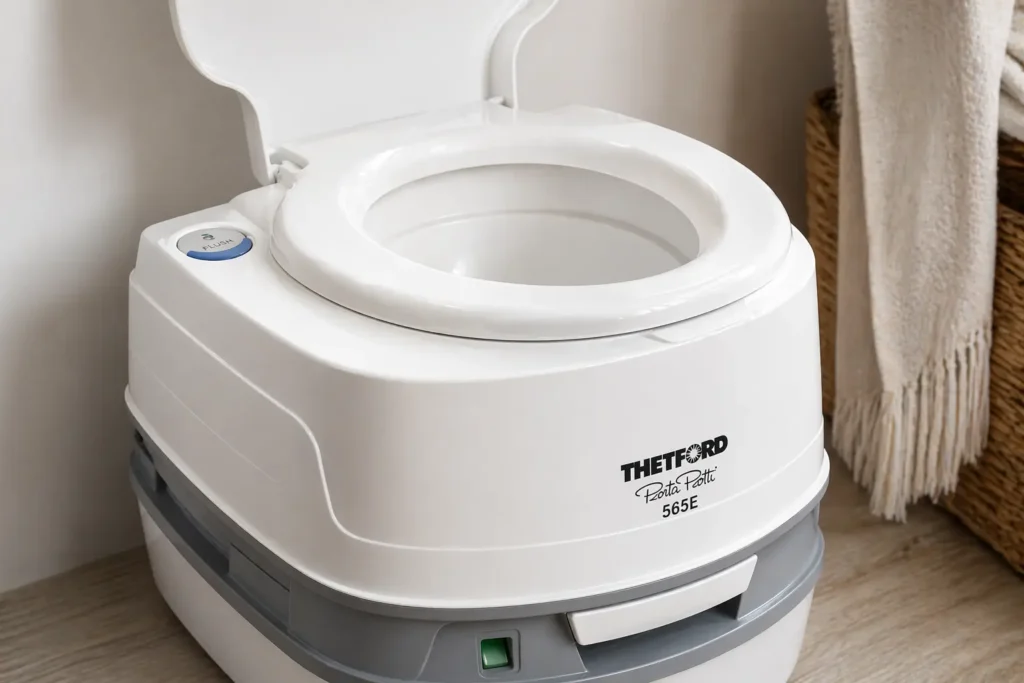
Specs
- 15L (4 gal) waste tank
- 10L (2.6 gal) fresh tank
- Manual piston flush
- No level indicator
- Locking latch
- No batteries needed
The 365 is the smaller, more affordable sibling of the 565E. It trades the electric flush and larger tank for a significantly lower price — while keeping Thetford’s reliable build quality and construction. In most RV portable toilet reviews, the 365 consistently tops the list for compact occasional use.
Why we picked it: If you don’t use it daily, there’s no reason to pay for the 565E’s extra features. The 365 is simple, dependable, globally available, and won’t let you down.
Who it’s for: Weekend campers, motorhome owners who want a backup toilet, and solo travellers who want Thetford reliability at a lower price. The 15L tank is rarely a limiting factor for occasional use.
- Thetford build quality at a lower price
- Compact and easy to store
- Reliable manual flush
- Globally available
- Good for solo or occasional use
- Smaller tank needs emptying more often
- No tank level indicator
- Lower seat height than the 565E
- Manual flush only
Bottom line: The right compromise between Thetford quality and budget. If you’re not using it daily, the smaller tank and manual flush won’t feel like a trade-off.
Types of Portable Camping Potty
Three main types exist. Understanding the differences helps you pick the right one before you buy.
Cassette Toilet
The most common type for RV and van use. A freshwater tank sits on top for flushing; a removable sealed cassette collects waste below. You empty the cassette at a dump station or approved toilet facility.
Best for: RVers, camper van users, motorhome owners, anyone using a portable toilet regularly.
- ✓ Flush mechanism — closest experience to a home toilet
- ✓ Sealed waste tank — good odour control
- ✓ Available worldwide with widely-stocked chemicals
- ✗ Heavier when full — requires dump access for emptying
Composting Toilet
Separates liquid and solid waste. Solids break down through aerobic decomposition — no mixed black water holding tank required. Ideal for long-term off-grid living. The US National Park Service covers composting toilet rules for outdoor use. Typically €500–€1,000+.
Best for: Full-time off-grid dwellers, eco-conscious campers, permanent van conversions.
- ✓ Very little odour when maintained correctly
- ✓ No chemicals needed, no black water to dump
- ✗ High upfront cost, requires ventilation, learning curve
Bag-Based Toilet
A simple frame and seat that holds disposable WAG bags with absorbent gelling material. No tank, no flush, no liquid waste. Waste bags go into approved waste bins or are packed out.
Best for: Backpacking, emergency backup, remote camping with pack-out rules. For proper waste handling, follow Leave No Trace waste disposal guidelines.
- ✓ Ultralight, no liquid to carry, no cleaning required
- ✗ Ongoing bag cost, limited disposal options, no flush
Camping Potty vs Built-In RV Toilet
A built-in RV toilet connects to your rig’s black water tank and needs plumbing, tank sensors, and regular dumping. A portable cassette toilet is fully self-contained — no installation, no plumbing, no tank sensors.
Camping Potty vs Built-In RV Toilet
| Feature | Portable Camping Potty | Built-In RV Toilet |
|---|---|---|
| Installation | None — plug and play | Requires plumbing |
| Waste storage | Self-contained cassette or bags | Connected to black tank |
| Capacity | 4–6 gallons typically | 15–40+ gallons |
| Cost | €50–€200 | €200–€800+ installed |
| Portability | Fully portable | Fixed in place |
For full-time RVers, a portable toilet works best as a backup for when common RV toilet issues arise. For van conversions and compact campers, it often replaces a fixed toilet entirely.
Buying Guide: How to Choose the Best Portable Camping Potty
For your main rig, also read our RV toilet maintenance tips to keep everything running well alongside your portable unit. For the portable toilet itself, here’s what actually matters:
Tank Capacity
A 15-litre waste tank gives roughly 50–60 uses before emptying. A 21-litre tank gets you 70–80 uses. Weekend camper or solo user: 15L is fine. Full-timer or two people: go 20L or more.
Flush System
Electric flush is the most comfortable but needs batteries. Manual piston or bellows flush is reliable, cheaper, and battery-free. Bag-based systems have no flush at all.
Odour Control
The valve between the bowl and the waste tank is the primary odour barrier. A sliding or rotating blade valve seals much better than a basic rubber flap. Combined with proper cassette chemicals, this is what keeps smells in check.
Portability and Weight
A full 21-litre waste tank weighs around 21 kg. Make sure you can carry it solo to a dump point before buying. Built-in carry handles and a compact footprint matter more than you’d expect in the real world.
Seat Comfort
Budget models sit at 36–38 cm. The Thetford 565E sits at 41 cm — much closer to a standard home toilet. Taller users should prioritise seat height.
Waste Disposal
Cassette models require a dump station or approved toilet facility. In most countries, emptying a cassette into a regular toilet is legal. Bag-based systems need approved waste bins or pack-out disposal — rules vary widely by location. For backcountry use, follow Leave No Trace waste disposal guidelines.
How to Empty a Portable Camping Toilet
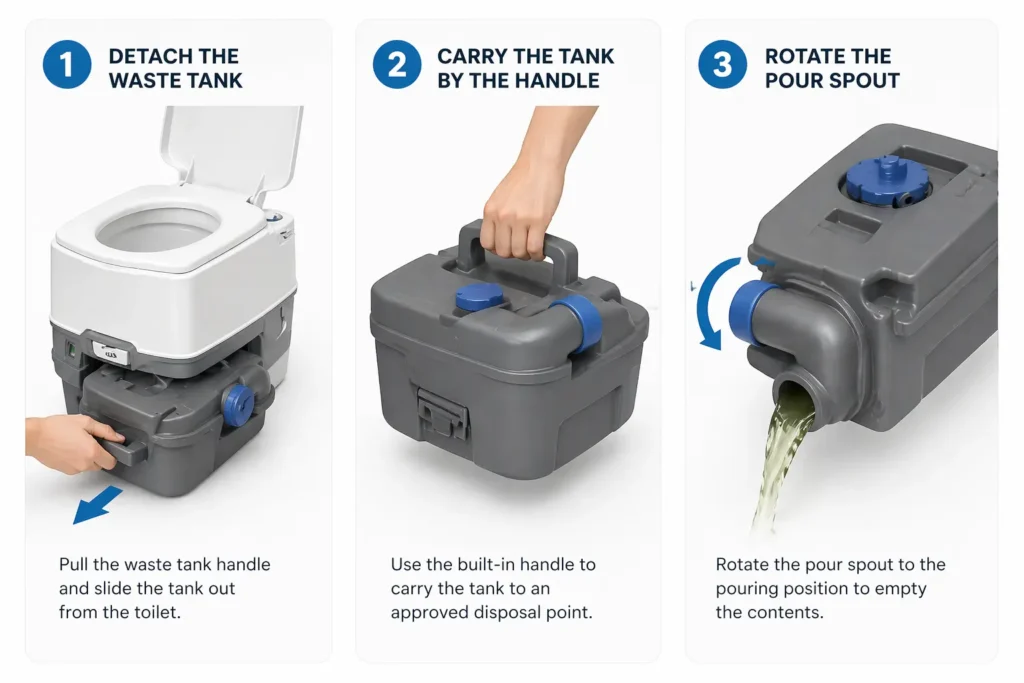
The process takes about 5 minutes. For dump station etiquette on your permanent rig, see our RV black tank dumping guide.
- Check the level indicator. If your model has one, check it. Empty at around 75% — don’t wait until it’s completely full. Easier to carry and cleaner to pour.
- Lock the blade valve. Close and lock the valve between the bowl and the cassette before separating the two parts. This prevents spills during transport.
- Remove the waste cassette. Press the release button and slide or lift the cassette out from the base of the unit. Carry it by the handle.
- Take it to the disposal point. Carry it to a dump station, campsite toilet block, or approved facility. Need to find one? Sanidumps.com is the most complete free dump station locator available.
- Open the vent cap first. Before pouring, open the small air vent on the cassette. Without it, you’ll get an uncontrolled splash instead of a clean pour.
- Pour slowly and steadily. Use the pour spout or rotating handle. Take your time — this is where rushing creates mess.
- Rinse the cassette. Add a small amount of clean water, shake, and rinse thoroughly. A proper rinse here prevents buildup that causes persistent odour on the next use.
- Add chemicals and reassemble. Dose with the correct amount of cassette chemical such as Thetford Aqua Kem before closing. Slide the cassette back in and lock it in place.
How to Control Smell in a Portable Camping Potty
With the right habits, smell is very manageable. For persistent odour issues on your main RV toilet, see our guide on RV toilet smell problems.
Use the right chemicals every time. Thetford Aqua Kem and Dometic ToiChem are the most trusted options. Add the correct dose every single time you empty and refill. This step alone does more for smell control than everything else combined.
Keep the blade valve fully closed. This is the primary odour barrier between the waste tank and your living space. Even a small gap lets smells through.
Don’t let the tank sit too long. A warm, full tank builds up smell quickly. Empty on schedule — around 75% full is the right time.
Ventilate after use. In a van or small camper, crack a window or open a roof vent after each use. Airflow makes a surprisingly big difference in a small space.
Rinse the cassette thoroughly every time you empty. Residue left after a half-hearted rinse builds up and causes persistent smell before the next use. A thorough 30-second shake-and-rinse is worth it.
Frequently Asked Questions
Is a portable camping potty good for RV use?
Yes, absolutely. A portable cassette toilet works well for compact RVs, camper vans, and as a backup for larger rigs. It requires no installation, works anywhere, and handles daily use well when maintained — emptied regularly and treated with the right chemicals. See our full page on common RV toilet issues if you’re using it while troubleshooting your main toilet.
Does a camping potty smell?
It can if you don’t maintain it — but with proper cassette chemicals, regular emptying, and keeping the blade valve closed between uses, smell is minimal. Most experienced users barely notice it. The key is staying on top of maintenance rather than letting a full, warm tank sit for too long.
How often should you empty a portable toilet?
A 20-litre waste tank used by one person lasts roughly 5–7 days with normal use. Two people: plan on every 3–4 days. Don’t wait until the tank is completely full — emptying at around 75% capacity is cleaner, lighter, and easier to handle.
Can a portable toilet be used inside a van?
Yes — that’s one of its most common uses. The best portable toilet for camper van setups are cassette models with sealed blade valves, which produce very little odour between uses. Keep a vent or window cracked after use and the smell clears quickly. Many vanlifers use a Thetford or Dometic cassette toilet every single day without issue.
Do portable toilets need chemicals?
For cassette toilets, yes. Chemicals like Thetford Aqua Kem break down solid waste for easier emptying and control odour inside the tank. Without them, smell builds up fast. Bag-based systems don’t need added chemicals — the WAG bags contain absorbent gelling agents that handle waste containment on their own.
Why does my RV toilet still smell after flushing even with a new seal?
If the bowl holds water but still smells, the problem is likely a blocked or failed black tank roof vent rather than the seal itself. The vent pipe routes tank gases up through the roof — if it’s blocked by debris or a failed vent cap, gases come back through the toilet. Check the roof vent cap for obstructions. If that’s fine, a thorough black tank flush and bacterial enzyme treatment usually resolves it. See our full guide on RV toilet smell problems.
Final Verdict
For most RV owners, camper van users, and vanlifers, the Thetford Porta Potti 565E is the best portable camping potty available. Electric flush, large tank, level indicator — it makes daily use genuinely comfortable and worth the extra cost.
On a budget, the Camco 5.3 Gallon delivers real value with its rotating pour spout. For vanlife and tight spaces, the Dometic 972 wins on odour control. And for a pack-small emergency backup with no liquid tank to carry, the Cleanwaste GO Anywhere is unmatched.
Whatever you choose: use the right chemicals, empty on schedule, rinse the cassette properly. Do those three things consistently and you’ll barely notice you’re using a portable toilet at all.
Choosing the right portable camping potty comes down to how often you travel, how much space you have, and how important comfort is to you. Use the comparison table above to match your situation to the right model.