TL;DR: You don’t need expensive RV-specific toilet paper for every trip. If your regular toilet paper is labeled septic-safe and passes a quick jar test, it’s safe for your black tank. The bigger risk isn’t your paper choice. It’s using too little water per flush. That said, rapid-dissolving RV-specific paper is the safer pick for boondocking, older plumbing, or anyone who frequently deals with clogs.
Pull into any RV campground and you’ll hear the same advice: use RV toilet paper. The stuff comes in small packages, costs twice as much, and feels like sandpaper. But is it actually necessary?
The short answer is no, not always. But rv toilet paper vs regular toilet paper isn’t a simple swap. Some regular paper is just as safe as RV-specific paper. Some isn’t. And in both cases, how much water you use matters more than the paper you choose.
This guide breaks down what actually separates the two, how to test any brand you already own, and exactly when the extra cost of RV-specific paper pays off.
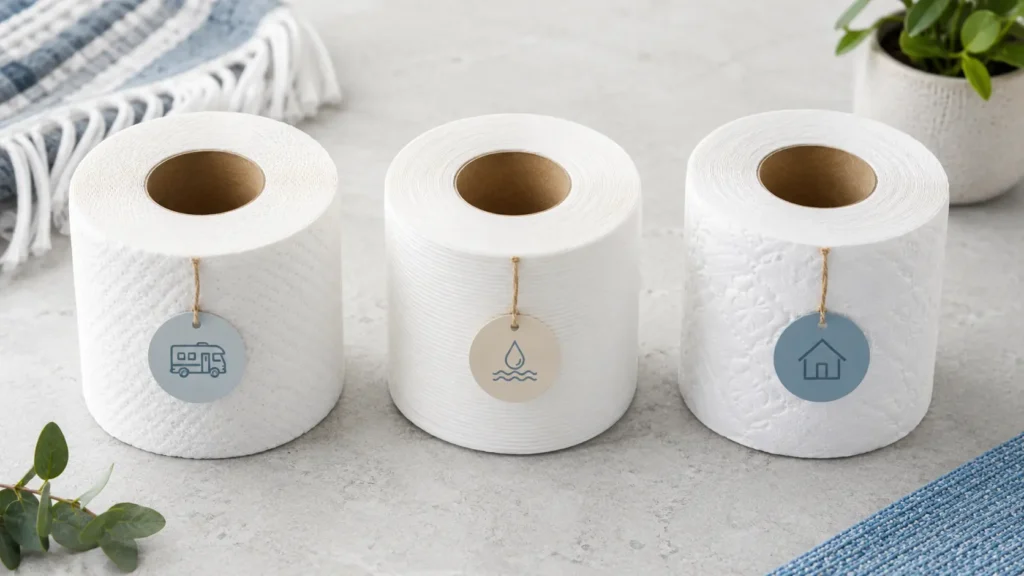
What’s the Real Difference Between RV Toilet Paper and Regular Toilet Paper?
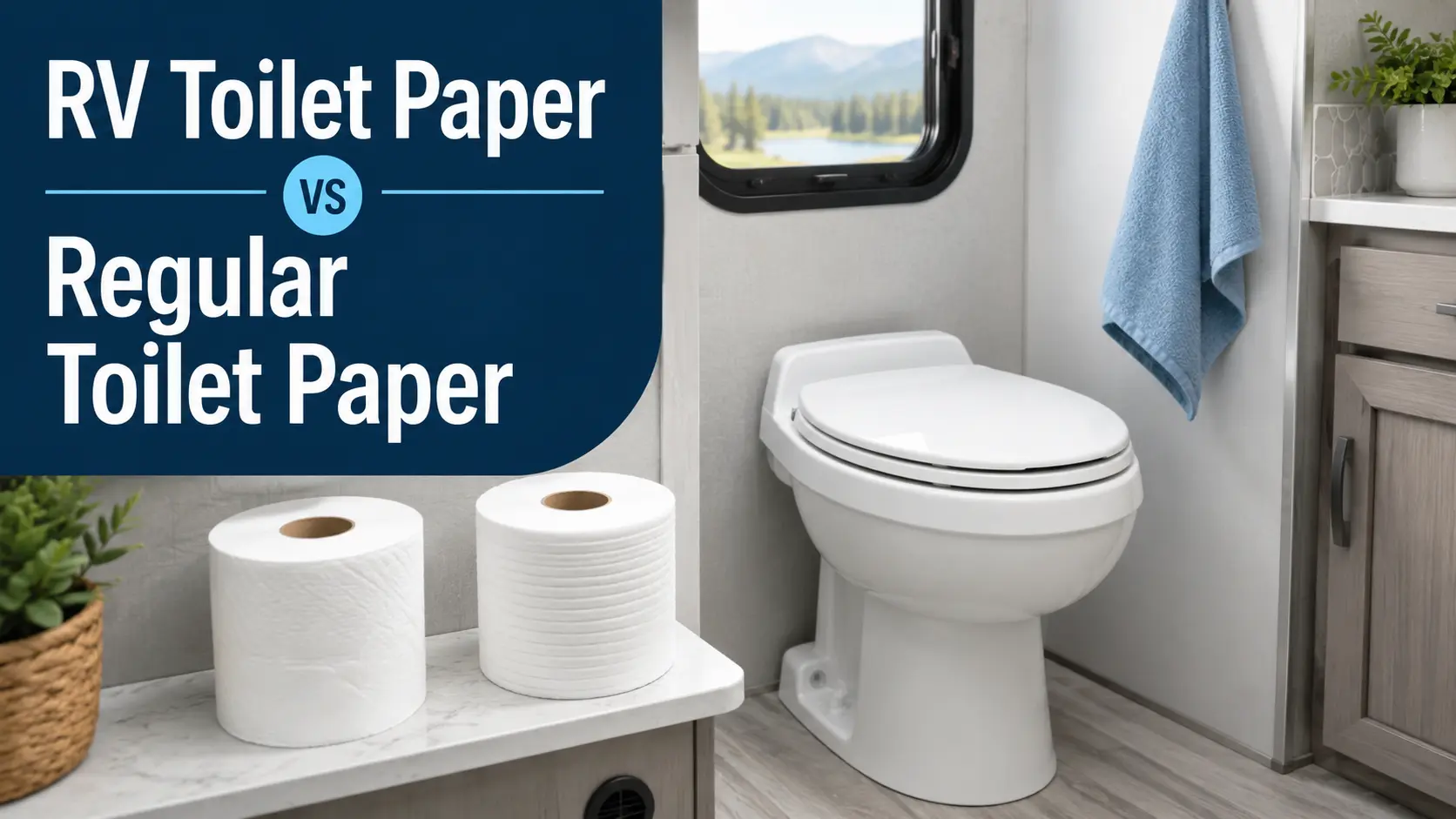
RV toilet paper and regular household toilet paper are both made from paper pulp. But they’re engineered for different jobs. RV-specific paper is designed to break apart quickly in low-water holding tank conditions. Most standard household toilet paper is designed for comfort first, and takes significantly longer to dissolve.
That difference matters because an RV black tank isn’t connected to a city sewer line. Everything that goes in stays in until you dump. Paper that doesn’t break down fast enough can stack up, block sensors, and eventually create a pyramid plug in your black tank that stops the tank from draining at all.
Unique Camping + Marine notes that RV-specific paper tends to be thinner and usually 1-ply. That means you often use more sheets per use to get the job done, which drives up the cost and cancels out the per-roll price difference. Many septic-safe regular brands dissolve just as well, cost less, and feel better to use.
The real question isn’t RV paper vs regular paper. It’s fast-dissolving paper vs paper that doesn’t dissolve fast enough. Paper that doesn’t break apart quickly can also contribute to residue around tank probes. If the gauge stays high after dumping, see our guide to cleaning stubborn black tank sensor buildup.
Can You Use Regular Toilet Paper in an RV?
Yes, but only if it’s septic-safe. Standard household toilet paper that is not labeled septic-safe takes too long to break down in an RV black tank and should not be flushed. Septic-safe regular toilet paper, used with enough water, works safely for most RVers in most situations.
This is the part that causes the most confusion. “Regular toilet paper” isn’t one thing. It covers two very different products:
- Ordinary household paper — thick, soft, multi-ply, designed for comfort. This is the kind that causes real black tank problems.
- Septic-safe household paper — formulated to break apart in a closed waste system. This is what most experienced RVers actually use.
Camp Addict found that more than half of the toilet paper on grocery store shelves is labeled septic-safe. You’ve probably already got compatible paper at home. You just haven’t been checking the label.
The RV Geeks have used regular septic-safe paper in their own RVs for over 20 years without a single clog. Scott’s own product description for their standard 1,000-sheet roll explicitly states it is safe for RV, boat, and camper use.
The right way to frame it: regular toilet paper is not automatically RV-safe. But septic-safe regular toilet paper works well for most RVers. The label is the first thing to check.
Why Water Matters More Than the Paper You Choose
The single biggest cause of RV black tank clogs isn’t the toilet paper. It’s not using enough water when you flush. Even the fastest-dissolving paper can stack up and harden if there isn’t enough water to carry it through the system and distribute it evenly in the tank.
Sue Rasmussen, an instructor at the National RV Training Academy who cleans RV black and gray tanks professionally, is direct on this point: tank problems almost always trace back to water use, not paper brand. Her recommended flush method for solid waste:
- Add water to the bowl before you go. Fill it roughly one-third to halfway.
- After you go, fill the bowl again before flushing.
- Aim for about 1 to 1.5 gallons / 3.8 to 5.7 liters of total water per flush.
- If your plumbing has a 90-degree elbow (common in fifth wheels), follow with a second bowl of water to push everything through the bend.
Kleen Tank, one of North America’s leading professional holding tank cleaning services, reinforces this. After cleaning thousands of tanks, their guidance is consistent: flush with a full extra bowl of water after each use, dump only when the tank reaches 90 to 100 percent full (a fuller tank drains more completely), and add 3 to 5 gallons / 11 to 19 liters of fresh water immediately after every dump.
This also connects directly to how well your best RV toilet treatment works. Enzyme and bacteria-based treatments need enough water to activate and circulate. Low water plus undissolved paper is how most serious clogs start, regardless of what paper you’re using.
Quick Rules for Using Regular Toilet Paper in an RV
Follow these every trip and most paper-related tank problems won’t happen:
- Use only paper labeled septic-safe
- Avoid thick quilted or luxury multi-ply paper
- Run the jar test before a long trip with any unfamiliar brand
- Use about 1 to 1.5 gallons / 3.8 to 5.7 liters of water for each solid waste flush
- Never leave the black tank valve open at full-hookup sites
- Dump when the tank is at least two-thirds full, ideally closer to full
- Add 3 to 5 gallons / 11 to 19 liters of fresh water to the tank immediately after every dump
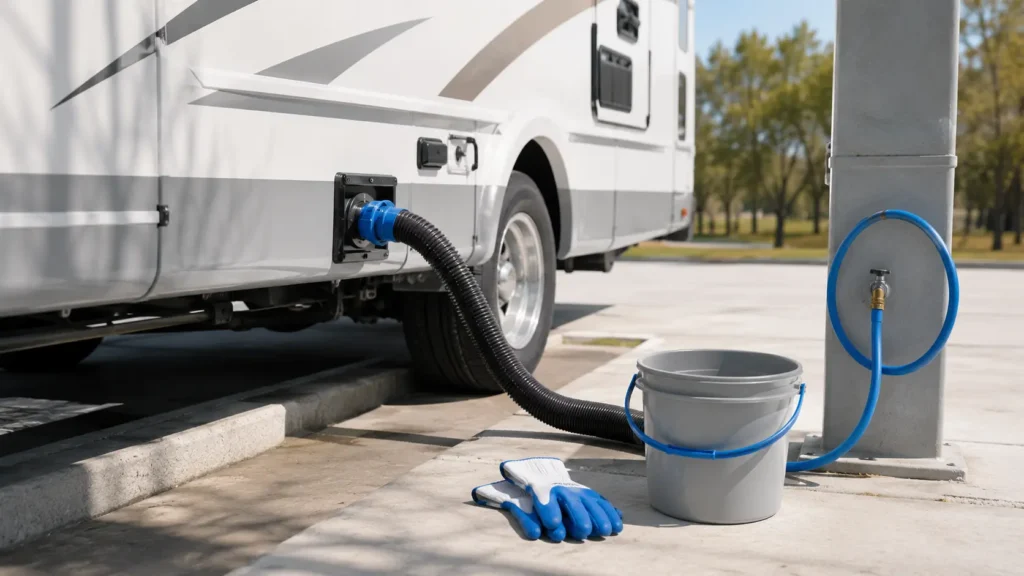
What Is Septic-Safe Toilet Paper — and Is It Really RV-Safe?
Septic-safe toilet paper is designed to break down in a closed waste system over time. For most RVers, it works just as well as dedicated RV-specific paper. The main practical difference is that RV toilet paper dissolves more completely and more quickly, which matters most when water use is low or when the tank is used heavily.
Here’s how the spectrum looks, from safest to riskiest for a black tank:
- RV-specific rapid-dissolving paper — fastest breakdown, designed for holding tanks, highest cost, least comfortable
- Septic-safe household paper — fast enough for most RVers, widely available, better comfort, lower cost
- Standard household paper (not septic-safe) — takes too long to break down, high clog risk, should not go into an RV black tank
Both septic-safe and RV-specific papers solve the same core problem: they break apart faster than standard household paper. The difference between them is how fast and how completely. For a boondocking trip with minimal water per flush, that speed difference matters. For a weekend trip at a full hookup site with good flushing habits, it matters less.
The important takeaway: all RV toilet paper is septic-safe, but not all septic-safe paper dissolves as fast as dedicated RV paper. Knowing which situation you’re in tells you which one to choose.
How to Test Any Toilet Paper for RV Use (The Jar Test)
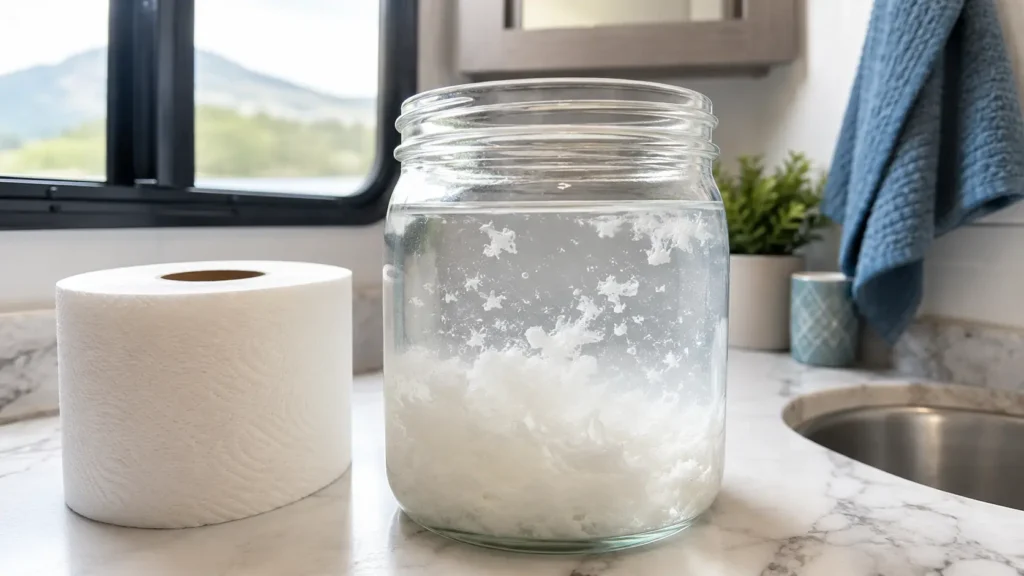
The jar test is the fastest way to check whether a toilet paper brand is safe for your black tank. It takes less than 30 seconds and requires nothing but a jar of water.
How to do it:
- Fill a jar with water.
- Drop in 2 to 3 sheets of the toilet paper you want to test.
- Shake it firmly for 5 to 10 seconds.
- Let it sit for another 10 to 15 seconds, then check the result.
If the paper breaks into small pieces and falls apart easily, it’s likely safe for RV use. If it stays together in large sheets with minimal breakdown, don’t use it. Unique Camping + Marine recommends this test for any brand you’re not sure about before committing to it on a trip.
The jar test has real limits, and it’s important to know what it can and can’t tell you. Kleen Tank points out that a real holding tank involves driving vibration, varying temperatures, sprayer flushing, and different waste content. None of that is in a jar of water. The National RV Training Academy makes the same point: a 110°F / 43°C summer day and a freezing overnight create conditions no jar can replicate.
The right way to read it: the jar test is a quick filter, not a lab result. If paper stays in large intact sheets, don’t use it in your RV. If it breaks into small pieces, it’s more likely to be safe. But your water use, flushing habits, tank level, and dump routine all matter just as much.
Is RV Toilet Paper Worth the Extra Cost?
RV-specific toilet paper does one thing better than any septic-safe regular paper: it dissolves faster and more completely. In most real-world RV situations, that advantage is real but narrow.
The catch is that RV paper tends to be thinner and rougher than what most people use at home. Because it’s thinner, many RVers end up using more sheets per use. More sheets means the roll runs out faster, which means you’re buying more often. That erodes most of the safety benefit you were paying for in the first place.
Camp Addict found that more than half of grocery store toilet paper is already labeled septic-safe. Septic-safe regular paper that passes the jar test and is used with enough water performs comparably to most RV-branded paper in normal full-hookup camping conditions.
The cost of dedicated RV toilet paper is worth it in specific situations: boondocking with limited water, guests who won’t follow flushing rules, kids who overuse paper, older plumbing with weak flush pressure, or any RV that regularly has sensor or clog problems. Outside those situations, a tested septic-safe regular paper is the better value.
When RV-Specific Toilet Paper Is Actually Worth Buying
For most weekend RVers at a full hookup site with solid flushing habits, septic-safe regular paper works fine. But there are specific situations where the faster breakdown of dedicated RV paper is genuinely worth the premium.
| Situation | Better Choice |
|---|---|
| Weekend trips with full hookup | Septic-safe regular TP |
| Full-time RV living | Tested septic-safe TP or rapid-dissolving RV TP |
| Boondocking / low-water camping | RV-specific rapid-dissolving TP |
| Kids or guests using the RV | RV TP or strict paper-use rules |
| Older plumbing, weak flush, frequent clogs | RV TP + more water per flush |
| Comfort is a priority | Soft septic-safe TP that passes the jar test |
Camp Addict specifically calls out the kids angle: children tend to overuse paper, and the faster breakdown of RV-specific paper provides a buffer when you can’t control how much goes in. When water is scarce during boondocking, you want the fastest-dissolving option available regardless of cost.
For older RVs with narrow pipes or weak flush pressure, paper buildup in the plumbing can also contribute to the kind of odor and pressure issues covered in our guide on rv toilet smells when flushed. The weaker the flush, the more important fast-dissolving paper becomes.
Safe Toilet Paper Options to Consider
Here’s a practical starting point without testing every brand yourself:
- Best budget regular option: Any 1-ply household paper labeled septic-safe. Run the jar test once before a long trip to confirm your specific batch.
- Best RV-specific pick: Scott Rapid Dissolving is widely available and explicitly marketed for RV and boat use, making it a practical starting point for buyers who want a dedicated RV-safe option. Thetford Aqua-Soft is the premium pick, popular with full-timers for consistent fast breakdown.
- Best comfort pick: A soft septic-safe 2-ply paper that passes your jar test. Some RVers use Costco-style septic-safe paper successfully, but test it first because formula and availability can vary by region.
- Best option for guests: Any labeled RV-specific paper. Guests won’t follow your water-use rules, so faster dissolving paper removes that variable entirely.
What Should You Never Flush Down an RV Toilet?
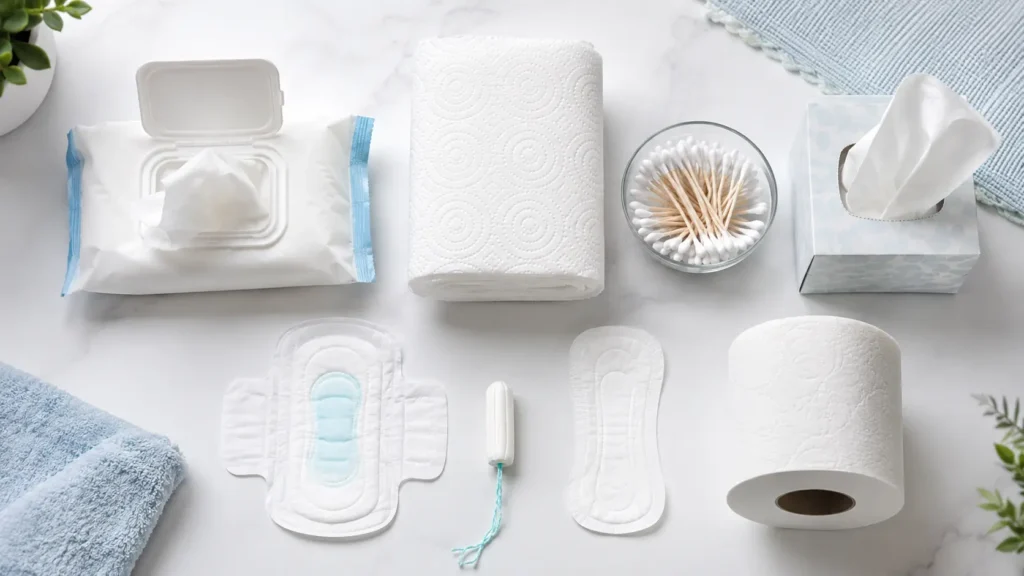
Never flush anything other than toilet paper and human waste down an RV toilet, including products marketed as “flushable.” An RV waste system is smaller, lower-volume, and far less forgiving than a home sewer connection. One wrong item can create a clog that takes days to clear.
Items that should never go into an RV toilet:
- Wet wipes or “flushable” wipes
- Paper towels
- Napkins or tissues
- Feminine hygiene products
- Thick, quilted, multi-ply household paper without a septic-safe label
- Cotton balls or swabs
- Any food waste
Camping World specifically lists baby wipes, paper towels, feminine hygiene products, and thick quilted paper as items that don’t belong in any RV waste system. The RV Geeks are equally clear that so-called flushable wipes don’t break down in a holding tank and will cause problems regardless of what the label says.
If something has already gone down that shouldn’t have, and your toilet is draining slowly, the fastest fix is to unclog your RV toilet before the obstruction hardens. And if you’re also noticing a smell after dumping, paper residue coating the tank walls is often part of that problem, alongside any blockage.
Conclusion
The rv toilet paper vs regular toilet paper debate isn’t as complicated as the industry makes it sound. Most RVers can use septic-safe regular toilet paper without issues, as long as they flush with enough water and maintain a consistent dump routine. Paper choice matters. Water use matters more.
RV-specific rapid-dissolving paper earns its cost in specific situations: boondocking, guests, older plumbing, or full-time living. Outside those situations, check for the septic-safe label, run a quick jar test on any unfamiliar brand, and focus on using at least 1 gallon / 3.8 liters of water for solid waste flushes.
Pair those habits with the right RV toilet treatment for your camping style. That combination does more for your black tank than any paper brand switch alone.
Frequently Asked Questions
Is it safe to use regular toilet paper in an RV black tank?
Standard household toilet paper without a septic-safe label is not safe for RV use. It doesn’t break down fast enough in a closed holding tank and can build up into blockages over multiple uses. Regular toilet paper labeled septic-safe works well for most RVers when paired with enough water per flush. The label is the first thing to check before any brand goes into your black tank.
What toilet paper brands are safe for RV use without being RV-specific?
Several common household brands work well in RV holding tanks. The RV Geeks recommend Scott 1000, which Scott explicitly labels as safe for RV, boat, and camper use. Angel Soft septic-safe and most store-brand 1-ply septic-safe papers also pass the jar test reliably. Run the test once on any new brand before committing to a full trip.
Does RV toilet paper really dissolve faster than septic-safe paper?
Yes. Dedicated RV toilet paper is formulated to dissolve faster and more completely than septic-safe household paper. The key difference is the speed and completeness of dissolution. For most weekend RVers at a full hookup site with normal flushing habits, that speed difference doesn’t change outcomes. For boondocking or low-water situations, the faster breakdown provides a real safety margin.
What happens if you use the wrong toilet paper in an RV black tank?
Paper that doesn’t dissolve fast enough builds up in the tank, coats sensors with residue that causes false full readings, and can eventually compact into a solid mass directly under the toilet drain. That’s a pyramid plug. It typically requires 48 to 72 hours of enzyme soaking to dissolve, and serious cases require professional tank cleaning that costs $150 to $300 or more.
How much water should you use when flushing an RV toilet?
The National RV Training Academy recommends a pre-fill before use, then enough additional water to reach a total of about 1 to 1.5 gallons / 3.8 to 5.7 liters per solid waste flush. The sudden rush of water carries everything through pipe bends and distributes it properly in the tank. Too little water, regardless of paper choice, is the leading cause of black tank buildup and odor problems.
Is septic-safe toilet paper the same as RV toilet paper?
No. Both types dissolve faster than standard household paper, but they’re not the same product. Septic-safe paper is formulated for home septic systems, which hold much more water than an RV black tank. RV-specific paper dissolves faster and more completely, which is a meaningful advantage in the smaller, lower-water environment of a holding tank. Most septic-safe paper is safe enough for RV use, but RV paper has a higher dissolution rate that matters most in low-water or high-use situations.
Should you put used toilet paper in the trash instead of flushing it?
Some RVers use a sealed waste bin instead of flushing toilet paper. Camping World notes this as a valid practice that completely removes paper-related tank issues. It’s common in van life setups and in older RVs with narrow plumbing or weak flush mechanisms. If you go this route, use a lidded bin with liner bags and empty it at every dump station stop.
Can thick, quilted, or multi-ply toilet paper clog an RV black tank?
Yes. Thick, quilted, or premium multi-ply paper that isn’t labeled septic-safe takes too long to dissolve in a holding tank. It doesn’t always cause a clog on the first use, but over several trips it accumulates, coats sensors, and contributes to serious blockages. Camping World specifically identifies thick quilted household paper as a category to avoid in any RV waste system.