TL;DR: Quick Verdict
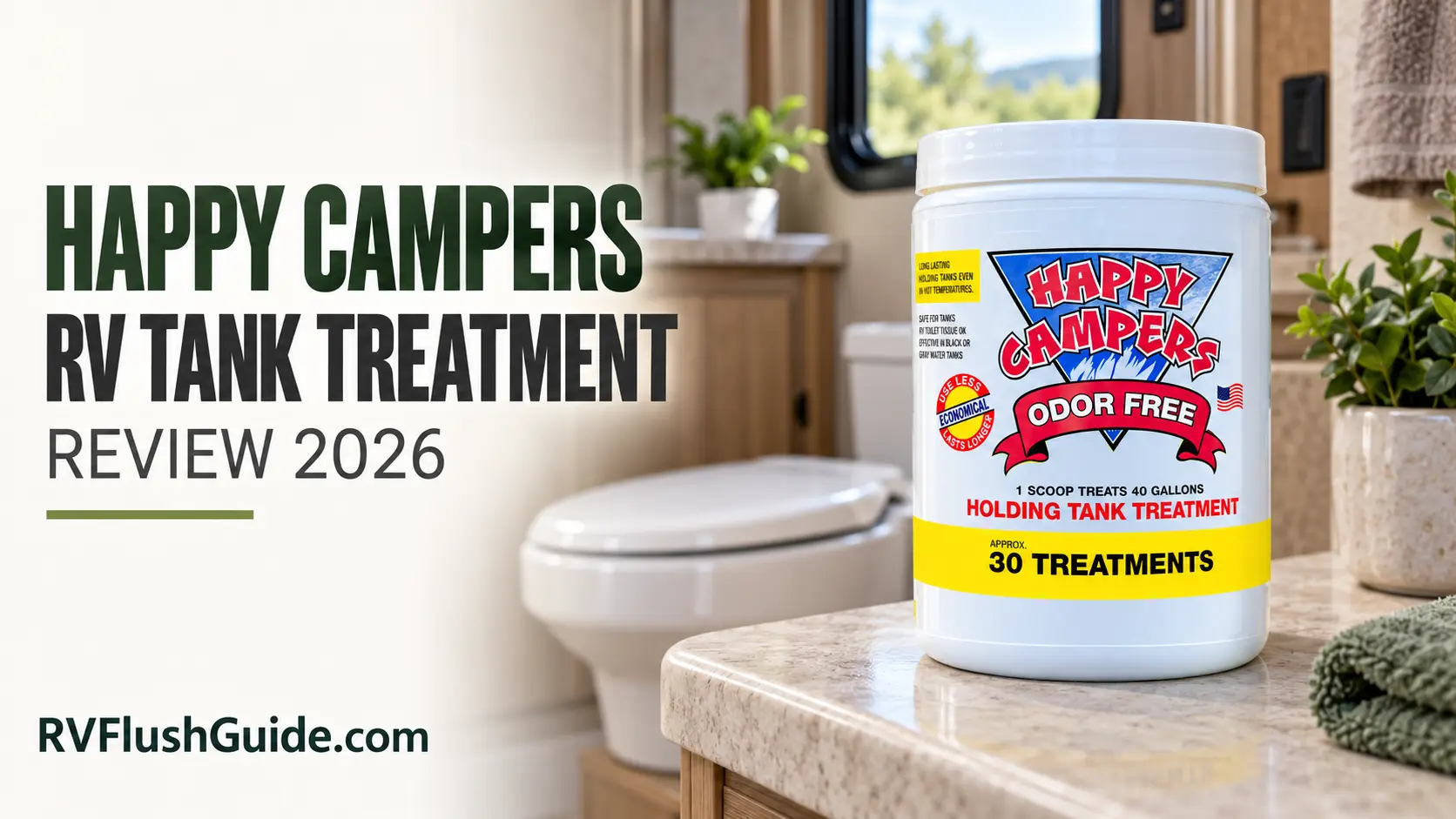
- Best for: Owners with a recurring tank odor who want a mineral-based, enzyme-free treatment dosed by the scoop: one scoop per 40 gallons for black, half a scoop for gray.
- Evidence: One independent 2026 cassette-toilet test ranked it near the top for odor but below plain water for solids. We found no independent test of the current product in a full-size RV black tank.
- Limits: It maintains, it does not repair. Blocked vents, worn seals, compacted waste, and dirty sensors need other fixes. The maker says it is not currently sold in California.
- Cost: Compare the current package price with how many treatment cycles your tanks need. A larger package does not automatically provide better value.
- Verdict: Preventive treatment is optional. Consider this one if odor persists after you check vents, seals, and water use. Skip it if your tanks are odor-free or you want a waste digester.
Happy Campers RV holding tank treatment is a mineral-based product sold to control black and gray tank odor, and the first question is whether your RV needs a treatment at all. This Happy Campers tank treatment review separates the maker’s claims from independent evidence, works out what a dose costs, and shows when a vent, a seal, or a dirty tank is the real problem.
We did not test this product ourselves. Look for these labels: Manufacturer saysIndependent sourceOur analysis
Happy Campers RV Holding Tank Treatment: Specifications and Features
| Type | Mineral-based, “without enzymes or harsh chemicals” |
| Dose, black tank | 1 scoop per 40 gallons (1 scoop = 2 tablespoons) |
| Dose, gray tank | ½ scoop mixed with water in a sink or shower |
| Package sizes | 12, 18, 30, 64, and 130 treatments (1 treatment = 1 scoop) |
| Claimed duration | One treatment lasts until you dump |
| Compatibility claims | “Septic-safe and safe for RV tank sensors,” “safe for RV toilet seals” |
| Availability | Maker says it is “not currently available for sale in California” |
| Formulation across packages | Not stated. Some listings say “Extra Strength” |
| Companion product | Extreme Cleaner, for heavy buildup. Not a daily treatment |
| Not published | Full ingredient list, pH, and a retrievable safety data sheet |
Source: the maker’s official product pages. Some listings say “Happy Camper tank treatment,” and the maker’s own product titles use the singular. “Extra Strength” appears in some listing names and web addresses, but the product pages we checked do not explain it. The maker does not confirm that every package shares one formulation or scoop size, so the cost comparison below assumes they match.
As an Amazon Associate I earn from qualifying purchases.
How Does Happy Campers Work?
Manufacturer saysThe treatment “physically bind[s] odor-causing gases” in the tank, uses no enzymes or bacteria, and lasts until you dump. Some third-party listings call it an enzyme product. The maker says it is not.
Our analysisHappy Campers is in the mineral family, one of the types of RV toilet treatment that work in very different ways. Fragrance products cover smell, and enzyme and bacteria products are marketed to digest paper and waste. A mineral product is meant to bind the gases behind the smell, so judge it on odor.
Three cautions apply to the maker’s science:
- The whitepaper is not independent. The maker’s comparison paper compares product categories in general terms and shows no test method, lab, or data in its visible text.
- Composition is unclear. The maker says only “naturally occurring minerals and micronutrients.” The Fit RV test reports that the safety data sheet names zinc sulfate monohydrate and that the company confirmed it by phone. We could not retrieve the sheet, so we state no composition.
- Some claims conflict. The product page says it “liquifies waste,” while its FAQ says it “softens waste enough to promote clean evacuation without creating sticky residue.” The page also lists “more reliable sensor readings,” yet the help page says inaccurate sensors need Extreme Cleaner first. A treatment alone may not correct black tank sensor readings caused by buildup.
Does Happy Campers Actually Work? Independent Evidence and Limitations
The independent evidence is encouraging on odor, thin on everything else, and never a test of today’s product in a full-size RV black tank.
Odor at rest
2nd of 6
Fit RV cassette test
Odor while dumping
1st of 6
Fit RV cassette test
Solids breakdown
Worse than water
Same test, simulated waste
Six entries: five treatments plus an untreated control.
The Fit RV cassette test (January 2026)
Independent sourceThe Fit RV tested five treatments and an untreated control in cassette toilets, and the author says no company contributed. Happy Campers ranked second for odor at rest, behind Thetford Aqua Max, which the author said won on its strong scent. It ranked first for odor while dumping. The untreated control ranked last. On solids, the product “performed significantly worse than the control.”
RV Flush Guide did not run this test, and it does not prove full-size tank performance. Its limits:
- Cassette tanks, not full-size holding tanks, with limited volume and holding time.
- Simulated waste, made from a recipe based on published research.
- Six odor evaluators, too few for strict statistics, per the author.
- Subjective 1-to-10 smell ratings, and acceptable smell varies by person.
- A dose the author says may be too concentrated for a cassette, so results may not transfer.
The University of Minnesota wastewater work (2020)
Independent sourceThe Onsite Sewage Treatment Program sampled four popular treatments in August 2020 after high contaminant levels turned up at septic-based dump stations in two Minnesota state parks. Dr. Sara Heger described the work in a trade-magazine article, and the university posted a republished summary.
| What it examined | Lab tests of oxygen demand, phosphorus, and pH for products dosed into water, from one round of sampling. |
| What it supports | The Happy Camper product had the lowest contaminant levels of the four but the lowest pH. Heger wrote that it “could drive the effluent overall to be acidic,” which could upset the bacteria that treat wastewater. |
| What it does not establish | Odor control, solids breakdown, or harm or safety for any particular septic system. It was a wastewater-load study, not an odor test. |
| Formulation and fit | The tested product was listed as “Happy Campers Organic RV Holding Tank Treatment,” and we cannot confirm it matches today’s formula. Dosed water also differs from a working black tank. |
| Source quality | We could not open the university’s PDF, so the values are unverified and the articles above are secondhand. |
Septic safety: two claims, neither proof
Manufacturer saysThe formula is “septic-safe,” and it publishes no pH. Independent sourceThe Minnesota work flagged acidity as a concern for treatment bacteria, in a 2020 water test of what may be a different formula. Neither side shows the product is proven safe or proven harmful for a given septic system. Extreme Cleaner is marked “NOT FOR HOME SEPTIC.” Follow any additive rules a campground or dump station posts.
Happy Campers Pros and Cons
Pros
- A published dose for black and gray tanks.
- Strong odor results in one independent cassette test.
- No bacteria to keep alive (maker claim, untested by others).
- Several pack sizes let owners choose an amount that fits how often they use their RV.
- The maker separates maintenance from deep cleaning.
Cons
- Worse than plain water on solids in that same test.
- Conflicting maker claims on waste and sensors.
- No independent full-size tank test.
- Not currently sold in California, per the maker.
- No full ingredient list or pH, and an older lab report flagged acidity.
- Scattered instructions: a 2017 article from the maker on another site says to treat gray every third dump, which conflicts with today’s half-scoop guidance.
How to Use Happy Campers in Black and Gray Tanks
These steps for the Happy Campers black tank treatment follow the maker’s customer help page and shop page.
- Empty and rinse the black tank. The maker recommends completely emptying and rinsing before switching products.
- Measure one scoop per 40 gallons of tank capacity. For a larger tank, use the maker’s treatment calculator. We could not see how it rounds, so we do not guess.
- Mix the scoop thoroughly in the bowl water and flush.
- Add about 2 more gallons of water. The help page says “approximately two gallons,” the shop page 2 to 3.
- Use enough water with every flush, and keep the black valve closed until you dump.
- Repeat after each dump, per the shop page.
| Detail | Black tank | Gray tank |
|---|---|---|
| Dose | 1 scoop per 40 gallons | ½ scoop |
| Where to add | Toilet bowl, mixed thoroughly | Sink or shower, mixed with water |
| Water | Flush, then about 2 gallons | Rinse down the drain |
| How often | After each dump | Not stated on the help page |
Other gray water tank treatments publish their own per-tank doses, so never carry one product’s dose over to another. Gray tank odors can also come from grease, soap residue, and neglected drain maintenance, which a scoop will not fix.
Soap, other treatments, and cleaners
- Ordinary soapy gray water is normal. The maker’s FAQ says gray tanks “often contain soap residue” and that the product can be used in both tanks, and its gray directions have you rinse the dose down a sink or shower drain. The pages we checked do not say soap helps or hurts the product.
- Two tank treatments together is unaddressed. The maker does not say whether using Happy Campers alongside another treatment changes how either works. It does publish two rules: empty and rinse completely before switching products, and use Extreme Cleaner first for buildup or inaccurate sensors, then regular Happy Campers. For anything else, ask the makers.
- Household cleaners are a separate question. The CDC says to “never mix bleach with ammonia or any other cleaner.” The maker’s pages do not mention bleach, and we make no claim about how bleach would affect Happy Campers. If a label does not say two products can be combined, ask before combining them.
Happy Campers vs. RV Digest-It
Unique Camping + Marine sells several Digest-It versions, and they are not interchangeable. This comparison uses RV Digest-It Ultra, the version on Unique’s current product page. The Fit RV test used RV Digest-It +, a different product, so its results cannot be assigned to Ultra.
| Compared on | Happy Campers | RV Digest-It Ultra |
|---|---|---|
| Method (maker’s description) | Mineral-based, binds odor gases, no enzymes | Enzymes and Bacillus bacteria |
| Waste and paper claims | “Liquifies waste” and “softens waste” | “Liquifies toilet paper and solid waste,” and “better than any other treatment available” |
| Sensor claim | “More reliable sensor readings.” Help page: Extreme first if inaccurate | “Cleans sensor probes” |
| Heat and water guidance | About 2 gallons after the dose. Claims extreme-temperature use, no data | Unique’s guidance for its RV Digest-It line: 3 to 5 gallons first. Bacteria products lose some efficiency in heat. Above 85°F, use more water and double the dose |
| Dose | 1 scoop per 40 gallons | Ultra page says to read the bottle |
| Buying comparison | Check the package count and scoops needed for your tank before comparing sellers. | Check the Ultra bottle’s dosing instructions before drawing per-use value conclusions. |
| Independent evidence | Fit RV and Minnesota, both limited | None found for Ultra |
Our analysisThe products aim at different goals, so there is no honest overall winner, and neither maker’s superiority claim has independent support. In the Fit RV test, the solids recommendation went to Camco TST Pro and Liquified, not to Happy Campers or Digest-It +. RVtravel’s summary of Heger’s work quotes her as knowing of “no third-party proofs” that enzyme products break down waste. If smell is your goal, Happy Campers has independent odor results to point to. If you want paper and solids to break down faster, an enzyme product matches that goal on paper, though proof is thin on both sides.
Is Happy Campers Worth the Money?
Cost per cycle = (package price ÷ treatments per package) × scoops used
It depends on package price, treatment count, tank capacity, scoops required, whether you treat black only or black and gray, and how often you dump.
Assumptions: the maker describes one treatment as one scoop, with one scoop per 40 gallons of black-tank capacity and half a scoop for gray tanks. Verify the label for the exact package. Formulation and scoop-size equivalence across package sizes, dosing above 40 gallons, and gray-tank frequency are not independently confirmed.
| Buying factor | What to check | Why it matters |
|---|---|---|
| Package count | Check the stated number of scoops or treatments for the exact package. | A treatment count is more useful than tub size alone. |
| Tank capacity | Use the manufacturer’s label for your tank size. Ask about tanks above 40 gallons. | A larger tank can need a different dose. |
| Cost per cycle | Divide your current checkout total by the complete treatment cycles you can get. | This reflects your actual dose instead of a marketing treatment count. |
| Shipping and tax | Check the seller’s final total and availability at checkout. | Seller prices and delivery charges can change. |
Example: If a package genuinely provides 64 one-scoop treatments and you choose to use one scoop for a black tank plus half a scoop for a gray tank per cycle, it provides about 42 complete cycles (64 ÷ 1.5, rounded down). This illustrates product usage, not a current price or a universal dosing schedule.
Compare like for like: Do not compare Happy Campers and RV Digest-It Ultra by advertised treatment count alone. Their dosing methods differ, and the Ultra bottle’s instructions must be checked before making a per-use value comparison.
Our analysisA treatment is worth paying for only if it addresses the problem you have. A larger pack will not fix a blocked vent, a bad toilet seal, or a tank with too little water. Compare the actual dose and current seller listing before buying.
When Happy Campers Will Not Fix the Problem
If your RV toilet smells when flushed, a worn bowl seal or blocked tank vent may be the cause, and no tank treatment repairs either one. The maker’s own maintenance guide tells owners with persistent odor to check roof vents, vent caps, air admittance valves, and toilet seals.
| What you notice | Likely meaning | Right next step | Happy Campers fit |
|---|---|---|---|
| Smell from the bowl or when you flush | Bowl seal or vent problem | Inspect the seal and vent | Not first |
| Smell continues after a dose | Vent, air admittance valve, seal, or too little water | Check plumbing. The maker also says the tank “may simply need to be emptied and rinsed” | No |
| Sensors read full after dumping | Film or buildup on probes | Sensor cleaner, or the maker’s Extreme Cleaner first | Not alone |
| Tank will not drain | Compacted waste | Mechanical or cleaning fix | No |
| Gray tank smells from sink or shower | Grease, soap residue, trap, or vent | Check drains first | Maybe |
| You want faster paper and solids breakdown | A different goal than odor control | Compare labels on products that claim it | Probably not |
Compacted waste, such as a pyramid plug, is a blockage problem. The maker says regular treatment “is not meant to remove years of sludge, grease film, hardened residue, or compacted waste already inside the tank.” For that job it offers Extreme Cleaner, which it says “will not dissolve wipes or repair broken or corroded probes” and is not a regular odor treatment.
Final Verdict: Who Should Buy It?
Preventive treatment is optional. If your tanks stay odor-free with enough water per flush, regular dumping, and rinsing, you may not need any product. One CamperFAQs article offers this opinion: “A product can have a measurable effect without being necessary for proper tank operation.” RVtravel reports Heger’s view that the best treatment is none, though her concern was wastewater load, not odor.
Consider the Happy Campers holding tank treatment if:
- Odor returns even though your vents and seals are sound and you use plenty of water.
- You want a no-enzyme product and will measure the dose each time.
- You expect to treat your tanks regularly and have checked which package size fits your usage.
Skip it or look elsewhere if:
- You live in California. The maker says it is not currently sold there, and we found nothing on whether you may use it.
- You want paper and solids to break down faster.
- You have false sensor readings, compacted waste, or odor that survives a dose and a rinse. Clean or repair first.
Happy Campers may be a reasonable option when odor is your actual problem and your plumbing is sound. Treat it as an odor product, not a repair, check vents and seals first, and confirm current price and availability before you buy.