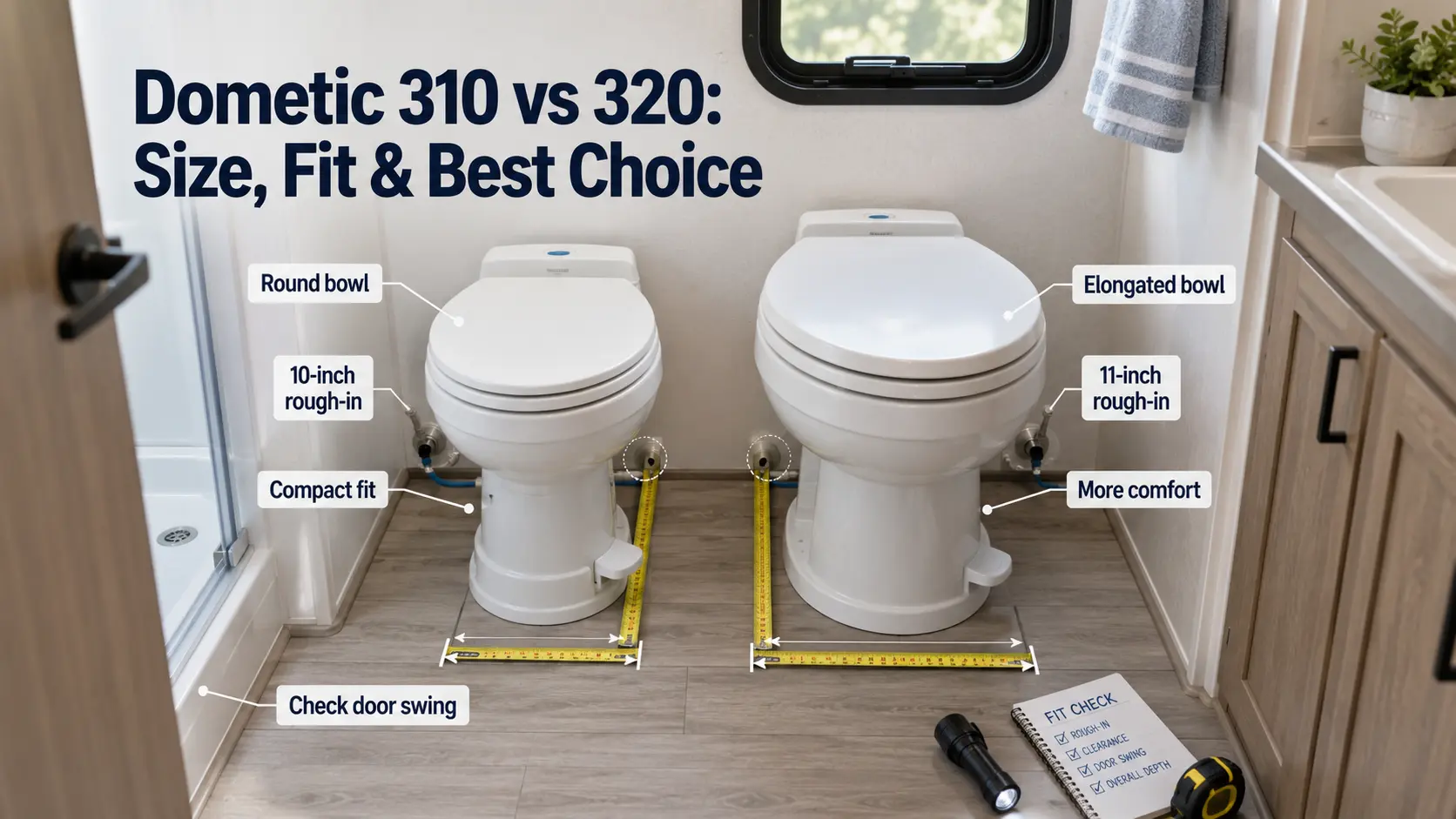
The Dometic 310 and 320 share the same basic gravity-flush platform, two-bolt mount, and several service parts, but they differ in bowl shape, rinse behavior, and size. Per Dometic’s published specifications, the 310 needs a 10-inch rough-in and is 19 inches deep overall. The 320 needs 11 inches and runs 22 inches deep with an elongated bowl. A 320 can replace a 310 only if your bathroom clears both numbers, plus door swing and fixtures. Measure first, then choose comfort or compactness.
Most people frame the Dometic 310 vs 320 decision as a comfort question. Round bowl or elongated bowl. In practice it is a measurement question first, because an incorrect measurement can leave you with a toilet that will not fit against the back wall or clear the bathroom door.
The two toilets look nearly identical in product photos. The differences that matter, one inch of rough-in and three inches of depth, hide in spec sheets many listings never show. This comparison puts those numbers up front, answers whether a 320 can take a 310’s place, then covers comfort, flush behavior, and reliability.
Dometic 310 vs 320 at a Glance
The table below uses Dometic’s published specifications and the official 300/310/320 series manual as the primary source. Retailer measurements appear only as noted.
| Spec | Dometic 310 | Dometic 320 |
|---|---|---|
| Bowl shape | Round | Elongated |
| Rough-in (minimum) | 10 inches | 11 inches |
| Overall depth | 19 inches | 22 inches |
| Overall height | 20 inches | 19.75 inches |
| Width | 15 inches | 14.75 inches |
| Seat height | 18 inches | 18.25 inches |
| Bowl material | Vitreous ceramic | Vitreous ceramic |
| Seat material (per manual) | Polypropylene | Enameled wood |
| Flush design | PowerFlush gravity flush, pressurized rim flow | PowerFlush gravity flush, pressurized rim flow |
| Water use | About 1 pint per flush | About 1 pint per flush |
| Listed weight | Varies by SKU and retailer; verify your part number | Varies by SKU and retailer; verify your part number |
| Serviceable parts | Flush ball seal, water valve | Flush ball seal, water valve |
| Best for | Compact bathrooms with a 10-inch rough-in | Residential comfort where space allows |
| Main drawback | Round bowl only | Needs the most space in the series |
Secondary note: etrailer’s hands-on measurements run slightly under the published depths (18.5 inches for the 310, 21.75 for the 320). Small gaps like this are normal, and the manual itself notes measurements may vary by ±0.38 inches. Plan your space around the official numbers.
Both toilets also come in low-profile versions (the 311 and 321). This comparison covers the standard-height models most buyers are choosing between.
For the full story on either model on its own, including owner complaints and model-specific buying advice, see the full Dometic 310 review and the complete Dometic 320 review.
What Is the Main Difference Between the Dometic 310 and 320?
The main difference is size and bowl shape, not mechanics. The Dometic 310 has a round bowl, needs a 10-inch rough-in, and is 19 inches deep. The 320 has an elongated bowl, needs an 11-inch rough-in, and is 22 inches deep. Underneath, both use the same gravity-flush platform, foot pedal design, and two-bolt floor mount.
That shared platform matters. Per the official Dometic manual, both use the same 3-inch floor flange, the same 1/2-inch NPT water fitting, and the same serviceable flush ball seal and snap-in water valve cartridge. One Dometic water valve kit (part 385311641) covers the 300, 310, and 320 series. You are choosing between two sizes of the same machine, and your bathroom usually makes that choice for you.
Will a Dometic 320 Fit in Place of a Dometic 310?
Sometimes, but not automatically. Dometic requires an 11-inch rough-in for the 320, while the 310 needs only 10 inches. A bathroom built around a 310 does not necessarily meet the 320’s requirement. Both models use a similar two-bolt mounting layout, but a swap is not guaranteed to be modification-free, so verify every clearance first.
Rough-in is the distance from the finished wall behind the toilet to the center of the floor flange, the ring in the floor the toilet bolts onto. If your flange center sits 10 inches from the wall, the 320 falls short of Dometic’s stated 11-inch requirement.
Both models use a standard two-bolt mounting layout, a 3-inch floor-flange opening, and a 1/2-inch NPT water fitting. That may let you reuse the existing flange and supply line, but a 310-to-320 swap is not guaranteed to be modification-free. Verify the bolt orientation, flange height, water-line reach, inlet access, and every bathroom clearance first.
Before Ordering a Dometic 320
Before ordering a 320 to replace a 310, verify all of these:
-
Rough-in
At least 11 inches from the back wall to the flange center
-
Toilet depth
The 320 measures 22 inches from its rear-most point to its front-most point, which is 3 inches longer than the 310. This is an overall product dimension, not an exact wall-to-front measurement
-
Door swing
Confirm the bathroom or shower door still opens past the longer bowl
-
Side clearance
The manual calls for 11 inches from the flange center to each side wall
-
Front fixture clearance
Cabinets, sinks, and shower walls near the front of the bowl
-
Lid-open clearance
Shelves or cabinets behind and above the toilet
-
Water-line reach
The supply line must reach the new valve position without strain
-
Water-inlet access
Enough room to get a wrench on the connection
A conservative data point: when a buyer asked etrailer whether a 320 could replace a 310, the answer was that a space built to the 310’s spec likely will not fit the 320, and measuring is the only way to know.
An anecdotal exception, not a plan: one Airstream owner documented installing a 320 with 10.5 inches from the mounting studs to the wall. That is a single install on one floor plan. Rigs vary in wall thickness, flange placement, and trim. Do not order a 320 for a sub-11-inch space based on one forum post. Dometic’s 11-inch requirement is the number to buy against.
How Do the Dimensions and Bathroom Fit Compare?
Here is a five-minute measuring method that settles the question before you spend anything.
Step 1: Find your flange center
If the old toilet is still installed, the two mounting bolts sit on the flange centerline. Measure from the back wall to the middle of one bolt. That is your approximate rough-in. For an exact number, measure after removal.
Step 2: Check the toilet footprint and front clearance
The 310 is 19 inches deep overall, while the 320 is 22 inches deep. These are product dimensions, not exact wall-to-front measurements. Compare the new toilet’s footprint with your existing toilet and check the installation drawing before marking the floor. If the bathroom is tight, confirm the flange-center-to-front distance with the seller or make a cardboard template based on the exact model.
Step 3: Check the sides and above
Measure from the flange center to each side wall (11 inches minimum per the manual) and confirm the lid can open fully.
Rough-in and overall depth are different measurements. Rough-in is about the back of the toilet clearing the wall. Depth is about the front clearing everything else. A bathroom can pass the rough-in check and still fail on door swing. Jayco owners comparing the two models repeatedly name front clearance and door swing as the surprises, not the back wall.
Height runs the other way. The 310 is a quarter inch taller overall (20 vs 19.75 inches), while the 320’s seat sits a quarter inch higher (18.25 vs 18). Neither gap changes a buying decision on its own.
Is the Dometic 320 More Comfortable Than the 310?
The 320 offers a larger seating area. Its elongated bowl is longer front to back than the 310’s round bowl, its seat is enameled wood rather than polypropylene per the Dometic manual, and its seat height is a quarter inch taller. Whether that feels meaningfully better depends on the user’s size and preference, and owner opinions are split.
Elongated bowls are the standard shape in home bathrooms, which is why the 320 may feel more residential to many users. It is often preferred by larger or taller users, who generally have more room on an elongated seat. If body size, seat height, and documented weight capacity are your main concerns, our RV toilet guide for larger adults compares the Dometic 320 with other suitable options. That part is geometry, not opinion.
What the extra size is worth is where owners disagree. Plenty of full-timers on Forest River Forums call the 320 the obvious pick when it fits. Others who have owned both report being perfectly happy with the 310. There is no verified comfort measurement here, only bowl dimensions and personal preference. Comfort remains personal.
Which Toilet Has the Better Flush?
Both toilets use a gravity-flush system and roughly one pint of water per flush, but their bowls distribute that water differently. Dometic describes the 310 as using pressurized rim flow that creates a vortex-style rinse. The 320 uses an elongated bowl with a pressurized full-rim rinse. Official specifications do not establish one as the stronger flush, so real-world performance also depends on water flow and bowl coverage.
The owner-reported pattern is worth knowing because it repeats across independent forums rather than coming from one complaint.
On a long-running Forest River Forums thread about the 320’s flush, multiple owners describe strong flow at the rear of the bowl that tapers toward the front, especially at lower water pressure. Some owners on Keystone Forums who have owned both report the 310 rinses its round bowl more evenly. These are repeated owner reports, not a confirmed design defect, and other 320 owners report no complaints at all.
Two practical notes apply to both toilets. The manual recommends adding water to the bowl before flushing solids, and it calls for at least 2 gallons per minute of flow at the inlet (3 to 5 recommended). Weak-flush complaints on either model often trace back to low campground pressure rather than the toilet. Versions of both are sold with a hand sprayer, a worthwhile add-on if you often run on an internal pump.
Reliability, Leaks, Parts and Repairs
Serviceability is nearly identical because the two models share their service platform.
The official manual is direct about what you can and cannot repair. Both models have factory-sealed bowl-to-base assemblies that should not be separated for any reason, and disassembly may void the warranty. The two parts designed for owner replacement are the flush ball seal, which swaps out from inside the bowl without tools, and the snap-in water valve cartridge. The flush ball itself is not sold as a standalone part on either model, so a cracked ball means a new toilet.
That shared parts list is good news for whichever model you pick. Replacement seals, water valves, and mounting hardware remain listed through Dometic and major RV-parts retailers as of July 29, 2026, although availability can vary.
On leaks, keep the diagnosis in order. Moisture at the floor usually points to the floor flange seal or a loose mount. Water at the rear points to the vacuum breaker or supply connection. A bowl that slowly loses water points to the flush ball seal. Some owners of recent-production units on Montana Owners Club report flush ball seals failing to hold water early; those are owner reports, not a confirmed pattern from Dometic. If you see water where it should not be, work through the guide to diagnosing a base leak first, and see the water valve replacement guide if the bowl fills or drips on its own.
On weight: listed weights vary by SKU and retailer, so this comparison does not treat weight as a deciding factor. If your rig is close to its cargo capacity, confirm the weight for the exact part number before ordering.
Are the Dometic 310 and 320 Still Worth Buying?
Yes, depending on price and availability. As of July 29, 2026, the 310 and 320 remain available from some major retailers, and several shared service parts are still listed for sale. However, Dometic’s current US toilet lineup focuses on the newer 400 Series, so compare current stock, warranty terms, and replacement options before paying a premium for either older model.
When checked on July 29, 2026, the 310 and 320 appeared for sale at retailers such as Amazon, Walmart, Camping World, and etrailer, with stock varying by SKU and color. Dometic’s US toilet page features the 400 Essential, 410 Complete, and 420 Platinum, and labels the 420 and 421 as coming soon even though retailers such as Camping World already list the 420 for sale. Availability changes fast, so treat this as a snapshot.
The 400 Series matters here for one reason: fit. The Dometic 410 puts a porcelain round bowl on a 7.625-inch rough-in, and the 420 Platinum offers an elongated porcelain bowl on the same short rough-in. If your space cannot fit a 320, the 420 is a newer elongated Dometic option that may fit, so confirm current stock before planning around it. If neither older model fits, the porcelain RV toilet comparison covers the wider field.
On warranty, check the paperwork for your specific unit. Dometic’s warranty documents for this series have varied by revision. Older printed manuals state a two-year limited warranty for personal use, and some 310-series documentation also references a ten-year warranty against scratching or crazing of the ceramic bowl. The current manual directs owners to Dometic’s warranty page for the up-to-date terms, and it expressly excludes coverage for freeze damage caused by improper winterization. Confirm the current terms with Dometic or your dealer before buying.
Final Verdict
Measure first. If your bathroom gives you a true 11-inch rough-in, room for the 320’s 22-inch footprint, and free door swing, the Dometic 320 is the more residential toilet. If any of those checks falls short, the Dometic 310 delivers the same ceramic bowl, flush platform, and serviceable parts in a package that fits, and a toilet that fits beats a toilet that impresses.
Existing 310 owners should verify every clearance on the checklist above rather than assuming a drop-in swap. Anyone with a bathroom too tight for either model now has a real alternative in Dometic’s 400 Series.
Frequently Asked Questions
Can a Dometic 320 directly replace a Dometic 310?
Only if the space meets the 320’s requirements. Dometic specifies an 11-inch rough-in for the 320 versus 10 inches for the 310, and the 320 is about 3 inches deeper overall. Because the two models use a similar two-bolt mounting layout and water fitting, the existing flange and supply line may be reusable. However, verify the flange condition, bolt orientation, water-line reach, and all bathroom clearances before treating it as a direct swap.
Do the Dometic 310 and 320 use the same floor flange and service parts?
Yes. Per the official Dometic manual, both mount on a standard 3-inch floor flange with a two-bolt design and use a 1/2-inch NPT water connection. They share the same replaceable water valve kit (part 385311641) and both allow tool-free flush ball seal replacement from inside the bowl. The flush ball itself is not sold separately on either model.
How much deeper is the Dometic 320 than the 310?
Three inches. Dometic’s published specifications list the 310 at 19 inches of overall depth and the 320 at 22 inches. The 320 also requires one extra inch of rough-in behind it, 11 inches versus 10. Both differences matter separately: rough-in decides whether the back clears the wall, and depth decides whether the front clears doors and fixtures.
Which model is better for a small RV bathroom?
The Dometic 310. Its 10-inch rough-in and 19-inch depth fit layouts where the 320 physically cannot go, and its round bowl leaves more open floor in front of the toilet. If your rough-in is under 10 inches, neither model fits, and Dometic’s 400 Series with its 7.625-inch rough-in is the direction to look. If neither model fits, compare the full list of RV toilets built for small bathrooms, including 7.625-inch rough-in, low-profile, and cassette options.
Can you put a household toilet seat on the Dometic 310 or 320?
Do not assume a household toilet seat will fit either model. Bolt spacing, hinge clearance, and bowl shape can vary by seat brand and toilet production version. Measure the existing seat and mounting holes carefully. A model-specific Dometic replacement seat is the safer choice when you need guaranteed compatibility.
Should you consider the newer Dometic 410 or 420 instead?
If fit is your constraint, yes. The Dometic 410 (round, porcelain) and 420 Platinum (elongated, porcelain) both work with a 7.625-inch rough-in, far shorter than the 310 or 320 need. As of July 29, 2026, some retailers list the 420 for sale while Dometic’s own lineup page still labels it coming soon, so confirm current stock before planning around it. Buyers with confirmed space for a 310 or 320 can still choose either model, with shared service parts still listed as of that date.