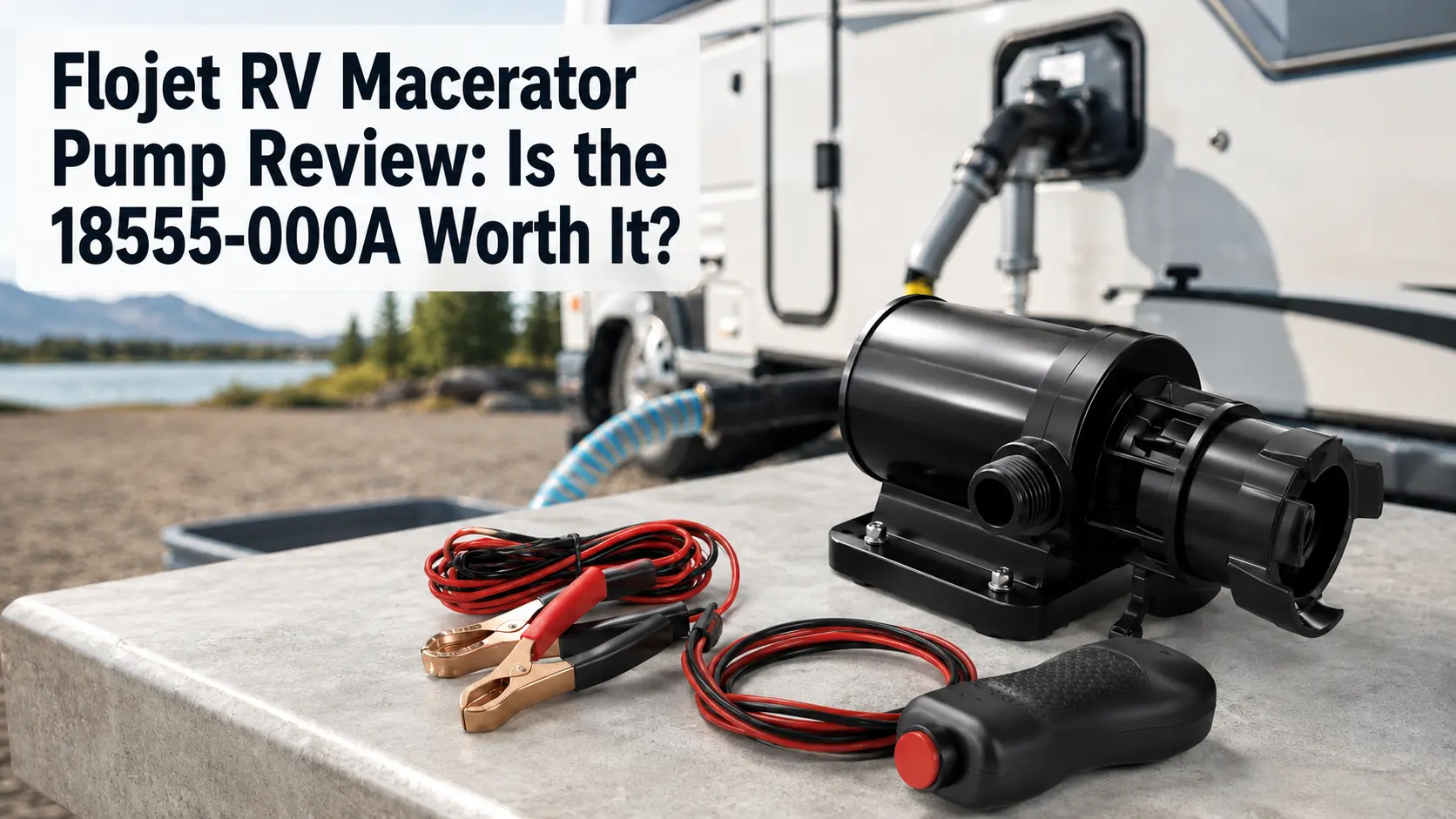
The Flojet 18555-000A is a repairable, well-documented portable macerator built for horizontal home-dumping runs. Its current manual rates it for up to 150 feet of horizontal discharge through reinforced 3/4-inch hose. Flow drops as the run gets longer. It’s intermittent-duty, rated for 30 minutes of continuous run time. The manual doesn’t publish a vertical-lift figure, so treat uphill performance as unverified. Some owner discussions link overheating to long hose runs or thin wiring, but those are individual reports, not confirmed causes.
This review covers the Flojet 18555-000A, also listed as model 18555000, the portable kit sold with a carrying case, a remote on/off switch, and a 6-foot wire harness. Flojet sells other pumps under different model numbers with different specs, so treat any number outside 18555-000A / 18555000 as a different product.
We have not personally tested this pump. This review is built from Flojet’s current official manual, the manufacturer’s product page, and owner reports from RV forums and retailer reviews, clearly separated from each other throughout.
Quick Verdict
RV owners who need to dump at home, use a long horizontal hose run, or reach a home sewer cleanout, and who don’t mind managing a 12V wiring setup.
You need confirmed uphill pumping capability, want a pump whose manufacturer explicitly documents over-temperature protection, or would rather avoid wiring and fuses altogether.
The pump comes with a documented parts breakdown, and the manual includes detailed disassembly and service instructions. That makes maintenance easier when a wear part eventually needs attention.
It’s rated for 30 minutes of continuous operation, and Flojet publishes no vertical-lift specification for this model. If your main use case involves pumping uphill, there isn’t a manufacturer rating to confirm how the pump will perform.
Flojet 18555-000A Specifications
Here are the specs Flojet publishes in its current instruction manual for model 18555000. This manual is the sole source for the numbers below. Anything a retailer states differently is noted separately.
Outlet: Garden hose male fitting
The manual doesn’t include a vertical-lift rating anywhere. If your setup involves pumping uphill, there’s no manufacturer figure to check that against.
Flojet’s own product page confirms the pump carries ISO 8846 ignition protection, plus CE and CSA certification. That’s useful if you’re comparing it against pumps that don’t publish any certification at all.
How Far Can the Flojet RV Macerator Pump Discharge?
Flojet’s current instruction manual rates the 18555-000A for up to 150 feet of horizontal discharge through reinforced 3/4-inch ID hose. Flow drops as the hose gets longer. On 5/8-inch hose, the limit is shorter: 25 feet max.
Two things matter here. First, these numbers are for horizontal discharge with no bends or kinks. Second, they’re based on open flow at 12 volts, which is a controlled test condition, not a guarantee for every tank, hose, and battery combination.
That second point explains why manufacturer numbers and real-world dump times don’t always line up. Flojet states the pump empties a typical tank in under five minutes on a short hose. Owner accounts scattered across RV forums range from a few minutes on short runs to closer to 20 minutes when the hose stretches past 60 or 75 feet. On a Forest River Forums thread, one owner described pumping through 60 feet of 3/4-inch hose without much trouble. A separate account on RV Tip of the Day describes a 75-foot run working, though slower than a direct sewer connection would be. Treat these as individual setups, not a guarantee your own hose length will perform the same way.
Vertical lift is the bigger gap. The manual doesn’t publish a lift spec for this model at all. If your sewer connection sits uphill, you’re working from owner anecdotes, not a documented rating. That’s a real limitation if uphill pumping is your main reason for buying.
Setup and Installation
Setup follows a fixed sequence. Connect the pump to the RV’s 3-inch waste outlet with a clockwise twist. Attach the discharge hose to the garden-hose-style outlet port. Connect a fresh water line to the rinse valve. Then wire the pump to a 12V source through the included harness and fuse.
Flojet specifies a dedicated 20-amp circuit. For wire gauge, use 12 AWG for runs up to 10 feet and 10 AWG for runs up to 20 feet between the battery and the motor. The included harness comes with alligator clamps for a direct battery connection. The included clamp harness allows a temporary battery connection, which fits the pump’s portable design without requiring a permanent electrical installation.
The manual is explicit that this pump isn’t meant for permanent mounting to the RV’s waste port. It’s a connect-for-each-dump tool, not a fixture. That’s a meaningful difference from permanently installed systems like Thetford’s Sani-Con line, covered in our macerator pump comparison guide.
Where the Flojet 18555-000A Stands Out
Documentation is the real differentiator here. The manual includes a full exploded parts diagram. It lists individual part numbers for the impeller, wearplates, seal, and chopper blade. There’s also a combined service kit (part 18598-2000) that bundles the wear items most likely to need replacing. That level of documentation is useful if you plan to service the pump instead of replacing the whole unit when a wear part fails.
The manual walks through complete disassembly and reassembly. It also describes a built-in impeller-release feature. After long storage, a stuck impeller can be freed with a screwdriver through the motor shaft slot, without opening the pump housing. That’s a specific, documented repair path, not a vague promise of “repairability.”
This basic pump design has been sold for years. That means it shows up often enough in owner forums that troubleshooting threads exist for most common failures. That’s not a manufacturer claim, just a practical upside of buying something that’s been around a while.
Duty Cycle, Heat, and Other Limitations
Flojet’s current manual states the motor is intermittent-duty and should not run for more than 30 minutes continuously, and should never run dry for more than 30 seconds. That 30-minute figure appears twice in the current manual (Rev. K, October 2023). Some older retailer listings and secondary sources still cite a 15-minute limit, which appears to reflect an earlier manual revision. Go with 30 minutes as the current, manufacturer-stated figure.
The manual doesn’t describe a thermal cutoff or auto-shutoff feature anywhere. That’s not the same as confirming the pump lacks one. It’s simply undocumented in the current manual. Don’t assume protection that isn’t explicitly stated.
Longer discharge runs create more resistance, and the manual notes this can raise motor temperature. On forums like RVForum.net, a recurring factor in several owner discussions is hose length combined with thin wiring or a weakening battery. Several owner discussions point to voltage drop, long wiring runs, or weak electrical connections when performance falls off. Flojet itself specifies 12 AWG wire up to 10 feet and 10 AWG from 10 to 20 feet, but the manual does not identify wiring problems as a confirmed cause of owner-reported overheating.
A few other issues turn up in owner accounts, none confirmed by the manufacturer as common defects:
- Wiring reversed. A thread on RVForum.net describes a pump wired backward pushing water back into the RV’s plumbing instead of out. Swapping the polarity resolved it.
- Loose electrical connectors. One report on the Good Sam Community forum describes a butt connector working loose over time and cutting power to the pump.
- Overheating on long, thin setups. An Amazon reviewer described the pump shutting off within two minutes while pushing waste 50 feet through 1-inch hose with a short battery cable run. This is one account, not a pattern confirmed across many buyers.
The pump also isn’t built for hard solid objects, sanitary products, wet wipes, or rags, per the manual. Running into any of these can jam the impeller. If your tank isn’t draining at all, rather than just running slowly, If the tank isn’t draining at all, check both the pump and tank-side causes such as a closed or stuck gate valve or blockage before assuming the motor itself has failed. Our guide on an RV black tank not draining walks through that separately.
Maintenance and Jam Clearing
Flojet’s manual documents a specific rinse sequence. Close both drain valves. Run fresh water through the rinse valve at 40 PSI max, and pump it through. That flushes the pump and hose before storage. Owners on iRV2 describe a similar routine, sometimes adding a manual turn of the impeller shaft to work loose any debris the rinse alone didn’t clear.
For a stuck impeller after storage, the manual has a built-in release procedure. Remove the metal shaft cover, turn the exposed motor shaft clockwise with a screwdriver, then replace the cover. This fixes impellers stuck from disuse. It’s not a general jam-clearing method for debris.
One owner on the My Grand RV forum reported broken impeller blades after accidentally running the pump in reverse during wiring. The blades were later replaced. Treat this as a single owner report, not a documented failure rate or manufacturer-confirmed defect.
If you dump into a home cleanout regularly, our guide to your RV’s black tank flush system covers the tank-side rinsing routine that pairs with this pump-side maintenance.
Who Should Buy It, and Who Should Skip It?
- You dump at home through a horizontal hose run and want a documented hose-length and flow table to plan around.
- You’re comfortable managing a 12V circuit, fuse, and wire gauge.
- You’d rather have a pump with published disassembly instructions and individual part numbers than a sealed unit.
- Your setup fits within the manual’s rated 150-foot horizontal limit using 3/4-inch hose.
- Your main use case is pumping uphill. Flojet doesn’t publish a manufacturer vertical-lift rating for this model.
- You want a pump whose manufacturer explicitly documents over-temperature protection.
- You mostly camp at full-hookup sites with the sewer inlet nearby. A standard hose from our best RV sewer hose guide can handle that job without wiring.
- You’d rather avoid managing wiring, fuses, and duty-cycle limits altogether.
If you’re still deciding between a macerator and a standard hose in general, our macerator pump vs. sewer hose comparison breaks that question down separately from any single product.
Flojet vs Alternatives
Flojet vs. a budget import macerator: Budget pumps often undercut the Flojet on price but publish less documentation. If you want a manufacturer hose table and a service kit with individual part numbers, the Flojet gives you both. Budget imports frequently don’t.
Flojet vs. Thetford Sani-Con: Thetford’s Sani-Con line uses a wider 1.5-inch hose and publishes faster flow figures on its stock hose. It also costs more, and the permanent 400S model requires real plumbing work. The Flojet stays portable and connects and disconnects at each dump.
Flojet vs. a standard sewer hose: A gravity hose is faster and simpler when your sewer inlet sits close and downhill. The Flojet earns its keep specifically for longer horizontal runs or home cleanouts a standard hose can’t reach.
Final Verdict
The Flojet 18555-000A is a solid pick for RV owners whose dumping situation is genuinely horizontal: home cleanouts, long hose runs, or awkward sewer access that a standard hose can’t reach. Its documentation is a real advantage if the pump ever needs a part replaced.
It’s not the pump to buy if you’re counting on uphill performance, since Flojet doesn’t publish a lift spec to check that against. It’s also not the choice for anyone who wants to avoid wiring, fuses, and a 30-minute duty cycle altogether. For those buyers, either a Thetford Sani-Con or a plain sewer hose is the better fit.
Prices change across retailers, so check current pricing before you decide.
Frequently Asked Questions
How far can a Flojet RV macerator pump discharge?
Flojet’s current manual rates the 18555-000A for up to 150 feet of horizontal discharge through reinforced 3/4-inch hose, with flow dropping from 7.8 GPM at 50 feet to 5.1 GPM at 150 feet. On 5/8-inch hose, the limit is 25 feet. These figures apply to horizontal runs only; the manual doesn’t publish a vertical-lift rating.
Can you run the Flojet macerator continuously, or does it need breaks?
Flojet’s current manual states the motor is intermittent-duty and shouldn’t run more than 30 minutes continuously. Some older sources cite a 15-minute limit, which appears to be from an earlier manual revision. The current manual (Rev. K, October 2023) states 30 minutes in two places.
Can you use a regular garden hose with the Flojet 18555-000A?
Yes. The pump is designed around a garden-hose-style discharge fitting. Flojet’s manual recommends reinforced 3/4-inch ID hose for its full 150-foot rating; a standard 5/8-inch hose is limited to 25 feet.
How fast does the Flojet empty an RV black tank?
Flojet states its pump empties a typical tank in under five minutes on a short hose run, based on the manufacturer’s own figures. Owner accounts on longer hose runs, 60 to 75 feet and beyond, report dump times closer to 15 to 20 minutes. Actual time depends on hose length, tank size, and how much waste the tank holds.