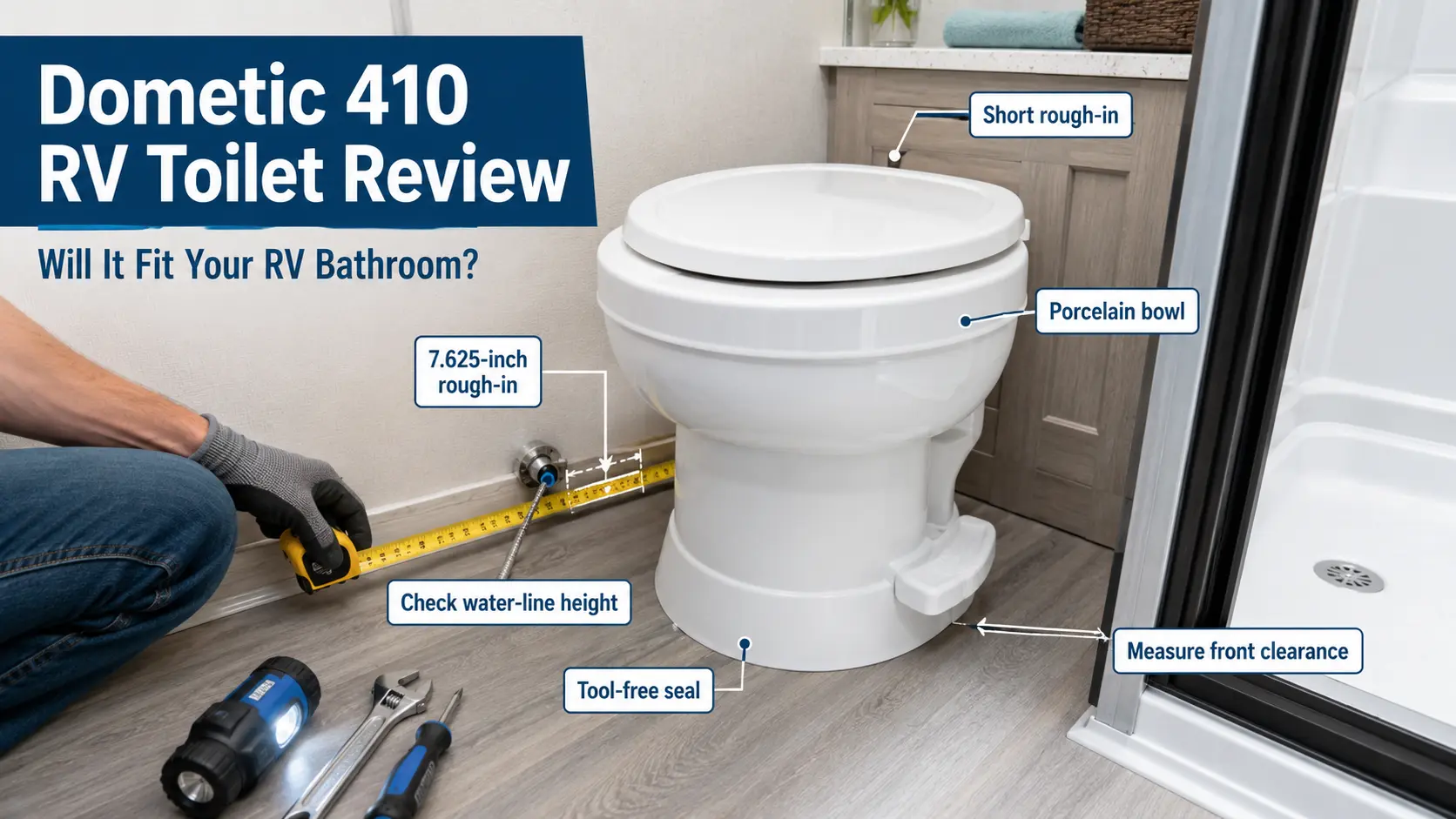
The Dometic 410 is one of Dometic’s newer porcelain RV toilets, built around a short 7.625-inch rough-in that fits many bathrooms where the older 310 or 320 won’t. It uses a tool-free ball seal, a reinforced valve tested to 150,000 flush cycles, and carries a 2-year warranty. Real owners report better sealing than the 310, though the seat’s underside screws complicate bidet installs and the low water intake can conflict with a raised floor step. Measure your rough-in and water-line height before ordering.
Most RV toilet upgrades don’t fail because the toilet is bad. They fail because it doesn’t fit. You order a porcelain model, it shows up, and it’s an inch too deep for the cabinet door to clear. The Dometic 410 is aimed at that exact problem: getting a porcelain RV toilet into bathrooms where older ceramic models are too deep. If you’re comparing it with other compact options, our RV toilets for small bathrooms guide compares the 410 against low-profile, lightweight, cassette, and other short-rough-in choices.
This review breaks down what the 410 actually is, whether it will fit your bathroom, and what real owners say after living with one. We’ll compare it against the 310 and 320, walk through installation, and flag the complaints that show up again and again on RV forums. If you’re deciding between models, our full porcelain RV toilet comparison covers all four current options side by side.
Quick Verdict Best for: Tight RV bathrooms, 7.625″+ rough-in, first porcelain upgrade Skip if: You want an elongated bowl, the cheapest possible option, or your water line sits behind a raised floor step Main risk: Low rear water-intake clearance Rating: 4.4/5
What Is the Dometic 410 Best For?
The Dometic 410 is best for RV owners who want a porcelain toilet but couldn’t fit the 310 or 320 because of a short rough-in. It is Dometic’s newer current-generation porcelain option for tight RV bathrooms, especially where older 310 or 320 models may not fit, and it works with as little as 7.625 inches of rough-in, according to Dometic’s official product listing.
If you’re replacing a stock plastic toilet and your bathroom is tight, the 410 is usually the safer porcelain pick over the 310 or 320. Full-timers with larger bathrooms who want an elongated bowl may still prefer the 320, or the newer 420 covered below. And if weight matters more than a ceramic bowl, the plastic-bowl Dometic 400 shares the same footprint at a lower price.
Dometic 410 Specs and Key Features
Here’s what the 410 actually offers on paper, pulled from Dometic’s official listings and retailer spec sheets.
| Spec | Dometic 410 |
|---|---|
| Rough-in distance | 7.625 inches |
| Seat height | 18 inches standard; 13.625 inches on the low-profile 411 |
| Depth | About 17.75 inches |
| Weight | About 27 lbs |
| Bowl material | Porcelain bowl on a plastic base |
| Mount | Universal 2-bolt |
| Flush type | Gravity flush, 360-degree spray |
| Seal | Ball seal, tool-free replacement |
| Colors | Classic White, Opulent Bone |
| Warranty | 2 years |
| Durability testing | Rated to 2x front-load capacity and 150,000 flush cycles |
As an Amazon Associate, we may earn from qualifying purchases.
According to Dometic’s official product page, the 410 is tested to 150,000 flush cycles and twice the front-load strength of leading competitors, with a reinforced, sonic-welded water valve. If you ever need replacement parts down the line, our RV toilet parts guide walks through what’s interchangeable across Dometic models.
5 Measurements to Check Before You Order
Fit problems are the most common complaint with any RV toilet swap, and they’re almost always avoidable. Check these five measurements before you order a Dometic 410:
- Rough-in distance. Measure from the finished wall behind the toilet to the center of the floor flange. The 410 needs at least 7.625 inches.
- Front clearance. Measure from the flange center to the nearest cabinet door, shower entry, or wall. The 410 runs about 17.75 inches deep, so confirm nothing blocks the front of the bowl.
- Side clearance. Check the space on both sides of the toilet against any adjacent cabinet, wall, or shower wall.
- Lid clearance. Make sure the lid can open fully without hitting a wall, shelf, or cabinet door behind it.
- Water-line height. Note where your existing water supply line connects. The 410’s intake sits low, around 5 inches off the floor, which matters if there’s a raised step or platform behind the toilet.
Getting any one of these wrong is the most common reason a replacement toilet gets boxed back up and returned.
Does the Dometic 410 Fit Your RV Bathroom?
The 410 fits many tight RV bathrooms, but not every one. Rough-in is only one measurement. Water-line position and rear-step clearance matter too.
Rough-in is the easy part. The 410’s 7.625-inch requirement is shorter than the 310’s 10 inches and the 320’s 11 inches, which is why it fits layouts those models simply can’t, per Dometic’s Complete Series page.
The water-line height catches more people off guard. A Forest River Forums thread documented a case where the 410’s water intake, sitting only about 5 inches off the floor, conflicted with a raised floor step that concealed plumbing behind the toilet. If your bathroom has a step or platform behind the toilet base, measure the intake clearance before ordering. If a low ceiling or shelf is the limiting factor instead, the low-profile 411 uses the same rough-in at a shorter seat height.
See the Dometic 410 on Amazon to check current dimensions against your own measurements before ordering.
Who Should NOT Buy the Dometic 410?
Skip the Dometic 410 if you fall into any of these groups. It’s a strong toilet for the right bathroom, but it isn’t the right choice for everyone.
- You want an elongated bowl. The 410 is round only. Look at the 320 or the newer 420 instead.
- Your RV has a raised step or platform directly behind the toilet. The low water intake can conflict with hidden plumbing or wiring in that step, as documented on Forest River Forums.
- You want the cheapest possible replacement. A plastic-bowl model like the Dometic 400 costs less and shares the same footprint.
- You plan to install a bidet and don’t want the extra hassle. The seat’s underside metal screws make bidet installs more fiddly than older top-bolt designs.
- Your rough-in is 11 inches or more and your bathroom has the space for it. A larger toilet like the 320 or 420 will give you more residential comfort.
How Does the Dometic 410 Perform in Real Use?
In real-world use, the Dometic 410 delivers a full 360-degree bowl rinse and an easier-to-control foot pedal than older Dometic models, according to verified buyer reviews. Owners upgrading from the 310 report a noticeable improvement in flush coverage and pedal feel.
One verified buyer on etrailer who switched from a 310 to a 410 said the spray pattern reaches the entire bowl instead of just the back, and that the flush and fill pedal is easier to control than the previous design. The dual-action foot pedal lets you add water to the bowl with a light press and trigger a full flush with a firmer one, which matters more than it sounds like when you’re trying to conserve tank water while boondocking.
Dometic 410 Pros and Cons
Pros
- One of the shortest rough-in requirements of any current porcelain RV toilet, fitting layouts the 310 and 320 can’t
- Tool-free ball seal that’s replaceable without pulling the toilet
- 2-year warranty, longer than what most RV toilets carry
- Reinforced water valve tested to 150,000 flush cycles and 2x the front-load capacity of competing models
- Real owners report noticeably better sealing than the older 310
- Full 360-degree spray flush that covers the whole bowl
Cons
- The seat mounts with metal screws from underneath instead of top-loading bolts, which complicates installing an aftermarket bidet
- The water intake sits low, around 5 inches off the floor, which can conflict with a step or raised platform behind some installs
- Some owners need a plumbing adapter to connect the side-mounted intake to their existing water line, according to an Airstream Forums thread
- Skeptics point out the bowl-to-base joint hasn’t fundamentally changed from the 310 and 320, so long-term reliability at scale is still unproven
If you’ve had leak issues with an older Dometic model, our Dometic toilet leaking at base guide covers the most common causes and whether they carry over to the 410.
Dometic 410 vs 310 vs 320: Which Should You Buy?
Choose the 410 if your rough-in is at least 7.625 inches but too tight for a 10-inch or 11-inch toilet. Choose the 310 if you already have a 10-inch rough-in and want the most tested design. Choose the 320 if you have 11 inches of rough-in and want an elongated bowl.
| Feature | Dometic 410 | Dometic 310 | Dometic 320 |
|---|---|---|---|
| Bowl shape | Round | Round | Elongated |
| Rough-in | 7.625″ | 10″ | 11″ |
| Seat height | 18″ | ~18″ | 18″ |
| Bowl material | Porcelain bowl / plastic base | Ceramic | Vitreous ceramic |
| Weight | ~27 lbs | 39 lbs | 37 lbs |
| Best for | Tight bathrooms | Proven round upgrade | Residential feel |
| Check on Amazon | Dometic 410 on Amazon | Dometic 310 on Amazon | Dometic 320 on Amazon |
Dometic 410
Dometic 310
Dometic 320
As an Amazon Associate, RVFlushGuide may earn from qualifying purchases.
Quick pick: if you’re not sure your bathroom can fit a 10-inch or 11-inch toilet, start by measuring for the 410. It’s the safer default for most stock-toilet replacements.
2026 buyer note: Dometic’s newer 420/421 Platinum models bring an elongated porcelain bowl to the same 7.625-inch rough-in as the 410, and they’re increasingly showing up at retailers like Camping World even though Dometic’s own site still lists them as coming soon in some listings. If you want an elongated bowl but can’t fit the 320’s 11-inch rough-in, check whether the 420 is in stock before choosing between the 410 and 320.
The 410 is part of Dometic’s current lineup, so it has better long-term parts support than the legacy 310 or 320. For a full side-by-side of every current model, see our porcelain RV toilet comparison. And if seal reliability is your main concern coming from a 310 or 320 that wouldn’t hold water, our toilet bowl not holding water guide explains what typically fails.
If you have already ruled out the 410 and are choosing strictly between the two older models, compare the Dometic 310 and 320 side by side, including dimensions, bathroom fit, flushing, and whether one can replace the other.
Installing the Dometic 410: What to Know Before You Start
Installing the Dometic 410 is a straightforward DIY job for most straight-across swaps. Dometic’s 400 series ships with the toilet, mounting hardware, a pre-installed floor flange seal, and an installation manual, and the universal 2-bolt mount is designed to fit within the footprint of most existing toilets.
Two things are worth checking before you start. First, confirm that your water line height and routing clear the 410’s low, rear-mounted intake, especially if there’s a step or cabinet base behind the toilet. Second, if you plan to add a bidet attachment, budget extra time for the seat swap. Because the seat bolts through from underneath with metal screws rather than top-loading plastic bolts, aligning it blindly and finding longer screws for the added height is a common frustration reported on Airstream Forums.
If you’re not confident about your rough-in measurement, our RV toilet parts guide has a walkthrough for locating your model number and measuring correctly before you order anything.
The Dometic 410 solves a real problem: getting a porcelain bowl into a bathroom too tight for the 310 or 320. It backs that up with a 2-year warranty, a tool-free seal, and consistently positive owner reports on sealing and flush coverage. The tradeoffs are minor but worth knowing, especially the low water intake and the bidet-unfriendly seat hardware.
If your rough-in measures under 10 inches, the 410 is currently one of the safest porcelain upgrades you can make. Measure your rough-in, front clearance, and water-line height first, then check the current price and availability of the Dometic 410 on Amazon before you order.
Frequently Asked Questions
Is the Dometic 410 better than the Dometic 310?
For most owners, yes. The 410 has a shorter rough-in, so it fits more bathrooms, and it carries improved sealing according to owner reports and a Dometic representative cited on Airstream Forums. It’s also part of Dometic’s current lineup, which means better long-term parts availability than the legacy 310.
What is the rough-in requirement for the Dometic 410?
The Dometic 410 requires 7.625 inches of rough-in distance, one of the shortest of any current porcelain RV toilet. This lets it fit bathrooms where the 10-inch 310 or 11-inch 320 won’t clear.
Does the Dometic 410 come in a low-profile version?
Yes. The Dometic 411 shares the same 7.625-inch rough-in and 2-bolt mount as the 410 but sits at a lower 13.625-inch seat height, making it a better fit for bathrooms with limited vertical clearance from a step or cabinet.
How long does a Dometic 410 last, and what’s the warranty?
Dometic backs the 410 with a 2-year warranty, longer than most RV toilets on the market. The water valve is reinforced and sonic-welded, and the toilet is tested to 150,000 flush cycles and twice the front-load capacity of competing models, though actual lifespan varies with usage and maintenance.
Will the Dometic 410 fit without plumbing modifications?
In most straight-across swaps, yes, since it uses a universal 2-bolt mount and ships with a pre-installed floor flange seal. Some installs need a water-line adapter for the side-mounted intake, and bathrooms with a step or raised platform behind the toilet should double-check intake height before ordering.