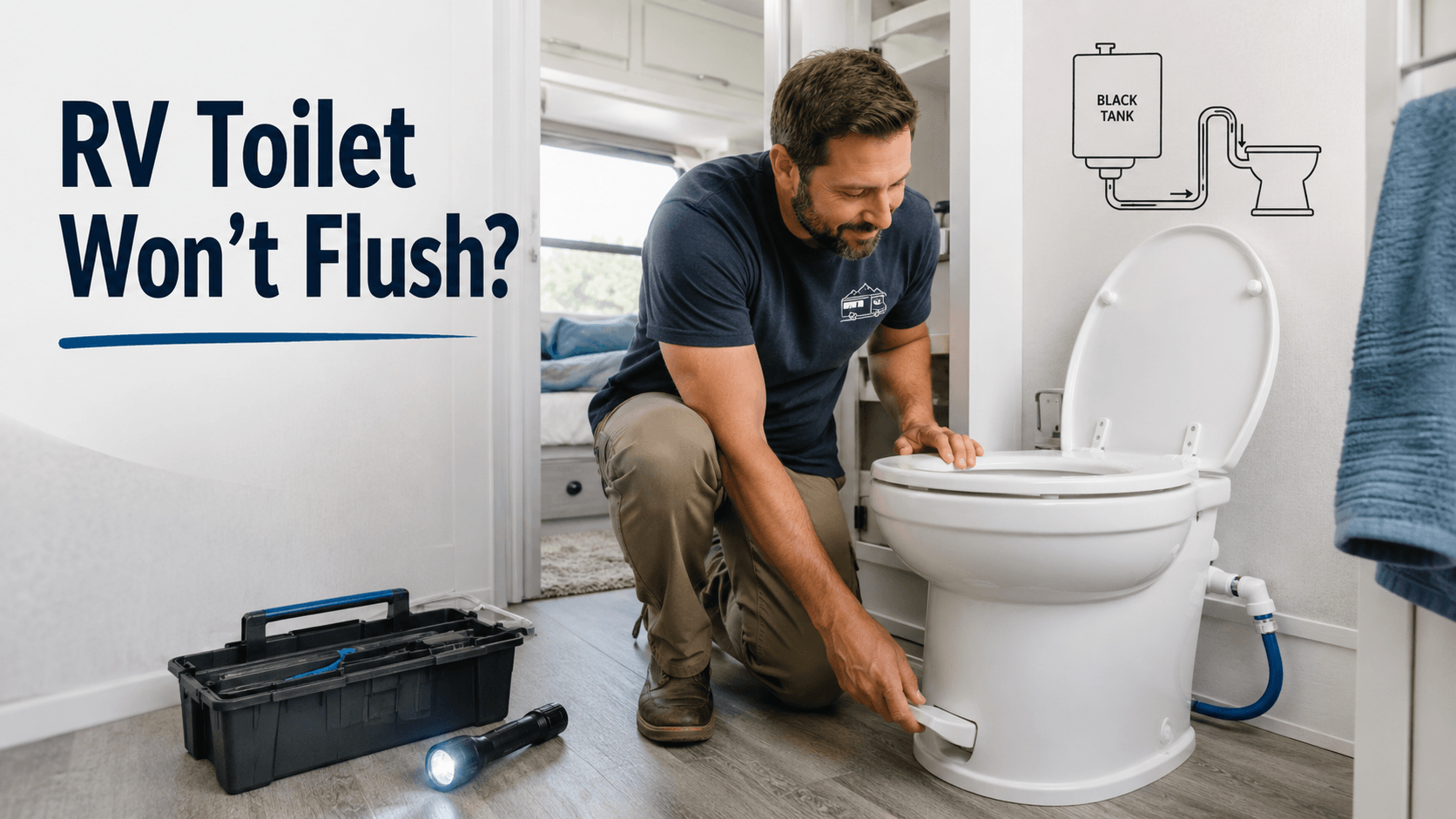
An RV toilet that won’t flush usually comes down to one of four problems: no water reaching the toilet, a broken pedal or linkage, a stuck flush ball, or a blockage on the black tank side. The fastest way to narrow it down is to watch what happens when you press the pedal. Does water enter the bowl? Does the blade open? Many fixes start with simple checks that cost nothing before you order any parts.
Your RV toilet won’t flush. You press the pedal, and nothing happens. Or water enters the bowl, but the waste just sits there. Either way, you need to figure this out now.
Here’s the thing: “RV toilet not flushing” (or camper toilet won’t flush) isn’t one problem. It’s four or five different problems that look the same from the outside. The fix depends entirely on which one you have.
The fastest way to diagnose it is to watch what happens when you press the pedal. Specifically:
- Does water enter the bowl?
- Does the blade (the rubber valve at the bowl bottom) swing open?
- Does waste move at all when water enters?
Those three observations will narrow it down fast. Once you know which symptom you’re dealing with, you can usually find the cause before spending money on parts.
This guide breaks down every “won’t flush” scenario by symptom. Find the one that matches your situation and start there.
Why Won’t My RV Toilet Flush?
An RV toilet won’t flush for one of four reasons: no water is reaching the toilet, the pedal or its linkage has failed, the flush ball (the rubber valve at the bottom of the bowl that opens to the black tank) is stuck or broken, or something on the black tank side is blocked. Watching what happens when you press the pedal tells you which one you’re dealing with.
Use this table to narrow it down fast:
| What happens when you press the pedal | Most likely cause | First thing to check |
|---|---|---|
| No water enters the bowl at all | Water pump off, empty tank, or failed water valve | Is the pump switched on? Is the freshwater tank empty? |
| Pedal does nothing, no movement at all | Broken pedal or disconnected linkage | Press firmly and check for any mechanical resistance |
| Pedal moves but blade doesn’t open | Stuck or seized flush ball | Watch the bottom of the bowl while pressing: does anything move? |
| Water enters but waste won’t drain | Full black tank or drop pipe clog | Check tank monitor first |
| Flush is weak or only partially clears | Low water pressure or partial valve failure | Check water pressure at the supply line, then inspect the valve |
| Won’t flush in freezing weather | Frozen water line or valve | Is the RV winterized, or has it been sitting in hard cold? |
| Electric toilet does not respond at all | 12V power issue or blown fuse | Check fuse and verify 12-volt power at the toilet |
What Should You Check First?
Before taking anything apart, run through these five checks. They cost nothing. And they solve the problem more often than you’d expect.
1. Is the water pump on, or is city water connected?
No pump, no water. The pump switch is usually on the main control panel. If you’re at a hookup site, check that the hose is attached and the spigot is actually open.
2. Is the freshwater tank empty?
Even with the pump running, an empty tank means nothing reaches the toilet. Check the monitor panel and fill the tank before doing anything else.
3. Does water actually enter the bowl?
Hold the pedal all the way down for a full three to five seconds. If the pump runs but no water appears in the bowl, the issue is on the supply side: the water valve, supply line, or inlet screen.
4. Does the blade or flush ball open?
Watch the bottom of the bowl while pressing the pedal. The rubber valve should swing open and stay open as long as you hold the pedal down. If nothing moves, the problem is mechanical, not a water supply issue.
5. Is the black tank full or clogged?
If water enters and the blade opens but waste doesn’t drop, check your tank monitor. A completely full tank means there’s no room for anything new. Empty it first, then troubleshoot from there.
Why Is There No Water When I Press the RV Toilet Pedal?
No water entering the bowl when you press the pedal means either water isn’t reaching the toilet at all, or the water valve inside the toilet has failed. The good news? Many of these causes are free to check before you buy anything, and the most common culprits are simple supply issues rather than broken parts.
Work through this list in order:
Water pump or city water
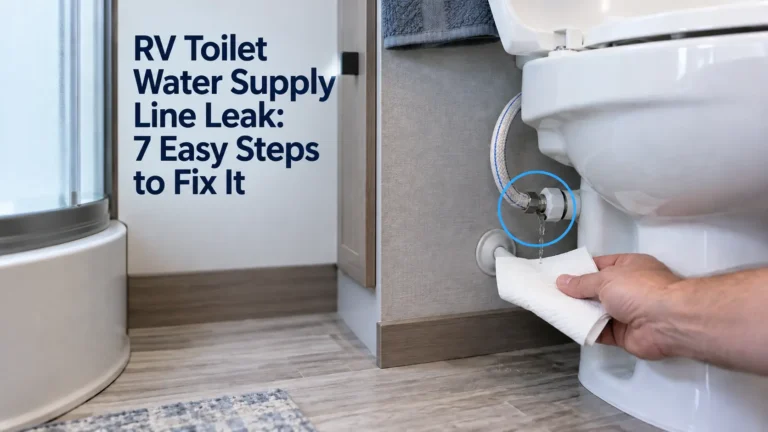
Confirm the pump is switched on at the control panel, or that city water is connected and pressurized at the exterior hookup. No connection means no pressure, and no pressure means the toilet valve won’t produce water no matter how hard you press. This is the cause of RV toilet won’t flush no water situations more often than most people expect.
Empty freshwater tank
If the pump runs but nothing comes through, the tank may be dry. The pump will run but can’t move water it doesn’t have. Fill the tank and test again before diagnosing anything further.
Closed shutoff valve
Some RVs have a manual shutoff valve directly behind the toilet or behind a nearby access panel. It can get bumped closed during travel. Check it.
Clogged water inlet screen
Thetford and Dometic toilets have a small inline screen on the water supply connection at the back of the toilet. Mineral deposits and debris build up on it over time and restrict flow. You can usually remove and rinse it without pulling the toilet off the floor. Check the parts diagram for your specific model to locate it.
Failed water valve
The water valve sits inside the toilet body and controls water flow when you press the pedal. If it fails in the closed position, no water enters. If it fails in the open position, water runs constantly.
Freeze damage is a common cause of valve failure. Water trapped inside the valve body can expand when it freezes and crack plastic valve components. If the toilet stopped producing water after a hard freeze, inspect the valve once everything has thawed completely before assuming you need a new part.
For the full swap process, see the RV toilet water valve replacement guide.
Why Does the Pedal Move but the Toilet Still Won’t Flush?
If the pedal moves when you press it but nothing happens inside the bowl, the mechanical connection between the pedal and the flush ball has broken somewhere. Either the linkage arm snapped or disconnected, or the flush ball itself is jammed and won’t open. This is a different problem from a stuck pedal. The pedal feels fine. The parts underneath it aren’t following.
Broken pedal or cracked housing
Thetford Aqua-Magic toilets use a plastic pedal that snaps into the toilet base. The plastic retaining ring wears down with age and the pedal can separate from the flush mechanism entirely. Pressing it feels completely normal, but nothing below moves. The part you usually need is the waste ball drive arm assembly. Confirm your exact model number before ordering, as parts vary by series.
Disconnected linkage arm
Behind the pedal housing is a small rod or arm that connects the pedal movement to the flush ball. On older toilets, this arm can pop out of its slot or snap completely. Remove the base cover (usually two or three screws on the front) to check whether the arm is still seated and intact.
Stuck or seized flush ball
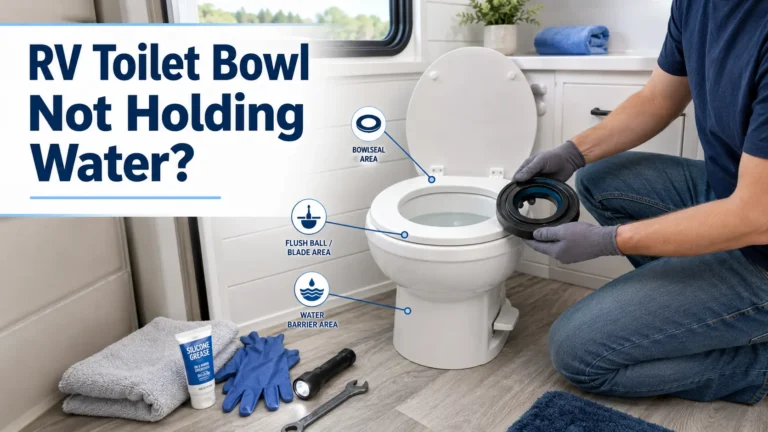
Mineral buildup, dried waste residue, or a warped rubber seal can lock the flush ball in the closed position even when the linkage is fine. Manufacturers, including Dometic, recommend using a water-soluble, silicone-based lubricant on toilet seals. Do not use WD-40 or petroleum-based products on RV toilet seals. Petroleum-based products are not recommended for rubber seals and can cause them to degrade over time.
Mineral buildup inside the blade groove
Hard water leaves calcium deposits inside the groove the blade slides through. Even a thin layer of scale creates enough friction to stop the blade from opening. A soak with diluted white vinegar can help clear light deposits. For heavier buildup, an RV-specific descaling product works faster. Do not use household drain cleaners.
For step-by-step repair, including guidance on Dometic and Thetford models, see the RV toilet foot pedal fix guide.
Why Does Water Enter but Waste Won’t Go Down?
If water enters the bowl and the blade opens, but waste stays in the bowl instead of dropping into the tank, the problem is on the tank side of the toilet. The most common causes are a full black tank, a clog in the drop pipe directly below the toilet, or a pyramid plug inside the tank. None of these require replacing any toilet parts.
Full black tank
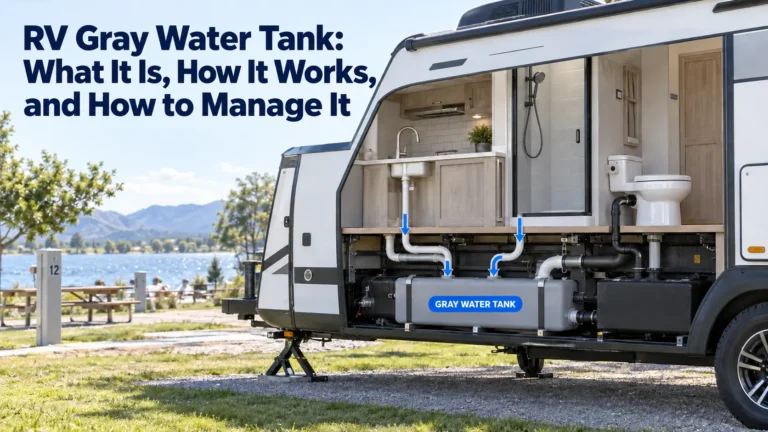
Start here before anything else. A full tank has no room for more waste. Tank monitors can give false readings when residue builds up on the sensor probes, causing the panel to read full even when the tank has room. If the monitor says full but usage hasn’t been heavy, dump and rinse the tank before diagnosing anything else.
Clogged drop pipe
The drop pipe is the short pipe between the toilet bottom and the top of the black tank. Waste flushed without enough water can dry and build up inside this pipe over a few days. The toilet works fine at the start of a trip and then stops draining completely by day three or four. That pattern usually points to a partial drop pipe blockage.
Pyramid plug
A pyramid plug forms when the dump valve is left open while the tank is in use. Solid waste piles up directly beneath the toilet opening and blocks new waste from entering the tank. Water usually still drains around it, so the symptom is waste sitting in the bowl while the water disappears. See the RV toilet unclogging guide for how to break one down safely.
Safe methods to try before anything mechanical:
- Close the dump valve if it’s currently open. Fill the tank with water to help hydrate and loosen any dried buildup.
- Pour a gallon of hot (but not boiling) water plus a few tablespoons of liquid dish soap into the bowl. Let it sit for 20-30 minutes, then try flushing again. Boiling water can damage toilet seals.
- Add an enzyme-based holding tank treatment and let it work overnight. Products like Happy Campers Organic Holding Tank Treatment are formulated to break down waste and paper without harming sensors or plastic components.
- A flexible tank rinse wand inserted through the bowl opening is the safest mechanical option if the clog appears to be in the drop pipe area.
On using a plunger: standard plungers don’t fit RV toilet bowls correctly, and forcing pressure down can push a soft blockage further into the pipe. Try hot water and dish soap first.
Can a Full Black Tank or Blocked Vent Stop an RV Toilet From Flushing?
Yes. Both can. A full tank stops waste from entering because there’s no physical room. A blocked roof vent can cause air pressure to push back against water entering the bowl, slowing or stopping the flush. If the toilet bubbles or burps after you flush, or if flushing feels sluggish and the bowl gurgles afterward, start with the tank and vent before looking at any other part.
Full tank vs. a false reading
Tank monitors can give false readings when residue builds up on the sensor probes. Waste and paper coating the probes can cause the panel to show full even when the tank has room. If the monitor says full but usage hasn’t been heavy, empty the tank and run a rinse cycle to clean the probes before concluding.
Blocked roof vent pipe
The vent pipe runs from the top of the black tank straight up through the RV roof. Insect nests, dried leaves, bird debris, and ice in winter can all block this pipe. When the vent is blocked, the black tank has no way to release pressure. Waste and water push back instead of going down.
A partial blockage usually shows up as slow flushing and gurgling. A full blockage can stop the flush entirely or cause water to back up through the bowl. In cold climates, ice inside an uninsulated vent pipe can create the same problem mid-trip.
When to stop flushing
If water is rising toward the bowl rim and not draining, stop. Continuing to flush with a blocked drain or full tank can push waste back into the bathroom. Empty the tank at a dump station first, then troubleshoot.
For a full walkthrough on testing and clearing a blocked vent, see the RV black tank vent clogged guide.
What If the RV Toilet Won’t Flush After Winterizing?
If the toilet stopped working after winterizing, start here: a properly winterized RV toilet is supposed to not work normally. The water pump is off. The freshwater lines have antifreeze in them instead of water. Pressing the pedal on a winterized toilet produces nothing, and that’s exactly how it’s meant to be.
If you’re trying to use the toilet in cold weather during an active trip, the issue is different. The most likely cause is a frozen water line or a frozen valve. Frozen components look identical to failed ones. The pedal moves, nothing sounds wrong, but no water comes through.
Do not force a frozen pedal or valve. RV toilet plastic is already under tension when frozen. Forcing it can crack housing that would have been perfectly fine after a normal thaw.
If the line or valve might be frozen:
- Move the RV to a heated garage, or bring a small electric space heater into the bathroom. Keep it away from plastic toilet components and don’t leave it unattended.
- Wait 30-60 minutes. Most frozen lines in a closed bathroom thaw faster than you’d expect.
- Once thawed, switch the pump on briefly and test. If water flows normally, you’re done.
- If the valve cracked during the freeze, it will leak when thawed. That valve needs to be replaced before using the toilet again.
If the RV is already winterized and you need to use the toilet temporarily, see the winterized RV toilet guide for the antifreeze flush method that won’t damage the system.
What If an Electric or Macerator RV Toilet Won’t Flush?
If an electric RV toilet won’t flush or the flush button does nothing, check 12-volt power, the fuse, and the wall switch or flush button before opening anything. Electric and macerator toilets run on 12V DC power instead of a foot pedal, and most non-responsive toilets have a power or fuse issue rather than a mechanical failure. Check those first.
Check 12V power and the fuse
Most electric RV toilets run on a dedicated circuit with its own fuse in the coach panel. If the fuse has blown, the toilet will be completely unresponsive. Check your toilet’s installation manual for the correct fuse location and rating. If power is present and the fuse is fine, check the flush button or wall switch, which can fail independently.
Listen for the motor
Press the flush button and listen. If you hear nothing, the problem is electrical: power supply, fuse, or solenoid. If the motor hums but nothing flushes, stop pressing the button. A humming motor that isn’t moving waste usually means the macerator pump is jammed. Running a jammed motor can burn it out. Check whether a foreign object entered the bowl before attempting any disassembly.
Electric water solenoid failure
Some electric RV toilets use a solenoid valve to control the water supply. If the solenoid fails, no water enters the bowl even when the motor runs normally. This requires part-specific diagnosis. Check the model manual for your toilet before assuming which component needs replacing.
For Dometic VacuFlush toilets and Thetford electric models, service documentation and parts diagrams are available on their respective websites. Always follow the model-specific manual before disassembly.
Is This Different for Dometic or Thetford RV Toilets?
The diagnosis for a Dometic or Thetford RV toilet that won’t flush follows the same process as any gravity-flush RV toilet: check water supply, pedal and linkage, flush ball, and black tank. The mechanics are the same across brands. What differs is parts location, replacement compatibility, and where to find the correct service documentation.
Dometic RV toilet won’t flush
Dometic 300, 310, and 320 toilets are among the most common Dometic models in production RVs. If a Dometic toilet won’t flush, work through the water valve, flush ball, inlet screen, and pedal linkage in that order. On some Dometic models, the ball seal can be serviced from above without removing the toilet from the floor. The part numbers for a Dometic 300 toilet are not the same as a Dometic 310 or Dometic 320. Always check the label on the toilet before ordering.
Thetford RV toilet won’t flush
Thetford Aqua-Magic toilets use a blade valve and a water module assembly. If the blade is stuck or the water module fails, the toilet stops flushing or the pedal moves without producing water. Thetford Aqua-Magic models include multiple series with different internals. A Style II and a Style V use different parts. Find the exact model number on the label on the back or underside of the toilet. Parts diagrams for all current Thetford toilet models are available on their service parts page.
Don’t buy parts based only on the brand name
Both Dometic and Thetford produce several toilet series with different components. Ordering a part based only on “Dometic” or “Thetford” without the model number is one of the most common sourcing mistakes. Check the label first, every time.
When Should You Replace Parts Instead of Keep Troubleshooting?
Most flush problems don’t need a new part. But there are situations where continuing to troubleshoot is just burning time.
Replace the water valve if:
- No water enters after confirming the pump, freshwater tank, shutoff valve, and inlet screen are all fine.
- The valve leaks after thawing from a freeze.
- Water runs constantly without pressing the pedal (valve stuck open).
Common replacement valves for Dometic 300, 310, and 320 series toilets and Thetford Aqua-Magic models are available online and through RV parts stores. Price varies by model, so confirm your model number before ordering. Replacement parts are generally cheaper than buying a new toilet, but the exact cost depends on the series.
Replace the pedal or linkage kit if:
- The pedal cracked, snapped, or separated from the base.
- The linkage arm is broken and can’t be reconnected.
Check the model number on the label on the back or underside of the toilet. Both Dometic and Thetford sell model-specific kits, and these are not interchangeable across series.
Replace the seal or flush ball assembly if:
- The blade is stuck and cleaning and lubrication both failed to free it.
- The bowl won’t hold water and lubrication didn’t fix it.
- The rubber shows visible cracking or permanent deformation.
Consider replacing the whole toilet if:
- The plastic body is cracked.
- Multiple major parts are failing at the same time.
- Repair costs are approaching the price of a new toilet.
Before making that call, check the complete RV toilet repair guide for a full repair vs. replacement breakdown by toilet type.
An RV toilet that won’t flush sounds like a big problem. Most of the time, it isn’t.
Start with one question: does water enter the bowl when you press the pedal? That single observation splits every “won’t flush” problem into two completely different categories, each with its own short checklist.
Before spending money on parts, confirm the water supply is on, the pedal and linkage are connected, the flush ball actually opens, and the black tank isn’t full or clogged. Most owners who work through that list find the cause before they’ve ordered anything.
When something does need replacing, it’s almost always a water valve, a pedal kit, or a seal. Replacement parts for common Dometic and Thetford models are widely available, but price and difficulty depend on the model. Check the label first.
Diagnose by symptom first. Work through the list. You’ll have it running again.
Frequently Asked Questions
Why won’t my RV toilet flush?
The most common reasons are no water reaching the toilet (pump off, empty freshwater tank, or failed water valve), a broken foot pedal or disconnected linkage, a stuck flush ball that won’t open, or a full black tank with no room for waste. Press the pedal and watch what happens. Does water enter the bowl? Does the blade at the bottom open? Those two observations narrow it down to the right checklist in under a minute.
Why is there no water coming into my RV toilet?
No water in the bowl usually means the water pump is off, the freshwater tank is empty, the manual shutoff valve behind the toilet is closed, or the water valve inside the toilet has failed. Check the pump first. If the pump runs and you hear pressure but nothing comes through, work through the shutoff valve and inlet screen next. If those are both fine, the water valve is the likely problem.
Can a full black tank stop an RV toilet from flushing?
Yes. A full tank has no room for more waste, so pressing the pedal pushes water in but nothing goes anywhere. A blocked roof vent pipe can also cause backpressure that slows or stops flushing. Check the tank monitor and empty the tank before troubleshooting any mechanical part of the system. Tank monitors can give false full readings when residue builds up on the probes, so when in doubt, dump it anyway.
Should I use a plunger on an RV toilet?
Not recommended. Standard plungers don’t fit RV toilet bowls properly and can push a soft clog further down the drop pipe instead of clearing it. A gallon of hot (but not boiling) water plus dish soap is a safer first step. For stubborn blockages, a flexible tank rinse wand is the safest mechanical tool that won’t damage the toilet body or plastic plumbing.
Can I manually flush an RV toilet if the pedal or valve is broken?
Pouring water directly into the bowl can move waste only if the blade or flush ball still opens on its own. If the blade is stuck shut, do not try to force it open with a screwdriver, knife, or sharp tool. Forcing the blade can damage the seal and make the repair more involved. If the pedal or linkage is broken but the blade still opens, fix the mechanism rather than improvising around it. As a short-term workaround while you wait for parts, use a campground restroom or a portable toilet instead.