TL;DR: RV toilet bubbles when flushed usually means air or gas is trapped in the black tank system with nowhere to go. The most common causes are a full or nearly full black tank, a blocked roof vent pipe, a pyramid plug under the toilet, or a clog in the drop pipe. Start by checking your tank level. If the tank is not full and it still bubbles after dumping, inspect the roof vent and look for waste buildup near the toilet opening. Most cases are DIY-fixable, but a blocked vent or deep pyramid plug may take more than a quick flush to clear.
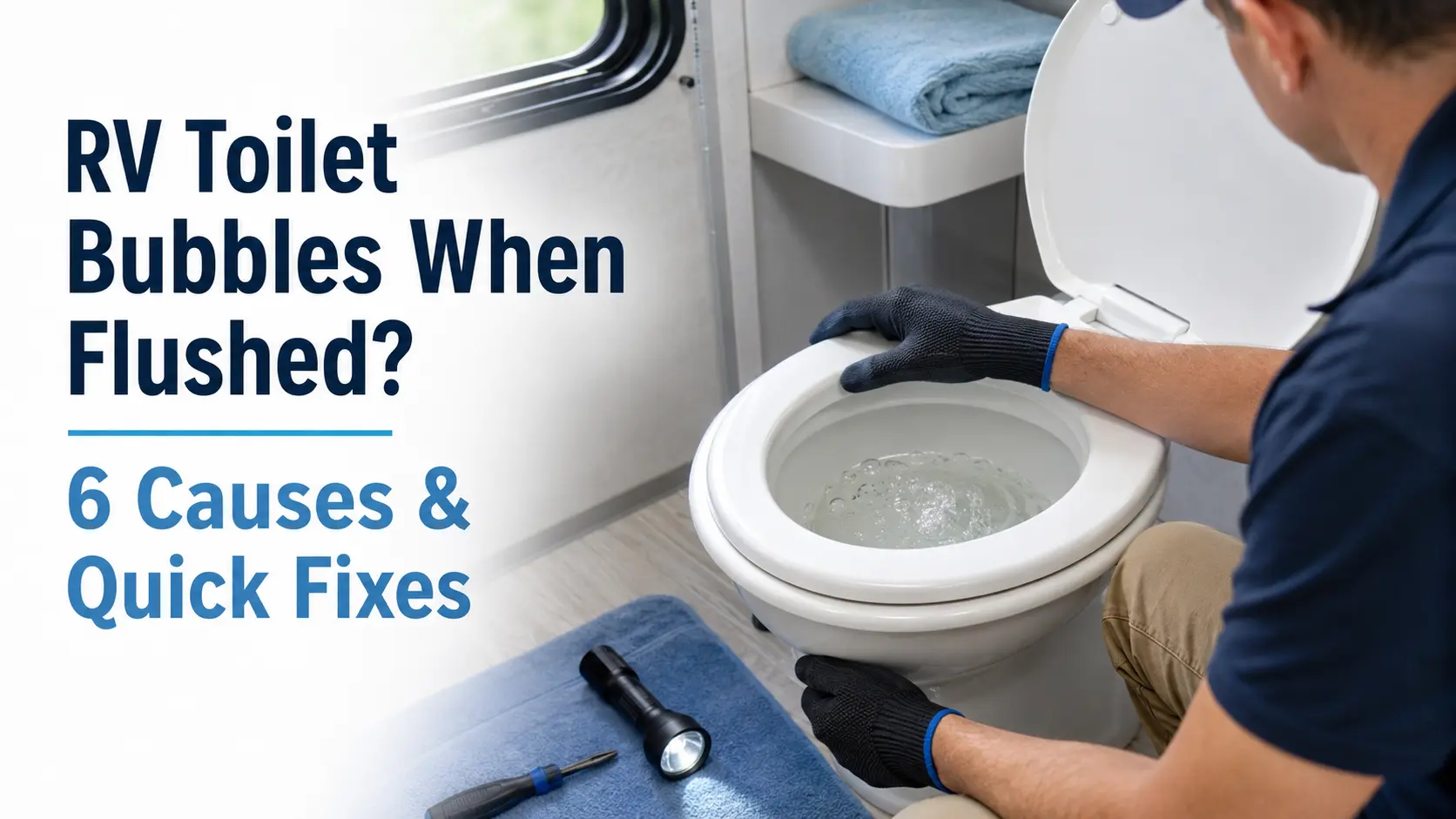
Your RV toilet bubbles when flushed, and now you’re wondering if this is a quick fix or a sign of something worse. The short version: it’s almost always a plumbing airflow problem, not a toilet malfunction. When your RV toilet burps or gurgles, that noise is trapped air or gas forcing its way back through the only opening available — the toilet bowl.
Unlike a home toilet, an RV toilet has no P-trap. There’s no water barrier between the bowl and the black tank. The only thing separating your bathroom from tank gases is the flush ball seal and the pressure balance in the vent system. When that balance breaks down, you notice it immediately.
This guide covers the most likely causes of RV toilet bubbling, plus a quick diagnosis table you can use right now to figure out what’s going on before you start pulling things apart.
Why Does an RV Toilet Bubble When Flushed?
Quick Answer
When you flush an RV toilet, the flush ball opens and water pushes waste into the black tank. That incoming waste displaces air inside the tank. Under normal conditions, that air escapes up through the roof vent pipe. If the vent is blocked, the tank is full, or there’s a buildup near the tank inlet, the displaced air has nowhere to go except back through the toilet bowl — which produces the bubbling or burping you’re hearing.
The black tank constantly produces gas as waste breaks down. Unique Camping + Marine notes that those gases — methane, hydrogen sulfide, and carbon dioxide — normally exit through the vent pipe that runs up through the roof of your RV. Interrupt that path in any way, and the pressure has to go somewhere.
There’s also a difference between a gas burp and water splash-back. A gas burp is that brief pop or gurgle right when the flush valve opens. Water splash-back is when liquid actually bounces back up into the bowl during or after the flush. Gas burps usually point to a vent or pressure issue. Water splash-back usually points to a blockage lower in the system — in the drop pipe or at the tank inlet. Both are covered below.
Quick Diagnosis — What You’re Seeing and What It Means
Before going through each cause in detail, use this table to narrow things down. Find the description that best matches what you’re seeing, and start there.
| What you notice | Most likely cause | First thing to check |
|---|---|---|
| Bubbles when tank is near full | Full or nearly full black tank | Dump the tank |
| Bubbles even after a recent dump | Blocked vent or waste buildup | Rinse tank and inspect roof vent |
| Big burp or splash when pedal opens | Trapped pressure in tank | Stop flushing, check tank level and vent |
| Toilet drains slowly and then bubbles | Drop pipe clog or pyramid plug | Shine a flashlight down the toilet opening |
| Tank gauge says empty but bubbles continue | Bad sensor or hidden buildup | Do not trust the gauge alone — flush and rinse the tank |
| Odor plus bubbling at the same time | Vent or tank gas issue | Check roof vent cap and tank level |
If you’re also getting odor without a clear bubbling pattern, see our full breakdown on RV toilet smells when flushed — that guide covers vent, seal, and tank odor causes in detail.
Cause 1 — Full or Nearly Full Black Tank
Quick Answer
When a black tank is full, there’s no room for the air displaced by each flush. That air gets pushed back through the toilet bowl as bubbles. RV Tech & Inspect lists a full or nearly full holding tank as the most common reason an RV toilet bubbles when flushed. Dump the tank first before assuming anything else is wrong.
A full black tank will sometimes give you an early warning before it fully backs up. The flush sound changes — it gets heavier or sluggish. The bubbling may start before the gauge hits 100%. That’s because the waste pile can block airflow before the liquid level reaches the sensor.
The fix is to find a dump station and empty the tank completely. Run a couple of rinse cycles after dumping. Add fresh water and 2 to 3 inches in the bowl before heading out. If the bubbling stops after a dump and rinse, you were simply overdue.
If the bubbling returns quickly after dumping, you likely have a second problem — buildup that isn’t clearing with a normal dump. Keep reading.
Cause 2 — Blocked Black Tank Vent Pipe
Quick Answer
A blocked vent pipe is a common cause of RV toilet bubbling, especially if the tank is not full. The vent pipe runs from the black tank up through the roof of the RV. When debris, nests, or buildup block that pipe, tank gas can’t escape upward — so it comes back through the toilet bowl instead.
The vent cap on your roof is exposed to everything: leaves, pine needles, mud dauber nests, bird nests, and in winter, ice. Any of those can partially or fully block the vent opening. A partial block is actually more annoying than a full block — it lets some gas through, so the bubbling is inconsistent and harder to trace.
How to check and clear a blocked vent pipe
⚠️ Safety note: Only inspect the roof vent if you can access the RV roof safely. Use a stable ladder, avoid wet or windy conditions, and do not climb onto a roof that is not designed to support weight. If in doubt, call an RV technician.
- Get on the roof safely. Locate the black tank vent cap, which is usually a small mushroom-shaped plastic cap on the roof above or near the bathroom.
- Remove the cap and look inside. Use a flashlight. Look for visible debris, nests, or buildup at the top of the pipe.
- Flush the pipe with water. Pour a bucket of water down the vent opening. If water drains freely, the blockage is lower in the pipe.
- Use a section of PEX pipe or a plumbing snake. Push a flexible 10-foot section of 1/2-inch PEX pipe down the vent to break up any solid obstruction. A garden hose on a slow flow can also work.
- Dump and rinse the tank. After clearing the vent, dump the tank and rinse it thoroughly before testing.
⚠️ If you clear the vent and the bubbling continues, do not stop there. A cleared vent pipe fixes the pressure path — it does not fix any buildup inside the tank or drop pipe. Move through the remaining causes below.
Cause 3 — Pyramid Plug Under the Toilet
Quick Answer
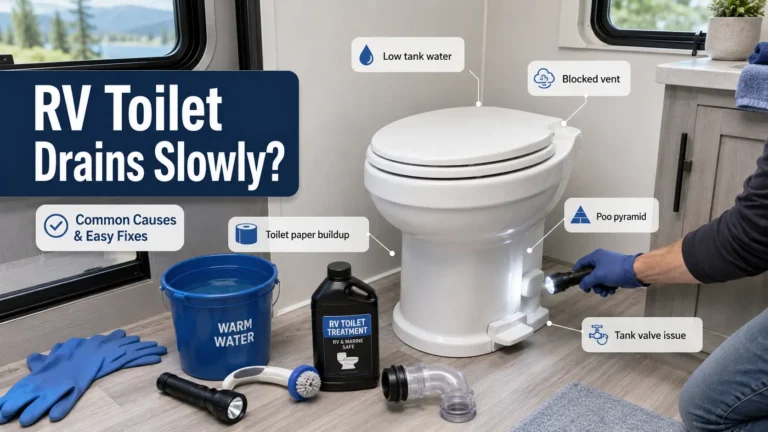
A pyramid plug is a mound of solid waste that builds up directly under the toilet drop tube inside the black tank. Even after dumping, if that mound is large enough, it partially blocks the tank inlet — trapping air below the toilet. Every flush compresses that air and pushes it back up as a burp.
Pyramid plugs usually form when two things happen at once: not enough water per flush, and the black tank valve is left open while connected to a sewer hookup. Liquids drain away, but solids stay behind and pile up directly under the toilet opening.
The symptom is subtle. Your tank gauge may read empty after dumping, but the bubbling returns within a day or two of use. That’s because the dump cleared the liquid but left the solid plug behind.
How to break up a pyramid plug
- Fill the tank with hot water and let it soak. Close the gate valve, run hot water into the toilet bowl, and let it sit for 3 to 4 hours. Heat softens the buildup.
- Use a black tank rinse wand. A tank rinse wand attaches to a garden hose and feeds down through the toilet. The high-pressure spray breaks up solids at the tank inlet. Our guide on how to unclog an RV toilet without a snake covers this in detail.
- Use a bacterial enzyme treatment. After clearing the plug mechanically, add an enzyme-based tank treatment and let it work for 24 to 48 hours before your next dump. Our best RV toilet treatment guide covers which products break down solid buildup most effectively.
- More water, every flush. Once the plug is gone, the fix is staying ahead of it. Use enough water per flush so solids move away from the toilet inlet and spread across the tank floor.
Cause 4 — Clogged Drop Pipe or Tank Inlet
The drop pipe is the short section of pipe between the toilet and the top of the black tank. It’s usually 3 or 4 inches in diameter and drops straight down through the floor. Partial clogs here are less common than pyramid plugs, but they produce a similar symptom: slow drainage followed by a bubble or splash-back when you flush.
The cause is almost always the same as a pyramid plug — not enough water per flush, combined with tissue paper that doesn’t dissolve fast enough. Using non-RV toilet paper makes this worse. Standard household toilet paper doesn’t break down in a low-water RV system. Over time, it clings to the walls of the drop pipe and narrows the opening.
To check: open the toilet flush valve and shine a flashlight down the opening. You should be able to see straight into the tank. If you see buildup on the pipe walls or a narrow opening, that’s your problem.
The fix is the same as a pyramid plug — hot water soak, rinse wand, and enzyme treatment. Switching to RV-safe toilet paper prevents it from coming back.
Cause 5 — Tank Sensor Says Empty, But the Tank Isn’t
Black tank sensors are notoriously unreliable. The probes that measure tank level sit on the tank wall and read the level of liquid inside. Solid waste, paper residue, and grease coat those probes over time. A coated probe reads “empty” even when the tank has significant waste inside.
If your tank gauge reads empty but you’re still getting bubbling — especially if you haven’t dumped recently or have been camping with multiple people — do not trust the gauge. Dump anyway. iRV2 forum members consistently report that a low-level reading from a sensor-coated tank is the first thing to rule out when bubbling appears alongside a gauge that seems fine.
After dumping, add water and a tank treatment designed to clean sensors, not just break down waste. Most enzyme treatments clean the sensor probes as a side effect of regular use.
If the bubbling stops after dumping a “supposedly empty” tank, your sensors need cleaning — not your vent or your drop pipe.
Cause 6 — Less Common Causes Worth Checking
If you’ve worked through causes 1 through 5 and the bubbling continues, one of these less common issues may be at play.
Vent pipe dropped too low into the tank
Some RVs leave the factory with a vent pipe that extends too far down into the black tank. When the liquid level inside the tank rises, the bottom of the vent pipe gets submerged — and the vent stops working as a gas exit. On a Grand Design forum, one owner traced a persistent bubbling issue to exactly this: the vent pipe ended too close to the tank floor, and the rising waste level was blocking it from the inside. This is a structural issue that usually requires a tech to fix.
Gate valve not fully closed
If the black tank gate valve isn’t closing all the way, outside air can enter the tank through the sewer hose connection — and that air can create pressure imbalances that push back through the toilet. Check that the valve closes completely and that the blade makes a full seal. If the valve blade does not close fully, inspect the dump valve assembly or have an RV technician check it.
Small refill bubbles after flushing
If you notice a small trickle of water or a brief bubble in the bowl immediately after flushing — not during the flush — the cause is likely the vacuum breaker rather than black tank pressure. The vacuum breaker is a small check valve in the water supply line at the back of the toilet. Its job is to stop water from flowing backward toward the fresh supply. A worn or failed vacuum breaker can allow a small amount of water to drip back into the bowl after the flush ends. This is a water supply issue, not a black tank gas issue. It produces a much smaller and wetter bubble than the gas burps described in causes 1 through 5, and it typically needs no immediate attention unless the dripping is significant.
How to Diagnose the Cause in 5 Minutes
Work through these steps in order
- Check the tank level — and don’t trust the gauge alone. If you’re at 2/3 full or higher, or if you can’t remember the last time you dumped, go to step 2 before anything else.
- Dump and rinse the tank. Empty completely, run 2 to 3 rinse cycles if possible, then retest. If the bubbling stops, you’re done.
- Check the roof vent. If the tank was not full or if bubbling returns quickly after dumping, inspect the vent cap. Remove it and look for debris or nests. Flush the pipe with water from the top. Only go on the roof if you can do it safely.
- Look down the toilet with a flashlight. With the flush ball open, shine a light down into the tank inlet. If you see buildup or a narrowed opening, you have a pyramid plug or drop pipe clog.
- Check the gate valve. Confirm the black tank gate valve is fully closed when not actively dumping.
If your RV has a built-in rinse port, follow our guide to using an RV black tank flush system safely before testing the toilet again.
Many simple cases resolve at step 2 or 3. If you reach step 5 without an answer, the problem is likely structural (vent pipe position, installation issue) or involves a valve component — at which point a certified RV technician is worth the call.
What Not to Do When Your RV Toilet Bubbles
- Do not keep flushing if the bowl is splashing back. Repeated flushing into a blocked or full tank pushes waste backward. Stop and diagnose the cause before flushing again.
- Do not trust the tank gauge alone. Sensor probes coat with residue and give false low readings. If you haven’t dumped in a while, dump regardless of what the gauge says.
- Do not leave the black tank valve open at full hookups. This is a common cause of pyramid plugs. Liquids drain away continuously while solids pile up near the tank inlet. Close the valve and only open it to dump.
- Do not pour harsh chemicals into the toilet without knowing the cause. Bleach and chemical drain openers can damage the flush ball seal and tank components. Use enzyme-based products designed for RV tanks instead.
- Do not climb on the roof unless you can do it safely. A blocked vent is worth fixing, but not at the cost of a fall. If roof access is unsafe, call an RV technician to handle it.
How to Prevent RV Toilet Bubbling
- Dump before the tank hits 2/3 full. Don’t wait for the gauge to say full. Dump early to give the tank room to breathe. If you’re camping with multiple people, check every 2 to 3 days.
- Use more water per flush. The single biggest cause of pyramid plugs and drop pipe clogs is not using enough water. Hold the pedal open for an extra 3 to 5 seconds on every flush. It makes a real difference over the course of a trip.
- Use only RV-safe toilet paper. Standard household paper does not dissolve quickly in a low-water system. Check our guide on RV toilet paper vs. regular toilet paper if you’re not sure what qualifies.
- Add an enzyme treatment after every dump. Bacterial enzyme products keep waste mobile and prevent solids from clumping near the inlet. They also clean the sensor probes as a side effect.
- Inspect the roof vent cap at least once a season. Check it in the spring before your first trip and after any trip through heavily wooded areas. Wasp nests and mud daubers are especially common in late spring and summer.
- Keep water in the bowl between uses. A few inches of water in the bowl keeps the flush ball seal hydrated and helps maintain the pressure balance in the system. If you notice a smell along with bubbling after a trip, see our guide on RV toilet smell after dumping for related causes.
The Bottom Line
RV toilet bubbling when flushed is almost always an airflow or blockage problem downstream of the toilet. In most cases, it comes down to a full tank, a blocked vent, or a solid waste buildup that’s trapping air with nowhere to go. Start with the tank level, dump if in doubt, and then check the roof vent if the problem continues.
Prevention is straightforward: more water per flush, regular dumping, seasonal vent checks, and RV-safe paper. None of this is complicated. It’s just easy to skip when you’re focused on actually enjoying your trip.
If you’ve worked through all six causes above and the bubbling still hasn’t stopped, the problem is likely inside the tank system at a structural level. At that point, a certified RV technician can scope the vent pipe and tank inlet and tell you what a flashlight and a rinse wand can’t.
Frequently Asked Questions
Is it dangerous if my RV toilet bubbles when flushed?
The bubbling itself is not dangerous, but what it signals can be. Black tank gases include hydrogen sulfide and methane. OSHA notes that hydrogen sulfide is harmful even at low concentrations and is responsible for the rotten egg smell in sewer gas. If you’re getting bubbling plus a strong odor inside the RV, ventilate the bathroom, fix the cause promptly, and don’t ignore it. A one-time mild burp on a full tank is not a health concern. A persistent bubbling problem with odor is worth taking seriously.
Can a bubbling RV toilet cause backflow into the bowl?
Yes, in severe cases. If the black tank is completely full and you continue flushing, the waste has nowhere to go and can back up into the bowl. This is one reason not to let the tank reach capacity before dumping. If you see the bowl filling with dark liquid rather than just hearing a burp or gurgle, stop flushing immediately and find a dump station.
How do I clear a blocked black tank vent pipe?
Only attempt roof access if you can do it safely. If conditions are safe, remove the vent cap and check for visible debris. Pour water down the vent opening. If water drains freely, the blockage is lower — push a 10-foot section of 1/2-inch PEX pipe down the vent to break it up. If the vent cap itself is clogged with a nest or debris, clean it thoroughly before reinstalling. After clearing the vent, dump and rinse the tank before testing whether the bubbling has stopped.
Why does my RV toilet only bubble sometimes and not every flush?
Intermittent bubbling usually points to a partial blockage rather than a full one — either a partially clogged vent, a buildup that’s not yet large enough to block every flush, or a tank that’s approaching full but not quite there yet. The bubbling gets worse as the problem progresses. Track when it occurs: if it mainly happens after the tank is 1/2 to 2/3 full, a full tank is likely the trigger. If it happens regardless of tank level, check the vent and look for waste buildup.
My black tank is empty but the toilet still bubbles — what’s wrong?
First, consider whether the gauge is actually accurate. Black tank sensors coat with residue over time and often read lower than actual levels. If you haven’t dumped recently, dump anyway and rinse the tank thoroughly. If the gauge is accurate and the tank is genuinely empty, the most likely culprits are a blocked roof vent pipe, a pyramid plug of solid waste near the tank inlet that didn’t clear during the dump, or a vent pipe that drops too far into the tank and is partially submerged. Work through causes 2, 3, and 6 in the guide above.
Why does my RV toilet burp after dumping?
If your RV toilet still burps after dumping, the tank may not have rinsed clean, the roof vent may be blocked, or a pyramid plug may still be sitting under the toilet drop pipe. Dumping removes liquid waste, but it does not always remove solid buildup near the tank inlet. Run 2 to 3 rinse cycles after your next dump, inspect the roof vent, and look down through the toilet with a flashlight to check for visible buildup at the tank opening.