You’re parked at a beautiful campsite, miles from the nearest town, and your RV toilet just stopped working. Whether it won’t flush, won’t hold water, or is leaking at the base, there’s almost always a straightforward fix you can handle yourself.
This guide is your starting point. Use the diagnostic flowchart and table below to quickly identify what’s actually wrong, then follow the link to our full step-by-step guide for that specific problem. Each dedicated guide covers the exact parts, tools, and repair steps in more depth than we can fit here.
How Does an RV Toilet Actually Work?
Before you can fix it, you need to understand how it works, and it’s simpler than you might think.
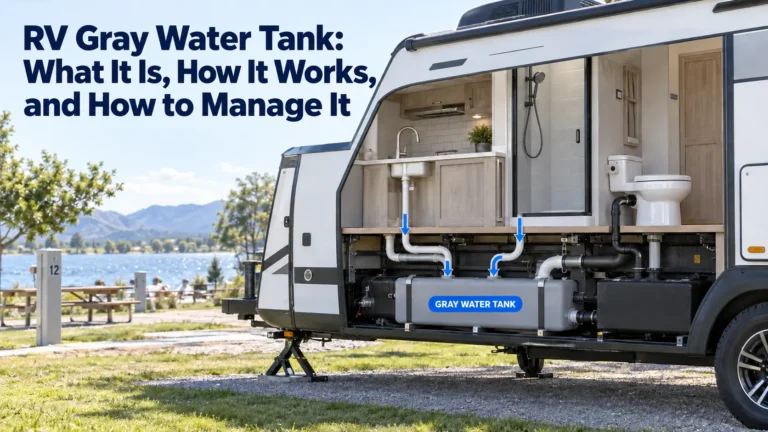
Unlike home toilets, RV toilets have no tank on the back. Water comes directly from your freshwater system when you press the foot pedal. Waste drops straight down into the black tank below. There’s no complex flushing mechanism, just a few rubber seals, a water valve, and a pedal linkage.
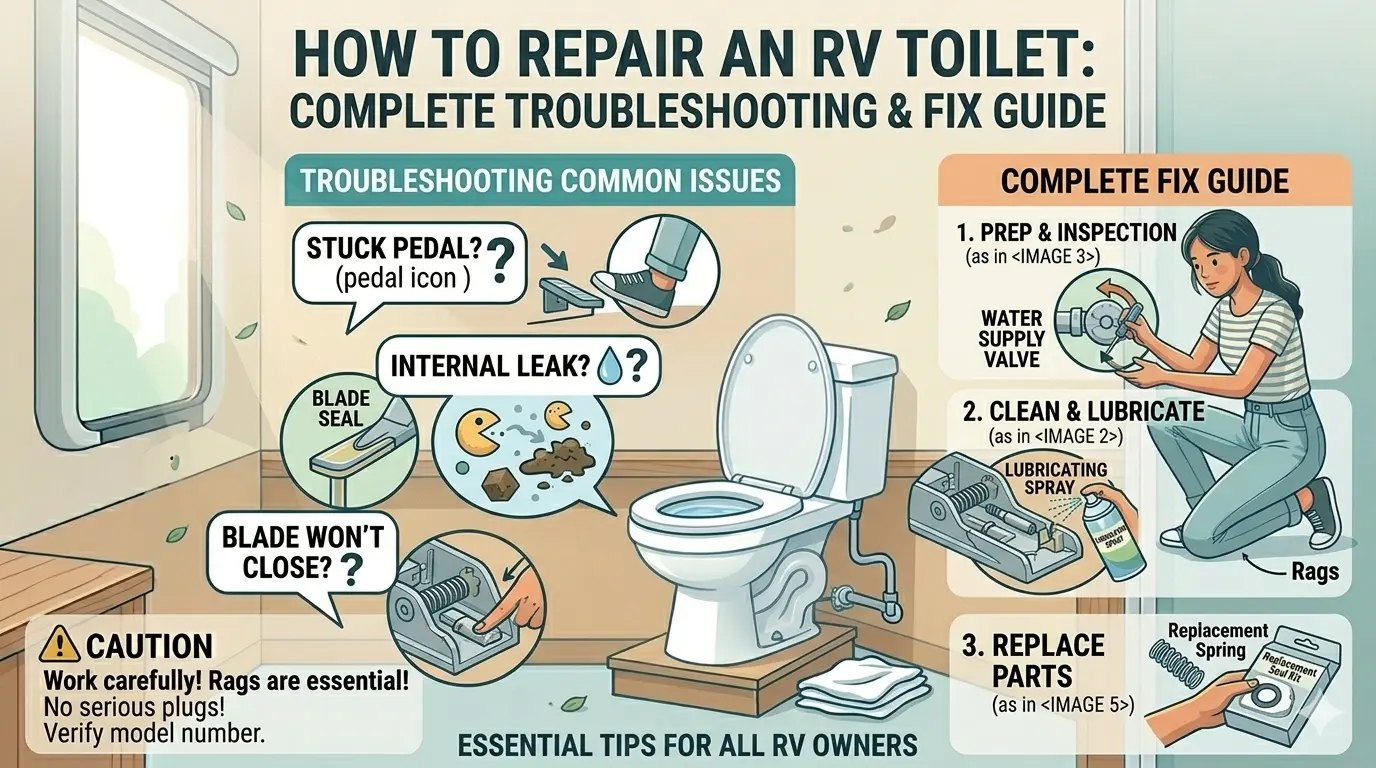
Key components to know:
- Blade / flush ball seal. The rubber seal at the bottom of the bowl. Holds water in and blocks odors from the black tank. The single most common failure point.
- Water valve. Controls water flow when you press the pedal. Can fail open (water runs constantly) or fail closed (no water enters).
- Foot pedal / flush linkage. Activates flushing. A broken linkage or cracked pedal disables the entire flush mechanism.
- Floor flange gasket. The rubber ring at the toilet base. Prevents leaks and odors escaping around the bottom.
- Vent pipe. Runs from the black tank up through the roof. If blocked, waste and water can’t drain properly.
Key difference from home plumbing: RV toilets use a rubber floor gasket at the base, never a wax ring. This is essential to know before buying any replacement parts.
Quick Diagnostic: Find Your Problem Fast
Not sure what’s wrong? Use this quick diagnostic guide to narrow down the problem fast before you start taking anything apart.
No water enters the bowl when you press the pedal
- If the pump is off or the tank is empty, fill the tank or turn on the pump.
- If the pump is on and the tank has water, the water valve is faulty or the pedal linkage is broken.
Water enters but waste won’t go down
- If the black tank is full, empty it at a dump station first.
- If the black tank is empty, you likely have a clog.
- If the blade does not open, it is likely stuck or seized.
Water enters and waste flushes, but the bowl drains empty between uses
Water keeps trickling into the bowl without pressing the pedal
Water or smell is coming from around the base
The toilet rocks or moves
Sewage smell without a visible leak
Most likely cause: a dry seal or the black tank valve was left open.
Before you assume the toilet is broken
Always check the simple stuff first: water supply, black tank level, and whether the blade valve actually opens.
Good next step
Once you match your symptom, jump to the detailed repair guide for that exact issue instead of guessing.
Symptom → Part → Difficulty → Cost → Full Guide
Once you’ve narrowed things down with the flowchart above, use this table to jump straight to the detailed fix.
| Symptom | Likely Part | Difficulty | Typical Cost | Full Guide |
|---|---|---|---|---|
| Won’t flush at all | Water valve or pedal linkage | Easy to Moderate | $0–$40 | RV Toilet Won’t Flush? 7 Causes and Fixes |
| Clogged, general | Depends on clog type | Moderate | $10–$40 | How to Unclog an RV Toilet Without a Snake |
| Pyramid plug (valve left open at hookups) | Black tank buildup | Moderate | $10–$30 | How to Fix a Pyramid Plug |
| Blocked toilet line | Pipe between toilet and tank | Moderate | $20–$40 | RV Toilet Drains Slowly When Flushed |
| Compacted tank (after storage) | Hardened waste | Moderate to Hard | $20–$60 | RV Black Tank Not Draining |
| Bowl won’t hold water | Blade / flush ball seal | Easy | $15–$25 | RV Toilet Bowl Not Holding Water (Dometic-specific version) |
| Water keeps running / won’t stop | Water valve or diffuser screen | Moderate | $25–$40 | RV Toilet Water Valve Replacement (Dometic ghost flushing) |
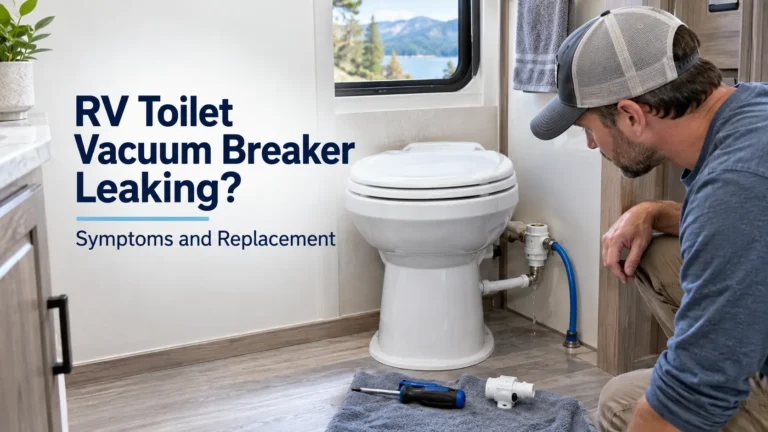
| Leaking at the base | Floor flange gasket | Moderate | $10–$20 | RV Toilet Leaking at Base (Thetford / Dometic versions) |
| Foot pedal not working | Linkage or pedal assembly | Easy | $10–$30 | How to Fix an RV Toilet Foot Pedal |
| Toilet wobbling or loose | Base mounting bolts | Easy | Free | Covered on this page below |
| Persistent odor | Dry seal or open tank valve | Easy | $5–$15 | Covered on this page below, plus RV Toilet Smell After Dumping |
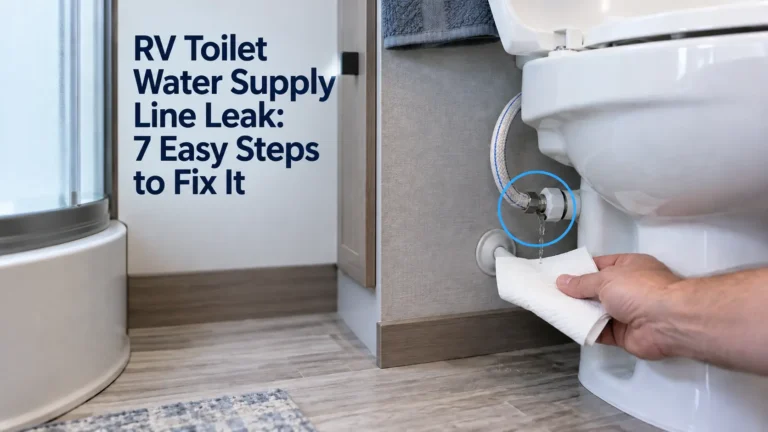
| Fresh water leaking behind toilet | Supply line or fitting | RV toilet water supply line leak |
The 8 Most Common RV Toilet Problems
Problem 1: RV Toilet Won’t Flush
Symptom: You press the pedal and nothing happens. No water enters the bowl, or water enters but waste stays in the bowl and won’t drop into the black tank.
There are two distinct versions of this problem, and they have different causes. If no water enters the bowl, the water pump may be off, the freshwater tank empty, the water valve failed closed, or the pedal linkage disconnected. If water enters but won’t drain, you’re likely dealing with a full black tank, a seized blade valve, or a clog further down the line.
Start by checking the simple things: pump on, tank not empty, pedal pressed fully and firmly. If those check out, the cause is almost always a specific failed part, and the fix depends on exactly which symptom you have.
→ Full step-by-step fix, including both scenarios: RV Toilet Won’t Flush? 7 Causes and Fixes by Symptom
Problem 2: RV Toilet Clogged / Not Draining
Symptom: Waste won’t flush down, water backs up in the bowl, or the toilet drains extremely slowly. This is one of the most common, and most unpleasant, RV toilet problems.
RV clogs aren’t all the same, and identifying which type you have determines how you fix it:
- Pyramid plug: Solid waste has built up directly below the toilet opening, usually because the black tank valve was left open at a hookup site.
- Blocked toilet line: A clog in the pipe between the toilet and the black tank, often from not using enough water per flush.
- Compacted tank: Waste has hardened after the RV sat in storage with a full or partially full tank.
Never use a standard household plunger on an RV toilet. It can damage the blade seal. Use a flexible wand or soft-cup plunger designed for RV toilets instead.
→ Full step-by-step fixes for all three clog types: How to Unclog an RV Toilet Without a Snake, How to Fix a Pyramid Plug, and RV Toilet Drains Slowly When Flushed
Prevention: Use plenty of water with every flush, only use RV-safe toilet paper (see What Toilet Paper Is Safe for RV), and never leave the black tank valve open at hookup sites.
Problem 3: Bowl Won’t Hold Water
Symptom: The bowl drains slowly or is completely dry between uses.
Root cause: The blade seal at the bottom of the bowl is dirty, dried out, or worn, and can no longer create a watertight barrier. Start with the simplest fix: clean around the seal edge and apply RV toilet seal lubricant. Never use petroleum jelly, since it degrades rubber and speeds up wear. If the bowl still won’t hold water after that, the seal needs replacing.
→ Full step-by-step fix: RV Toilet Bowl Not Holding Water? 4 Causes and Easy Fixes (Dometic owners: see the Dometic-specific version)
Problem 4: Water Keeps Running / Won’t Stop
Symptom: Water trickles into the bowl continuously, even when you haven’t pressed the pedal.
Root cause: The water valve isn’t closing fully, or a clogged diffuser screen is causing back-pressure that mimics a valve failure. Mineral deposits from hard water are a common trigger. Start by soaking the diffuser screen in white vinegar for 30 minutes. If water still runs after that, the valve itself needs replacing.
A running toilet can drain your entire freshwater supply overnight. If you notice this while camping, switch off the water pump until the repair is done.
→ Full step-by-step fix: RV Toilet Water Valve Replacement (Dometic owners: see Dometic RV Toilet Ghost Flushing)
Problem 5: Toilet Leaking at the Base
Symptom: Water or odor seeping from around the toilet base onto the bathroom floor.
Root cause: The floor flange gasket has compressed or cracked over time. But don’t assume that automatically. Water runs to the lowest point, so the base is where it shows up, not always where it starts. The blade seal, water valve, or a loose mounting bolt can all cause a leak that looks like it’s coming from the base.
→ Full step-by-step fix: RV Toilet Leaking at Base, with brand-specific versions for Thetford and Dometic owners
Problem 6: Foot Pedal Not Working
Symptom: Pressing the pedal does nothing. No water flow, no blade movement.
Root cause: The flush linkage has disconnected, or the pedal assembly has cracked. Check underneath the pedal first. A small plastic clip or rod often simply pops out of place during travel, and snapping it back in solves the problem for free.
→ Full step-by-step fix: How to Fix an RV Toilet Foot Pedal
Problem 7: Toilet Wobbling or Loose
Symptom: The toilet rocks from side to side, most noticeable while driving or on uneven ground.
Root cause: The two base mounting bolts have worked loose from road vibration over time.
Difficulty: Easy | Cost: Free, just a wrench
How to fix it:
- Pop off the plastic caps at the front base of the toilet to expose the two mounting nuts.
- Tighten both bolts evenly with an adjustable wrench. Do not overtighten. The plastic base will crack. Firm and snug is enough.
- If the toilet still wobbles after tightening, the floor flange may have shifted. Reinstall with a fresh rubber gasket.
Problem 8: Persistent Odors
Symptom: Sewage smell in the bathroom area, even when the toilet hasn’t been recently used.
Root cause: Black tank valve left open, a dry blade seal, or not enough water left in the bowl.
Difficulty: Easy | Cost: $5–$15 for treatment products
How to fix it:
- Close the black tank valve. Never leave it open while at a full-hookup campsite. When the valve stays open, liquid drains out freely but solids accumulate, and odors travel back up into the RV.
- After each dump, add 2 to 5 gallons of clean water to the black tank. Keep a shallow layer of water in the toilet bowl to maintain the odor barrier and prevent the seal from drying out.
- Add a black tank treatment after every dump. Drop-in pods are the most convenient option.
- Apply seal lubricant to the blade seal. A dry seal allows odors through even when it looks fine visually.
For a deeper look at why odors return even after cleaning, see RV Toilet Smell After Dumping.
Tools & Parts You’ll Need
Gather these before you start so you’re not stopping mid-repair:
- Adjustable wrench
- Thick rubber gloves
- Blade seal kit (model-specific, check your toilet’s model number first)
- RV toilet seal lubricant, not petroleum jelly
- Replacement water valve (if water won’t stop running)
- Rubber floor gasket (if leaking at base)
- Enzyme-based black tank treatment (for clogs)
- Flexible tank wand or garden hose (for clog clearing)
- Bucket and old towels
- Flashlight or headlamp
Finding your model number: Check the underside of the toilet seat, the rear of the base, or a label near the waterline inside the bowl. You need this exact number before ordering parts. Thetford and Dometic both make many variations that look identical but use different seals and kits. For a full breakdown of what each part does, see our RV Toilet Parts Guide.
How to Remove an RV Toilet
Most seal and valve repairs require removing the toilet. It sounds daunting the first time, but it’s a 15-minute job once you know the steps. There are no wax seals, no lead pipes. It’s a clean, straightforward process.
Step 1: Turn off the water supply. Close the valve near the toilet or switch off the freshwater pump. Press the flush pedal several times to relieve any residual pressure in the line.
Step 2: Disconnect the water line. Locate the supply connection at the back of the toilet. Have a towel ready, since a small amount of water will spill. Unscrew the fitting by hand or with a wrench.
Step 3: Remove the base bolt covers and nuts. Pop off the plastic caps at the front base of the toilet. You’ll find two nuts underneath. Remove both with a wrench.
Step 4: Lift straight up. The toilet lifts cleanly off the floor flange. Porcelain models are heavier than expected, so get help if needed. Set it on its side on old towels outside the bathroom.
Step 5: Cover the flange opening. Stuff a rag into the exposed flange hole immediately to block sewer gases while you work. Do not skip this step.
Reinstallation tip: When putting the toilet back, tighten the two base bolts in small, alternating increments, like tightening lug nuts on a wheel. Tightening one side fully before the other will crack the plastic base.
Thetford vs. Dometic: Brand-Specific Notes
Thetford and Dometic cover the vast majority of RV toilets on the road. Here’s what you need to know before buying parts or starting any repair.
Thetford Aqua-Magic
- The most common RV toilet in North America. Parts are widely available at Walmart, Amazon, and most RV supply stores.
- Blade seal replacement requires removing the toilet. Access is from underneath. There is no shortcut.
- Freeze damage warning: The Aqua-Magic Style II is especially vulnerable in cold climates. Any water left in the valve housing during freezing temperatures will crack the plastic. Always winterize by draining fully and adding RV antifreeze before cold-weather storage.
- The official Thetford seal kit includes a lubricant packet inside the box. Don’t throw it out.
Dometic 310 / 320
- The Dometic 320 has a significant advantage: the seal can be replaced from above through the bowl opening, without removing the toilet at all.
- The Dometic 300, 310, and 320 use a flush-ball seal that can normally be removed from above without removing the toilet. Other components, including water valves and floor seals, may still vary by model, so confirm the model and part number before ordering.
- Dometic toilets use a ball-and-seal system rather than a flat blade. Parts are slightly more expensive, but the design holds up better with heavy or daily use.
- Widely used in European RV and motorhome markets.
Should You Repair or Replace?
If the repair has to wait or you need a toilet while parts are on order, keeping a portable RV toilet as a temporary backup can keep the trip usable.
Repair when:
- The problem is a seal, gasket, or water valve ($15–$45 in parts)
- The toilet is 5 years old or newer with an intact bowl
- Only a single component has failed
Replace when:
- The plastic blade housing or bowl itself is cracked
- Multiple parts are failing simultaneously
- The toilet is 10+ years old and repairs aren’t holding
- You want to upgrade from plastic to porcelain
- Repair cost exceeds 50% of what a new toilet costs
Cost reference:
| Repair / Part | DIY Cost | Shop Labor |
|---|---|---|
| Blade seal replacement | $15–$25 | $80–$130 |
| Water valve replacement | $25–$40 | $90–$150 |
| Floor gasket replacement | $10–$20 | $75–$120 |
| Full pedal assembly | $20–$35 | $85–$140 |
| New Thetford Aqua-Magic V | $110–$140 | + ~$80 install |
Preventive Maintenance Tips
These six habits will prevent almost every common RV toilet problem before it starts.
1. Lubricate the seal every 6 months. Use RV-specific seal conditioner, never petroleum jelly. A moist, well-lubricated blade seal lasts 4 to 6 years. A neglected, dry one can fail in under a year.
2. Only use RV-approved toilet paper. Standard household tissue doesn’t break down properly in the black tank and can cause both line clogs and blade seal jams. See What Toilet Paper Is Safe for RV for a full breakdown of safe options.
3. Never leave the black tank valve open. Only open it to dump when the tank is full, then close it immediately. Leaving it open is the leading cause of pyramid plugs, compacted tanks, and chronic odor problems. See How to Unclog an RV Toilet Without a Snake for more.
4. Winterize properly. Drain all water from the valve and water lines before temperatures drop below freezing. Add RV antifreeze to the system if storing in a cold climate. This single step prevents the most expensive RV toilet damage.
5. Descale the diffuser screen in hard water areas. Remove the screen every 6 months and soak in white vinegar for 30 minutes. Mineral buildup can restrict flow enough to cause flushing problems or mimic a valve failure.
6. Always leave water in the bowl. Keep 2 to 4 inches of water in the bowl when the toilet isn’t in use. This maintains the odor barrier and keeps the blade seal properly lubricated between uses.
Frequently Asked Questions
Why won’t my RV toilet flush?
There are two distinct causes. If no water enters the bowl, the most likely culprits are a faulty water valve, a disconnected pedal linkage, or the water pump being off. If water enters but waste won’t drain, the issue is usually a full black tank, a clog in the pipe to the tank, or a seized blade valve. See our full guide, RV Toilet Won’t Flush? 7 Causes and Fixes, to pinpoint your exact problem.
How do I unclog an RV toilet?
First, identify the type of clog. A pyramid plug needs enzyme treatment and a 48 to 72 hour soak. A line clog can often be cleared with a flexible tank wand or hot water. A compacted tank from long-term storage needs extended enzyme soaking. Full instructions are in How to Unclog an RV Toilet Without a Snake.
How much does it cost to repair an RV toilet?
Most DIY repairs cost between $15 and $55 in parts. A blade seal kit runs $15 to $25, and a replacement water valve $25 to $40. Professional shop labor adds $75 to $150 on top of parts. In most cases, the repair is simple enough that paying for labor isn’t necessary.
Can I repair my RV toilet without removing it?
Sometimes. Some Dometic 320 seal replacements can be done from above through the bowl opening. Most Thetford repairs, however, require removing the toilet. Clog clearing, wobbling, odor fixes, and pedal linkage repairs can often be done without removal.
Why does my RV toilet smell even after cleaning?
The most common cause is a dry blade seal that’s no longer blocking odors from the black tank. Apply seal lubricant and keep 2 to 4 inches of water in the bowl at all times. Also verify your black tank valve is fully closed. See RV Toilet Smell After Dumping for a deeper breakdown.
Is there a wax ring under an RV toilet?
No. RV toilets use a rubber floor gasket instead of a wax ring. This is an important distinction when buying replacement parts. A wax ring will not form a proper seal and will cause leaks and odors.
Should I consider a composting toilet for my RV?
If you frequently boondock off-grid and want to eliminate black tank management, a composting toilet is worth considering. They require no water and produce no liquid waste. See our guide on RV Composting Toilet Pros and Cons for what first-time buyers need to know.