TL;DR: The Dometic 400 Essential is a lightweight plastic-bowl RV toilet built on Dometic’s newer 400-series platform. It uses the same short 7-5/8-inch rough-in as the porcelain Dometic 410, weighs about 9.5 lbs, and costs less than porcelain models. The main tradeoff is bowl care: plastic can stain and scratch more easily over time, so it needs gentler, more frequent cleaning. This review covers verified specs, fit measurements, cleaning tips, and how the 400 compares with the 410, 401, and older 300 series. If you want the lightest, most affordable 400-series toilet and don’t mind a little extra upkeep, the Dometic 400 is a solid pick.
Most people don’t choose a plastic RV toilet bowl on purpose. They choose it because it’s lighter, cheaper, or both, and then they wonder a year later if they made a mistake. The Dometic 400 Essential RV toilet sits at the center of that tradeoff. It shares Dometic’s 400-series rough-in and mounting pattern with the porcelain 410 we reviewed here, but swaps the ceramic bowl for heavy-duty plastic.
That swap saves weight and money. It also means more scrubbing. This guide walks through verified specs, the measurements that matter before you order, cleaning do’s and don’ts, and where the 400 makes sense compared to porcelain or an older Dometic 300.
What Is the Dometic 400 Best For?
Quick Answer: The Dometic 400 is best for RV owners who care more about weight and price than long-term bowl finish. It suits budget-conscious replacements, weight-sensitive builds like vans and lightweight trailers, and fleet or rental units where a scratched bowl isn’t a dealbreaker.
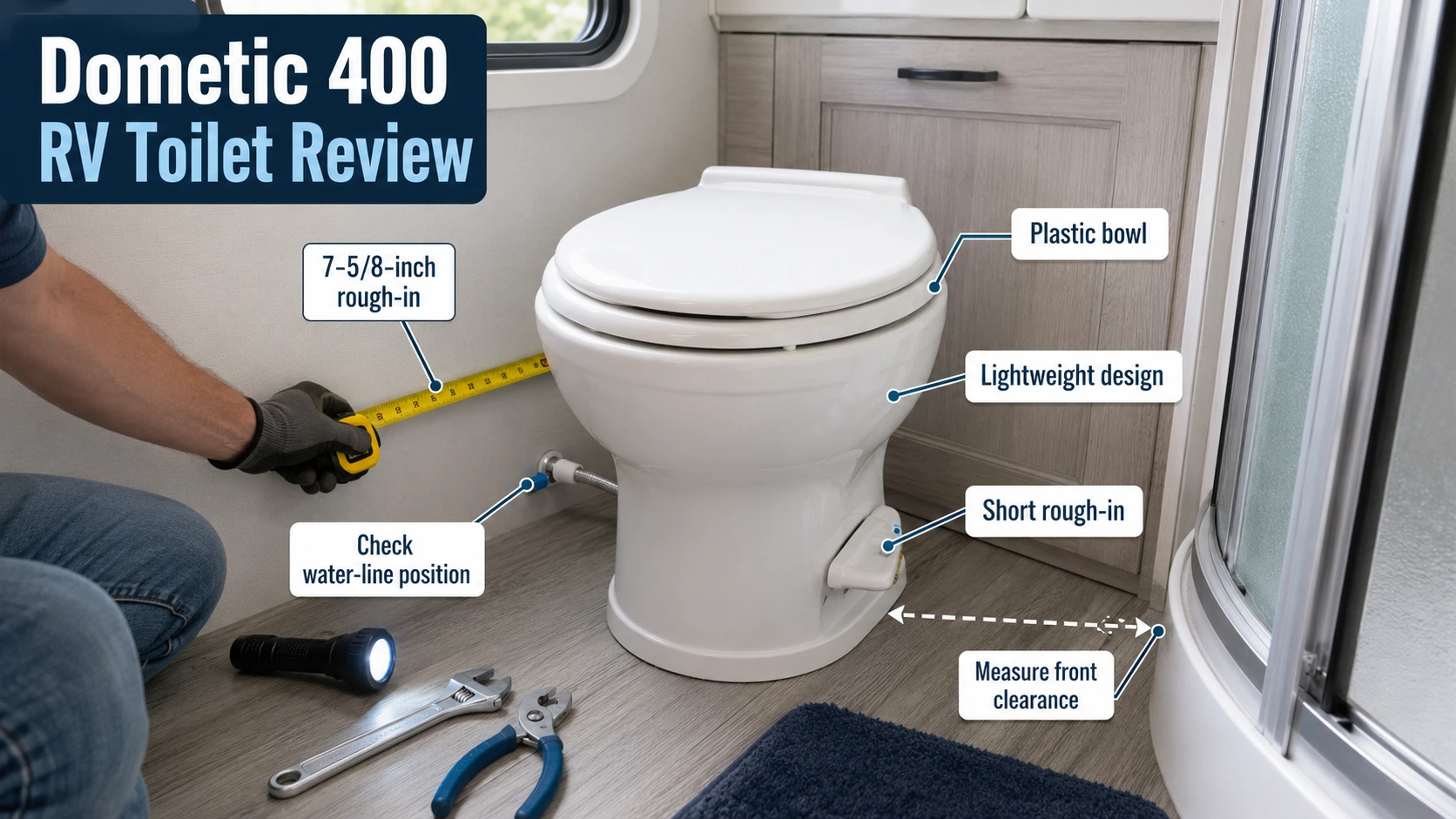
Dometic built the 400-series platform (the 400, 410, and 420) around a shared rough-in and mounting pattern, so all three models use a universal 2-bolt mount and a 7.625-inch or greater rough-in. The difference between them comes down to bowl material and finish, not the basic mounting fit. The 400 Essential is the entry point: an all-plastic bowl front-load tested to hold twice the weight of competing toilets, at roughly a third the weight of the porcelain 410.
If your priority is dropping pounds from a lightweight build, or you’re replacing a toilet in a rental or fleet RV where durability against abuse matters more than looks, the 400 is worth putting at the top of your list.
Who Should Avoid the Dometic 400?
Not everyone should buy the plastic model, and an honest review has to say so. Consider skipping the 400 if you fall into one of these groups:
- Full-time RVers who want the easiest possible cleaning. Daily use means daily contact with the bowl surface, and plastic shows wear faster than porcelain.
- Anyone who’s already dealt with plastic bowl staining on a Dometic 300 or similar toilet and didn’t enjoy it.
- Buyers who want a true porcelain feel, including the higher-end 320 or 410.
- Anyone who wants an elongated bowl. The 400 is round only; the elongated option in this platform is the 420 Platinum.
- People replacing a toilet mainly because of odor issues and wanting maximum odor resistance. Porcelain’s non-porous surface holds odor-causing residue less than plastic.
- Buyers whose budget can stretch to the 410. If the price gap is small relative to your total project cost, porcelain is usually the better long-term value.
Dometic 400 Specs and Key Features
Here’s what you’re actually buying, verified against Dometic’s own listings and Camping World’s product spec sheet.
A quick note on weight: retailers sometimes list a separate “unit” or shipping weight that includes packaging materials, which can run several pounds heavier than the toilet’s actual product weight. The 9.5 lbs figure above is the toilet itself, not the boxed shipping weight.
The seat and lid close softly instead of slamming, and the foot pedal lets you add a splash of water or trigger a full flush depending on how far you press it. Servicing is tool-free, and Dometic rates the 400 for 10,000 flush cycles with no required maintenance. The ball seal, the part that fails most often on any gravity-flush toilet, pulls out and reseats by hand from inside the bowl.
If a seal ever fails and stops holding water in the bowl, our guide to fixing a Dometic toilet that won’t hold water walks through the fix step by step.
Dometic 400 vs Dometic 410: Plastic or Porcelain?
Quick Answer: The 400 and 410 share the same rough-in, seat height, and mounting pattern. The real difference is the bowl. The 410’s porcelain bowl resists stains and scratches better and feels more like a household toilet, while the 400’s plastic bowl is roughly a third the weight and costs less, but needs more frequent cleaning to stay looking new.
Porcelain simply holds up better against daily use. Dometic’s own product page for the 410 Complete Series describes its glossy porcelain bowl as scratch and stain resistant in a way plastic isn’t. That lines up with broader reporting on RV toilet materials: plastic bowls save weight but are more prone to scratching over time than porcelain.
That’s the honest tradeoff. If easier cleaning matters more to you than saving weight or money, read our full porcelain RV toilet comparison before you decide. If you’re still weighing your full replacement options beyond just these two models, our RV toilet replacement guide breaks down the wider Dometic and Thetford lineup.
Dometic 400 vs Dometic 300: Is It a Real Upgrade?
If you’re replacing an older Dometic 300, the 400 is the natural current-generation comparison. Here’s how they stack up:
- Rough-in: The 400 uses a shorter 7-5/8-inch rough-in, which fits more bathroom layouts than some older 300-series installations.
- Seat and lid: The 400 adds a soft-close seat and lid, which the 300 lacks.
- Seal and valve design: Dometic markets the 400’s water valve and gravity seal as redesigned to reduce internal leakage and odor buildup compared to older models.
- Bowl material: Both are plastic, so you won’t gain porcelain-level stain resistance by moving from a 300 to a 400. If plastic bowl staining is what’s driving the replacement in the first place, the 410 addresses that; the 400 does not.
- Known 300-series issues: If your current 300 has a history of base leaks or seal problems, it’s worth reading our guide on Dometic toilets leaking at the base to confirm the fix is worth doing versus just replacing the toilet outright.
Bottom line: the 400 is a real, current-generation upgrade over an aging 300 in terms of fit, seals, and comfort features. It is not an upgrade in bowl material. If plastic bowl complaints are your main frustration, put the 410 on your shortlist instead.
Dometic 400 vs Dometic 401: Which Height Fits Your Bathroom?
Both share the same bowl, mount, and rough-in. The only real difference is seat height.
| Feature | Dometic 400 | Dometic 401 |
|---|---|---|
| Profile | Standard height | Low profile |
| Seat height | 18″ | 13-1/2″ |
| Overall height | 19-5/8″ | 15-1/8″ |
| Best for | Normal RV bathroom floor | Raised platform or limited vertical clearance |
| Bowl | Heavy-duty plastic, round | Heavy-duty plastic, round |
| Rough-in | 7-5/8″+ | 7-5/8″+ |
If your bathroom floor sits on a raised platform, or a cabinet, step, or shower lip limits how tall a toilet can sit, measure your available vertical clearance before assuming the standard 400 will fit. The 401 exists specifically for that situation. For more compact choices beyond the 400 and 401, see our guide to the best toilets for small RV bathrooms, including porcelain, low-profile, and cassette options.
5 Measurements to Check Before You Order
Rough-in is only the first number that matters. Before you buy, check all five of these:
Installation Notes Before You Buy
A few practical points worth confirming before your toilet ships:
- It’s a gravity-flush toilet, so it needs to sit directly over the black tank drop pipe. It won’t work if your layout requires a macerating or cassette-style toilet instead.
- No electricity is required. The flush is entirely foot-pedal and gravity powered.
- Check your existing water-line location against the new toilet’s connection height, especially if you’re changing seat height.
- Confirm whether your current toilet sits on a raised platform, which affects whether you need the standard 400 or the low-profile 401.
- Inspect your floor flange condition before ordering. A cracked or warped flange needs replacing regardless of which toilet you install.
- The universal 2-bolt mount fits most existing RV toilet floor flanges, but confirm your current mounting pattern matches before assuming a drop-in fit.
- Keep new mounting bolts and a floor flange seal on hand. Reusing old hardware on a new toilet install is a common source of leaks.
- Don’t assume rough-in alone guarantees fit. Work through the full measurement checklist above first.
Does the Dometic 400 Fit Your RV Bathroom?
The 400 Series’ compact rear profile is designed to free up bathroom floor space compared to older Dometic models. Because the 400, 401, 410, and 411 share a rough-in and mounting pattern, you can generally move between models later without changing your floor layout, though exact overall dimensions vary slightly by model, so measure your specific bathroom rather than assuming an identical footprint.
How the Dometic 400 Performs in Real Use
The foot pedal gives you control that a lot of cheaper toilets skip. A light press adds water to the bowl before you go. A full press triggers the flush and rinse. That two-stage design helps you use less water overall, which matters if you’re boondocking or running on tank water.
A few things to know going in:
- Flush performance is solid for normal use, but the plastic bowl surface may need a brush more often than porcelain to look clean.
- Water use stays low thanks to the partial-press-to-fill, full-press-to-flush pedal design.
- Surface care matters here more than on porcelain. An abrasive cleaner or brush will dull the plastic finish faster than it would harm ceramic.
- Noise and comfort benefit from the soft-close seat and lid, which is a genuine upgrade over older stock RV toilets.
- Long-term data is still limited. The 400 Series is newer than Dometic’s 300 line, so there isn’t yet the same volume of multi-year owner reports that older models have accumulated.
If you already deal with buildup or clogs in your system, our RV toilet repair guide covers the most common gravity-flush problems and how to fix them without a service call.
How to Clean the Dometic 400 Plastic Bowl Without Scratching It
Since the plastic bowl is the main tradeoff in this review, cleaning technique matters more here than it would on a porcelain toilet.
- Use a non-abrasive toilet cleaner. Dometic’s own toilet manuals instruct owners to use a non-abrasive bathroom and toilet bowl cleaner for routine cleaning.
- Scrub with a soft brush or soft cloth, not a stiff-bristle brush or scouring pad, which can scratch the plastic surface.
- Avoid abrasive powders and pumice-style cleaning tools entirely on plastic bowls.
- Skip harsh drain cleaners. They’re built for pipes, not toilet bowls, and can damage seals.
- Avoid bleach and other caustic chemicals around the seals. Dometic’s gravity toilet manuals explicitly warn that chlorine and caustic chemicals like laundry bleach damage the seals in toilets and dump valves.
- Clean under the ball seal if the bowl stops holding water between uses; a buildup of mineral deposits on the seal is a common cause.
- Don’t use stiff metal tools near the flush ball or seal area. If a seal ever needs replacing, our RV toilet seal replacement guide walks through the process without special tools.
Dometic 400 Pros and Cons
Pros
- Shares the 400-series platform’s short 7-5/8-inch rough-in, so it fits where older toilets can’t
- About a third the weight of the porcelain 410, which matters for weight-sensitive builds
- Tool-free ball seal replacement
- Soft-close seat and lid, quiet flush operation
- Rated for 10,000 flush cycles with no required maintenance
- Lower price point than porcelain options in the same lineup
Cons
- Plastic bowl stains and scratches more easily than porcelain
- Needs more frequent, more careful cleaning to stay looking new
- Less residential feel than the 410 or 420
- Round bowl only; no elongated option in this model
- Limited long-term owner data since it’s newer than Dometic’s 300 line
Conclusion
The Dometic 400 Essential does exactly what its name suggests: it covers the essentials. You get the same short rough-in and universal mount as Dometic’s newer porcelain models, at a lower price and about a third the weight, with a plastic bowl that asks for more upkeep in return. For budget builds, weight-conscious rigs, and rental or fleet use, that’s a fair trade. It’s a genuine step up from an aging Dometic 300 in fit and comfort features, though not in bowl material.
If a spotless bowl matters more to you than saving a few pounds, step up to the Dometic 410 review before you buy. Otherwise, check current pricing and availability on the Dometic 400 Essential RV Toilet and measure your bathroom before it ships.
Frequently Asked Questions
Is the Dometic 400 better than the Dometic 410?
Neither is universally better. The 400 is lighter and cheaper with a plastic bowl, while the 410 costs more but has a porcelain bowl that resists stains and scratches better. Choose based on whether weight and price or long-term cleaning ease matters more to you.
What is the rough-in requirement for the Dometic 400?
The Dometic 400 needs a rough-in of 7-5/8 inches or greater, the same requirement as the 410 and 420 in Dometic’s 400-series platform. Always confirm this measurement from the wall to the center of your mounting bolts before ordering.
Does the Dometic 400 come in a low-profile version?
Yes. The Dometic 401 Essential uses the same bowl, mount, and rough-in as the 400 but has a 13-1/2 inch seat height for RV bathrooms with limited vertical clearance, such as raised platforms.
Is the Dometic 400 plastic or porcelain?
Plastic. Dometic builds it from heavy-duty plastic rated to handle twice the load of competing toilets. If you want a porcelain bowl on the same rough-in platform, look at the 410 instead.
Does the Dometic 400 need electricity?
No. It’s a gravity-flush, foot-pedal toilet with no electrical connection required.
Will the Dometic 400 replace a Dometic 300?
In many RVs, yes, since the 400 uses a shorter rough-in than most 300-series installations require. Always measure rough-in, front clearance, side clearance, and water-line position first, since exact fit varies by RV.
Can I use regular toilet cleaner on the Dometic 400?
Use a non-abrasive cleaner and avoid bleach or other caustic chemicals, which Dometic’s own toilet manuals warn can damage the seals. A soft brush or cloth protects the plastic bowl’s finish better than a stiff brush.
How long does a Dometic 400 last, and what’s the warranty?
The Dometic 400 carries a standard 2-year limited warranty and is rated for 10,000 flush cycles with no required maintenance. How long the bowl looks good depends heavily on cleaning habits, since plastic shows staining and wear faster than porcelain.