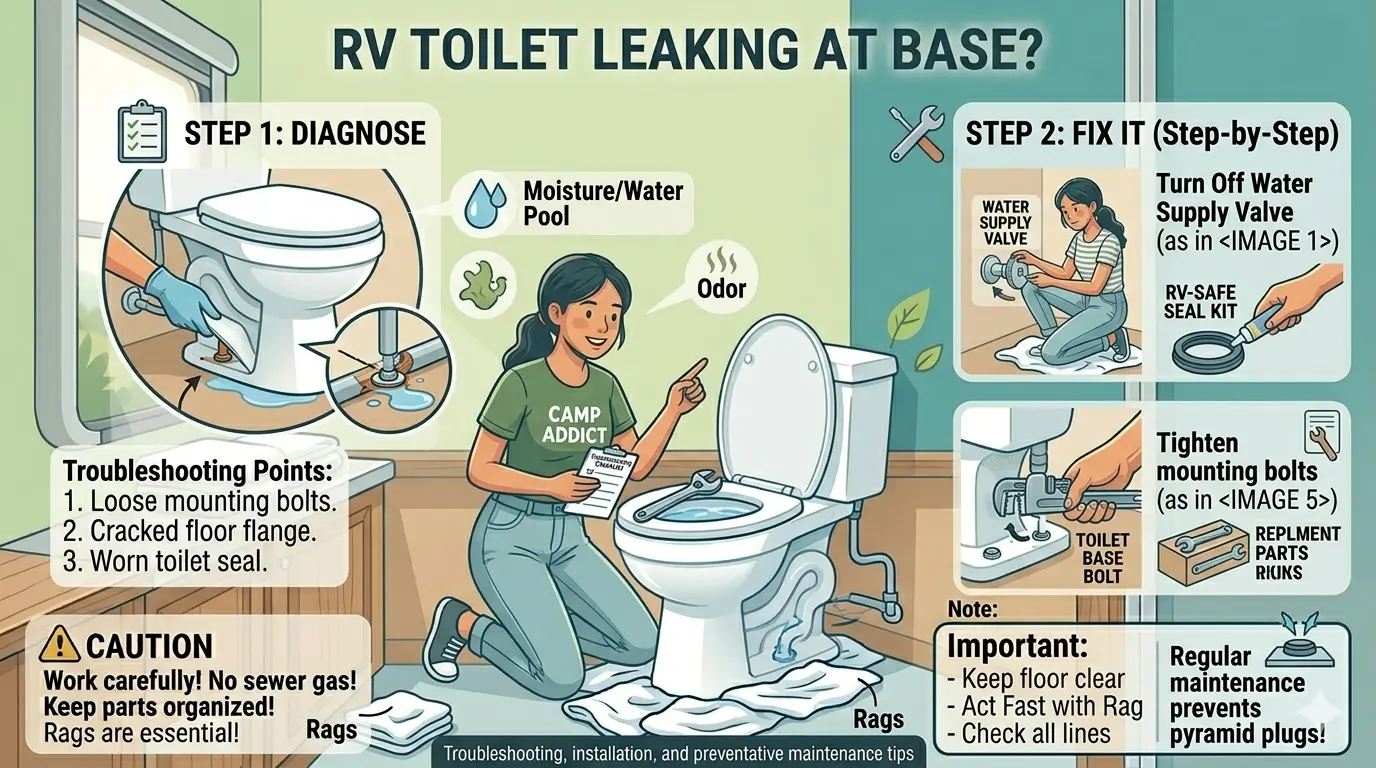
Water around your RV toilet base is one of those problems that looks worse than it usually is. The good news? This is a relatively simple and inexpensive repair — most RV owners can fix it themselves in an afternoon. The bad news? RV toilets have several seals and connections, and different leaks can look identical at first glance — so if you skip the diagnosis step and go straight to replacing the flange seal, there’s a good chance you’ll pull the whole toilet out for nothing.
This guide walks you through finding the real source of the leak first, then fixing it correctly the first time. We’ve also included brand-specific tips for Dometic and Thetford owners, a troubleshooting flowchart, common mistakes to avoid, and 2026-updated part costs.
⚠️ Quick note before we start: RV toilets and residential toilets are built very differently. Household parts like wax rings and standard plumbing fittings usually don’t apply here. Keep that in mind before you head to a regular hardware store for parts.
🔀 Troubleshooting Flowchart — Find Your Leak in 2 Minutes
Use this table before touching anything. The symptom column tells you exactly which section to jump to.
| Symptom | Most Likely Cause |
|---|---|
| Leak only after flushing, directly under base | Worn flange seal |
| Water around base after every trip or drive | Loose mounting bolts |
| Water constant — flush or no flush | Supply line drip or condensation |
| Water appears at back or side of toilet | Supply line connection drip |
| Bowl loses water level between uses | Leak only after flushing, directly under the base |
| Leak only when flush pedal is pressed | Flush valve (Dometic-specific) |
| Damp base but can’t replicate with flush | Condensation or slow park leak |
Step 1: Don’t Touch Anything Yet — Confirm the Leak Source
This is the step most guides skip, and it’s the most important one. Water can run, drip, or collect in ways that make a leak appear to come from the wrong place. What looks like an RV toilet base leak is often a supply line drip running down the back of the toilet and pooling on the floor. Fix the wrong thing and you’ll be right back here next weekend.
The Dry Test
Dry everything around the toilet completely — floor, base, back of toilet, supply line connection. Flush once and watch for 60 seconds. Where does moisture appear first?
- Moisture at back or side → Supply line drip, not a base seal issue
- Moisture directly under base, after flush only → Flange seal or loose bolts
- Moisture constant, not triggered by flush → Condensation or slow supply line leak
- Moisture appears after driving → Loose mounting bolts — very common in RVs
The Bowl Test
Flush the toilet and wait 5 minutes. If the bowl water level drops without flushing, the ball seal is failing — and this repair does not require removing the toilet from the floor. Many owners mistake a failing ball seal for an RV toilet seal leaking at the base because the water eventually migrates downward.
The 3 Most Common “False Base Leaks”
Before assuming the flange seal needs replacing, rule these out:
1. Supply Line Drip
A slow drip from the supply line can run down the back of the toilet and pool at the base — looking exactly like a water-around-RV-toilet-base problem. Look closely at the connection where the line meets the toilet. Tighten the fitting slightly. If that stops it, no further repair is needed.
2. Condensation
High humidity inside the RV — especially in summer — can cause condensation to form on the tank and drip to the floor. If the area is consistently damp but you can’t replicate it by flushing, humidity is the likely cause, not a seal failure.
3. Ball Seal / Bowl Seal Failure
Water slowly leaks from the bowl into the black tank, then runs down the outside and collects at the base. This ball valve gasket creates a watertight seal on the flush valve — when it fails, water escapes and migrates downward. Since this fix doesn’t require removing the toilet, always check it before pulling bolts.
The 4 Real Causes of an RV Toilet Base Leak
Cause 1: Worn or Dried-Out Flange Seal
This is the most common culprit for a true RV toilet base gasket replacement situation. The flange seal sits between the toilet base and the floor — you know this is the source when the toilet only leaks after flushing. This is the classic RV toilet leak after flush pattern. Over time, rubber dries out, cracks, or compresses unevenly.
- Cost (2026): Thetford flange seal $7.99–$15.99 | Dometic/universal flange kit $12–$25
- Fix: Replace the flange seal — toilet must be lifted off the floor
Cause 2: Loose Mounting Bolts (Road Vibration)
This is unique to RVs and often missed by guides written for residential plumbing. RV toilet tee bolts loosen when the rig gets rocked during travel — loose bolts let the toilet shift slightly, breaking the flange seal, causing water to seep at the base each flush.
- How to confirm: Rock the toilet gently by hand — any movement means bolts need tightening
- Cost: Free — just snug the bolts with a wrench
⚠️ Don’t overtighten. Too much pressure cracks the toilet base — converting a free fix into a $150–$400 replacement job.
Cause 3: Cracked Toilet Base (Plastic Models)
Many RVs have plastic bowls which crack due to improper winterization or freeze damage. Hairline cracks are nearly invisible. Wrap a dry towel tightly around the base and let it sit — if water seeps through at specific points, you have a hairline fracture.
- Cost (2026): Replacement toilet $150–$400 depending on model
- Fix: Temporary sealant may buy time — but full replacement is the only permanent solution
Cause 4: Flush Valve / Pedestal Leak (Dometic-Specific)
Some Dometic 300 series toilets appear to have an RV toilet flange leak, but the real culprit is the flush valve, which only leaks when the pedal is depressed. Placing a paper towel around both the base AND the flush valve area isolates the actual source. This misdiagnosis is extremely common.
- Cost (2026): Dometic water valve replacement kit $29–$45
How to Fix RV Toilet Leaking at Base (Step-by-Step)
What You’ll Need
- Adjustable wrench
- Rubber gloves
- Old towels and a plastic garbage bag
- Small bucket
- RV-specific flange seal matched to your toilet model
- Teflon tape
- Flashlight
- RV-safe silicone sealant (optional but recommended)
⚠️ Important: RV toilets don’t use standard plumbing parts. Purchase a seal that matches your toilet model specifically. Amazon, Camping World, and United RV Parts stock model-specific kits.
Shut Off the Water
If hooked up at a campground, disconnect from the water supply. Turn off the water pump if boondocking. Flush once after shutting off to relieve pressure and drain residual water from the bowl and line.
Prepare the Area
Lay old towels around the base. Put on gloves. Place a bucket nearby. You’re working near the black tank connection — prep makes this a far less unpleasant job.
Disconnect the Water Supply Line
Unscrew the water supply line from the back of the toilet. Have a towel ready to catch residual water. Inspect the line for cracks or wear while it’s in your hand.
Remove the Mounting Bolts
Two tee bolts hold the toilet to the floor — usually under plastic caps. Pop the caps off and unscrew the nuts with your wrench. Keep the nuts somewhere safe.
Lift and Remove the Toilet
Gently rock the toilet side to side to break the old seal’s grip, then lift it straight up. Set it on a garbage bag or towels. Immediately stuff a rag into the drain opening to block black tank odors.
Inspect the Flange and Old Seal
Look at the flange on the floor for warping or cracks. Now check the old seal — is it flattened, cracked, or brittle? Even if it looks okay visually, replacing it while you’re here is the right call. Rubber seals don’t recover once they’ve compressed.
Install the New Flange Seal
Clean the floor area and the bottom of the toilet base thoroughly. Let dry completely. Set the new gasket in place. A thin bead of RV-specific silicone caulk along the base perimeter after reinstalling adds extra protection.
Reinstall the Toilet
Remove the rag from the drain opening. Lower the toilet carefully back onto the flange, lining up the bolt holes. Sit on it briefly to set the seal, then hand-tighten the bolts first, then snug with the wrench. Reconnect the supply line with fresh Teflon tape on the threads.
⚠️ Do NOT over-tighten — the most common mistake that cracks toilet bases.
Test
Turn the water back on and flush several times. Watch carefully for a full minute each flush. Check again after 30 minutes. If dry — you’re done.
⛔ Common Mistakes to Avoid
These mistakes are responsible for most failed RV toilet seal leaking repairs:
- Skipping the diagnosis step. Most base leaks aren’t actually base seal failures. A 5-minute dry test saves hours of unnecessary work.
- Overtightening the mounting bolts. Snug is the goal. Gorilla-tight cracks a plastic base — converting a $15 fix into a $200 replacement.
- Using residential wax rings. They don’t work on RV toilet flanges. Always buy RV-specific seals.
- Not replacing the seal while the toilet is already off. If you’re lifting the toilet anyway, put in a fresh seal. It’s a $10–$25 insurance policy.
- Ignoring floor condition. A long-running water-around-RV-toilet-base problem silently rots the subfloor. Press the surrounding floor while the toilet is lifted — soft spots mean professional intervention is needed.
- Ordering the wrong brand’s parts. Dometic and Thetford seals are not interchangeable. Know your model number before ordering.
Brand-Specific Repair Tips
Dometic 300 / 310 / 320 Series
The Dometic 300 series is the most common RV toilet in North America, and it has quirks that residential plumbing guides never cover.
Bowl-to-pedestal leak (Dometic 320): A leak between the ceramic bowl and plastic pedestal is caused by rusty steel bolts or failed plastic grommet nuts. The pedestal fills with toilet water which rots the floor while seeping over the top. These parts aren’t available from Dometic directly — but stainless steel bolts and nylon grommet nuts on eBay solve it for about $10, no toilet replacement needed.
Flush valve misdiagnosis: Many Dometic 300 RV toilet flange leak cases are actually flush valve leaks. Paper towel testing around both areas isolates the real source.
Warranty tip: Call Dometic at 800-544-4881 before spending money — warranty replacement is often possible.
👤 Real example: A Keystone Bullet owner noticed a distinct sewage odor from a Dometic 300 after ~200 nights of use. After disassembly, the cause was two small internal seal rings that weren’t preventing vacuum pressure between the inner and outer bowl — not a base seal issue at all. The fix was clear silicone caulk on both seal rings. The repair has held ever since. — via johnmarucci.com
Dometic 300 Series — Recommended Parts (2026 Prices)
| Part | Part Number | 2026 Price | Buy |
|---|---|---|---|
| Water Valve Kit (300/310/320/400/410/420) | Dometic 385311641 | ~$29–$45 | Amazon |
| Flange Seal + Socket Kit | 385345892 | ~$12–$22 | Camping World |
| Flush Ball Valve | Model-specific | ~$30–$50 | eTrailer.com |
📺 YouTube: Dometic 300 Toilet Repair — Valve Replacement (step-by-step visual)
📖 Full repair guide: johnmarucci.com — Dometic 300 RV Toilet Repair Process
🔗 Official support: dometic.com/us/service-and-support
Thetford Aqua Magic V & Style Plus
Free parts program: Thetford has been known to ship replacement parts at no cost when you contact them with your model number. Many owners report getting parts within days — worth a call before purchasing anything.
Water module leak: On Aqua Magic models, the water valve/module is a frequent RV toilet seal leaking source especially when moisture appears above the black seal at the back of the toilet. In many cases the toilet doesn’t need to be removed. The Thetford 31705 Water Module Replacement Package handles this repair.
👤 Real example: A Grand Design RV owner was convinced they had a Dometic 300 and ordered the wrong seal. After forum advice, they discovered it was a Thetford — required full toilet removal to access the seal, but two flange bolts and a water connection made it under 30 minutes total. — via gdrvowners.com
Thetford — Recommended Parts (2026 Prices)
| Part | Part Number | 2026 Price | Buy |
|---|---|---|---|
| Flange Seal | Thetford standard | $7.99 | Spanky’s RV Online |
| Waste Ball Seal — Aqua Magic | 42141 | $24.99 | United RV Parts |
| Water Module Kit — Style Lite/Plus | 31705 | ~$49–$55 | Amazon |
| Aqua Magic IV Closet Bolt Package | Thetford standard | $15.99 | Spanky’s RV Online |
📺 YouTube: EASY RV Toilet Seal Replacement — Thetford Aqua Magic
📺 Ball valve gasket guide: Unique Camping + Marine — RV Toilet Gasket Fix
🔗 Official support: thetford.com/support
🔧 When to Call a Professional
Most RV toilet base leaks are genuine DIY jobs. But these situations require a professional RV technician:
- The floor flange itself is cracked, warped, or separated from the drain pipe. Flange repair requires cutting access to the underside of the floor — not a weekend project.
- Soft or spongy spots in the floor around the toilet. This indicates subfloor rot from a long-running leak. Structural repair is needed before reinstalling the toilet.
- The leak returns within weeks of a fresh seal replacement. Repeated RV toilet base gasket replacement failures usually signal a flange or drain pipe issue deeper in the system.
- Black tank odor is constant — not just after flushing. This suggests the flange seal has completely failed and black tank gas is escaping into the RV — a health and safety issue.
💡 Cost perspective: RV repair shops typically charge $75–$150/hour for labor. A flange repair requiring subfloor access can run $300–$800 or more. Catching a water-around-RV-toilet-base problem early — before subfloor damage — saves a lot of money.
🌿 RV Park Rules & Black Tank Contamination
A leaking RV toilet base isn’t just a plumbing issue — it has real consequences at campgrounds:
- Most RV parks prohibit any sewage or gray water discharge outside of designated dump stations. A flange seal failure that allows black tank seepage onto the ground can result in immediate ejection from the park — and potentially a fine.
- Even a slow RV toilet flange leak that doesn’t reach the ground can saturate your subfloor with black tank effluent over time, creating a serious sanitation problem that’s expensive to remediate.
- If your RV toilet has been leaking for an extended period, press firmly on the floor around the toilet before assuming a new seal is all you need. Soft or spongy material means professional assessment is required.
How to Prevent RV Toilet Base Leaks
- Check base seal condition every 3–6 months. Look for flattening, cracking, or dry/brittle texture. Apply Thetford Aqua Magic toilet seal lubricant or Camco RV toilet seal treatment to keep rubber supple.
- Tighten mounting bolts before every trip. 30 seconds of prevention vs. a repeat repair.
- Winterize properly every season. Completely drain the toilet bowl and water supply line. Use RV antifreeze in the bowl and tank. A frozen water valve is a common source of RV toilet leak after flush problems the following spring.
- Use only RV-safe toilet cleaners. Highly acidic or alkaline residential cleaners accelerate rubber seal degradation.
- Keep a spare seal on hand. A flange seal costs $8–$25 and weighs almost nothing. Having one in your parts kit turns a mid-trip leak into a two-hour fix instead of a ruined week.
Repair vs. Replace — 2026 Cost Reference
| Situation | Decision | 2026 Estimated Cost |
|---|---|---|
| Worn flange seal only | ✅ Repair | $8–$25 parts |
| Loose mounting bolts | ✅ Repair — free | $0 |
| Supply line drip | ✅ Repair | $10–$20 parts |
| Dometic 300 flush valve failure | ✅ Repair | $29–$45 parts |
| Dometic 320 pedestal bolt failure | ✅ DIY bolt replacement | ~$10 |
| Cracked plastic toilet base | ❌ Replace toilet | $150–$400 |
| Leak returns after 2+ seal replacements | ❌ Replace toilet | $150–$400 |
| Subfloor rot detected | ⚠️ Call a professional | $300–$800+ |
| Dometic 300 within warranty | 📞 Call Dometic first — 800-544-4881 | Potentially free |
📚 Related Guides
🔗 How to Repair an RV Toilet — Complete guide covering all common RV toilet problems beyond base leaks: ball seal failure, water valve replacement, bowl cracks, and more.
🔗 RV Composting Toilet Pros and Cons — If your toilet is beyond repair, this guide covers the top Dometic and Thetford models, prices, and installation considerations.
Frequently Asked Questions
Can a base leak mean black tank contamination?
Only in severe cases where the flange seal has completely failed, and the problem has been ignored for weeks. A freshwater-around-RV-toilet-base problem is almost always clean water from the supply side — not the black tank. However, if you detect a sewage smell alongside the leak, treat it as a black tank breach and inspect it immediately.
Do RV toilets use wax rings like house toilets?
No — RV toilets and residential toilets are built completely differently. Household wax rings and standard fittings don’t apply. Always buy an RV-specific flange seal matched to your exact toilet model number.
How long does RV toilet base gasket replacement take?
Most RV owners complete this repair in 1–2 hours. If the flange itself is damaged, add another hour or more. If subfloor rot is discovered, professional repair adds significant time and cost.
Can I use regular silicone caulk to seal the base?
RV-specific or bathroom-rated silicone can supplement a proper gasket installation, but it should never replace it. Caulk alone will not hold under repeated flushing pressure and will eventually fail.
What’s the most common RV toilet leak after flushing?
A worn or dried-out flange seal is the most common cause. The rubber compresses over time and no longer creates a watertight connection at the base. This is a $10–$25 parts fix that most owners can complete in an afternoon.
My Thetford is leaking, but I can’t find the model number — what do I do?
Check the rear of the toilet for a label. If none is visible, Thetford’s customer service line can often identify your model based on your RV’s year and make. Their support team is also known to ship replacement parts at no charge in many cases.

Hi, I’m Daniel Brooks. I research and write about RV toilet repair, black tank maintenance, and sanitation troubleshooting. I create practical guides that help RV owners fix problems quickly and prevent costly damage.
3 thoughts on “RV Toilet Leaking at Base?How to Diagnose and Fix It (Step-by-Step)”