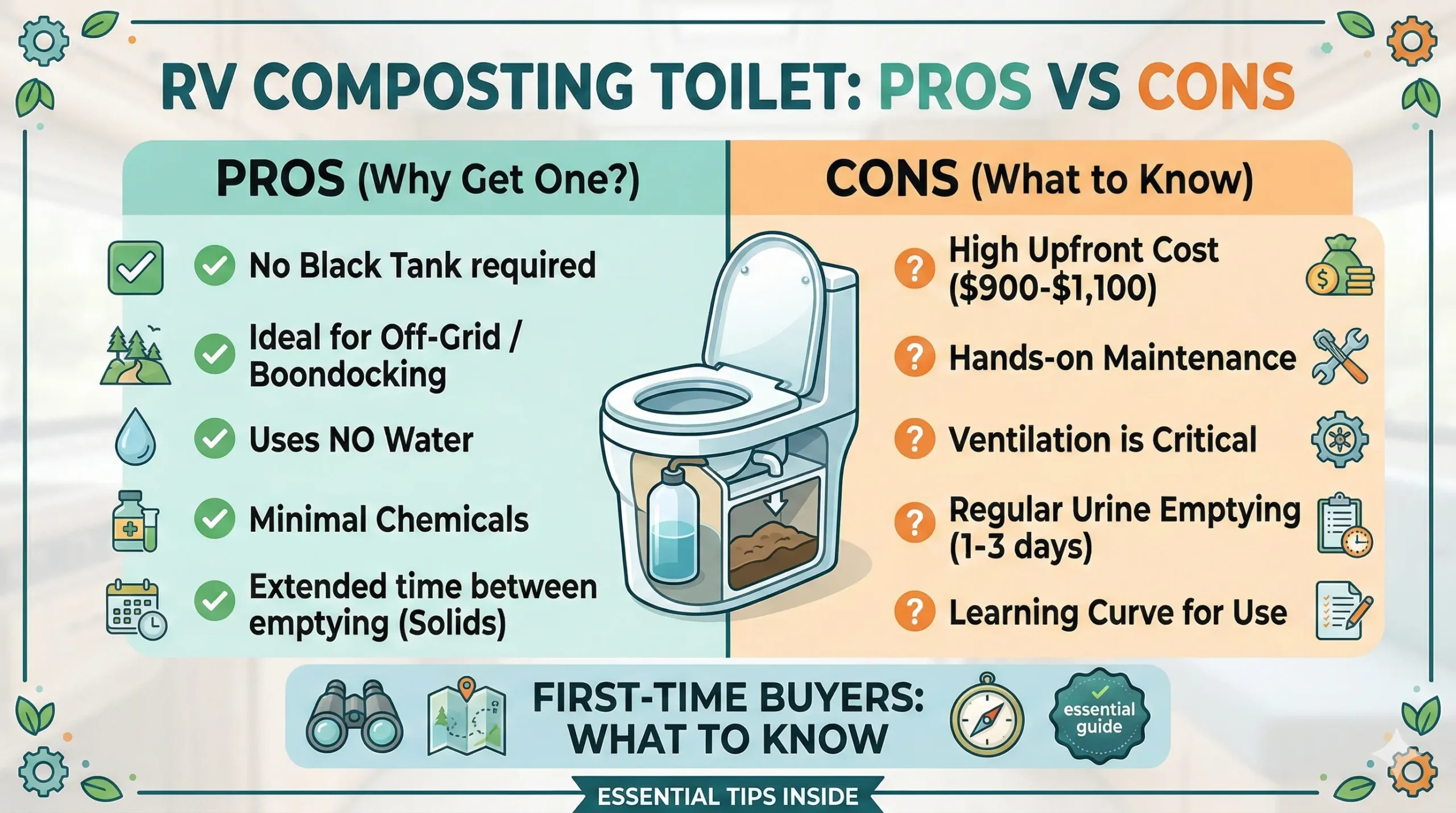
If you’re considering an RV composting toilet, you’re probably asking one question:
Is this actually better — or just different?
The truth is, composting toilets can be a smart move for some RVers. For others, they add complexity without much benefit.
Let’s break it down clearly.
We’ll cover:
- How they work
- The real pros
- The real cons
- Cost comparisons
- Maintenance reality
- Odor myths
- Legal dumping rules in the U.S.
- Environmental impact
No hype. No scare tactics. Just what you need to know before deciding.
How an RV Composting Toilet Works (Quick Overview)
Before weighing the pros and cons, you need to understand the basics.
The Separation System (Liquids vs Solids)
Most RV composting toilets use a urine-diverting design, which separates liquid waste from solid waste. This separation reduces odor and slows bacterial growth, according to the U.S. Environmental Protection Agency (EPA).
Liquids go into a removable bottle. Solids drop into a separate container mixed with a carbon material like coconut coir or peat moss.
The Role of Ventilation
Composting toilets use a small 12V fan that runs continuously to move air outside the RV. Proper ventilation is critical for odor control, and the EPA notes that ventilation is a key component of odor reduction in composting systems (EPA Composting Toilet Guidance).
No fan. No airflow. You’ll notice.
What “Composting” Actually Means in an RV
Here’s the catch: RV composting toilets don’t create fully finished compost like a backyard compost pile.
According to the National Park Service, true composting requires specific temperature, time, and microbial conditions. Most RV units primarily dehydrate and partially break down waste rather than producing garden-ready compost.
That distinction matters.
The Pros of RV Composting Toilets
1. No Black Tank Required
Traditional RV toilets rely on a black water tank that must be emptied at a dump station.
With a composting toilet, there is no black tank. That means:
- No black tank flushing
- No tank sensors failing
- No sewer hose setup
For many RVers, removing black tank maintenance is a major advantage.
2. Ideal for Boondocking and Off-Grid Camping
If you camp without hookups, composting toilets extend your independence.
Traditional systems require dump stations. According to the RV Industry Association (RVIA), millions of RV trips happen annually in the U.S., and many include off-grid travel where dump access is limited.
Composting toilets reduce that dependency because:
- Liquids are emptied separately
- Solids can last weeks for solo travelers
For extended boondocking, that flexibility matters.
3. Water Savings
Standard RV toilets use water per flush. While amounts vary, RV gravity toilets typically use between 0.3 to 0.5 gallons per flush, according to product specifications from major RV toilet manufacturers like Dometic (Dometic 300 Series Specifications).
Composting toilets use no water for flushing.
If your RV fresh tank holds 40 gallons, cutting flush water can noticeably extend your off-grid stay.
4. Reduced Chemical Use
Traditional black tanks often rely on chemical treatments to control odor and break down waste. The EPA notes that chemical additives are commonly used in holding tank systems to manage odor and bacteria (EPA Wastewater Overview).
Composting toilets typically rely on:
- Airflow
- Carbon material
- Waste separation
That means fewer chemicals stored inside your RV.
The Cons of RV Composting Toilets
Now let’s talk about what surprises people.
1. Upfront Cost Compared to Traditional RV Toilets
This is usually the first shock.
- A basic RV gravity toilet can cost between $150–$300, based on pricing from major retailers like Camping World and manufacturer listings.
- Popular composting models like Nature’s Head and Air Head typically range from $900–$1,100, according to manufacturer pricing pages (Nature’s Head Pricing).
That’s a significant price gap.
Installation may also require:
- Vent hole drilling
- Electrical connection for the fan
If budget is tight, this is a real factor.
2. Maintenance Reality: What Owners Don’t Always Expect
Here’s what the brochures don’t emphasize.
You handle waste more directly.
Liquids may need emptying every 1–3 days for two people. Solids may last 2–4 weeks depending on usage, based on manufacturer guidance from Nature’s Head and Air Head.
Emptying solids involves removing the container and disposing of contents properly.
It’s not difficult. But it is hands-on.
For families, emptying frequency increases significantly.
3. Odor Control: Myth vs Reality
“Do composting toilets smell?”
When installed and used properly — typically no.
The EPA confirms that properly ventilated composting systems are designed to minimize odor through airflow and aerobic breakdown (EPA Composting Systems Overview).
Odor usually happens when:
- The fan fails
- Liquids and solids aren’t separated correctly
- The carbon material isn’t maintained
So the system works — but only if you maintain it.
4. Legal Dumping Considerations in the U.S.
This is where confusion happens.
Urine disposal: In most states, urine must be disposed of in a toilet or approved dump facility. Regulations vary by jurisdiction, and dumping on the ground is often prohibited, especially in public lands managed by the Bureau of Land Management (BLM) and National Park Service (BLM Waste Disposal Guidelines).
Solid waste disposal: Even partially composted material is still considered human waste in many areas. The Leave No Trace Center for Outdoor Ethics states that human waste must be disposed of in catholes, pack-out systems, or designated facilities depending on land regulations (Leave No Trace Human Waste Guidance).
You cannot assume composted waste is automatically legal to discard anywhere.
Check local rules every time.
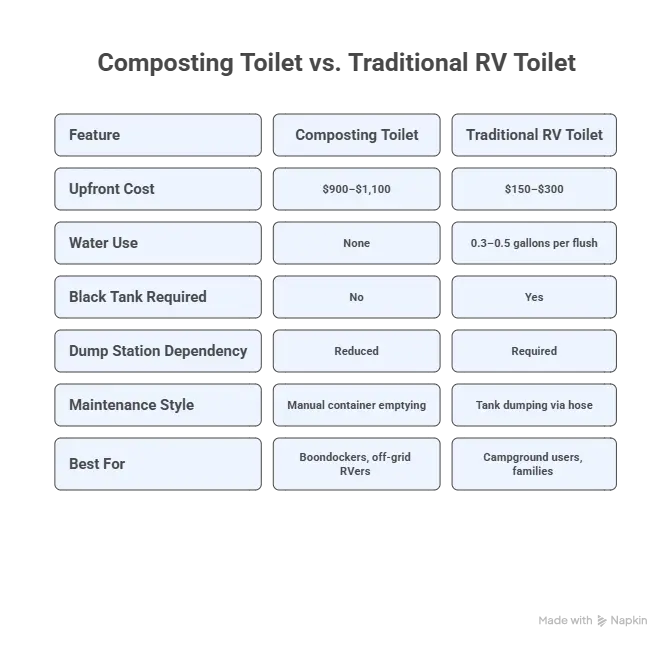
Composting Toilet vs Traditional RV Toilet: Side-by-Side Comparison
Environmental Impact: Is One Option Actually Greener?
It depends.
Traditional RV waste enters municipal wastewater systems when dumped at approved stations. The EPA regulates wastewater treatment under the Clean Water Act to reduce environmental contamination (EPA Wastewater Treatment Overview).
Composting toilets:
- Reduce water use
- Avoid chemical tank treatments
- Minimize black water storage
However, because most RV composting toilets don’t reach full thermophilic composting temperatures, waste still requires responsible disposal.
So while composting toilets can reduce water and chemical usage, environmental benefit depends on how waste is ultimately handled.
The system alone doesn’t guarantee lower impact.
Who Should Consider a Composting Toilet?
Good fit:
- Full-time boondockers
- Solo travelers
- RVers avoiding black tank maintenance
- Small rigs without large holding capacity
Less ideal:
- Large families
- Campground-only travelers with full hookups
- RVers uncomfortable with manual waste handling
There’s no universal answer.
It’s about how you camp.
Final Verdict: Is a Composting Toilet Worth It?
If you want:
- More off-grid flexibility
- Zero black tank
- Lower water usage
It might be a smart move.
If you prefer:
- Lower upfront cost
- Simpler waste handling
- Hookup-based camping
A traditional system may make more sense.
This isn’t about which system is better.
It’s about which one fits your RV lifestyle.
FAQ
1. How often do you have to empty an RV composting toilet?
For two people, liquid containers often need emptying every 1–3 days, while solids may last 2–4 weeks depending on usage, based on manufacturer guidance from Nature’s Head and Air Head. Frequency increases with more users.
2. Do RV composting toilets smell?
When properly ventilated, they are designed to minimize odor through continuous airflow, according to the EPA’s composting toilet guidance (https://www.epa.gov/sanitationtools/composting-toilets). Odor typically results from ventilation issues or improper waste separation.
3. Can you legally dump composting toilet waste anywhere?
No. Disposal rules vary by state and land agency. The Bureau of Land Management and National Park Service require proper waste disposal in designated facilities in many areas (https://www.blm.gov/programs/recreation/camping). Always verify local regulations.
4. Are composting toilets better for boondocking?
They can extend off-grid time because they eliminate black tank dependence and reduce water use. That makes them attractive for extended dry camping situations.
5. How much does it cost to install a composting toilet in an RV?
Units typically cost between $900 and $1,100 based on manufacturer pricing (https://natureshead.net). Installation may require venting and wiring adjustments, which could increase total cost depending on your RV setup.

Hi, I’m Daniel Brooks. I research and write about RV toilet repair, black tank maintenance, and sanitation troubleshooting. I create practical guides that help RV owners fix problems quickly and prevent costly damage.
1 thought on “RV Composting Toilet Pros and Cons: What First-Time Buyers Should Know”