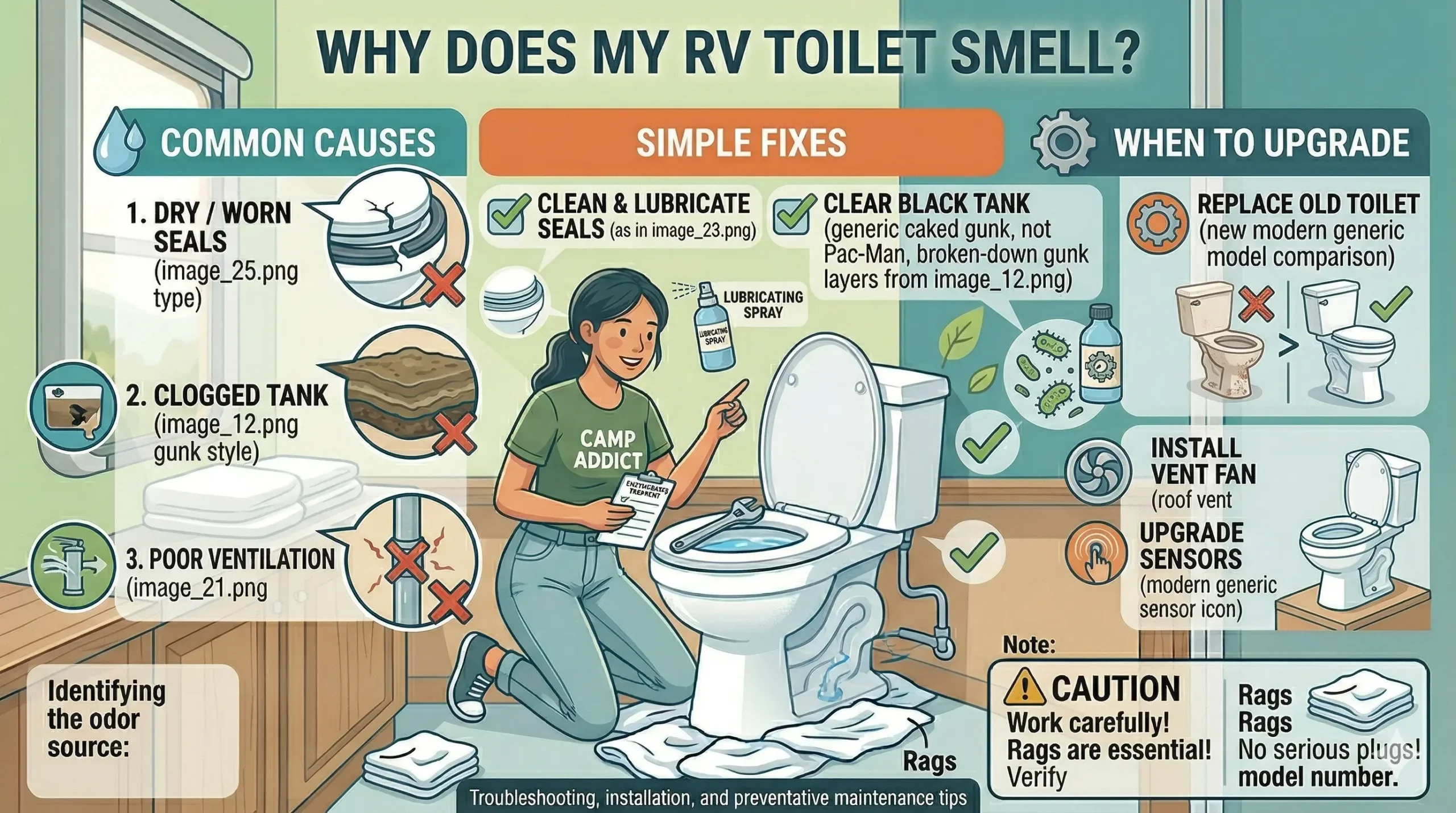
You’re parked at a beautiful campsite, the windows are open, and then it hits you — that unmistakable sewer gas creeping through your RV bathroom. Every RV owner runs into this at some point. The frustrating part? The smell usually has nothing to do with how clean you keep things.
RV toilet systems are fundamentally different from what you have at home. Instead of a water-sealed trap and municipal sewer line, you’re working with a holding tank, a vent pipe, a rubber seal, and a valve that all have to work together. When any one of them fails — even slightly — the smell finds its way in.
The good news: most of these issues are fixable. Some take ten seconds, some take an afternoon. This guide walks you through every common cause, the right fix for each one, and how to decide whether it’s time to repair or replace your toilet altogether.
First: Understanding How Your RV Toilet System Actually Works
Before you can fix a smell, you need to understand what you’re dealing with. Your RV bathroom isn’t plumbed like a house — and the differences matter when something goes wrong.
A standard home toilet connects to a municipal sewer line via a water-filled trap that permanently blocks sewer gas. Your RV toilet connects to a black water holding tank that sits below the floor and stores waste until you dump it. According to Good Sam RV ProCare, the system depends on three components working together: the black tank stores waste, a vent pipe channels gases out through the roof, and a toilet seal creates a water barrier to keep odors contained. When any of these three fail, the odor gets in.
The other critical difference: your RV toilet uses a foot-pedal flush mechanism with a rubber ball valve and seal at the bottom of the bowl. That seal holds a small amount of water — and that water is your primary odor barrier between your living space and the tank below. RVshare explains that if that seal dries out or cracks, tank gases rise directly through the toilet bowl and the problem usually gets worse every time you flush.
Heat makes everything worse. RV Toilet Experts notes that the anaerobic breakdown of waste inside your black tank produces hydrogen sulfide (the rotten egg smell), ammonia, and methane — and warm temperatures significantly accelerate this bacterial activity, which is why summer camping tends to produce more odor complaints than cool-weather trips.
6 Reasons Your RV Toilet Smells — and How to Fix Each One
Don’t skip straight to buying products. Track down the source first. Here are the six most common causes, starting with the most likely culprits.
1 A Blocked Roof Vent Pipe
Your RV has two vent pipes on the roof — one for the gray tank, one for the black tank. The black tank vent lets sewer gases escape outside and creates airflow so gases pull up and out rather than backing into the RV. When it’s clear and working, you shouldn’t smell much of anything.
When it’s blocked — by leaves, bird nests, mud daubers, or insects — those gases have nowhere to go except back through the toilet. DoItYourselfRV explains that a blocked vent pipe forces gas back up through the RV toilet rather than out through the rooftop vent. Bubbling sounds when you flush are a strong indicator of a blocked vent. The RV Geeks also note that bees and other insects building nests inside vent pipes is far more common than most owners expect.
The fix: Get on the roof safely and run a garden hose down the vent pipe. Turn the water on and let it run. Camp Addict notes that if water drains freely, the stream likely cleared the blockage. If water backs up out of the pipe, push through the clog with more water pressure or a plumbing snake. Consider upgrading to a rotating 360 Siphon-style vent cap — these use ambient wind to actively pull gases out rather than relying on passive escape.
2 A Worn or Dry Toilet Seal
This is the single most common cause of persistent RV toilet odor. The rubber seal at the bottom of your toilet bowl holds a small amount of water that acts as a physical barrier between you and the black tank. When that seal dries out, shrinks, or cracks, the water drains away and the barrier disappears.
Kleen Tank points out that a toilet bowl that won’t hold water is almost certainly the result of a failing seal that is also letting black tank smells into the RV. The test is simple: flush your toilet, then wait 15 minutes. If the bowl is dry when you come back, your seal is failing.
Quick fix: Coat the seal with Vaseline or Plumber’s Grease using rubber gloves. This can re-hydrate a mildly dried-out seal and restore the water barrier temporarily.
Full fix: Replace the seal. RVshare’s repair walkthrough covers the process: turn off the water pump, flush to relieve pressure, disconnect the water lines, remove the upper toilet section, swap the old seal for the correct replacement, reassemble, and test. Most RVers can do this in under an hour. The full step-by-step is also covered in our guide on How to Repair an RV Toilet.
3 Black Tank Buildup and the Pyramid Plug Problem
The pyramid plug — or poop pyramid — is what happens when solid waste accumulates directly under the toilet’s drop tube instead of spreading across the tank floor. RV Toilet Experts identifies this as a direct result of two bad habits: not using enough water per flush, and leaving the dump valve open at full-hookup sites.
Leaving your dump valve open feels convenient — but it drains liquids while leaving solids behind, which dry out and harden. Happy Campers recommends keeping the black tank valve closed until the tank is roughly two-thirds full, then dumping — this ensures enough liquid volume to carry solids out cleanly.
The fix: Close the dump valve, add water through the toilet using a backflush wand, and let it soak before dumping. RVshare advises continuing the backflush until the water exiting the dump hose runs completely clear. Follow up with a bacteria and enzyme tank treatment to prevent future buildup.
4 A Leaking Toilet Base or Floor Gasket
The base gasket seals the connection between your toilet and the floor flange. When it wears out, you get two problems simultaneously: a slow water leak at the base and a direct pathway for sewer gas to enter your bathroom. You’ll usually spot moisture or water staining around the toilet base, and the smell tends to be strongest right at floor level.
Kleen Tank notes that a leak around the bottom of the toilet points to a worn gasket letting smells in. The fix is straightforward but requires pulling the toilet off the floor. Check the subfloor around the flange for any soft spots before reinstalling — if water has reached the subfloor, that damage needs to be addressed first. Full repair steps are in our dedicated article on RV Toilet Leaking at Base.
The fix: Turn off the water, disconnect the supply line, remove the two floor bolts, lift the toilet, remove the old wax ring or rubber gasket from the flange, press in a new seal, lower the toilet back into place, tighten the bolts evenly, and reconnect the water line.
5 Running the Exhaust Fan While Flushing
This one surprises most people. Your bathroom vent fan pulls air out of the RV — which is exactly what you want most of the time. But when you flush the toilet with the fan running, it can create enough negative pressure to overcome the black tank vent’s airflow and pull sewer gas up through the toilet bowl rather than letting it escape through the roof.
The RV Geeks explain that when the fan overcomes the tank vent’s natural updraft, air and odor get pulled up and out of the tank through the toilet instead of being exhausted through the roof. You’ll know this is your issue if the smell hits you hard the moment you flush and the fan is on.
The fix: Turn the fan off before flushing. Wait until the valve has fully closed before turning it back on. No tools, no parts, no cost.
6 A Dirty Toilet Bowl — Especially a Plastic One
Plastic toilet bowls are microscopically porous. Over time, waste residue and bacteria work into the surface and create background odor that cleaning the visible bowl surface doesn’t fully address. DoItYourselfRV notes that a thorough toilet scrubbing — including the underside of the rim and the outside of the bowl — should be your first troubleshooting step.
The fix: Use a dedicated RV toilet bowl cleaner or equal parts white vinegar and water. The RV Geeks warn against harsh or abrasive cleaners — they damage the bowl, blade valve, and seal. If a thorough cleaning doesn’t resolve a persistent odor from a plastic bowl, the bowl itself may be past its serviceable life. That’s a sign it’s time to consider the upgrade options below.
Chemical Treatments vs. Enzyme Treatments vs. Mineral-Based Options
Not all black tank products do the same thing — and picking the wrong one can make your odor problem worse. Here’s a clear-eyed breakdown of your options.
The Three Main Approaches
Chemical deodorizers (formaldehyde-based or similar) mask odors and may slow bacterial activity, but they don’t break down waste. Over time they contribute to clogs, and many RV parks that use septic systems refuse dumping from RVs using them because chemical treatments kill the beneficial bacteria the septic system depends on. Jayco Owners Forum members confirm this is a real issue at campgrounds on private septic. If you mix chemical treatments with enzyme products, the chemicals kill the bacteria the enzymes need, so the two approaches are mutually exclusive.
Enzyme-based treatments use targeted proteins to break down specific waste compounds — particularly toilet paper, which Walex’s chemist Bryan Spraul, Ph.D., describes as acting like structural reinforcement for clogs inside holding tanks. Enzyme treatments deliver active digesting enzymes immediately rather than waiting for bacteria to slowly produce them, which makes them faster-acting and consistent across a wide range of temperatures. They’re also safe for septic systems and the environment.
Bacteria and enzyme combinations are generally the most complete solution for odor and waste management. Unique Camping + Marine explains that the combined formula converts odor-causing hydrogen sulfide and ammonia into odorless carbon dioxide and water — addressing the smell at its source rather than masking it. Products in this category (like RV Digest-It Ultra) typically cost between $0.66 and $0.94 per treatment.
Mineral-based treatments (like Happy Campers) take a completely different approach: no biological processes at all. Happy Campers explains that their mineral formula physically binds odor-causing gases before they rise through the toilet — and because performance isn’t dependent on bacterial activity, it remains consistent in hot climates where enzyme treatments can lose effectiveness. This makes mineral treatments a strong choice for desert camping and summer road trips.
The Geo Method
Some RVers skip commercial treatments entirely and use the Geo Method: one capful of Calgon water softener plus one capful of Dawn dish soap, flushed into the tank with a few quarts of water. Our Campfire Unplugged explains that Calgon keeps tank walls slippery so waste flows out cleanly during dumping. It’s budget-friendly but doesn’t address odor at the molecular level — pairing it with an enzyme product gives you the best of both approaches.
Treatment Comparison
| Type | Odor control | Waste breakdown | Hot weather performance | Septic safe |
|---|---|---|---|---|
| Chemical / formaldehyde | Masks only | Poor | Consistent | Often no |
| Enzyme-only | Moderate | Good | Varies | Yes |
| Bacteria + enzyme | Eliminates | Excellent | Moderate | Yes |
| Mineral-based | Eliminates | Softens | Excellent | Yes |
DIY Plumbing Fixes You Can Do Yourself
Most RV toilet repairs don’t require a technician. Here are the core procedures broken down by what they involve.
Replacing the Toilet Seal
This is the most common and most impactful DIY repair. The process is nearly identical across Dometic and Thetford toilets, with model-specific seal kits available at any RV parts supplier. The full walkthrough is also covered in our guide on How to Repair an RV Toilet.
- Turn off your water pump and disconnect from city water. Flush the toilet to release any remaining pressure in the lines.
- Disconnect the water supply line from the back of the toilet. Have a towel ready for residual water in the line.
- Put on rubber gloves and separate the toilet at its midpoint. Most RV toilets split into an upper bowl section and a lower base — consult your model’s manual for the exact method.
- Remove the old seal from the flange area. It may be dry, cracked, or compressed out of shape. Clean the seating area thoroughly before installing the new seal.
- Press the new seal into place evenly with no gaps or folds. An uneven seal will leak from day one — take your time here.
- Reassemble, reconnect the water line, and restore pressure. Flush several times and check the bowl after 15 minutes. A full water level that holds means the seal is working.
Fixing a Leak at the Toilet Base
If water appears around the base of your toilet, or the smell is strongest at floor level, the floor gasket is the likely issue. The complete repair walkthrough is in our dedicated article on RV Toilet Leaking at Base. The short version:
- Shut off water and disconnect the supply line. Remove the two floor bolts securing the toilet to the flange.
- Lift the toilet straight up and set it aside. Scrape the old gasket or wax ring completely off the flange and clean the surface.
- Press a new wax ring or rubber gasket onto the flange. Lower the toilet straight down onto the bolts, press firmly to compress the seal, and tighten the nuts evenly — alternate sides to keep even pressure.
- Reconnect the water line and test. No moisture at the base after several flushes confirms the seal is working.
Check the subfloor before reinstalling
While the toilet is off the floor, press around the flange area with your finger or a screwdriver handle. Any soft spots, discoloration, or springiness indicate water damage to the subfloor. That needs repair before the toilet goes back down — otherwise you’ll be doing this job again in six months with a bigger problem.
Clearing the Vent Pipe
Get on the roof safely with a ladder and a spotter. Remove the vent cap and check for debris, nests, or visible blockage. Run a garden hose into the pipe — if water drains freely, the stream likely cleared it. If it backs up, use more pressure or a plumbing snake. The RV Geeks recommend replacing a standard vent cap with a 360 Siphon-style rotating model, which uses ambient wind to actively draw odors out rather than relying on passive airflow.
Backflushing the Black Tank
A backflush wand connects to a garden hose and drops through the open toilet valve to jet water around the interior of the tank. RVshare advises running the backflush until the water exiting the dump hose is completely clear — not just cleaner, completely clear. Follow up immediately with a fresh enzyme treatment before the next use.
The No-Tool Vent Fan Fix
If your smell is tied specifically to flushing with the exhaust fan running, the fix requires zero tools: turn the fan off before flushing, and don’t turn it back on until the valve has closed. A simple habit change with immediate results.
When to Replace Your RV Toilet Entirely
Sometimes another repair isn’t the right answer. Here’s how to know when replacement makes more sense.
Signs It’s Time to Replace
- Persistent odor that returns within days of a fresh seal replacement
- A cracked bowl — especially plastic bowls showing hairline fractures
- A flush mechanism that won’t seal fully, even after cleaning and lubricating
- A plastic bowl with deep staining or surface degradation that holds odor
- A foot pedal or cable mechanism that has failed more than once
- You’ve purchased a used RV and want a clean start — often the smartest move
Plastic vs. Porcelain: What Actually Matters
| Factor | Plastic bowl | Porcelain / ceramic bowl |
|---|---|---|
| Weight | Lighter — better for weight-sensitive rigs | Heavier — check your payload before ordering |
| Odor resistance | Porous — absorbs odors over time | Non-porous — doesn’t hold smells |
| Cleanability | Surface scratches; harder to fully clean | Smooth glaze; significantly easier to clean |
| Road vibration | More flexible — handles bumps well | Can crack if impacted; better in modern rigs |
| Cost | Lower upfront cost | Higher upfront, lower long-term maintenance |
| Feel | Noticeably RV-like | Residential feel |
Camping World’s buyer guide confirms that porcelain doesn’t hold stains or smells and is significantly easier to clean than plastic — and porcelain RV toilets are becoming more common as RV suspension systems improve and the vibration concern diminishes. For full-timers and anyone dealing with persistent odor from a plastic bowl, the upgrade typically pays for itself quickly.
Three Toilets Worth Considering
Dometic 310 Best All-Rounder
Porcelain bowl, round footprint, residential seat height (~18″), rimless design for easier cleaning. The same bolt pattern as the Dometic 300 makes it a near drop-in replacement for many Forest River, Grand Design, and Airstream owners. Requires 9 5/8″ rough-in clearance from the rear wall to the flange bolts — measure before ordering.
Forest River Forums members consistently note the 310’s swirl flush pattern rinses the bowl far more effectively than the single-stream design found on most Thetford models. Multiple owners report that a persistent smell they assumed was a tank problem disappeared entirely after the swap. Head-to-head comparisons name it the most versatile upgrade for tight spaces.
Dometic 320 Most Residential Feel
Full one-piece ceramic bowl and base. Elongated bowl. Soft-close wooden seat. Detailed comparisons describe the 320 as feeling exactly like a high-quality residential toilet — zero flex, solid ceramic construction throughout. It requires at least 11″ from the flange bolts to the rear wall, so measure carefully before ordering. It runs about $100 more than the 310.
Grand Design owners report the seal on the 320 is replaceable without removing the entire toilet — a meaningful practical advantage for long-term ownership and seal maintenance.
Thetford Aqua-Magic Style II (Ceramic)Budget-Friendly Ceramic Option
The ceramic bowl version of the Aqua-Magic Style II offers a non-porous surface at a lower price than the Dometic line. Camping World notes the ceramic version has a residential-height seat and won’t stain or hold odors. Flush mechanics use a single-stream design rather than the Dometic swirl flush. Bolt patterns differ from Dometic — confirm compatibility with your existing flange before ordering.
Before you order: measure your rough-in
Measure from the center of your floor flange bolts to the rear wall. The Dometic 310 needs approximately 9 5/8″; the 320 needs approximately 11″. Also check that any cabinet doors above the toilet can still open over the new toilet’s taller seat height — this catches people off guard more often than the rough-in measurement does.
Can You Install a Replacement Toilet Yourself?
For most RVers, yes. Turn off the water, disconnect the supply line, unbolt the two floor bolts, lift the old toilet, swap the floor gasket, lower the new toilet onto the bolts, tighten evenly, reconnect the water, and test. The water inlet location sometimes differs between brands — a short braided stainless flexible toilet line with a built-in shutoff valve handles any offset without cutting your existing plumbing. Multiple forum members report completing the swap in under 45 minutes once they had the right parts on hand.
How to Keep Your RV Toilet Smell-Free Long-Term
The best fix is the one you don’t have to make. These habits prevent most odor problems before they start.
- Flush with more water than you think you need. Hold the pedal for 10–15 seconds on solid waste flushes. More water keeps solids in suspension and moving toward the drain rather than accumulating on tank walls.
- Keep the dump valve closed between dumps. Only open it to dump. Aim to dump when the tank is roughly two-thirds full — this ensures enough liquid volume to carry solids out cleanly.
- Add tank treatment after every dump. Drop your enzyme or mineral treatment in with a quart or two of water before leaving the dump station, giving it a head start before new waste accumulates.
- Use only RV-safe, quick-dissolve toilet paper. Regular household two-ply takes much longer to break down and contributes to clogs and sensor fouling. Our Campfire Unplugged recommends brands like Thetford Aqua-Soft or biodegradable options like Caboo for both performance and environmental reasons.
- Inspect and lubricate your toilet seal each spring. Before the camping season starts, check that the bowl holds water. Apply a thin coat of Plumber’s Grease or Vaseline to keep the seal supple. A seal that never dries out rarely needs replacing.
- Check the roof vent cap annually. Birds and insects love these openings over winter. A quick look with a flashlight and a few seconds of garden hose takes 10 minutes and prevents a whole season of mysterious odors.
- Don’t mix treatment types. Chemical treatments kill the bacteria that enzyme treatments depend on. Pick one system and stick with it throughout the season.
- Top off P-traps before storage or long drives. Happy Campers recommends running 10–15 seconds of water down each sink and shower drain before parking for extended periods — road vibration can siphon the water out of P-traps and open another pathway for tank gas to enter the RV.
Frequently Asked Questions
Why does my RV toilet smell specifically when I flush?
If the smell appears only at the moment of flushing, the two most likely causes are a blocked roof vent pipe or a bathroom exhaust fan running during the flush. DoItYourselfRV explains that a blocked vent forces tank gases back up through the toilet opening rather than out through the roof. The fan issue creates negative pressure that pulls gases up rather than down.
Try flushing with the fan off first. If the smell goes away, the fan is your issue. If it persists, get on the roof and check the vent pipe for debris, nests, or insects.
Can I use regular toilet bowl cleaner in an RV?
No. Harsh chemical cleaners, bleach-based products, and abrasive scrubbers can damage the rubber toilet seal and ball valve — which accelerates odor problems rather than solving them. The RV Geeks warn that these cleaners also kill the beneficial bacteria that enzyme-based tank treatments depend on, making your tank treatment ineffective from that point forward.
Use an RV-specific toilet cleaner or a diluted white vinegar solution instead. They clean effectively without damaging seals or disrupting your tank biology.
How often should I dump and treat my black tank?
Dump when the tank reaches about two-thirds full — not before, and not after it fills completely. Happy Campers advises that the two-thirds rule ensures adequate liquid volume to carry solids out cleanly during the dump, which prevents pyramid plug formation and sensor fouling.
After every dump, add your treatment of choice with at least a quart of water before the next use. For heavy-use weeks, consider a mid-trip backflush to stay ahead of buildup.
Is it worth upgrading from a plastic to a porcelain RV toilet?
For most RVers dealing with persistent odor or a failing plastic bowl — yes, worth it. Camping World notes that porcelain doesn’t hold stains or smells and is significantly easier to clean than plastic. The Dometic 310 and 320 are the most commonly recommended upgrades in the RV community, with owners frequently reporting that a smell they assumed was a tank issue disappeared after swapping the toilet.
The main considerations are weight (porcelain is heavier) and rough-in clearance — both manageable with a bit of planning before you order.
Why does my RV smell like rotten eggs specifically?
The rotten egg smell is hydrogen sulfide gas — a byproduct of anaerobic bacteria breaking down organic waste inside your black tank. RV Toilet Experts note that hydrogen sulfide is especially pronounced in hot weather and in untreated tanks, because warm temperatures significantly accelerate anaerobic bacterial activity.
If the smell is coming from the toilet, check your bowl seal and roof vent pipe. If it’s strongest outside the RV or near ground level, check your sewer hose connections and dump valve seal for leaks. A bacteria and enzyme treatment added after your next dump addresses the gas at its source rather than masking it.

Hi, I’m Daniel Brooks. I research and write about RV toilet repair, black tank maintenance, and sanitation troubleshooting. I create practical guides that help RV owners fix problems quickly and prevent costly damage.
3 thoughts on “Why Does My RV Toilet Smell? Causes, Fixes & When to Upgrade”