You’ve got the rig. You’ve mapped the route. You’ve stocked the fridge. And then someone asks: Did you get the right toilet paper?
It sounds like a joke. It isn’t.
For new RV owners, toilet paper is genuinely one of the most consequential supply decisions you’ll make before your first trip. Use the wrong kind, and you’re looking at a clogged black tank, broken sensors, and a repair bill that can easily reach $200–$300 for professional cleaning. Use the right kind, and you never think about it again.
This guide covers everything you need to know — how your RV toilet works, what “RV safe” actually means, which brands hold up in real-world testing, and how to check any brand at home before you commit to a bulk purchase.
Why Your RV Toilet Isn’t Like the One at Home
Your home toilet connects directly to a municipal sewer line or a large septic system. When you flush, waste travels through pipes with plenty of water and disappears. An RV toilet works very differently — waste empties into a black water holding tank that sits directly below the rig and stays there until you drive to a dump station and empty it yourself.
Black tanks range from 15 to 50 gallons, depending on your RV, and unlike a home septic system, they don’t have weeks or months to break down what you put inside them. They need to be dumped every few days to a week, depending on how many people are using the rig. The entire system runs on far less water per flush than a home toilet, which means anything you put in there needs to dissolve fast — on its own, with limited liquid, in a confined space.
That’s why toilet paper choice matters. Thick, quilted, ultra-soft home paper doesn’t dissolve quickly enough in that environment. It sits. It builds up. And eventually, it causes problems that are neither cheap nor pleasant to fix.
Good to Know Keystone RV’s own guidance for new owners is straightforward: use only single-ply RV toilet paper that dissolves quickly, and keep your black tank valve closed unless you’re actively dumping. Both rules exist to protect the same thing — a clean, functional black tank.
What Makes Toilet Paper “RV Safe”?
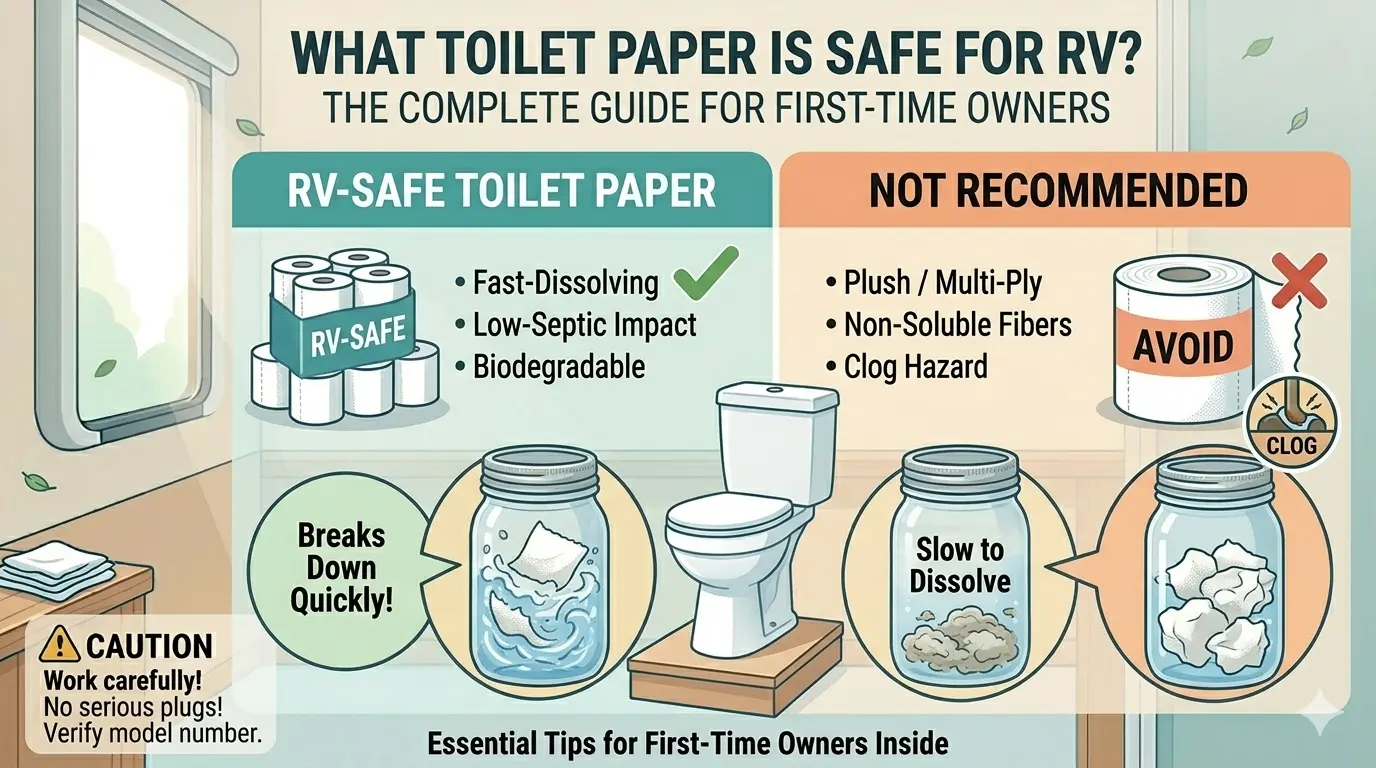
Two things matter above all else: how fast the paper dissolves, and whether it breaks down completely rather than clumping.
RV toilet paper is engineered to dissolve rapidly on contact with water. It’s usually free of dyes, fragrances, and additives that can interfere with the breakdown process or coat black tank sensors with residue. When you hold a sheet under the tap, it should start coming apart within seconds.
When shopping, look for these phrases on the packaging:
- “Rapid-dissolving” or “quick-dissolving”
- “RV and marine approved”
- “Septic safe”
- “Biodegradable”
What to avoid is just as important. Ultra-plush, thick, quilted, and multi-ply options designed for comfort at home are built to hold together under pressure — which is the exact opposite of what you want in a black tank. The more cushion-y and durable it feels in your hand, the more skeptical you should be.
What to Avoid
Skip anything labeled “ultra soft,” “triple-ply,” “quilted,” or “comfort plus” for use in your RV. These papers are designed to resist breaking apart — a great feature for home use, and a recipe for a clog on the road.
RV-Labeled TP vs. Septic-Safe TP — What’s the Real Difference?
This is one of the most common questions new RV owners have, and the answer is nuanced.
RV-specific toilet paper is engineered for the most demanding conditions: very low water volume, a small sealed holding tank, and the need to dissolve completely within days rather than weeks. Brands like Thetford Aqua-Soft and Camco RV are designed with this exact environment in mind.
Septic-safe toilet paper — like Angel Soft Septic-Safe or Kirkland Signature from Costco — is made to dissolve faster than standard home TP, but it’s calibrated for a home septic system that holds 1,000–1,500 gallons and processes waste over months. As Roadtrippers explains, a home septic tank and an RV black tank are fundamentally different systems, and septic-safe paper isn’t guaranteed to perform equally well in both.
That said, many experienced RVers use septic-safe household brands without any issues — particularly with proper tank care. The RV blog Travels with Ted notes that Scott 1000 works just as well as branded RV paper and is significantly cheaper and easier to find. The key difference is consistency: RV-labeled paper is a safer bet right out of the box, while septic-safe household paper should be verified with a quick test before you stock up (more on that below).
The verdict for new owners: Start with a purpose-built RV brand for your first few trips. Once you’re comfortable with how your specific system performs, you can experiment with tested septic-safe household options if the cost or convenience makes sense for you.
What Happens If You Use the Wrong Toilet Paper?
There are three things that go wrong when non-dissolving TP ends up in a black tank, and they tend to compound each other.
1. The Poop Pyramid
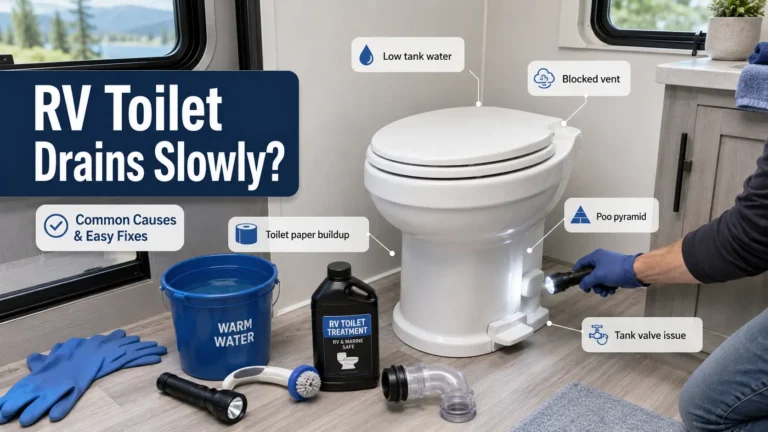
A poop pyramid — also called a pyramid mound — is exactly what it sounds like: a buildup of solid waste and undissolved toilet paper that stacks up inside the black tank, directly below the toilet opening. It forms when paper doesn’t break down and solids don’t stay suspended in liquid. Once it grows large enough, it blocks the pipe entirely — nothing goes down, nothing comes out.
Clearing one is a multi-day process involving enzyme treatments, wand sprayers, and a lot of patience. If it’s severe, you’re calling a professional.
2. Sensor Failures
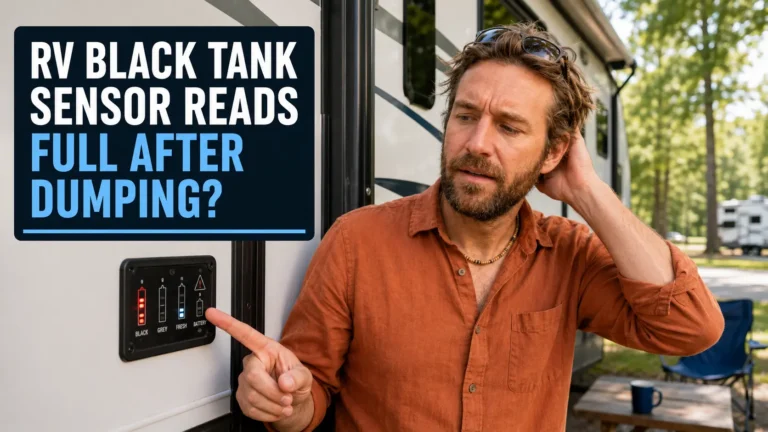
RV black tanks have level sensors that tell you how full the tank is. When undissolved TP coats these sensors, they give false readings — your tank looks full when it isn’t, or empty when it’s nearly overflowing. This leads to guesswork, over-dumping, or, worst-case scenario, an overflow. Sensor problems are one of the most common complaints among RV owners, and toilet paper buildup is a leading cause.
3. Repair Costs
If DIY methods don’t clear the clog, professional hydro-jet tank cleaning runs $200–$300 for a single tank. Tank Rangers prices full service at $275–$375 for up to three tanks. It’s a fixable problem — but it’s an expensive lesson when the root cause was a $6 pack of the wrong toilet paper.
Camping World’s RV blog identifies improper toilet paper as one of the leading causes of black tank clogs, right alongside leaving the tank valve open. Both are entirely preventable.
Top RV-Safe Toilet Paper Brands Compared
Here’s how the most commonly recommended options stack up. Prices are approximate and vary by retailer.
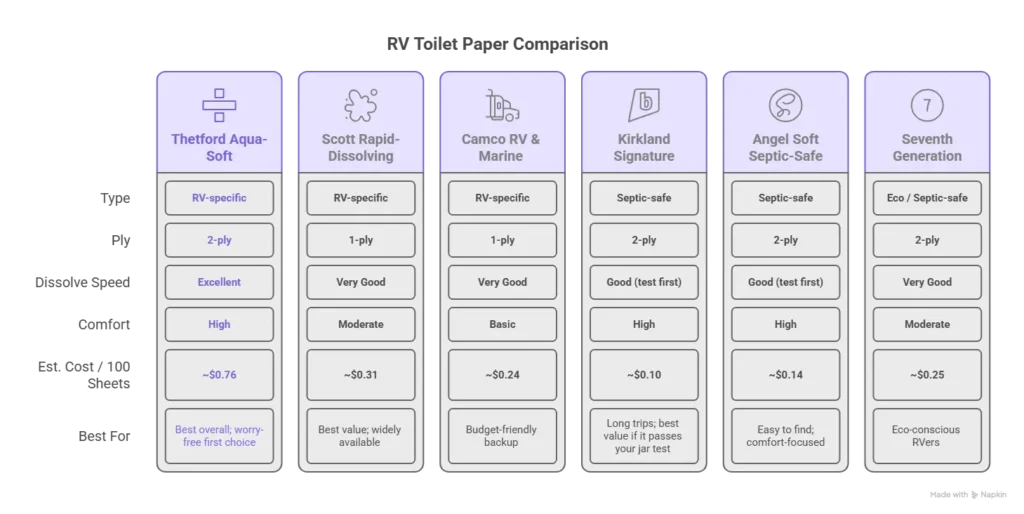
In a head-to-head dissolve test conducted by RV Enthusiast magazine, Thetford Aqua-Soft broke down immediately after the first few shakes, while Scott Rapid-Dissolving performed very well right behind it. Camco’s offering was slightly slower but still within an acceptable range. The takeaway: all three purpose-built RV brands performed reliably — the differences come down to comfort and cost.
One honest caveat on household brands: manufacturers periodically change their formulas, sometimes without notice. A brand that passed your jar test last year may perform differently now. It’s worth re-checking periodically, especially if you notice a change in texture or roll weight.
The 60-Second Jar Test — How to Check Any Brand at Home
You don’t have to buy RV-branded paper exclusively. You just need to verify that whatever you’re using actually dissolves. The jar test is the gold standard among RVers — simple, takes under a minute, and tells you everything you need to know.
Here’s the method used by experienced RV owners
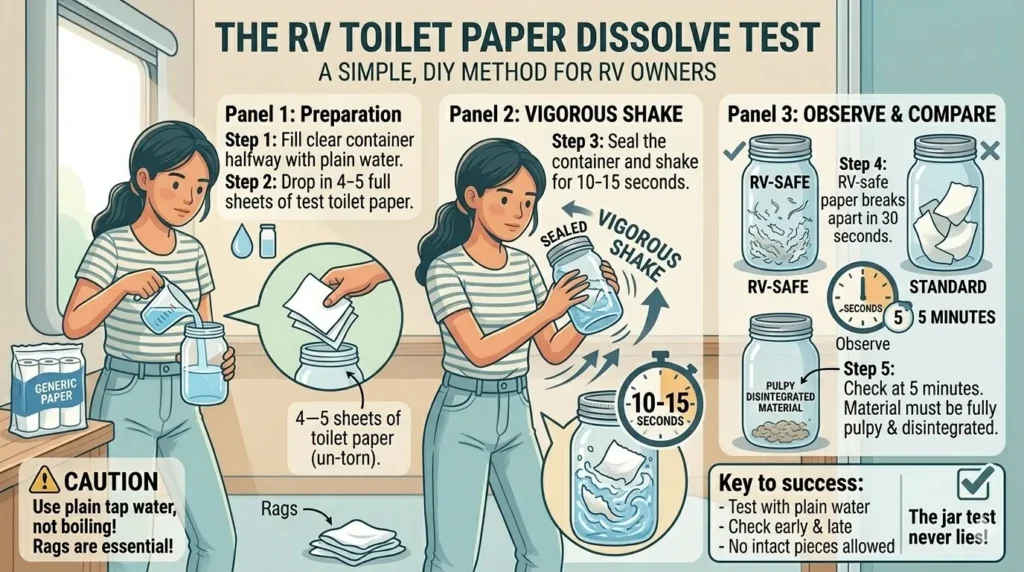
Pass: Paper falls apart during the shake test and continues dissolving until nothing intact remains. Safe for your black tank.
Fail: Paper holds its shape, clumps, or remains in visible sheets after agitation. Don’t use this brand in your RV.
Pro Tip: Run this test on every new brand before committing to a bulk purchase — even ones labeled “septic safe.” It takes 60 seconds and could save you a weekend of headaches.
Pro Tips for New RV Owners (Beyond the TP)
The right toilet paper is a solid foundation. These habits make the whole system run better:
- Keep the black tank valve closed. Leaving it open at a full-hookup campsite is one of the most common mistakes new RVers make. Liquid drains out, solids stay behind and harden. Always keep it closed until the tank is ready to dump.
- Use plenty of water per flush. A half-bowl of water before and after flushing keeps waste suspended and flowing properly. The #1 cause of buildup is too little water — not the wrong paper.
- Dump at two-thirds full. Emptying at 75–100% capacity gives you a stronger flush that clears the tank more thoroughly. Dumping too early means a weak flow that leaves residue behind.
- Use an enzyme-based tank treatment. Products like RV Digest-It break down waste biologically rather than just masking odors. Add treatment and a few gallons of water right after each dump so the tank is never dry.
- Never flush wipes. More on this below — but the short answer is: regardless of what the packaging says, no wipe dissolves fast enough for an RV black tank. Trash them.
Frequently Asked Questions
Can I use regular Charmin in my RV?
Standard Charmin Ultra Soft is not safe for RV use — it’s engineered to stay together under pressure, which is the opposite of what a black tank needs. Roadtrippers advises against using regular toilet paper in an RV, noting it leads to clogs, blocked sensors, and backed-up tanks. Charmin does make a septic-safe version that some RVers use cautiously on short trips, but it should be run through the jar test first, and it’s not a first-choice recommendation for new owners.
Is septic-safe toilet paper the same as RV toilet paper?
Not exactly. Septic-safe paper is designed for large home septic tanks that process waste over months, while RV black tanks are small holding systems that need to be dumped within days. Septic-safe paper dissolves faster than standard TP, but it isn’t guaranteed to break down quickly enough in the low-water, low-volume conditions of an RV black tank. Many septic-safe brands work fine with proper tank care, but verify any specific brand with the jar test before relying on it for long trips.
How do I know if my toilet paper is safe for my RV’s black tank?
The jar test is your most reliable answer. Place a few sheets in a jar of water, shake it for 10–15 seconds, and watch what happens. If the paper breaks apart quickly and continues dissolving until nothing intact remains, it’s safe. If it holds together, clumps, or stays in visible pieces, don’t use it. Run this test on any new brand — even ones labeled “RV safe” or “septic safe” — since formulas can change without notice.
What toilet paper do experienced RVers recommend?
Thetford Aqua-Soft is consistently rated the top overall choice by long-term RVers for its combination of dissolve speed and comfort. Scott Rapid-Dissolving is the go-to budget-friendly pick that’s easy to find at most grocery stores. For household brands, Unique Camping and Marine’s experts recommend Angel Soft or Kirkland from Costco as the best-performing septic-safe household options — both dissolve well and cost significantly less per roll than RV-branded alternatives.
Can I use flushable wipes in my RV toilet?
No — and this is one of the most important rules in RV ownership. Kleen Tank, one of the leading RV tank cleaning services, is clear: wipes labeled “flushable” or “septic safe” do not break down fast enough for an RV holding tank. Unlike toilet paper, wipes are manufactured to stay wet and intact for long periods. In an RV tank, they accumulate, grab onto other waste, and create blockages that can jam the dump valve and require professional removal. Keep a small trash can next to your RV toilet and dispose of wipes there.